
In the early 20th century, unmanned aerial vehicles (UAVs) began to take shape, undergoing a prolonged period of technological preparation before entering a phase of rapid advancement in the early 21st century. In recent years, drone shows have gradually permeated the visual culture sphere, serving as a technical medium for performances and emerging as a novel art form that shines in large-scale events, festivals, and commercial promotions. A drone show refers to the dynamic aerial display of multiple UAVs, orchestrated through computer control, programming, wireless communication, and swarm coordination technologies, forming various patterns and shapes to deliver an awe-inspiring audiovisual experience. As drone show technology becomes widely adopted and rapidly popularized, the inherent conflict between technological rationality and humanistic values has become increasingly apparent. The cultural essence risks being diluted and marginalized amid swift technological iterations. This contradiction not only hampers the artistic quality of drone performances but also threatens the sustainable development of the field, presenting an urgent issue to address. This study analyzes the conflict between technological rationality and humanistic values in drone shows, aiming to broaden the scope and depth of research on the relationship between technology and humanities, and to foster the healthy progression of UAV performances.
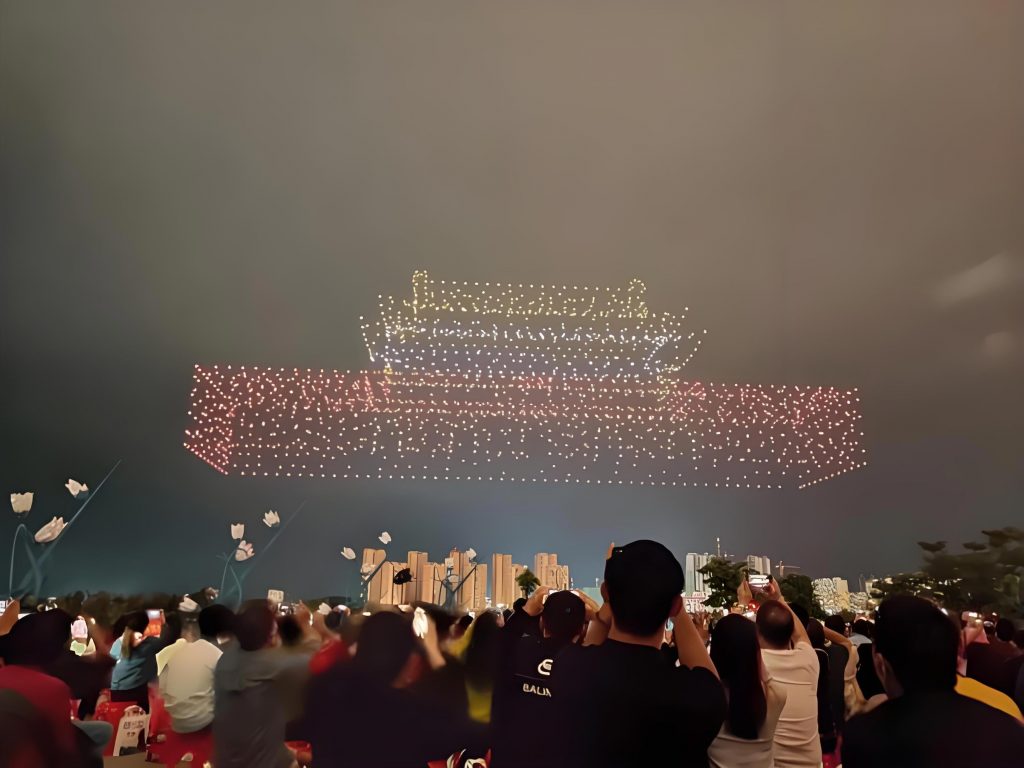
Technological rationality in drone shows encompasses the material foundations and methodological systems that enable their realization, including flight control, swarm coordination algorithms, lighting systems, and communication technologies. The core of UAV show performances lies in the precise adjustment and control of drone formations, lighting effects, and flight trajectories through code, optimizing efficiency, accuracy, and visual impact to captivate audiences. The “transcodality” of drone technology allows for flexible conversion between data and symbols, transforming physical space into a programmable virtual canvas, thus creating a unique “sky encoding” phenomenon. This distinctive media practice enables drone formations to convey deep cultural meanings and artistic values by presenting symbols, graphics, and even dynamic imagery in the air. The relationship between technological rationality and humanistic values in drone performances is dialectically unified and complex. UAV technology facilitates the presentation of rich cultural elements and creative artistic expressions, while humanistic values provide meaningful direction, guiding technological innovation and application. Their positive interaction enhances the artistic quality of performances and imbues technological development with humanistic care, meeting the profound spiritual and cultural needs of society.
To elucidate the components of technological rationality and humanistic values, consider the following table summarizing key elements:
| Technological Rationality Components | Humanistic Value Elements |
|---|---|
| Flight control systems | Cultural symbolism |
| Swarm coordination algorithms | Artistic expression |
| Lighting control programming | Emotional resonance |
| Communication protocols | Social and ethical implications |
| Data-symbol conversion | Historical and traditional contexts |
The interplay can be modeled mathematically. Let \( T \) represent technological rationality, encompassing parameters like precision and efficiency, and \( H \) denote humanistic values, involving aspects such as cultural depth and emotional impact. The overall performance quality \( Q \) can be expressed as a function: $$ Q = f(T, H) = \alpha \log(T) + \beta \arctan(H) $$ where \( \alpha \) and \( \beta \) are weighting coefficients that balance the contributions. In an ideal drone show, \( T \) and \( H \) should be optimized to maximize \( Q \), but in practice, imbalances lead to conflicts.
One major conflict is the misalignment between technological dominance and humanistic experience. The reliability of UAV technology is foundational for audience engagement, yet technical challenges such as signal interference or battery failures can cause performance failures. For instance, a 2018 drone show in Xi’an involving 1374 UAVs experienced a “pattern glitch” due to technical issues, severely compromising the visual effect. Similarly, a 2024 drone show in Quanzhou, intended to combine drones with fireworks, ended with numerous UAVs crashing into the sea due to control failures, leaving audiences disappointed. Even in successful drone performances, the emphasis often lies on visual spectacles like formation changes and lighting effects, neglecting the exploration and interpretation of humanistic spirit. For example, a 2024 UAV show in Shanghai, promoting a documentary, displayed brand logos and product shapes but was perceived by many as mere technical “stunt,” failing to convey deeper brand culture and emotional value. This highlights a dislocation where technology overshadows cultural narrative.
Another conflict arises from the dissonance between technical standardization and cultural diversity. As the demand for drone shows grows, expanding into new markets, technical standardization can lead to homogenized content, potentially eroding local cultures. In Shanghai’s Bund area, UAV formations have altered the visual landscape by presenting landmarks and modern elements, shifting the narrative of urban space and impacting residents’ cultural experiences. During the 2025 Spring Festival, multiple cities featured similar drone shows with repetitive mythical figures like the “Great Sage,” which initially impressed audiences with visual impact but eventually led to waning interest due to lack of originality. This uniformity undermines regional cultural distinctions, as traditional art forms and folk customs are not adequately represented, dissolving cultural uniqueness under technical norms.
A third conflict is the imbalance between visual impact and cultural depth. Continuous technological innovations in drone shows drive new visual spectacles, but without a profound understanding of cultural elements, performances may resort to superficial imitations. In a 2023 cultural forum in Beijing, a drone performance themed “Dunhuang Feitian” incorporated elements of Dunhuang flying goddesses through formations and lighting. While novel, it lacked depth in portraying the associated cultural heritage, leaving humanistic values underdeveloped. Similarly, a 2024 National Day drone show in Shenzhen employed advanced techniques to showcase futuristic symbols like city models and spaceships, creating a sci-fi ambiance. However, despite the technical awe, it failed to evoke deeper emotional connections or cultural reflections among viewers.
The causes of these conflicts are multifaceted. First, the technology-driven development model prioritizes technical aspects. In the early stages of UAV show applications, experts focused on flight performance, formation control, and audio-visual effects, treating technical display as the core, with limited integration of cultural elements or emotional expression. Humanists and artists often have low involvement in planning and R&D, leading to performances that are technically proficient but humanistically deficient. Second, economic interests and cultural values are imbalanced. Commercialization pushes drone shows toward marketing tools, where visual impact is leveraged for promotional goals, reducing investment in cultural creativity. Cost-cutting measures further tilt the scale toward technology, exacerbating the disparity. Third, differences in social cognition and cultural identity play a role. Technical experts view drone shows through a lens of innovation and performance metrics, while general audiences seek sensory experiences and emotional resonance. Cultural backgrounds influence perceptions; familiar symbols resonate locally but may not translate globally, making it challenging to satisfy diverse expectations and intensifying the conflict.
To analyze the conflict causes systematically, the following table outlines key factors:
| Conflict Cause Category | Description | Example Impact |
|---|---|---|
| Technology-Driven Model | Focus on technical specs over cultural integration | Reduced artistic depth in drone shows |
| Economic-Cultural Imbalance | Commercial priorities overshadow cultural value | Homogenized UAV show content |
| Socio-Cognitive Differences | Divergent expectations from experts and audiences | Difficulty in achieving universal appeal |
Mathematically, the economic-cultural imbalance can be represented by a utility function. Let \( E \) denote economic收益 (e.g., profit from a drone show), and \( C \) represent cultural value. If the decision-making prioritizes \( E \), the overall utility \( U \) might be: $$ U = \gamma E – \delta C $$ where \( \gamma \) and \( \delta \) are coefficients reflecting emphasis. When \( \gamma \gg \delta \), cultural aspects are neglected, leading to conflict.
To address these issues, adaptation mechanisms are proposed across three layers: technical, creative, and institutional. At the technical layer, cultural embedding involves aligning technology with cultural content. For example, in portraying Dunhuang dance movements, techniques like 3D scanning and motion capture can digitize poses into algorithms, enabling drone formations to accurately replicate the elegance. This enhances artistic expression and serves as a tool for cultural preservation. Additionally, augmented reality (AR) can be integrated to boost interactive experiences. By allowing partial control over formation lighting or using AR glasses to overlay cultural information, audiences transition from passive viewers to active participants, personalizing patterns and gaining insights. This breaks the unidirectional nature of drone performances, deepening cultural understanding and engagement. The technical process can be modeled with a transformation function: $$ \mathbf{P}_{\text{cultural}} = g(\mathbf{D}_{\text{scan}}, \mathbf{A}_{\text{algo}}) $$ where \( \mathbf{D}_{\text{scan}} \) is digital scan data, \( \mathbf{A}_{\text{algo}} \) is the algorithm, and \( \mathbf{P}_{\text{cultural}} \) is the cultural performance output.
At the creative layer, cross-subject collaboration fosters integration. Forming interdisciplinary teams of engineers, humanists, and artists leverages complementary expertise. Engineers provide technical support for realizing creative ideas, humanists offer cultural interpretations, and artists transform elements into visual narratives. This synergy produces drone shows with high technical standards and rich cultural内涵. To avoid homogeneity, creative teams can engage audiences through online idea solicitations, surveys, and interviews, incorporating diverse inputs and adjusting performances based on feedback to meet cultural expectations. A collaboration efficiency metric can be defined as: $$ \eta = \frac{\sum_{i=1}^{n} S_i \cdot H_i}{n} $$ where \( S_i \) is technical score, \( H_i \) is humanistic score for each team member, and \( n \) is team size, maximizing \( \eta \) for optimal outcomes.
At the institutional layer, value anchoring establishes a multi-level system to maintain balance. Developing technical standards and review criteria for drone shows defines safety thresholds and cultural expression limits, preventing technological alienation from eroding local culture. A tripartite coordination mechanism involving government, enterprises, and cultural representatives assesses projects comprehensively, balancing commercial and public interests. Moreover, a “dual-track” evaluation system can be implemented: a “technological innovation award” for breakthroughs and a “cultural heritage award” for outstanding cultural communication. This dual approach, through regulations and incentives, guides drone shows from technical display to cultural媒介, ensuring coexistence of rationality and values. The institutional framework can be summarized in the table below:
| Institutional Layer Measure | Implementation | Expected Outcome |
|---|---|---|
| Technical Standards | Set safety and cultural limits for UAV shows | Prevent cultural erosion |
| Tripartite Review | Government, business, culture reps evaluate projects | Balance commercial and public needs |
| Dual-Track Awards | Innovation and cultural prizes | Encourage holistic development |
The overall adaptation effectiveness \( A \) can be modeled as: $$ A = \omega_t T_{\text{embed}} + \omega_c C_{\text{collab}} + \omega_i I_{\text{anchor}} $$ where \( T_{\text{embed}} \), \( C_{\text{collab}} \), and \( I_{\text{anchor}} \) represent technical, creative, and institutional adaptation scores, and \( \omega_t, \omega_c, \omega_i \) are weights indicating their importance.
In conclusion, technological rationality in drone shows provides the foundation and impetus for innovation, enabling visual wonders and creative concepts to materialize. Humanistic values manifest through the deep interpretation of cultural symbols, artistic language, and societal cultural construction. Achieving a balance between technological rationality and humanistic values is crucial for the sustainable development of drone performances. Only through equilibrium can audiences enjoy both the novelty of visual experiences and the fulfillment of cultural and emotional needs. This study has analyzed the conflicts in UAV shows, explored their manifestations and causes, and constructed adaptation mechanisms to harmonize these elements, supporting the long-term viability of drone shows. The integration of technical and humanistic aspects, as detailed through layers and models, underscores the potential for drone performances to evolve as a meaningful art form that resonates across diverse contexts.