
In my research, I focus on the problem of small object detection in aerial images captured by UAV drones. UAV drones have become highly capable mobile sensing platforms, and their deployment in environmental monitoring, infrastructure inspection, agricultural management, traffic analysis, disaster response, and military reconnaissance has expanded rapidly. Because UAV drones can fly at different altitudes and view scenes from steep and changing perspectives, the images they collect often contain many small targets, severe scale variation, cluttered backgrounds, and weather-induced degradation. These properties make robust detection difficult, especially when the detector must also run on an embedded platform with limited computation and power.
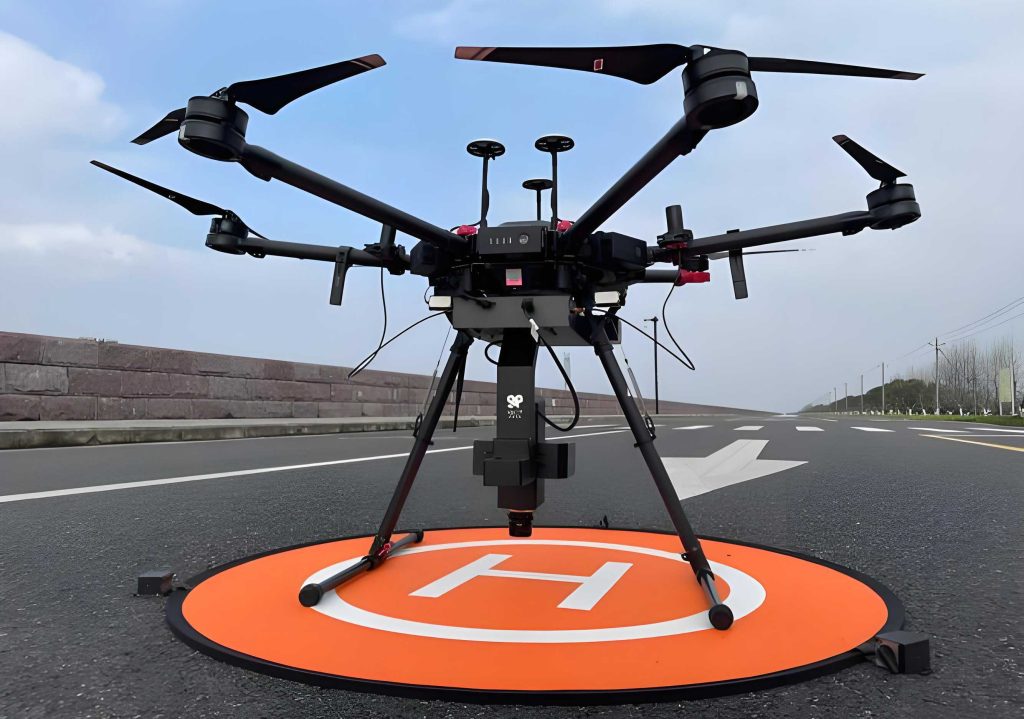
The central motivation of my work is therefore twofold. First, I aim to improve the detection accuracy of small objects in UAV drone imagery by strengthening feature extraction, multi-scale fusion, and detection-head attention. Second, I aim to make the resulting detector lightweight enough for edge deployment on UAV drones. I build my approach on YOLOv11 because it provides a strong balance between accuracy and efficiency, and I then introduce targeted modifications that are specifically useful for aerial small-object detection. The resulting models are called EGD-YOLO and EGD-YOLO-Lite. In the following sections, I describe the background, the architecture design, the mathematical formulations, the experimental protocol, and the quantitative results in detail.
1. Introduction
Object detection is a core task in computer vision. It supports autonomous driving, video surveillance, face recognition, medical image analysis, and many other applications. When object detection is combined with UAV drones, the resulting system can perform real-time or near-real-time visual understanding from the sky. In intelligent transportation, UAV drones can detect illegal lane usage, pedestrian violations, and intersection congestion. In ecological protection, UAV drones can locate rare animals, detect poaching equipment, and estimate biodiversity from tree species. In disaster response, UAV drones can identify trapped people, assess damaged buildings, and locate blocked roads. In military applications, UAV drones can support reconnaissance, target localization, and battle damage assessment.
Despite these promising applications, aerial images from UAV drones present several challenges. Targets are often small in pixel area, blurred at boundaries, and lacking in discriminative texture. Background noise and mutual occlusion among dense targets can cause both false positives and false negatives. In addition, the computational capability of UAV drones is usually limited, so a high-complexity detector cannot be deployed directly. My research therefore addresses the tension between accuracy and efficiency. I seek a detector that improves small-object accuracy while remaining lightweight enough for UAV drones.
2. Related Work
2.1 Traditional Object Detection
Traditional detection pipelines usually consist of region proposal generation, handcrafted feature extraction, and classification. Early methods such as Viola-Jones, HOG with SVM, and deformable part models achieved success in specific domains. However, they rely heavily on manually designed features and sliding-window search, which leads to high redundancy and limited adaptability. These limitations motivated the shift toward deep learning.
2.2 Deep Learning Object Detection
Deep learning detectors can be divided into two-stage and one-stage families. Two-stage detectors such as R-CNN, Fast R-CNN, Faster R-CNN, and Mask R-CNN first generate region proposals and then classify and refine them. They often achieve high accuracy but incur significant computation. One-stage detectors such as YOLO and SSD directly predict classes and boxes from the image. YOLO has evolved through many versions, including YOLOv2, YOLOv3, YOLOv4, YOLOv5, YOLOv7, YOLOv8, YOLOv10, and YOLOv11. Each version improves the accuracy-speed trade-off. YOLOv11, in particular, introduces C3k2, C2PSA, and a more efficient detection head, making it a strong baseline for aerial small-object detection.
2.3 Small Object Detection in UAV Images
Research on UAV drone imagery has proposed many improvements. Some methods enhance the backbone with lightweight convolution or attention. Some add a P2 layer for tiny objects. Some redesign the neck with bidirectional fusion or re-parameterized blocks. Some introduce deformable convolution, focal loss, or angular losses. Although these methods improve accuracy, they often increase model complexity. In my work, I aim to combine accuracy improvement with structured lightweighting, so that the final model is suitable for UAV drones.
3. Theoretical Foundations
3.1 Convolutional Neural Networks
A convolutional neural network typically contains convolutional layers, pooling layers, activation functions, and fully connected layers. The convolution operation can be written as:
$$y_{i,j,c} = \sum_{m=0}^{M-1}\sum_{n=0}^{N-1}\sum_{c’=0}^{C’-1} x_{i+m,j+n,c’} \cdot w_{m,n,c’,c} + b_c$$
Pooling reduces spatial resolution and improves translation robustness. Common activation functions include Sigmoid, Tanh, and ReLU:
$$\sigma(x)=\frac{1}{1+e^{-x}}$$
$$\tanh(x)=\frac{e^{x}-e^{-x}}{e^{x}+e^{-x}}$$
$$\mathrm{ReLU}(x)=\max(0,x)$$
ReLU is widely used because it is simple and mitigates vanishing gradients. A fully connected layer maps distributed features to the output space, but it can introduce many parameters if used excessively.
3.2 YOLOv11
YOLOv11 contains a backbone, a neck, and a detection head. The backbone extracts features using Conv, C3k2, SPPF, and C2PSA modules. The C3k2 module improves gradient flow and reduces computation. The C2PSA module combines attention with feed-forward networks. The neck uses an improved PAN-FPN structure to fuse shallow spatial details and deep semantic information. The head uses depthwise separable convolution to reduce parameters. I use YOLOv11n as my baseline because it is compact and has strong potential for UAV drones.
3.3 Model Lightweighting
Model pruning removes redundant weights, neurons, channels, or layers. Structured pruning removes whole channels or filters, which is more deployment-friendly than unstructured pruning. Knowledge distillation trains a smaller student model under the guidance of a larger teacher model. Feature distillation aligns intermediate representations, while logit distillation aligns output distributions. I use structured pruning and feature distillation to compress my detector for UAV drones.
3.4 Datasets and Metrics
I evaluate on VisDrone2019, DOTAv1.0, DOTAv1.5, and COCO. VisDrone2019 contains 6471 training images, 548 validation images, and 1610 test images, with ten categories. DOTAv1.0 contains 2806 aerial images and 188282 instances across fifteen categories. The evaluation metrics include precision, recall, mAP@50, mAP@50-95, parameters, and GFLOPs. The formulas are:
$$\mathrm{Precision}=\frac{TP}{TP+FP}$$
$$\mathrm{Recall}=\frac{TP}{TP+FN}$$
$$\mathrm{mAP}=\frac{1}{N}\sum_{i=1}^{N} AP_i$$
Here \(TP\), \(FP\), and \(FN\) denote true positives, false positives, and false negatives, respectively. mAP@50 uses an IoU threshold of 0.5, while mAP@50-95 averages over IoU thresholds from 0.5 to 0.95 with a step of 0.05.
4. Proposed EGD-YOLO
4.1 Overall Architecture
My EGD-YOLO improves YOLOv11 in three places. First, I replace the C3k2 module in the backbone with a dual-path convolutional efficient layer aggregation module called ELAN-DC. Second, I reconstruct the neck with a global-to-local bidirectional feature pyramid network called GLBiFPN. Third, I replace the original detection head with a dynamic head called DyHead. These changes increase small-object sensitivity while keeping the model relatively compact.
4.2 ELAN-DC
ELAN-DC integrates ELAN-style aggregation with Dual Conv. Dual Conv uses 3×3 and 1×1 convolutions in parallel. The 3×3 branch captures spatial details, while the 1×1 branch reduces channel dimension and computational cost. The dual convolution can be expressed as:
$$F_{\mathrm{DC}}(x)=\mathrm{BN}\left(W_{3\times3} * x + W_{1\times1} * x + b\right)$$
ELAN-DC splits the input into two branches. One branch passes through identity mapping, and the other branch passes through stacked dual convolution blocks. The outputs are concatenated:
$$F_{\mathrm{ELAN-DC}}=\mathrm{Concat}\left(F_{\mathrm{identity}}, F_{\mathrm{dual1}}, F_{\mathrm{dual2}}, \dots\right)$$
This design preserves shallow details and enriches deep semantics. It also reduces parameter redundancy. In my ablation study, ELAN-DC improves mAP@50 and mAP@50-95 while reducing parameters compared with several alternative C3k2 replacements.
| Method | P (%) | R (%) | mAP@50 (%) | mAP@50-95 (%) | Param (M) | GFLOPs |
|---|---|---|---|---|---|---|
| C3k2-SCConv | 40.3 | 30.7 | 30.2 | 17.3 | 2.87 | 6.4 |
| C3k2-EMBC | 39.4 | 31.9 | 30.5 | 17.4 | 2.87 | 6.1 |
| C3k2-DLKA | 40.3 | 31.2 | 30.1 | 17.2 | 3.30 | 6.9 |
| ELAN-DC | 41.6 | 31.7 | 31.1 | 17.7 | 2.43 | 6.9 |
4.3 GLBiFPN
GLBiFPN extends BiFPN with a global-to-local spatial attention module called GLSA. GLSA splits channels into two groups and processes them with global spatial attention and local spatial attention. The fusion can be written as:
$$F_i^1, F_i^2 = \mathrm{Split}(F_i)$$
$$F_i’ = \mathrm{Conv}_{1\times1}\left(\mathrm{Concat}\left(\mathrm{GSA}(F_i^1), \mathrm{LSA}(F_i^2)\right)\right)$$
The global spatial attention is:
$$\mathrm{Att}_G(F_i^1)=\mathrm{Softmax}\left(\mathrm{Transpose}\left(\mathrm{Conv}_{1\times1}(F_i^1)\right)\right)$$
$$G_{sa}(F_i^1)=\mathrm{MLP}\left(\mathrm{Att}_G(F_i^1)\right) \cdot F_i^1 + F_i^1$$
The local spatial attention is:
$$\mathrm{Att}_L(F_i^2)=\sigma\left(F_c(F_i^2) + F_i^2\right)$$
$$L_{sa}(F_i^2)=\mathrm{Att}_L(F_i^2) \cdot F_i^2 + F_i^2$$
GLSA strengthens both long-range dependencies and local texture details. This is especially useful for UAV drones because small objects require local detail while complex backgrounds require global context. My neck comparison shows that GLBiFPN achieves a better accuracy-efficiency trade-off than BiFPN or BiFPN-SDI.
| Method | P (%) | R (%) | mAP@50 (%) | mAP@50-95 (%) | Param (M) | GFLOPs |
|---|---|---|---|---|---|---|
| Baseline | 43.8 | 33.3 | 33.3 | 19.4 | 2.58 | 6.3 |
| +BiFPN | 43.7 | 34.3 | 33.8 | 19.9 | 1.92 | 6.3 |
| +BiFPN-SDI | 43.8 | 33.7 | 33.6 | 19.8 | 1.95 | 6.5 |
| +GLBiFPN | 44.2 | 34.0 | 34.0 | 20.2 | 2.07 | 6.7 |
4.4 DyHead
DyHead unifies scale-aware, spatial-aware, and task-aware attention. Its attention function is:
$$W(F)=\pi_C\left(\pi_S\left(\pi_L(F)\right)\right) \cdot F$$
Here \(\pi_L\), \(\pi_S\), and \(\pi_C\) denote scale-aware, spatial-aware, and task-aware attention, respectively. DyHead allows the detector to adapt to extreme scale changes. This property is valuable for UAV drones, where near and far objects appear at very different scales. In my experiments, DyHead gives the largest single-module improvement in mAP@50 among the three proposed modules.
| Method | P (%) | R (%) | mAP@50 (%) | mAP@50-95 (%) | Param (M) | GFLOPs |
|---|---|---|---|---|---|---|
| LQEHead | 39.8 | 30.9 | 29.9 | 17.3 | 2.58 | 6.3 |
| MultiSEAMHead | 40.3 | 31.4 | 30.2 | 17.0 | 4.59 | 6.0 |
| SEAMHead | 40.7 | 31.0 | 30.2 | 17.0 | 2.49 | 5.8 |
| DyHead | 41.9 | 32.1 | 31.9 | 18.6 | 3.10 | 7.5 |
5. Experiments on EGD-YOLO
5.1 Experimental Setup
I conduct experiments on Windows 11 with an Intel i5-12400F CPU and an NVIDIA RTX 4060-TI GPU with 16 GB memory. The software environment includes Python 3.9.21, PyTorch 2.2.2, and CUDA 12.1. I train for 300 epochs on VisDrone2019 and 200 epochs on DOTAv1.0. The batch size is 16 for VisDrone2019 and 8 for DOTAv1.0. Images are resized to 640×640. I use SGD as the optimizer.
| Item | Configuration |
|---|---|
| CPU | Intel i5-12400F |
| GPU | NVIDIA RTX 4060-TI 16GB |
| Python | 3.9.21 |
| PyTorch | 2.2.2 |
| CUDA | 12.1 |
| Batch size | 8 or 16 |
| Image size | 640×640 |
| Optimizer | SGD |
5.2 Ablation on VisDrone2019
The ablation study shows that each proposed module contributes positively. ELAN-DC improves mAP@50 by 0.5% and mAP@50-95 by 0.2% over the baseline. GLBiFPN improves mAP@50 by 0.7% and mAP@50-95 by 0.8%. DyHead improves mAP@50 by 2.4% and mAP@50-95 by 1.7%. When all three modules are combined, EGD-YOLO achieves 38.4% mAP@50 and 22.9% mAP@50-95, which is 5.1% and 3.5% higher than YOLOv11n, respectively.
| Model | P (%) | R (%) | mAP@50 (%) | mAP@50-95 (%) | Param (M) | GFLOPs |
|---|---|---|---|---|---|---|
| Baseline | 43.8 | 33.3 | 33.3 | 19.4 | 2.58 | 6.3 |
| Baseline+A | 43.5 | 34.1 | 33.8 | 19.6 | 2.43 | 6.9 |
| Baseline+B | 44.2 | 34.0 | 34.0 | 20.2 | 2.07 | 6.7 |
| Baseline+C | 46.7 | 35.1 | 35.7 | 21.1 | 3.10 | 7.5 |
| Baseline+A+B | 46.1 | 35.6 | 36.2 | 21.3 | 2.46 | 9.7 |
| Baseline+A+C | 47.8 | 35.8 | 36.7 | 21.7 | 2.95 | 8.0 |
| Baseline+B+C | 47.1 | 36.0 | 36.0 | 21.4 | 2.70 | 8.0 |
| Baseline+A+B+C | 47.7 | 37.7 | 38.4 | 22.9 | 3.01 | 10.5 |
5.3 Ablation on DOTAv1.0
On DOTAv1.0, the same trend appears. Adding module A improves mAP@50 from 38.7% to 39.8%. Adding module B further improves mAP@50 to 40.4%. Adding module C gives the best result of 40.9% mAP@50 and 24.4% mAP@50-95. These results confirm that the improvements transfer to remote sensing imagery and are not limited to VisDrone2019.
| Model | P (%) | R (%) | mAP@50 (%) | mAP@50-95 (%) | Param (M) | GFLOPs |
|---|---|---|---|---|---|---|
| Baseline | 66.2 | 34.9 | 38.7 | 23.0 | 2.58 | 6.3 |
| Baseline+A | 63.0 | 37.6 | 39.8 | 23.5 | 2.43 | 6.9 |
| Baseline+A+B | 68.8 | 37.0 | 40.4 | 24.3 | 2.46 | 9.7 |
| Baseline+A+B+C | 68.4 | 37.3 | 40.9 | 24.4 | 3.01 | 10.5 |
5.4 Comparison with Mainstream Detectors
I compare EGD-YOLO with Faster R-CNN, YOLOv5s, YOLOv7tiny, YOLOv8n, YOLOv10s, YOLOv11n, and YOLOv11s. EGD-YOLO achieves 38.4% mAP@50 and 22.9% mAP@50-95. It outperforms YOLOv11n by 5.1% and 3.5% in these two metrics. It also outperforms YOLOv8n by 5.3% and 3.5%. Compared with YOLOv11s, EGD-YOLO has slightly lower mAP but uses about 50% fewer GFLOPs and about 6.4M fewer parameters. This demonstrates a strong balance between accuracy and efficiency for UAV drones.
| Model | Params (M) | GFLOPs | P (%) | R (%) | mAP@50 (%) | mAP@50-95 (%) |
|---|---|---|---|---|---|---|
| Faster R-CNN | 41.0 | 207.0 | 45.5 | 32.2 | 33.1 | 16.0 |
| YOLOv5s | 9.1 | 24.1 | 50.0 | 38.5 | 33.9 | 23.2 |
| YOLOv7tiny | 6.01 | 13.1 | 50.3 | 37.6 | 32.7 | 16.0 |
| YOLOv8n | 3.0 | 8.1 | 45.4 | 32.6 | 33.1 | 19.4 |
| YOLOv10s | 8.04 | 24.5 | 50.5 | 38.3 | 39.1 | 23.5 |
| YOLOv11n | 2.58 | 6.3 | 43.8 | 33.3 | 33.3 | 19.4 |
| YOLOv11s | 9.41 | 21.3 | 50.5 | 38.7 | 39.3 | 23.6 |
| EGD-YOLO | 3.01 | 10.5 | 47.7 | 37.7 | 38.4 | 22.9 |
5.5 Generalization and Visualization
I also evaluate on DOTAv1.5 and COCO. On DOTAv1.5, EGD-YOLO improves precision from 69.2% to 73.4%, recall from 32.3% to 33.5%, mAP@50 from 36.2% to 37.7%, and mAP@50-95 from 21.7% to 23.0%. On COCO, precision improves from 61.4% to 61.6%, recall from 44.8% to 46.5%, mAP@50 from 49.0% to 50.3%, and mAP@50-95 from 34.4% to 35.3%. These results indicate that my improvements generalize beyond UAV drone-specific datasets. Visual comparisons show that EGD-YOLO detects more distant pedestrians and vehicles and handles dim, dense scenes better than YOLOv11n.
| Dataset | Model | Classes | P (%) | R (%) | mAP@50 (%) | mAP@50-95 (%) |
|---|---|---|---|---|---|---|
| DOTAv1.5 | YOLOv11n | 15 | 69.2 | 32.3 | 36.2 | 21.7 |
| DOTAv1.5 | EGD-YOLO | 15 | 73.4 | 33.5 | 37.7 | 23.0 |
| COCO | YOLOv11n | 80 | 61.4 | 44.8 | 49.0 | 34.4 |
| COCO | EGD-YOLO | 80 | 61.6 | 46.5 | 50.3 | 35.3 |
| VisDrone2019 | YOLOv11n | 10 | 43.8 | 33.3 | 33.3 | 19.4 |
| VisDrone2019 | EGD-YOLO | 10 | 47.7 | 37.7 | 38.4 | 22.9 |
6. Proposed EGD-YOLO-Lite
6.1 Motivation
Although EGD-YOLO improves accuracy, it also increases parameters and computation. For UAV drones, this is a problem. I therefore propose EGD-YOLO-Lite, which replaces the neck with a lighter BiFPN, applies LAMP structured pruning, and uses CWD feature distillation. My goal is to keep accuracy close to EGD-YOLO while significantly reducing model size and computation.
6.2 BiFPN Neck
BiFPN uses bidirectional cross-scale connections and weighted feature fusion. It removes redundant nodes and preserves key fusion paths. This reduces computation while maintaining multi-scale representation. In my design, BiFPN replaces the heavier GLBiFPN structure to reduce overhead. The weighted fusion can be written as:
$$O = \sum_i \frac{w_i}{\sum_j w_j} \cdot I_i$$
where \(w_i\) are learnable weights and \(I_i\) are input features from different scales. This formulation helps the model emphasize informative scales for UAV drones.
6.3 LAMP Structured Pruning
LAMP assigns a layer-adaptive importance score to each weight. The LAMP score for the \(u\)-th weight in layer \(l\) is:
$$\mathrm{Score}(u; W) = \frac{(W[u])^2}{\sum_{v \geq u} (W[v])^2}$$
Weights are flattened and sorted by magnitude. Lower scores indicate lower importance, so they are pruned first. LAMP allocates pruning ratios adaptively across layers. I compare global and local pruning and find that local pruning preserves accuracy better at the same GFLOPs. I also test different speedup ratios:
$$\mathrm{Speedup} = \frac{\mathrm{GFLOPs}_{\mathrm{before}}}{\mathrm{GFLOPs}_{\mathrm{after}}}$$
A speedup of 1.5 provides a good balance. The pruned model reduces parameters from 2.86M to 1.94M and GFLOPs from 10.0 to 6.6, while mAP@50 drops from 38.2% to 37.4%. Higher speedups reduce accuracy more severely.
| Pruning Method | P (%) | R (%) | mAP@50 (%) | Weight (MB) | GFLOPs |
|---|---|---|---|---|---|
| Unpruned | 50.6 | 36.7 | 38.2 | 5.8 | 10.0 |
| Group-taylor | 39.2 | 25.6 | 25.8 | 3.1 | 5.0 |
| LAMP | 44.4 | 32.7 | 33.1 | 3.2 | 5.0 |
| Strategy | P (%) | R (%) | mAP@50 (%) | Weight (MB) | Param (M) | GFLOPs |
|---|---|---|---|---|---|---|
| Global pruning | 42.7 | 32.6 | 32.6 | 2.7 | 1.23 | 5.0 |
| Local pruning | 44.4 | 32.7 | 33.1 | 3.2 | 1.52 | 5.0 |
| Speedup | mAP@50 (%) | mAP@50-95 (%) | Param (M) | GFLOPs |
|---|---|---|---|---|
| 1.0 | 38.2 | 23.0 | 2.86 | 10.0 |
| 1.5 | 37.4 | 21.8 | 1.94 | 6.6 |
| 1.6 | 36.6 | 21.3 | 1.84 | 6.2 |
| 1.7 | 35.6 | 20.9 | 1.75 | 5.8 |
| 1.8 | 34.9 | 20.4 | 1.65 | 5.5 |
| 2.0 | 33.1 | 19.2 | 1.52 | 5.0 |
6.4 CWD Feature Distillation
To recover accuracy after pruning, I use channel-wise knowledge distillation. CWD normalizes each channel into a probability distribution and minimizes the KL divergence between teacher and student distributions. The channel distribution is:
$$\phi(y_c) = \frac{e^{y_{c,i}/\tau}}{\sum_{i=1}^{W H} e^{y_{c,i}/\tau}}$$
The distillation loss is:
$$L_{\mathrm{CWD}}(y_T, y_S) = \frac{\tau^2}{C} \sum_{c=1}^{C} \sum_{i=1}^{W H} \phi(y_{c,i}^T) \log \frac{\phi(y_{c,i}^T)}{\phi(y_{c,i}^S)}$$
I compare logit distillation and feature distillation. CWD alone gives the best result among the tested methods. It raises mAP@50 from 37.4% to 37.6% without changing parameters or GFLOPs. Combining CWD with logit L1 does not exceed CWD alone in my setting.
| Distillation Method | Weight (MB) | mAP@50 (%) | Param (M) | GFLOPs |
|---|---|---|---|---|
| Student only | 4.0 | 37.4 | 1.94 | 6.6 |
| Logit_L1 | 4.0 | 36.9 | 1.94 | 6.6 |
| Logit_L2 | 4.0 | 36.8 | 1.94 | 6.6 |
| CWD | 4.0 | 37.6 | 1.94 | 6.6 |
| Logit_L1+CWD | 4.0 | 37.1 | 1.94 | 6.6 |
6.5 Ablation of EGD-YOLO-Lite
The ablation confirms that BiFPN reduces parameters and GFLOPs with only a small accuracy drop. LAMP pruning further compresses the model but lowers mAP@50 to 37.4%. CWD distillation restores mAP@50 to 37.6% while keeping the model size unchanged. Overall, EGD-YOLO-Lite achieves a strong balance between accuracy and efficiency.
| Baseline | BiFPN | LAMP | CWD | mAP@50 (%) | Weight (MB) | Param (M) | GFLOPs |
|---|---|---|---|---|---|---|---|
| √ | 38.4 | 6.1 | 3.01 | 10.5 | |||
| √ | √ | 38.2 | 5.8 | 2.86 | 10.0 | ||
| √ | √ | √ | 37.4 | 4.0 | 1.94 | 6.6 | |
| √ | √ | √ | √ | 37.6 | 4.0 | 1.94 | 6.6 |
6.6 Comparison of EGD-YOLO-Lite
Compared with YOLOv5s, YOLOv7tiny, YOLOv8n, AFL-YOLOv8, WCCE-YOLO, YOLOv11n, and EGD-YOLO, EGD-YOLO-Lite has 1.94M parameters and 6.6 GFLOPs. Its mAP@50 is 37.6%, which is higher than YOLOv5s, YOLOv7tiny, YOLOv8n, AFL-YOLOv8, and YOLOv11n. Its mAP@50-95 is 22.1%, which is also competitive. Although it is slightly lower than EGD-YOLO in accuracy, it is much smaller and more suitable for UAV drones.
| Model | Params (M) | GFLOPs | mAP@50 (%) | mAP@50-95 (%) |
|---|---|---|---|---|
| YOLOv5s | 9.1 | 24.1 | 33.9 | 23.2 |
| YOLOv7tiny | 6.01 | 13.1 | 32.7 | 16.0 |
| YOLOv8n | 3.0 | 8.1 | 33.1 | 19.4 |
| AFL-YOLOv8 | 2.38 | 15.9 | 32.8 | 19.5 |
| WCCE-YOLO | – | – | 37.3 | 21.6 |
| YOLOv11n | 2.58 | 6.3 | 33.3 | 19.4 |
| EGD-YOLO | 3.01 | 10.5 | 38.4 | 22.9 |
| EGD-YOLO-Lite | 1.94 | 6.6 | 37.6 | 22.1 |
6.7 Teacher Model Selection
I compare several teacher models. The student model has 37.4% mAP@50. The unpruned EGD-YOLO-Lite n version has 38.2%, YOLOv11s has 39.3%, and the unpruned EGD-YOLO-Lite s version has 41.5%. I select the s version as the teacher because it provides the largest performance gap and the strongest guidance.
| Model | P (%) | R (%) | mAP@50 (%) |
|---|---|---|---|
| Student | 48.9 | 36.7 | 37.4 |
| EGD-YOLO-Lite (unpruned n) | 50.6 | 36.7 | 38.2 |
| YOLOv11s | 50.5 | 38.7 | 39.3 |
| EGD-YOLO-Lite (unpruned s) | 52.5 | 40.0 | 41.5 |
6.8 Deployment Feasibility
For UAV drones, model size and power matter. EGD-YOLO-Lite has a weight of 4.0 MB and 1.94M parameters. Compared with YOLOv11n, it improves mAP@50 from 33.3% to 37.6% while reducing parameters by about 24.8% and weight by about 24.5%. The GFLOPs increase slightly from 6.3 to 6.6, which is acceptable. Common edge platforms such as Jetson Nano, Jetson Xavier NX, and Jetson Orin Nano can support models in this size range. My model is therefore a practical candidate for deployment on UAV drones, although real embedded testing remains future work.
| Model | mAP@50 (%) | Weight (MB) | Param (M) | GFLOPs |
|---|---|---|---|---|
| YOLOv11n | 33.3 | 5.3 | 2.58 | 6.3 |
| EGD-YOLO-Lite | 37.6 | 4.0 | 1.94 | 6.6 |
7. Discussion
My results show that accuracy and efficiency can be improved together when the architecture is designed for small-object aerial detection. ELAN-DC enhances feature extraction with dual-path convolution. GLBiFPN improves multi-scale fusion by combining global and local attention. DyHead increases the detector’s sensitivity to scale and spatial variation. EGD-YOLO-Lite then compresses the model with BiFPN, LAMP pruning, and CWD distillation. Across VisDrone2019, DOTAv1.0, DOTAv1.5, and COCO, the proposed methods consistently improve over the baseline. The improvements are especially visible in dense scenes, low-light scenes, and scenes with many small objects, which are common for UAV drones.
One limitation is that some categories remain difficult. Very small objects, heavy occlusion, and extreme class imbalance still cause false negatives and false positives. Future work should expand multi-scene UAV drone datasets, add higher-resolution feature modeling, and explore adaptive multi-scale fusion. Another limitation is that I have not yet completed large-scale deployment on a real UAV drone platform. Future work should test the model on Jetson devices with quantization, pruning, and TensorRT acceleration. These steps will further improve real-time inference and engineering applicability.
8. Conclusion
In my research, I studied small-object detection in aerial images captured by UAV drones. I proposed EGD-YOLO, which improves YOLOv11 with ELAN-DC, GLBiFPN, and DyHead. On VisDrone2019, EGD-YOLO improves mAP@50 and mAP@50-95 by 5.1% and 3.5% over YOLOv11n. I then proposed EGD-YOLO-Lite, which uses BiFPN, LAMP structured pruning, and CWD feature distillation. EGD-YOLO-Lite reduces parameters and computation by about 36% and 37% relative to EGD-YOLO, with only a 0.8% drop in mAP@50. The final model has 1.94M parameters, 4.0 MB weight, and 6.6 GFLOPs, making it suitable for resource-constrained UAV drones. My experiments confirm that the proposed methods achieve a favorable balance between detection accuracy and inference efficiency. In future work, I will extend the dataset, improve tiny-object modeling, and deploy the model on embedded UAV drone platforms.