
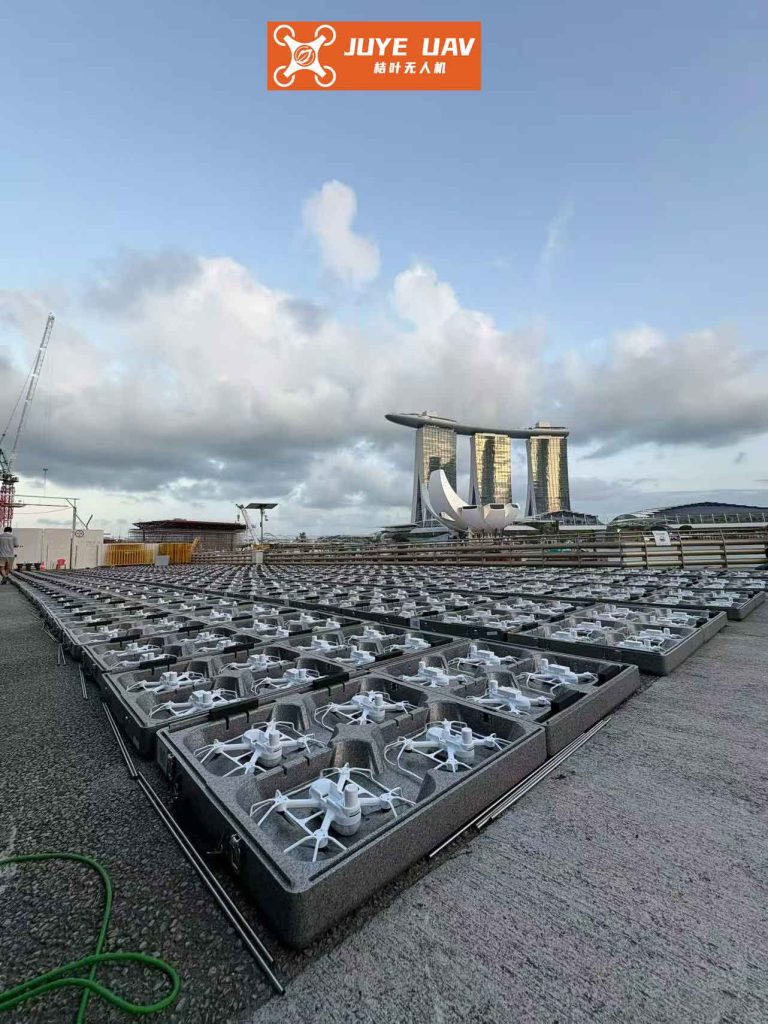
The mesmerizing spectacle of a formation drone light show, where hundreds of luminescent drones move as a single, intelligent entity to paint the night sky, represents one of the most visually stunning and technically demanding applications of multi-agent systems. Beneath the artistic beauty lies a profound engineering challenge: the precise and reliable control of a swarm of unmanned aerial vehicles (UAVs) subject to real-world physical limitations. This article delves into the core control algorithms that make such synchronized aerial ballets possible, focusing on the optimization of consensus-based formation control under critical motion constraints.
The foundation for coordinating multiple autonomous agents is often built upon consensus theory. In its basic form for second-order systems (governing both position and velocity), the control input for agent i is designed based on the relative states of its neighbors. The standard second-order consensus protocol can be expressed as:
$$
\begin{aligned}
\dot{\mathbf{s}}_i &= \mathbf{v}_i \\
\dot{\mathbf{v}}_i &= \mathbf{u}_i \\
\mathbf{u}_i &= \sum_{j \in \mathcal{N}_i} a_{ij} \left[ (\mathbf{s}_j – \mathbf{s}_i) + \gamma (\mathbf{v}_j – \mathbf{v}_i) \right]
\end{aligned}
$$
where \(\mathbf{s}_i\) and \(\mathbf{v}_i\) are the position and velocity vectors of drone \(i\), \(\mathcal{N}_i\) is its set of neighboring drones from which it receives information, \(a_{ij}\) are the elements of the weighted adjacency matrix defining the communication topology, and \(\gamma > 0\) is a coupling gain. While this protocol can achieve agreement on velocity, its final positional consensus state \(\mathbf{s}_i(t) \to \mathbf{1} \mathbf{h}^T \mathbf{s}(0) + t \mathbf{1} \mathbf{h}^T \mathbf{v}(0)\) is dependent on the initial conditions of the entire swarm. For a formation drone light show, this is unacceptable. The drones must converge not to a single point, but to a specific, pre-defined geometric pattern relative to a moving reference, regardless of their starting positions.
Enhanced Consensus with a Virtual Reference for Precise Formations
To direct the swarm towards a specific formation, the concept of a virtual structure or a virtual leader is integrated. We define a virtual reference point that dictates the swarm’s collective motion. Let \(\mathbf{s}^r\) and \(\mathbf{v}^r\) be the position and velocity of this virtual reference. The desired formation is defined by fixed offsets \(\mathbf{r}_i^d\) for each drone in a coordinate frame attached to the virtual reference. Transforming these offsets to the global inertial frame \(\mathcal{I}\) using the rotation matrix \(\mathbf{C}_{b}^{\mathcal{I}}\) (which depends on the reference heading \(\psi^r\)), we get the ideal position for drone \(i\): \(\mathbf{s}_i^{\mathcal{I}} = \mathbf{s}^r + \mathbf{C}_{b}^{\mathcal{I}} \mathbf{r}_i^d\). The ideal velocity is simply \(\mathbf{v}_i^{\mathcal{I}} = \mathbf{v}^r\).
We then define the consensus variables as the errors from these ideal trajectories: \(\tilde{\mathbf{s}}_i = \mathbf{s}_i – \mathbf{s}_i^{\mathcal{I}}\) and \(\tilde{\mathbf{v}}_i = \mathbf{v}_i – \mathbf{v}_i^{\mathcal{I}}\). The control objective shifts from achieving simple consensus to driving these error variables to zero. An enhanced second-order consensus protocol incorporating the virtual reference is proposed:
$$
\begin{aligned}
\dot{\mathbf{s}}_i &= \mathbf{v}_i \\
\dot{\mathbf{v}}_i &= \mathbf{u}_i^e \\
\mathbf{u}_i^e &= \sum_{j \in \mathcal{N}_i} a_{ij} \gamma \left[ (\mathbf{v}_j – \mathbf{v}_i) + \alpha (\mathbf{v}^r – \mathbf{v}_i) \right] + \sum_{j \in \mathcal{N}_i} a_{ij} \left[ (\mathbf{s}_j – \mathbf{s}_i + \mathbf{r}_{ij}) + \alpha (\mathbf{s}^r – \mathbf{s}_i + \mathbf{r}_i^{\mathcal{I}}) \right]
\end{aligned}
$$
where \(\alpha > 0\) is a reference coupling gain, and \(\mathbf{r}_{ij} = \mathbf{r}_j^{\mathcal{I}} – \mathbf{r}_i^{\mathcal{I}}\) is the desired relative position between drones \(i\) and \(j\). This protocol uses both neighbor-to-neighbor relative state feedback and feedback from the drone’s own state to the virtual reference’s state. In compact matrix form for the stacked error vectors \(\tilde{\mathbf{S}}\) and \(\tilde{\mathbf{V}}\), the closed-loop dynamics are:
$$
\begin{bmatrix} \dot{\tilde{\mathbf{S}}} \\ \dot{\tilde{\mathbf{V}}} \end{bmatrix} =
\begin{bmatrix}
\mathbf{0}_{n \times n} & \mathbf{I}_n \\
-(\mathbf{L} + \alpha \mathbf{D}) & -\gamma (\mathbf{L} + \alpha \mathbf{D})
\end{bmatrix} \otimes \mathbf{I}_3
\begin{bmatrix} \tilde{\mathbf{S}} \\ \tilde{\mathbf{V}} \end{bmatrix} = \mathbf{\Gamma}_1 \begin{bmatrix} \tilde{\mathbf{S}} \\ \tilde{\mathbf{V}} \end{bmatrix}
$$
where \(\mathbf{L}\) is the Laplacian matrix and \(\mathbf{D}\) is the in-degree matrix of the communication graph. For an undirected, connected communication topology with \(\gamma > 0, \alpha > 0\), the matrix \(\mathbf{\Gamma}_1\) is Hurwitz (all eigenvalues have negative real parts). This guarantees asymptotic stability, meaning the formation errors converge to zero:
$$
\lim_{t \to \infty} \mathbf{s}_i(t) = \mathbf{s}^r(t) + \mathbf{r}_i^{\mathcal{I}}, \quad \lim_{t \to \infty} \mathbf{v}_i(t) = \mathbf{v}^r(t), \quad \lim_{t \to \infty} (\mathbf{s}_j(t) – \mathbf{s}_i(t)) = \mathbf{r}_{ij}.
$$
This result is fundamental for a reliable formation drone light show, as it ensures the swarm will reliably lock into the designed pattern, whether it’s a static logo or a dynamic, moving shape.
Accounting for Real-World Limits: Motion Constraints in Formation Flight
The theoretical protocol above assumes drones can produce any required acceleration. In reality, drones in a formation drone light show are subject to strict motion constraints. Their thrust is limited, leading to bounds on maximum achievable speed and acceleration. Violating these constraints can lead to instability, loss of formation, or even collisions. Therefore, the control input \(\mathbf{u}_i^e\) must be constrained.
A common approach is to pass the control signal through a saturation function. Let \(\text{SAT}(\cdot)\) denote a symmetric saturation function with upper and lower limits \(u_{\text{max}}\) and \(u_{\text{min}}\). The constrained control law becomes:
$$
\begin{aligned}
\dot{\mathbf{s}}_i &= \mathbf{v}_i \\
\dot{\mathbf{v}}_i &= \text{SAT}( \mathbf{u}_i^e )
\end{aligned}
$$
The saturation limits are dynamic and depend on the drone’s current state to respect both acceleration and speed constraints. For the x-axis component (and similarly for y and z), the limits at time \(t\) are:
$$
\begin{aligned}
c_{\text{max}}^x(t) &= \min \left\{ a_{\text{max}}, \frac{ (v_{\text{max}} – \beta) – v_i^x(t) }{\Delta t} \right\} \\
c_{\text{min}}^x(t) &= -\min \left\{ a_{\text{max}}, \frac{ v_i^x(t) – (v_{\text{min}} + \beta) }{\Delta t} \right\}
\end{aligned}
$$
where \(a_{\text{max}}\) is the maximum acceleration magnitude, \(v_{\text{max}}\) and \(v_{\text{min}}\) are the speed limits, \(\beta\) is a safety margin, and \(\Delta t\) is the control update period. This ensures the commanded acceleration will not cause the drone to exceed its speed bounds in the next time step.
The stability of the constrained system can be analyzed by introducing a time-varying diagonal matrix \(\mathbf{F}(t)\) with elements \(0 < \epsilon_i(t) \leq 1\), such that \(\text{SAT}(\mathbf{u}^e) = \mathbf{F}(t) \mathbf{u}^e\). The closed-loop dynamics with saturation can be rewritten as \(\dot{\mathbf{X}} = \mathbf{M}(t) \mathbf{\Gamma}_1 \mathbf{X}\), where \(\mathbf{M}(t) = \text{blkdiag}(\mathbf{I}, \mathbf{F}(t))\). Since \(\mathbf{M}(t)\) is positive definite and \(\mathbf{\Gamma}_1\) is Hurwitz, the constrained system remains asymptotically stable, though typically with a slower convergence rate compared to the unconstrained case. This stability guarantee is crucial for the safe operation of a large-scale formation drone light show.
Multi-Channel Controller Architecture for Full Formation Control
To execute a complete formation drone light show maneuver, separate but coordinated controllers are designed for different channels. We assume a simplified quadrotor model where horizontal motion is primarily controlled by velocity commands derived from the consensus algorithm, while altitude and heading are controlled more directly.
1. Altitude & Heading Channels (First-Order Consensus & PID):
For altitude \(z\) and heading \(\psi\), a simpler first-order consensus tracking the virtual reference is sufficient, followed by a PID controller for smooth tracking.
$$
\begin{aligned}
\text{Altitude:} & \quad \tilde{z}_i = z^r + r_{z,i} – z_i, \quad \dot{z}_i^{cmd} = K_{p}^z \tilde{z}_i + K_{i}^z \int \tilde{z}_i \, dt + K_{d}^z \frac{d\tilde{z}_i}{dt} \\
\text{Heading:} & \quad \tilde{\psi}_i = \psi^r – \psi_i, \quad \dot{\psi}_i^{cmd} = K_{p}^{\psi} \tilde{\psi}_i + K_{i}^{\psi} \int \tilde{\psi}_i \, dt + K_{d}^{\psi} \frac{d\tilde{\psi}_i}{dt}
\end{aligned}
$$
2. Velocity Channels (Constrained Second-Order Consensus):
The core horizontal motion (East, \(x\), and North, \(y\)) is governed by the constrained enhanced consensus protocol developed earlier. The control accelerations \(\ddot{x}_i^{cmd}\) and \(\ddot{y}_i^{cmd}\) are computed as the saturated outputs of \(\mathbf{u}_i^e\) projected onto the x and y axes. These accelerations are then integrated to obtain velocity commands for the drone’s low-level flight controller.
The table below summarizes the control architecture for a single drone in the formation drone light show.
| Control Channel | Desired State | Control Law Principle | Output Command |
|---|---|---|---|
| Altitude (Z) | \(z^r + r_{z,i}\) | First-Order Reference Tracking + PID | Vertical Velocity \(\dot{z}_i^{cmd}\) |
| Heading (\(\psi\)) | \(\psi^r\) | First-Order Reference Tracking + PID | Yaw Rate \(\dot{\psi}_i^{cmd}\) |
| Horizontal Velocity (X, Y) | \(\mathbf{v}^r = [v_x^r, v_y^r]^T\) | Constrained Enhanced Second-Order Consensus | Acceleration \([\ddot{x}_i^{cmd}, \ddot{y}_i^{cmd}]^T\) (integrated to velocity) |
Simulation Analysis: Validating the Algorithm for Formation Assembly
The performance of the proposed constrained enhanced consensus algorithm is validated through numerical simulations of a five-drone formation assembly, a critical phase for initiating any formation drone light show. The drones start from a scattered line formation and must converge into a predefined V-shape pattern while matching a virtual reference moving at 4 m/s. The communication topology is a line graph. Key parameters are: \(\gamma = 20\), \(\alpha = 1\), \(v_{\text{max}} = 5.0 \, \text{m/s}\), \(a_{\text{max}} = 5g\).
We compare four algorithms to highlight the improvements:
- Alg-A: Basic consensus with only velocity reference.
- Alg-B: Proposed Enhanced Consensus (without saturation).
- Alg-C: Proposed Constrained Enhanced Consensus (with SAT).
- Alg-D: Enhanced Consensus with a hyperbolic tangent (tanh) constraint.
The convergence performance is summarized in the following table. The metrics are the time and the number of control iterations required for all drones to reach within a small threshold of their target states within the formation.
| Algorithm | Description | Convergence Time (s) | Iterations to Converge | Key Property |
|---|---|---|---|---|
| Alg-A | Basic + Velocity Ref | > 107.8 | > 5389 | Converges to a point, not formation; state depends on initial conditions. |
| Alg-B | Enhanced Consensus | ~94.0 | ~4700 | Converges accurately to desired formation, independent of initial conditions. |
| Alg-C | Constrained Enhanced Consensus (SAT) | ~95.4 | ~4769 | Converges accurately to formation with motion constraints; marginally slower than Alg-B. |
| Alg-D | Enhanced + tanh constraint | ~201.5 | ~10077 | Converges with constraints but significantly slower than Alg-C. |
The position error trajectories clearly show that Alg-A fails to form the V-shape, while Alg-B, Alg-C, and Alg-D succeed. The velocity plots show that Alg-B and Alg-C drive the drones to the correct reference speed of 4 m/s, while Alg-A converges to an incorrect speed. The critical comparison between Alg-C and Alg-D demonstrates the efficiency of the saturation function (SAT) over a smooth nonlinear function like tanh for enforcing constraints in this context, as Alg-C converges less than half the time. This efficiency is vital for a dynamic formation drone light show where formations must change rapidly and reliably.
The final state errors at convergence for the successful algorithms are remarkably small, confirming the asymptotic stability and precision of the proposed method. For Alg-C, the maximum positional error was under 0.4 meters and velocity error under 0.02 m/s, which is highly precise for a large outdoor formation drone light show.
The Application to Formation Drone Light Shows
The transition from theoretical multi-agent control to the captivating spectacle of a formation drone light show is direct. The virtual reference point’s trajectory \(\mathbf{s}^r(t)\) becomes the choreographed path for the entire swarm—it could trace a curve over a stadium or hold a fixed geospatial position. The formation offsets \(\mathbf{r}_i^d\) define the intricate shapes: letters, logos, or complex 3D objects. The proposed control algorithm ensures that each drone in the massive swarm accurately becomes a moving pixel in this aerial display.
Handling motion constraints is not merely an academic exercise but a safety and practicality imperative for formation drone light shows. The saturation mechanism prevents drones from being commanded to execute impossibly sharp turns or accelerations, which would drain batteries prematurely, create excessive positional error, and increase the risk of mid-air collisions within the dense swarm. The stability proof ensures that even when some drones hit their control limits temporarily, the overall swarm will recover and maintain the formation, preventing a cascade of failures.
In conclusion, the optimization of consensus algorithms through the integration of a virtual reference and the explicit, stable handling of actuator saturation provides a robust and practical framework for autonomous drone swarms. This technology forms the invisible backbone that enables the reliable, safe, and breathtaking synchronization seen in modern formation drone light shows, pushing the boundaries of aerial artistry and coordinated autonomous systems.