
In complex and dynamic disaster scenarios such as forest fire monitoring, traditional fixed monitoring systems suffer from limited coverage, severe terrain interference, and rigid resource scheduling. These limitations make it difficult to satisfy the real-time and reliability requirements of emergency response. As a highly mobile and flexible platform, the UAV drone has become a key carrier for disaster monitoring. However, existing research on UAV drone-assisted mobile edge computing (MEC) mostly focuses on static or single-device mobility scenarios. It often ignores the collaborative mobility of terminal devices and edge devices, dynamic communication links, real-time resource constraints such as safe distances among UAV drones and upper limits of computing resources, and the joint optimization of task completion time, energy efficiency, and load balancing. To address these challenges, I propose UAV drone-assisted edge computing based on movable terminals and edges, focusing on task offloading and resource scheduling optimization in forest fire monitoring.
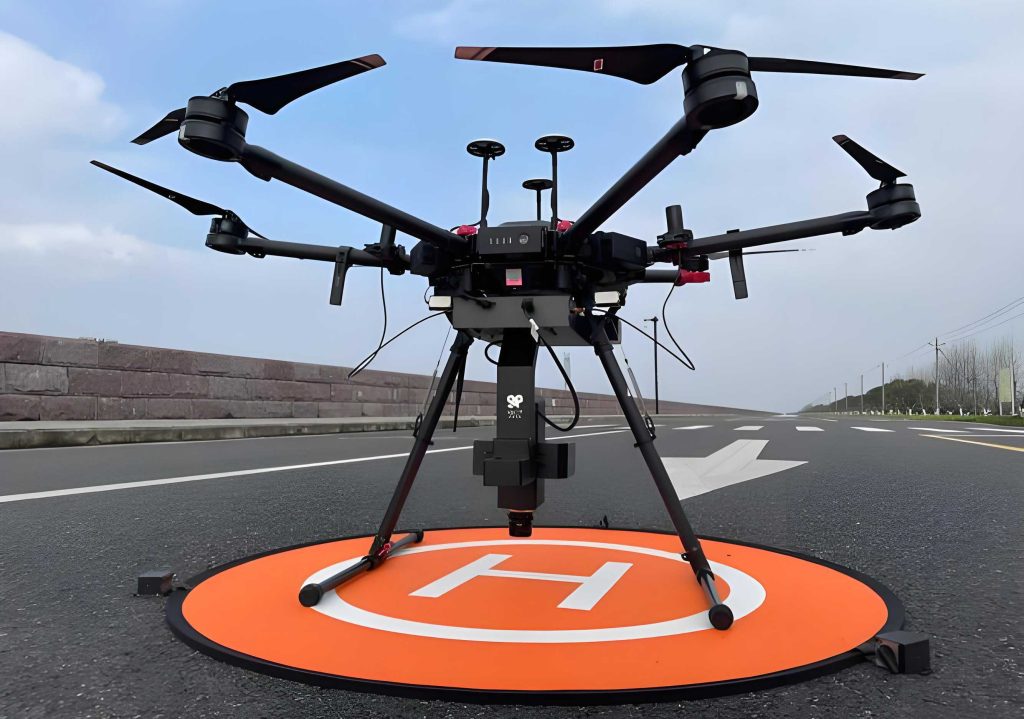
My work is organized around two main research problems. First, I establish an edge computing model based on a parallel-moving UAV drone and a circular-moving mobile terminal, and I use a genetic algorithm to implement the computation offloading strategy. Second, I establish an edge computing model based on multiple motion modes of UAV drones and mobile terminals, and I optimize the motion modes of UAV drones and the movement strategies of mobile terminals. In both models, I consider dynamic communication link constraints, safe distance constraints among UAV drones, and real-time allocation of computing resources. The objective is to minimize a total system cost that integrates task completion time and system energy consumption. Simulation experiments verify that my optimization strategies effectively reduce average task execution delay, improve computing efficiency, reduce total system energy consumption, and dynamically adapt to environmental changes in complex scenarios.
The remainder of this article is organized as follows. I first introduce the relevant theoretical background. Then I present the collaborative optimization model with edge translation and terminal circular motion. Next I extend the model to multiple motion modes of both edges and terminals. Finally I summarize my work and discuss future directions.
Relevant Theoretical Background
Mobile edge computing is a new computing architecture that migrates computing tasks from centralized cloud platforms to network edge devices to achieve lower latency, higher bandwidth efficiency, and better real-time performance. In an MEC system, terminal devices such as smartphones and IoT sensors can offload local computing tasks to edge servers. The edge computing nodes provide powerful computing, storage, and communication capabilities. The key technologies of MEC include computation offloading, resource management, low-latency communication, and energy efficiency optimization.
A UAV drone can act as a flexible aerial platform that is rapidly deployed in complex environments to provide data collection and communication support for MEC systems. A UAV drone can participate in task processing as a mobile terminal or serve as an aerial base station to provide communication and computation offloading services to ground devices. The flexibility of a UAV drone makes it an important component for improving MEC system performance. Nevertheless, UAV drone-assisted MEC still faces many technical challenges, especially in dynamic environments, including mobility management, network topology changes, and energy limitations.
Genetic algorithm (GA) is an optimization algorithm based on Darwinian evolution. It simulates natural selection and genetic variation. GA has strong global search ability and is suitable for nonlinear and high-dimensional problems. In MEC task scheduling, the fitness function of GA is usually related to task completion time, energy consumption, or resource utilization. The goal is to find an optimal task allocation scheme that maximizes system performance.
| Symbol | Meaning |
|---|---|
| \(M\) | Set of mobile terminals |
| \(U\) | Set of UAV drones |
| \(T\) | Set of time periods |
| \(L_m(t)\) | Data size of computing task generated by terminal \(m\) |
| \(C_m\) | CPU cycles required for the task |
| \(z_{m,u}(t)\) | Binary variable indicating whether terminal \(m\) connects to UAV drone \(u\) |
| \(d_{m,u}(t)\) | Distance between terminal \(m\) and UAV drone \(u\) |
| \(r_{m,u}(t)\) | Offloading rate from terminal \(m\) to UAV drone \(u\) |
| \(D_{m,u}^{comm}(t)\) | Communication time for offloading |
| \(D_{m,u}^{comp}(t)\) | Computation time at UAV drone \(u\) |
| \(D_{u,m}^{down}(t)\) | Downlink transmission time for results |
| \(D_{u,m}^{wait}(t)\) | Waiting time for reconnection |
| \(C_{total}\) | Total system cost |
Collaborative Optimization with Edge Translation and Terminal Circular Motion
I first consider a scenario in which each mobile terminal moves along a circular path, while each UAV drone performs a translational motion. This scenario reflects the need for continuous data collection around a local area and rapid large-scale search by UAV drones. The system consists of multiple mobile terminals and multiple UAV drones. A UAV drone completes a flight mission over \(T\) time periods. At the beginning of each period, the UAV drone hovers to serve terminals.
For each mobile terminal \(m\), the initial position is randomly generated within a rectangular region. The coordinates are:
$$x_{center} = x_{\min} + rand() \cdot (x_{\max} – x_{\min})$$
$$y_{center} = y_{\min} + rand() \cdot (y_{\max} – y_{\min})$$
The terminal moves along a circle with radius \(r\). The angular increment per step is:
$$\Delta\theta_{step} = \frac{2\pi}{movesteps}$$
At each time period \(t\), the new position is computed as:
$$x_{next} = x_{center} + r \cos(\theta_{current})$$
$$y_{next} = y_{center} + r \sin(\theta_{current})$$
For the UAV drone, the horizontal coordinate at time \(t\) is \(q_u(t) = (x_u(t), y_u(t))\). The UAV drone moves with speed \(v_u\) and flight angle \(\alpha_u(t)\). The position update is:
$$x_u(t) = x_u(t-1) + v_u t_u \cos(\alpha_u(t))$$
$$y_u(t) = y_u(t-1) + v_u t_u \sin(\alpha_u(t))$$
The propulsion energy of UAV drone \(u\) in period \(t\) is:
$$E_u^{fly}(t) = p_u(t) t_u$$
The communication distance between terminal \(m\) and UAV drone \(u\) is:
$$d_{m,u}(t) = \sqrt{H^2 + \|S_m(t) – q_u(t)\|^2}$$
The channel power gain is:
$$g_{m,u}(t) = \beta d_{m,u}^{-\alpha}(t)$$
The offloading rate from terminal \(m\) to UAV drone \(u\) is:
$$r_{m,u}(t) = \frac{B_M}{M} \log_2\left(1 + \frac{P_M g_{m,u}(t)}{\sigma^2}\right)$$
The communication time for task offloading is:
$$D_{m,u}^{comm}(t) = \frac{z_{m,u}(t) L_m(t)}{r_{m,u}(t)}$$
The communication energy consumption is:
$$E_{m,u}^{comm}(t) = D_{m,u}^{comm}(t) P_M$$
After computation, the UAV drone downlinks the result to the terminal. The downlink rate is:
$$r_{u,m}(t) = \frac{B_U}{M} \log_2\left(1 + \frac{P_U g_{m,u}(t)}{\sigma^2}\right)$$
The downlink time is:
$$D_{u,m}^{down}(t) = \frac{D_{m,i}^{result}(t)}{r_{u,m}(t)}$$
The waiting time for reconnection is approximated as:
$$D_{u,m}^{wait}(t) = \frac{2 d_{toboundary}}{v_u}$$
The computation time at UAV drone \(u\) is:
$$D_{m,u}^{comp}(t) = \frac{L_m(t) C_m z_{m,u}(t)}{f_{m,u}(t)}$$
The completion time of a task \(i\) on terminal \(m\) is:
$$D_{m,i}(t) = D_{m,i}^{gene}(t) + D_{m,u}^{comm}(t) + D_{m,u}^{comp}(t) + D_{u,m}^{down}(t) + D_{u,m}^{wait}(t)$$
The total completion time of all tasks on terminal \(m\) is:
$$D_m(t) = \max(D_{m,1}(t), D_{m,2}(t), \ldots, D_{m,I}(t))$$
The total system cost is defined as the weighted sum of total task completion time and total system energy consumption:
$$C_{total} = \omega_D D_{total}(t) + \omega_E E_{total}(t)$$
where
$$D_{total}(t) = \max(D_1(t), D_2(t), \ldots, D_M(t))$$
and
$$E_{total}(t) = \sum_{m=1}^{M} \sum_{u=1}^{U} \left( E_{m,u}^{comm}(t) + E_{u,m}^{down}(t) \right) + \sum_{u=1}^{U} E_u^{fly}(t)$$
The optimization problem is formulated as:
$$\min C_{total} = \min \left( \omega_D D_{total}(t) + \omega_E E_{total}(t) \right)$$
subject to:
$$0 \leq \alpha_u(t) \leq 2\pi, \quad \forall u \in U$$
$$z_{m,u}(t) \in \{0,1\}, \quad \sum_{u=1}^{U} z_{m,u}(t) \leq 1, \quad \forall m \in M, t \in T$$
$$f_{m,u}(t) \geq 0, \quad \sum_{m \in M} f_{m,u}(t) \leq f_u^{\max}$$
$$\|q_u(t) – q_{u’}(t)\| \geq d_{\min}, \quad \forall u, u’ \in U, u \neq u’$$
To solve this mixed-integer optimization problem, I design a genetic algorithm. Each individual is a three-dimensional binary matrix of size \(T \times M \times U\), where the element \(z_{m,u}(t)\) indicates whether terminal \(m\) connects to UAV drone \(u\) at time \(t\). The fitness function is:
$$Fitness = \omega_D D_{total}(t) + \omega_E E_{total}(t)$$
I use roulette wheel selection, single-point crossover, and mutation. The algorithm runs for a fixed number of generations and returns the best individual.
| Parameter | Value |
|---|---|
| Number of mobile terminals | 40 |
| Circular motion radius | 20 m |
| Number of movement steps | 25 |
| Number of UAV drones | 10 |
| UAV drone coverage radius | 50 m |
| Number of iterations | 50 |
| Rectangular region | (0,0) to (100,100) m |
The experimental results show that the fitness value decreases as the number of generations increases. The average fitness value across 30 runs gradually decreases, proving the stability and global search ability of the algorithm. The final fitness values are close to 1900 or lower, indicating that the algorithm finds efficient task allocation schemes in complex environments.
I also record a complete task allocation scheme. The scheme shows that each mobile terminal connects to different UAV drones at different time periods. This dynamic allocation reflects the adaptability of the algorithm to changes in task demands and UAV drone resources. The load balancing among UAV drones is also improved.
I analyze the sensitivity of the model to key parameters. The number of mobile terminals, the number of UAV drones, and the movement step length significantly affect the task completion time and energy consumption. As the number of mobile terminals increases, the total completion time and energy consumption increase nonlinearly. As the number of UAV drones increases, the total cost decreases, but the marginal benefit diminishes. Larger movement steps increase the dynamicity of the system, but they also increase the complexity of task offloading and the total cost.
| Number of Terminals | Completion Time (s) | Energy (J) | Total Cost |
|---|---|---|---|
| 5 | 420.04 | 5,073.14 | 88.54 |
| 10 | 904.67 | 17,284.04 | 254.26 |
| 20 | 2,159.38 | 90,315.16 | 1,097.50 |
| 40 | 4,300.01 | 325,141.12 | 3,638.41 |
I compare my genetic algorithm with a traditional strongest-signal scheme. When the number of mobile terminals is small, the strongest-signal scheme has a lower total cost. However, as the number of mobile terminals increases, the strongest-signal scheme exhibits large fluctuations. Due to uneven task allocation and overload of some UAV drones, the total cost rises sharply. In contrast, my genetic algorithm effectively reduces task completion time and system energy consumption and maintains high load balancing. This advantage is more prominent when the number of mobile terminals is large.
Collaborative Optimization with Multiple Motion Modes of Edges and Terminals
In real application scenarios, the motion modes of devices are far more than translation and circular motion. For example, in mountainous areas, a UAV drone may need to adopt a zigzag flight mode to flexibly shuttle through valleys and avoid obstacles. In urban environments, mobile terminals may move linearly or circularly. Therefore, I further study the collaborative optimization problem of multiple motion modes of edges and terminals.
I consider three motion modes for UAV drones: linear motion, circular motion, and zigzag flight. For mobile terminals, I consider circular motion and linear motion. I analyze the impact of different motion modes on task delay, energy consumption, and coverage efficiency.
The position of a UAV drone in linear motion is:
$$P_u(t) = (x_0 + vt \cos\theta, y_0 + vt \sin\theta)$$
The position of a UAV drone in circular motion is:
$$x_{uav}(t) = x_{center} + R_{uav} \cos(\omega_{uav} t + \phi_0)$$
$$y_{uav}(t) = y_{center} + R_{uav} \sin(\omega_{uav} t + \phi_0)$$
The position of a UAV drone in zigzag motion is:
$$x_{uav}(t) = x_0 + A \sin\left(\frac{2\pi}{T_{zigzag}} t\right)$$
$$y_{uav}(t) = y_0 + v_y t$$
For mobile terminals, the circular motion model is the same as in the first model. The linear motion model is:
$$x_m(t) = x_0 + v_m t \cos\theta$$
$$y_m(t) = y_0 + v_m t \sin\theta$$
The communication and computation models are the same as those in the first model. The total cost function now includes not only task completion time and energy consumption but also load balancing. I define the fitness function as:
$$Fitness = \alpha \frac{\sum_{i=1}^{m} T_{completion,i}}{\max_{i} T_{completion,i}} + \beta \frac{\sum_{j=1}^{u} E_{uav,j}}{\max_{j} E_{uav,j}} + \gamma \frac{\sum_{k=1}^{u} |L_{uav,k} – \bar{L}|}{\max_{k} |L_{uav,k} – \bar{L}|}$$
where \(\alpha\), \(\beta\), and \(\gamma\) are weight coefficients. \(T_{completion,i}\) is the completion time of task \(i\), \(E_{uav,j}\) is the energy consumption of UAV drone \(j\), and \(L_{uav,k}\) is the computing load of UAV drone \(k\). \(\bar{L}\) is the average computing load.
To solve this problem, I use an improved genetic algorithm. I encode the UAV drone motion mode, the terminal motion mode, and the task allocation matrix into an individual. I use tournament selection, partial mapping crossover (PMX), and targeted mutation. The algorithm framework is shown in Algorithm 4-1.
| Parameter | Value |
|---|---|
| Number of mobile terminals | 20, 40, 50 |
| Number of UAV drones | 4, 10 |
| UAV drone coverage radius | 25 m |
| Number of iterations | 30, 50 |
| Rectangular region | (0,0) to (100,100) m |
| Motion Mode | Parameter | Value |
|---|---|---|
| UAV drone circular motion | Radius | 30 m |
| UAV drone zigzag motion | Amplitude | 10 m |
| UAV drone zigzag motion | Period | 10 s |
| UAV drone zigzag motion | Y-direction speed | 5 m/s |
| Mobile terminal linear motion | Speed | 3 m/s |
The experimental results show that the average fitness value decreases as the number of generations increases for all motion modes. This verifies the stability and optimization ability of the algorithm. I record the best task allocation schemes for different motion modes. The schemes show that mobile terminals can obtain efficient data transmission services from UAV drones in different time periods.
I compare the genetic algorithm with the strongest-signal scheme under multiple motion modes. When the number of mobile terminals is small, the strongest-signal scheme has a lower total cost. However, as the number of mobile terminals increases, the total cost of the strongest-signal scheme grows sharply due to uneven task allocation and overload. The genetic algorithm achieves global optimization and significantly reduces the total cost.
| Number of Terminals | Genetic Algorithm Total Cost | Strongest-Signal Total Cost |
|---|---|---|
| 5 | 8,077.87 | 32,252.60 |
| 10 | 15,957.11 | 58,382.02 |
| 15 | 24,373.42 | 98,602.91 |
| 20 | 32,879.02 | 124,396.44 |
| 25 | 41,403.66 | 153,066.91 |
| 30 | 48,729.30 | 181,462.19 |
I further compare the total cost under six combinations of motion modes. The combinations include UAV drone zigzag motion with terminal circular motion, UAV drone zigzag motion with terminal linear motion, UAV drone circular motion with terminal circular motion, UAV drone circular motion with terminal linear motion, UAV drone linear motion with terminal circular motion, and UAV drone linear motion with terminal linear motion. The experimental results show that the total cost of all combinations decreases as the number of iterations increases. However, the combinations with UAV drone linear motion have significantly higher total costs than the combinations with zigzag and circular motion. This is because linear motion follows a fixed path and cannot flexibly cover irregular areas. It easily leads to signal blind zones, longer task offloading delays, and unbalanced task allocation.
| Motion Combination | Total Cost (20 terminals) | Total Cost (50 terminals) |
|---|---|---|
| UAV zigzag + terminal circular | Low | Low |
| UAV zigzag + terminal linear | Low | Low |
| UAV circular + terminal circular | Medium | Medium |
| UAV circular + terminal linear | Medium | Medium |
| UAV linear + terminal circular | High | High |
| UAV linear + terminal linear | High | High |
In forest fire monitoring, I recommend avoiding the UAV drone linear motion mode. The UAV drone zigzag motion is more suitable for complex forest terrain because it can flexibly shuttle through mountains and avoid obstacles. The UAV drone circular motion is suitable for monitoring fixed high-risk areas. By combining these motion modes with the genetic algorithm for task allocation, the total cost can be reduced, and the timeliness and completeness of fire monitoring can be improved.
Conclusion and Future Work
In this article, I study the collaborative optimization of UAV drone-assisted MEC systems with movable terminals and edges. I first establish a model with edge translation and terminal circular motion. I formulate the total system cost as a weighted sum of task completion time and system energy consumption. I design a genetic algorithm to solve the task offloading and resource allocation problem. Simulation results show that my strategy reduces average task execution delay, improves computing efficiency, and reduces total system energy consumption.
I then extend the model to multiple motion modes of UAV drones and mobile terminals. I consider linear, circular, and zigzag flight for UAV drones, and circular and linear motion for mobile terminals. I design an improved genetic algorithm with load balancing. Experimental results show that the proposed model effectively improves system performance under different motion combinations. The UAV drone zigzag motion combined with terminal mobility achieves the best performance in complex environments.
Future work will focus on three directions. First, I will introduce more accurate environment perception models, combining geographic information and signal propagation characteristics to improve the modeling of complex environments. Second, I will combine the genetic algorithm with other heuristic algorithms to reduce computational complexity and improve convergence speed. Third, I will validate the proposed models in more diverse real-world scenarios, such as smart logistics in urban environments and emergency communication in remote areas. These efforts will further enhance the adaptability and reliability of UAV drone-assisted edge computing systems.
| Research Problem | Model | Algorithm | Main Result |
|---|---|---|---|
| Edge translation and terminal circular motion | UAV drone and mobile terminal MEC system | Genetic algorithm with 3D matrix encoding | Reduced delay and energy consumption |
| Multiple motion modes of edges and terminals | UAV drone linear, circular, zigzag; terminal circular, linear | Improved genetic algorithm with PMX and load balancing | Optimized task offloading and resource scheduling |
Overall, my research provides new ideas for the application of UAV drones in disaster monitoring, emergency communication, and other complex scenarios. It also provides theoretical support for the research of subsequent intelligent optimization methods.