
In recent years, quadrotor drones have gained widespread application in military, agricultural, and civilian fields due to their compact size, agility, and versatility. Autonomous flight for quadrotor drones necessitates efficient trajectory planning and stable flight control. However, the flight process of quadrotor drones is often susceptible to factors such as parameter uncertainties and external disturbances, which can degrade control performance and even lead to system instability. Therefore, developing reliable trajectory planning algorithms and robust flight control strategies is a critical focus for both academia and industry. This paper addresses these challenges by proposing a trajectory planning method that minimizes the fourth-order derivative of the trajectory with respect to time and a composite trajectory tracking control method that combines an Extended State Observer (ESO) and a Kalman Filter (KF) in parallel. The goal is to enhance the precision and disturbance rejection capabilities of quadrotor drones during autonomous operations.
Trajectory planning involves generating a collision-free and executable path for a quadrotor drone based on environmental maps. Existing methods, such as those using control barrier functions or time-optimal techniques, have shown promise but may not fully account for the smoothness and dynamic constraints specific to quadrotor drones. For trajectory tracking control, linear methods like PID control are commonly used in industry due to their simplicity, but they struggle with significant disturbances and nonlinearities. Nonlinear approaches, including backstepping, sliding mode, and adaptive control, offer better robustness but often involve complex implementations. To balance performance and practicality, this paper integrates a smooth trajectory planner with a disturbance-estimation-based controller, aiming to achieve high tracking accuracy under real-world conditions.
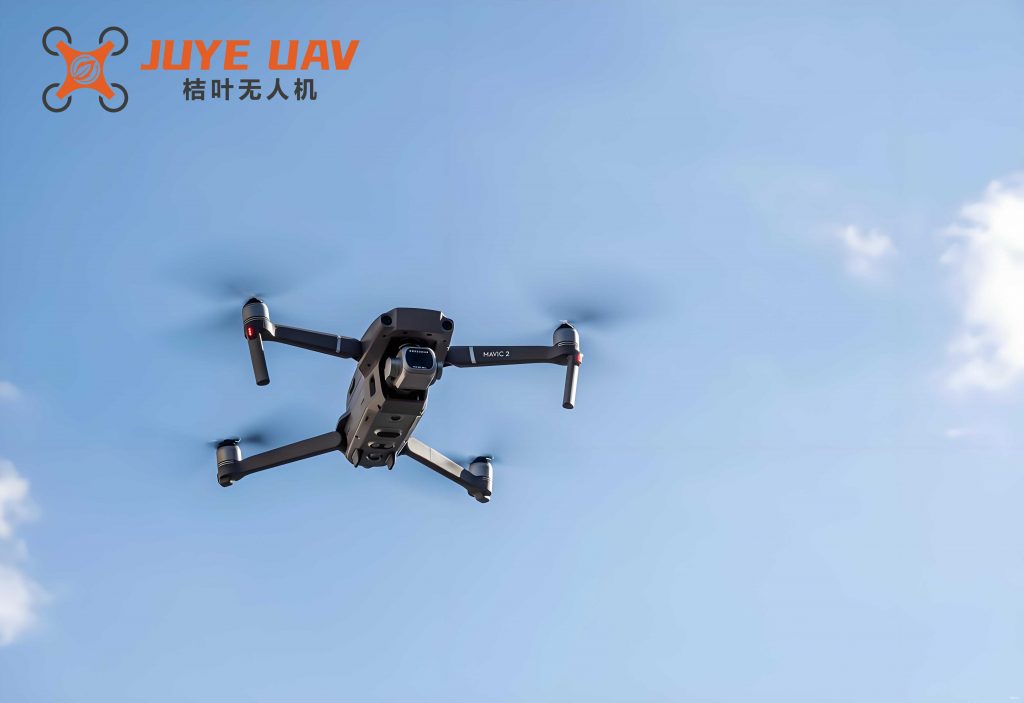
The mathematical model for the position subsystem of a quadrotor drone is derived based on Newton’s second law. Consider a quadrotor drone as a rigid body with symmetric structure, constant mass, and coincident center of mass and geometric center. Ignoring effects like Earth’s rotation, the position dynamics in an inertial frame are given by:
$$ \ddot{x} = \frac{f}{m} (\cos\psi \sin\theta \cos\phi + \sin\psi \sin\phi) + d_x $$
$$ \ddot{y} = \frac{f}{m} (\sin\psi \sin\theta \cos\phi – \cos\psi \sin\phi) + d_y $$
$$ \ddot{z} = -g + \frac{f}{m} \cos\phi \cos\theta + d_z $$
where \(x\), \(y\), and \(z\) are the positions in the inertial frame; \(\phi\), \(\theta\), and \(\psi\) are the roll, pitch, and yaw angles in the body frame; \(g\) is the gravitational acceleration; \(m\) is the mass of the quadrotor drone; \(f\) is the total thrust generated by the quadrotor drone; and \(d_x\), \(d_y\), \(d_z\) represent lumped disturbances including parameter uncertainties and external disturbances. By defining the position vector \(\mathbf{P} = [x, y, z]^T\), the control input vector \(\mathbf{U} = [u_x, u_y, u_z]^T\), and the disturbance vector \(\mathbf{d} = [d_x, d_y, d_z]^T\), the system can be simplified to a second-order model:
$$ \ddot{\mathbf{P}} = \mathbf{U} + \mathbf{d} $$
This model forms the basis for trajectory planning and control design. The lumped disturbances are assumed to be slowly time-varying with a bounded rate of change, which is reasonable for physical systems. For control purposes, we focus on one channel (e.g., the x-axis) without loss of generality, as the dynamics are decoupled in the position subsystem under small attitude angles. The state-space representation with measurement noise is:
$$ \dot{\boldsymbol{\Xi}} = \mathbf{A} \boldsymbol{\Xi} + \mathbf{B}_u u_x + \mathbf{B}_d d_x $$
$$ y = \mathbf{C} \boldsymbol{\Xi} + v $$
where \(\boldsymbol{\Xi} = [x_1, x_2]^T = [x, \dot{x}]^T\), \(\mathbf{A} = \begin{bmatrix} 0 & 1 \\ 0 & 0 \end{bmatrix}\), \(\mathbf{B}_u = [0, 1]^T\), \(\mathbf{B}_d = [0, 1]^T\), \(\mathbf{C} = [1, 0]\), \(u_x\) is the acceleration control input, \(y\) is the measured output, and \(v\) is measurement noise. This formulation allows for the design of observers and controllers to handle disturbances and noise.
Trajectory planning for quadrotor drones aims to generate smooth paths that pass through predefined waypoints while minimizing higher-order derivatives to ensure feasibility and stability. Based on differential flatness, the trajectory of a quadrotor drone can be parameterized by flat outputs, typically position and yaw angle. For simplicity, we focus on position planning, and similar methods apply to other channels. Given a set of waypoints in 3D space, the trajectory is divided into \(k\) segments, each represented by an \(n\)-th order polynomial. The time intervals are assigned based on distances between waypoints, resulting in a time sequence \(t_0, t_1, \dots, t_k\). The desired trajectory for the x-axis is expressed as:
$$ x_d(t) = \begin{cases}
[1, t, \dots, t^n] \boldsymbol{\sigma}_1 & t_0 \leq t \leq t_1 \\
[1, t, \dots, t^n] \boldsymbol{\sigma}_2 & t_1 \leq t \leq t_2 \\
\vdots & \\
[1, t, \dots, t^n] \boldsymbol{\sigma}_k & t_{k-1} \leq t \leq t_k
\end{cases} $$
where \(\boldsymbol{\sigma}_i = [\sigma_{i0}, \sigma_{i1}, \dots, \sigma_{in}]^T\) is the parameter vector for the \(i\)-th segment, and \(n\) is the polynomial order (typically 7 or higher for quadrotor drones to ensure smoothness). The trajectory planning problem is formulated as a constrained optimization to minimize the integral of the square of the fourth-order derivative, which promotes smoothness and reduces abrupt changes:
$$ \min \int_0^T (x_d^{(4)}(t))^2 dt = \min \sum_{i=1}^k \int_{t_{i-1}}^{t_i} (x_d^{(4)}(t))^2 dt $$
This can be rewritten in quadratic form as \(\min \boldsymbol{\sigma}^T \mathbf{Q} \boldsymbol{\sigma}\), where \(\boldsymbol{\sigma} = [\boldsymbol{\sigma}_1^T, \boldsymbol{\sigma}_2^T, \dots, \boldsymbol{\sigma}_k^T]^T\) and \(\mathbf{Q}\) is a block-diagonal matrix derived from the integrals. Constraints include waypoint positions, velocities, and accelerations at start and end points, as well as continuity conditions at segment junctions. These are expressed as linear equality constraints \(\mathbf{A}_{\text{eq}} \boldsymbol{\sigma} = \mathbf{b}_{\text{eq}}\). The optimization problem becomes:
$$ \min \boldsymbol{\sigma}^T \mathbf{Q} \boldsymbol{\sigma} \quad \text{subject to} \quad \mathbf{A}_{\text{eq}} \boldsymbol{\sigma} = \mathbf{b}_{\text{eq}} $$
Solving this yields the parameter vector \(\boldsymbol{\sigma}\), from which the smooth trajectory is constructed. This method ensures that the planned trajectory for the quadrotor drone is dynamically feasible, with bounded velocity and acceleration, and minimizes jerks for stable flight.
For trajectory tracking control, we design a composite scheme that estimates and compensates for disturbances while filtering measurement noise. The control architecture combines a Proportional-Derivative (PD) controller with an ESO for disturbance estimation and a KF for noise reduction. Considering the x-axis subsystem with lumped disturbance \(d_x\), we treat \(d_x\) as an extended state \(x_3 = d_x\), leading to the augmented system:
$$ \dot{\tilde{\boldsymbol{\Xi}}} = \tilde{\mathbf{A}} \tilde{\boldsymbol{\Xi}} + \tilde{\mathbf{B}}_u u_x + \mathbf{G} h $$
$$ y = \tilde{\mathbf{C}} \tilde{\boldsymbol{\Xi}} + v $$
where \(\tilde{\boldsymbol{\Xi}} = [\boldsymbol{\Xi}^T, x_3]^T\), \(\tilde{\mathbf{A}} = \begin{bmatrix} \mathbf{A} & \mathbf{B}_d \\ \mathbf{0} & 0 \end{bmatrix}\), \(\tilde{\mathbf{B}}_u = [\mathbf{B}_u^T, 0]^T\), \(\mathbf{G} = [0, 0, 1]^T\), \(\tilde{\mathbf{C}} = [\mathbf{C}, 0]\), and \(h = \dot{x}_3 = \dot{d}_x\). An ESO is designed to estimate the states and disturbance:
$$ \dot{\mathbf{Z}} = \tilde{\mathbf{A}} \mathbf{Z} + \tilde{\mathbf{B}}_u u_x + \mathbf{K}_{\text{eso}} (y – \tilde{\mathbf{C}} \mathbf{Z}) $$
where \(\mathbf{Z} = [z_1, z_2, z_3]^T\) is the estimate of \(\tilde{\boldsymbol{\Xi}}\), and \(\mathbf{K}_{\text{eso}} = \text{diag}(k_1, k_2, k_3)\) is the ESO gain matrix tuned via pole placement. However, a high-gain ESO may amplify measurement noise, compromising performance. To address this, we parallelize the ESO with a KF that pre-filters the noise. The combined observer structure is:
$$ \dot{\mathbf{Z}} = \tilde{\mathbf{A}} \mathbf{Z} + \tilde{\mathbf{B}}_u u_x + \mathbf{K}_{\text{eso}} (\mathbf{C} \hat{\boldsymbol{\Xi}} – \tilde{\mathbf{C}} \mathbf{Z}) $$
$$ \dot{\hat{\boldsymbol{\Xi}}} = \mathbf{A} \hat{\boldsymbol{\Xi}} + \mathbf{B}_u u_x + \mathbf{B}_d z_3 + \mathbf{K}_{\text{kf}} (y – \mathbf{C} \hat{\boldsymbol{\Xi}}) $$
where \(\hat{\boldsymbol{\Xi}}\) is the KF state estimate, \(z_3\) is the disturbance estimate from the ESO, and \(\mathbf{K}_{\text{kf}}\) is the Kalman gain computed from the Riccati equation:
$$ \dot{\mathbf{P}} = -\mathbf{P} \mathbf{C}^T \mathbf{R}^{-1} \mathbf{C} \mathbf{P} + \mathbf{A} \mathbf{P} + \mathbf{P} \mathbf{A}^T + \mathbf{B}_d \mathbf{Q} \mathbf{B}_d^T $$
$$ \mathbf{K}_{\text{kf}} = \mathbf{P} \mathbf{C}^T \mathbf{R}^{-1} $$
Here, \(\mathbf{R}\) and \(\mathbf{Q}\) are covariance matrices for measurement noise and disturbance estimation error, respectively. The control law for the x-axis is then formulated as:
$$ u_x = -K_p (z_1 – x_d) – K_d (z_2 – \dot{x}_d) – z_3 + \ddot{x}_d $$
where \(K_p\) and \(K_d\) are positive PD gains, and \(x_d\), \(\dot{x}_d\), \(\ddot{x}_d\) are the planned desired position, velocity, and acceleration. This control input compensates for the estimated disturbance \(z_3\) and drives the tracking error to zero. Stability analysis shows that the tracking error converges asymptotically to a bounded region under bounded disturbances and noise, ensuring robust performance for the quadrotor drone.
The proposed methods are validated through experiments on a Crazyflie 2.1 micro quadrotor drone platform equipped with a high-precision motion capture system. The experimental setup includes the quadrotor drone, a Crazyradio PA for communication, and a workstation processing data from eight cameras to estimate the drone’s pose. The trajectory planning and control algorithms run online on a ground station computer. Key parameters of the quadrotor drone are summarized in Table 1.
| Parameter | Value |
|---|---|
| Accelerometer & Gyroscope | BMI088 |
| Barometer | BMP388 |
| Microprocessor | STM32F405 |
| Communication Module | nRF51822 |
| Radio Bandwidth | 2.4 GHz |
| Dimensions | 92 mm × 92 mm × 29 mm |
| Takeoff Mass | 27 g |
| Flight Time | 7 minutes |
The desired trajectory for the quadrotor drone consists of multiple waypoints in 3D space, with a total planning time of 20 seconds. Constraints include zero velocity and acceleration at start and end points, maximum velocity of 0.2 m/s, and maximum acceleration of 0.2 m/s². The trajectory is generated using the proposed planning method with 7th-order polynomials. For control, we compare four approaches: PID, PD+ESO with small gains, PD+ESO with large gains, and PD+ESO+KF. The controller parameters are tuned as follows: PD gains \(K_p = 4.5\), \(K_d = 5\) for x and y axes, and \(K_p = 5\), \(K_d = 3\), \(K_i = 1\) for the z-axis. ESO poles are set to \(-3\) for small gains and \(-6\) for large gains. KF parameters are initialized with \(\mathbf{P}_0 = \text{diag}(1000, 1000)\), \(\mathbf{R} = 0.01\), and adaptive \(\mathbf{Q}\) based on tracking error. An external disturbance \(d_z = -3 \, \text{m/s}^2\) is introduced in the z-axis to test robustness.
Experimental results demonstrate the effectiveness of the proposed methods. The planned trajectory for the quadrotor drone smoothly passes through all waypoints, with velocity and acceleration profiles within the specified bounds. Tracking performance is evaluated using error metrics: average error, maximum error, and standard deviation. Table 2 summarizes the results for the x-axis tracking error under different controllers.
| Controller | Average Error (m) | Maximum Error (m) | Standard Deviation (m) |
|---|---|---|---|
| PID | 0.0070 | 0.0165 | 0.0079 |
| PD+ESO (Small Gains) | 0.0053 | 0.0231 | 0.0071 |
| PD+ESO (Large Gains) | 0.0047 | 0.0253 | 0.0066 |
| PD+ESO+KF | 0.0034 | 0.0160 | 0.0040 |
Similar trends are observed for the y-axis and z-axis. The PD+ESO+KF controller reduces the average error by over 5.7%, maximum error by over 26.7%, and standard deviation by over 7% compared to PD+ESO with large gains. Notably, the PD+ESO+KF controller achieves fast disturbance estimation while suppressing high-frequency noise in control inputs, as shown in acceleration plots. The z-axis disturbance estimation error converges rapidly, with a settling time of about 2 seconds, outperforming PID and PD+ESO with small gains. These results validate that the composite control method enhances trajectory tracking accuracy and disturbance rejection for quadrotor drones.
The trajectory planning method ensures smooth paths by minimizing the fourth-order derivative, which reduces jerks and improves flight stability for quadrotor drones. The optimization formulation with polynomial segments allows flexible waypoint constraints while maintaining continuity. In practice, this method can be extended to dynamic environments by incorporating real-time obstacle avoidance, though this paper focuses on predefined waypoints. The computational complexity is manageable for online implementation, as the optimization is solved offline or with efficient solvers.
The composite control strategy leverages the strengths of both ESO and KF. The ESO provides rapid estimation of lumped disturbances, enabling effective compensation in the control law. However, its sensitivity to measurement noise is mitigated by the parallel KF, which filters the output before feeding it to the ESO. This synergy balances dynamic performance and noise suppression, crucial for practical quadrotor drone applications where sensors like IMUs and motion capture systems introduce noise. The control law is derived from feedback linearization, with the disturbance estimate canceling uncertainties. Stability is proven using Lyapunov analysis, ensuring bounded errors under realistic assumptions.
Further analysis of the quadrotor drone dynamics reveals that the position subsystem is coupled with the attitude subsystem through nonlinear terms. However, for trajectory tracking, we assume that the attitude controller stabilizes the angles sufficiently, allowing decoupled design. This is standard in hierarchical control architectures for quadrotor drones. The proposed method can be integrated with such architectures, where a high-level planner generates trajectories and a low-level controller executes them. The disturbance observer accounts for mismatches between the model and real dynamics, including aerodynamic effects and payload variations.
Experiments were conducted in a controlled indoor environment with the motion capture system providing millimeter-level accuracy. The quadrotor drone performed autonomous flights with the planned trajectory, and data was logged for analysis. The PD+ESO+KF controller showed consistent performance across multiple runs, with minimal overshoot and steady-state error. Table 3 compares the tracking errors for all axes under the PD+ESO+KF controller, highlighting overall improvements.
| Axis | Average Error (m) | Maximum Error (m) | Standard Deviation (m) |
|---|---|---|---|
| X | 0.0034 | 0.0160 | 0.0040 |
| Y | 0.0033 | 0.0137 | 0.0040 |
| Z | 0.0143 | 0.0080 | 0.0599 |
The z-axis errors are higher due to the introduced disturbance, but the controller manages to recover quickly. The performance metrics confirm that the proposed methods advance the state-of-the-art in quadrotor drone control, offering a practical solution for applications requiring precise trajectory tracking under disturbances.
In conclusion, this paper presents a comprehensive approach for three-dimensional trajectory planning and anti-disturbance trajectory tracking control of quadrotor drones. The trajectory planning method minimizes the fourth-order derivative to generate smooth paths, while the composite control method combines an ESO and KF to estimate and compensate for disturbances while filtering noise. Experimental results on a real quadrotor drone platform demonstrate significant improvements in tracking accuracy and robustness compared to conventional PID and ESO-based controllers. Future work will extend this framework to multi-quadrotor drone formations, incorporating collaborative planning and distributed control. Additionally, adaptive tuning of observer gains and integration with vision-based sensors could enhance performance in unstructured environments. The proposed methods contribute to the development of reliable autonomous systems for quadrotor drones, paving the way for more complex missions in diverse fields.
The mathematical formulations and control designs are generalized for quadrotor drones, but they can be adapted to other UAV platforms with similar dynamics. The key insight is the parallel observer structure, which mitigates the trade-off between response speed and noise sensitivity. This is particularly relevant for quadrotor drones operating in cluttered or windy conditions. Further studies could explore nonlinear observer designs or machine learning techniques to improve disturbance prediction. Overall, this research underscores the importance of integrated planning and control in achieving high-performance autonomy for quadrotor drones.