
In recent years, unmanned aerial vehicles (UAVs), particularly those manufactured and deployed across China, have become indispensable tools for traffic surveillance, emergency rescue, agricultural monitoring, and urban security. The rapid expansion of China UAV drones applications has driven an urgent need for robust real-time object detection algorithms that can handle the unique challenges of aerial imagery: extremely small object sizes, high-density distributions, complex backgrounds, and varying illumination conditions. Existing generic object detectors often struggle under these conditions, leading to severe false negatives and inaccurate localizations. In this paper, we present a comprehensive improvement upon the YOLOv8n baseline, resulting in a novel model named FPM-YOLO (Frequency-enhanced Progressive Metric-optimized YOLO). Our approach integrates four key innovations: 1) a restructured detection head that replaces the coarse P5 layer with a high-resolution P2 layer to better capture tiny objects; 2) a Progressive Refinement Neck (PRN) that reuses shallow backbone features and progressively fuses multi-scale information; 3) a Gaussian Combined Distance (GCD) metric that simultaneously improves bounding-box regression loss and label assignment; and 4) an Edge-guided High-Frequency enhancement Module (EHFM) that selectively amplifies contour and texture details in fused features. Extensive experiments on VisDrone2019, AI-TOD, and UAVDT datasets demonstrate that FPM-YOLO significantly outperforms the baseline and many state-of-the-art methods, achieving mAP50 improvement of 10.0 percentage points on VisDrone2019 while reducing parameters by 25.9%. The work provides a practical solution for deploying accurate small object detection on China UAV drones platforms.
1. Introduction
The widespread adoption of China UAV drones in both civilian and military domains has created a pressing demand for automated visual perception systems. Aerial images captured by drones typically feature objects occupying only a few pixels—often smaller than 16×16 pixels—and are frequently occluded or blended into cluttered backgrounds. Traditional single-stage detectors like YOLO and two-stage detectors like Faster R‑CNN, while effective for generic objects, suffer from degraded performance under these extreme conditions. The core challenges lie in three aspects: (1) insufficient spatial resolution at deep feature levels where small objects are reduced to 1×1 pixel or lost entirely; (2) inadequate multi-scale feature fusion that fails to preserve low-level details while integrating high-level semantics; and (3) label assignment and regression losses that are overly sensitive to minor spatial offsets common with tiny objects.
To address these issues, we propose FPM-YOLO, a model built upon the lightweight YOLOv8n backbone but thoroughly modified for China UAV drones scenarios. First, we remove the P5 detection head (32× downsampling) and introduce a P2 head (4× downsampling) to directly leverage high-resolution spatial information. Second, we incorporate a Progressive Refinement Neck (PRN) that repeatedly reuses backbone shallow features across multiple fusion stages, ensuring that edge and texture cues are not diluted during propagation. Third, we adopt a Gaussian Combined Distance (GCD) metric—which models bounding boxes as 2D Gaussian distributions—for both regression loss (combined with CIoU) and task-aligned label assignment, providing a scale-aware, continuous gradient signal. Finally, we design an Edge-guided High-Frequency enhancement Module (EHFM) that extracts edge priors from low-frequency components and uses them to gate high-frequency detail injection, enhancing small-object contours without amplifying background noise. The entire framework is trained end-to-end on standard aerial datasets involving China UAV drones imagery.
The main contributions of this paper are:
- Detection layer reconstruction that removes the redundant P5 head and adds a P2 head, reducing parameters by 33.2% and improving small object sensitivity.
- Introduction of PRN into the neck network, which progressively refines multi-scale features by reusing backbone features, achieving a synergy between high-resolution details and semantic context.
- A GCD-based optimization strategy that unifies regression loss and label assignment, improving bounding box matching quality and training stability for tiny objects.
- An EHFM module that leverages Sobel-derived edge priors to enhance frequency-domain high-frequency components, boosting contour and texture discriminability with minimal extra computation.
2. Related Work
2.1 Small Object Detection in UAV Imagery
Object detection in China UAV drones imagery has drawn increasing attention. Many works focus on modifying the feature pyramid to better capture small objects. For instance, FBRT-YOLO improves multi-scale feature extraction, while SAHI slices images into patches for higher resolution inference. Methods like FDE-YOLO and FT-YOLO incorporate edge information and task synchronization. However, most approaches either increase computational complexity or fail to fully preserve shallow details. Our PRN addresses this by explicitly reusing shallow features across multiple fusion stages, a design that is both parameter-efficient and detail-preserving.
2.2 Bounding Box Regression and Label Assignment
Traditional IoU-based losses (CIoU, GIoU, DIoU) suffer from gradient vanishing when boxes do not overlap, a frequent occurrence with small objects. Gaussian-based metrics such as NWD and KLD model boxes as distributions and provide continuous gradients even at zero overlap. The recently proposed Gaussian Combined Distance (GCD) further incorporates both center offset and scale differences in a normalized fashion, making it particularly suitable for small objects. In FPM-YOLO, we adapt GCD for both regression loss (in a weighted combination with CIoU) and label assignment (replacing IoU in the task-aligned assigner), leading to more precise localization.
2.3 Frequency-Domain Enhancement
Spatial-domain enhancements often struggle with noise amplification. Frequency-domain methods can selectively boost high-frequency components related to edges and textures. Our EHFM is inspired by the observation that low-frequency components provide stable structural priors; we employ Sobel edge detection on the low-frequency sub-band to generate a gating map that controls the injection of high-frequency details, effectively suppressing background clutter.
3. Proposed Method
3.1 Overall Architecture
FPM-YOLO adopts the YOLOv8n backbone but restructures the head and neck. The backbone remains the same CSPDarknet. The neck is redesigned using PRN instead of the standard PAN-FPN. The detection head uses three scales (P2, P3, P4) instead of the original three (P3, P4, P5). The GCD loss and label assignment are integrated into the training pipeline. The EHFM is inserted after the first concatenation in the PRN stage (specifically at position S1-P2). The overall structure is illustrated conceptually: an input image passes through the backbone, then through three progressive refinement stages in the neck, where EHFM is applied once, and finally to the three detection heads.
3.2 Detection Layer Restructuring
In YOLOv8n, the P5 detection head operates on a 32× downsampled feature map. For a typical small object of size 16×16 pixels, the corresponding feature on P5 covers only 0.5×0.5 pixels—effectively zero. This makes P5 practically useless for China UAV drones tiny targets while contributing unnecessary parameters and FLOPs. We remove the P5 head and add a P2 head operating on 4× downsampled features. The new detection scales are P2 (stride 4), P3 (stride 8), and P4 (stride 16). This change reduces the total parameters from 3.01M to 2.01M (a 33.2% reduction) and improves the mAP50 by 3.1 percentage points as shown in ablation experiments.
3.3 Progressive Refinement Neck (PRN)
The standard PAN-FPN in YOLOv8 suffers from insufficient reuse of shallow features. Shallow high-resolution features are used only once in the top-down path and then fade. PRN addresses this by three stages:
- Stage 1 (Top-down fusion): High-level features are upsampled and concatenated with backbone features at P4, P3, and P2, producing three preliminary features.
- Stage 2 (Cross-stage re-fusion): The preliminary P2 feature is fused again with the original backbone P2 feature, and the result is further fused with upsampled features from Stage 1.
- Stage 3 (Final refinement): Similar to Stage 2, but operating on Stage 2 outputs to produce the final multi-scale features for detection heads.
Each concatenation is followed by standard CBS (Conv-BN-SiLU) blocks. The total trainable parameters increase only marginally from 2.01M to 2.23M, but recall improves from 35.1% to 39.1% and mAP50 from 35.0% to 40.9%.
3.4 Gaussian Combined Distance (GCD) Metric
A bounding box B = (x, y, w, h) is modeled as a 2D Gaussian distribution N(μ, Σ):
$$
\mu = \begin{bmatrix} x \\ y \end{bmatrix}, \quad
\Sigma = \begin{bmatrix} \frac{w^2}{4} & 0 \\ 0 & \frac{h^2}{4} \end{bmatrix}.
$$
Let Bp and Bt denote predicted and ground-truth boxes, with Gaussian parameters (μp, Σp) and (μt, Σt). The GCD distance is defined as:
$$
D_{gc}^2(B_p, B_t) = \|\mu_p – \mu_t\|_2^2 + \text{tr}(\Sigma_p + \Sigma_t – 2(\Sigma_p^{1/2}\Sigma_t\Sigma_p^{1/2})^{1/2}).
$$
Then GCD similarity is:
$$
GCD(B_p, B_t) = \exp\left(-D_{gc}^2(B_p, B_t)\right).
$$
Regression Loss: We combine CIoU loss and GCD loss with a balancing coefficient λ:
$$
L_{box} = \lambda \cdot (1 – CIoU) + (1-\lambda) \cdot (1 – GCD),
$$
where λ is set to 0.5 after ablation.
Label Assignment: In the task-aligned assigner (TAL), the quality metric uij is changed from IoU to GCD:
$$
u_{ij} = GCD(B_{p,i}, B_{t,j}).
$$
The alignment metric becomes:
$$
t_{ij} = s_{ij}^\alpha \cdot u_{ij}^\beta,
$$
where sij is the classification score, α=1.0, β=6.0 (default values). Positive samples are selected based on top-k tij values.
Ablation experiments (Table 2) show that using GCD in both loss and assignment with λ=0.5 gives the best mAP, improving training stability and final performance by 0.6% in mAP50 over using GCD only in loss.
| λ | Precision | Recall | mAP50 | mAP50-95 |
|---|---|---|---|---|
| 0+ | 0.414 | 0.326 | 0.319 | 0.181 |
| 0.5 | 0.445 | 0.317 | 0.319 | 0.183 |
| 0.5+ | 0.430 | 0.327 | 0.325 | 0.184 |
| 0.6 | 0.435 | 0.320 | 0.320 | 0.184 |
3.5 Edge-guided High-Frequency Enhancement Module (EHFM)
The EHFM is inserted after the concatenation operation in the neck to refine fused features. Given input feature X ∈ ℝC×H×W, it performs three steps:
Step 1: Frequency decomposition. Low-frequency component Xlf is obtained via average pooling with kernel size 3, stride 1, padding 1:
$$
X_{lf} = \text{AvgPool}(X).
$$
High-frequency component is the residual:
$$
X_{hf} = X – X_{lf}.
$$
Step 2: Edge prior generation from low-frequency. Sobel operators Kx and Ky (pre-defined, non-learnable) are applied on Xlf to compute gradients:
$$
E_x = \text{Conv}(X_{lf}, K_x), \quad E_y = \text{Conv}(X_{lf}, K_y).
$$
Edge intensity map:
$$
E = \sqrt{E_x^2 + E_y^2 + \epsilon}, \quad \epsilon = 1e-8.
$$
Channel-wise normalization and sigmoid produce a gating map G:
$$
\hat{E} = \frac{E}{\text{Mean}(E) + \epsilon}, \quad G = \sigma(\hat{E}).
$$
Step 3: Edge-aware high-frequency enhancement. The output is:
$$
Y = X + \gamma \cdot (X_{hf} \odot G),
$$
where γ is a learnable scalar initialized to 0, bounded by a sigmoid mapping: γ = 2·σ(θ) – 1 to keep it in (-1, 1). The element-wise product ⊙ selects high-frequency components only at locations with strong edge responses, thus avoiding background noise amplification.
We tested different insertion positions in the PRN. Placing EHFM at the first concatenation in Stage 1 at the P2 level (S1-P2) gave the best trade-off, improving mAP50-95 to 0.250 while adding only negligible parameters (a single scalar γ). Table 4 summarizes the position ablation.
| Position | Precision | Recall | mAP50 | mAP50-95 | Training Time (h) |
|---|---|---|---|---|---|
| S1-P2 | 0.512 | 0.404 | 0.419 | 0.250 | 4.5 |
| All | 0.517 | 0.408 | 0.420 | 0.247 | 5.9 |
| No EHFM | 0.526 | 0.395 | 0.416 | 0.246 | 4.2 |
4. Experiments
4.1 Datasets and Settings
We evaluate on three datasets: VisDrone2019 (6,471 training, 548 validation, 1,610 test images, 10 classes), AI-TOD (28,036 images with extremely small objects averaging 12.8 pixels, 8 classes), and UAVDT (aerial traffic scenes with multiple altitudes and weather conditions). For VisDrone2019 we follow standard splits; for AI-TOD and UAVDT we use their official splits. Input size is 640×640. Training hyperparameters: optimizer SGD, momentum 0.937, weight decay 0.0005, initial LR 0.01, final LR 0.01 (cosine decay), batch size 8 (VisDrone2019) or 4 (AI-TOD) or 16 (UAVDT), 200 epochs (150 for generalization experiments). All experiments run on NVIDIA RTX 4090 GPU with PyTorch 2.0.0.
4.2 Ablation Studies
We conduct stepwise ablation on VisDrone2019 to validate each component. Results are shown in Table 6.
| Model | Params (M) | Precision | Recall | mAP50 | mAP50-95 |
|---|---|---|---|---|---|
| A: YOLOv8n | 3.01 | 0.444 | 0.315 | 0.319 | 0.184 |
| B: +Layer restruct | 2.01 | 0.448 | 0.351 | 0.350 | 0.207 |
| C: B + PRN | 2.23 | 0.509 | 0.391 | 0.409 | 0.246 |
| D: C + GCD | 2.23 | 0.526 | 0.395 | 0.416 | 0.246 |
| F (full): D + EHFM | 2.23 | 0.512 | 0.404 | 0.419 | 0.250 |
From Table 6, each module contributes positively. The complete FPM-YOLO improves mAP50 by 10.0% and mAP50-95 by 6.6% over baseline, while reducing parameters by 25.9%.
4.3 Comparison with State-of-the-Art
We compare FPM-YOLO with classic and recent detectors on VisDrone2019 (Table 7).
| Model | mAP50 (%) | mAP50-95 (%) | Params (M) | GFLOPs |
|---|---|---|---|---|
| SSD | 33.6 | 20.3 | 12.13 | 25.36 |
| YOLOv5n | 29.3 | 14.2 | 2.68 | 7.5 |
| YOLOv7_tiny | 34.5 | 17.5 | 6.2 | 13.1 |
| YOLOv8n | 31.9 | 18.4 | 3.01 | 8.1 |
| YOLOv10n | 31.8 | 18.2 | 2.7 | 8.2 |
| YOLOv11n | 33.7 | 20.5 | 2.58 | 6.3 |
| RT-DETR (r18) | 41.4 | 25.1 | 57 | 20 |
| LUDY-N | 35.2 | – | 2.81 | – |
| RFAG-YOLO | 38.9 | 23.1 | 5.94 | 15.7 |
| YOLO-MARS | 40.9 | 23.4 | 2.93 | – |
| REI-YOLOv8n | 36.9 | 22.3 | – | – |
| MASW-YOLO | 38.3 | 24.5 | 2.42 | 7.1 |
| FPM-YOLO (ours) | 41.9 | 25.0 | 2.23 | 17.3 |
FPM-YOLO achieves the highest mAP50 of 41.9% among all compared models, and mAP50-95 of 25.0% (on par with RT-DETR but with 25× fewer parameters). The model strikes an excellent balance between accuracy and efficiency, making it suitable for deployment on China UAV drones with limited resources.
4.4 Generalization Experiments
To verify cross-dataset generalization, we test FPM-YOLO on AI-TOD and UAVDT without any dataset-specific tuning.
| Method | Precision | Recall | mAP50 | mAP50-95 |
|---|---|---|---|---|
| YOLOv8n | 57.8 | 29.7 | 30.8 | 12.7 |
| FPM-YOLO | 59.7 | 36.6 | 37.3 | 16.4 |
| Method | Precision | Recall | mAP50 | mAP50-95 |
|---|---|---|---|---|
| YOLOv8n | 42.5 | 30.3 | 32.3 | 19.3 |
| FPM-YOLO | 46.4 | 31.6 | 34.2 | 20.6 |
On AI-TOD, the most challenging small-object dataset, FPM-YOLO improves recall by 6.9% and mAP50 by 6.5%. On UAVDT, mAP50 improves by 1.9%. These results confirm the method’s robustness and transferability across different China UAV drones data sources.
4.5 Visualization Analysis
We show example detections from VisDrone2019 test set. In low-light scenes, FPM-YOLO detects distant pedestrians missed by YOLOv8n; in dense scenes, it captures tiny vehicles along the road edges; under occlusion, it successfully identifies partially hidden cars behind trees; in complex rural backgrounds, it correctly classifies bicycles and cars among cluttered textures. These qualitative improvements align with the quantitative gains.
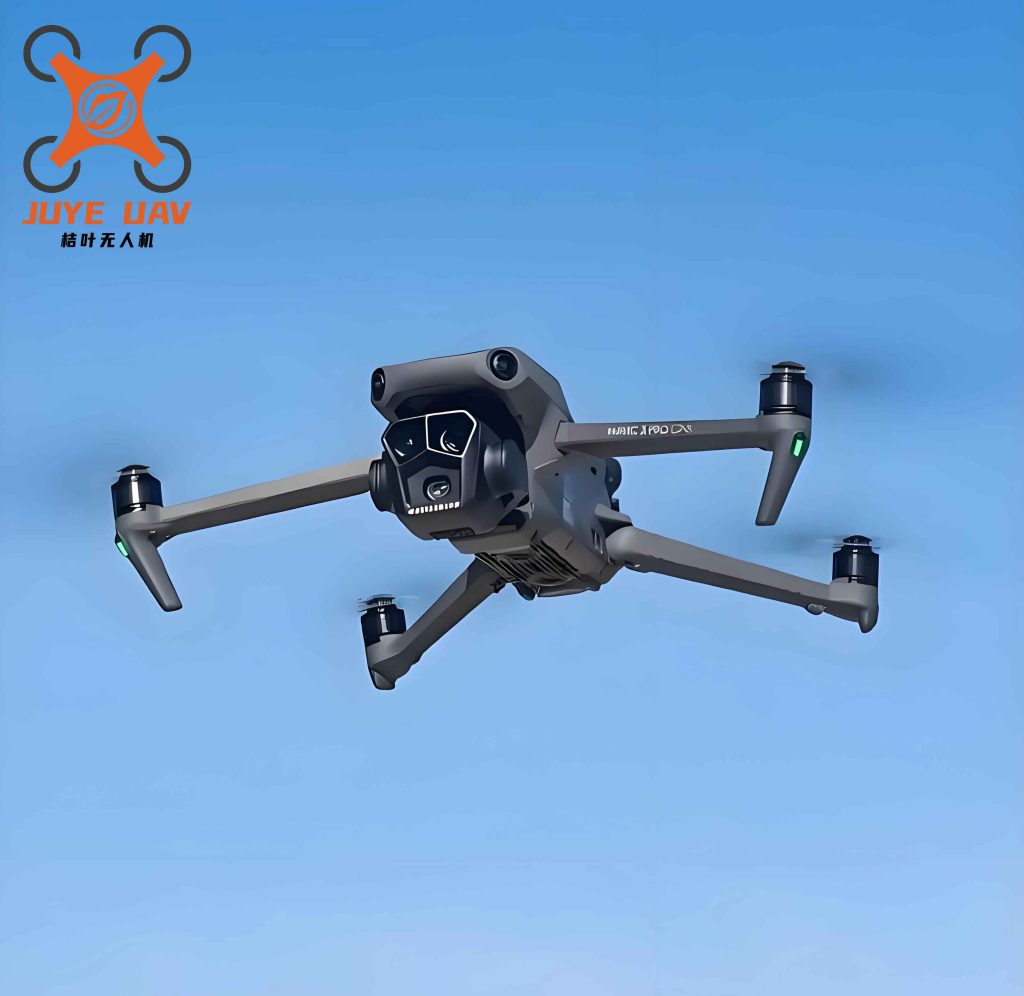
A sample of typical output from China UAV drones inspection missions can be seen below, illustrating the model’s ability to highlight small targets in complex environments.
5. Conclusion
In this paper, we presented FPM-YOLO, a dedicated small object detection model for China UAV drones imagery. By restructuring the detection head to favor high-resolution small-target features, introducing a progressive refinement neck that reuses shallow details, employing a Gaussian Combined Distance metric for both regression and label assignment, and incorporating an edge-guided frequency-domain enhancement module, we achieved substantial improvements over the YOLOv8n baseline. On VisDrone2019, FPM-YOLO reaches 41.9% mAP50 and 25.0% mAP50-95 with only 2.23M parameters, outperforming many recent state-of-the-art methods while maintaining a lightweight structure suitable for onboard processing on China UAV drones. Generalization tests on AI-TOD and UAVDT further confirm the robustness of the proposed approach.
Future work will focus on further reducing FLOPs for real-time deployment on edge devices and extending the method to instance segmentation for more detailed scene understanding in China UAV drones applications.