
In the context of the rapid proliferation of unmanned aerial vehicles (UAVs), the challenge of effective drone regulation has become a pressing concern for both civil authorities and security agencies. Drawing upon extensive analysis of operational requirements, technical capabilities, and the unique difficulties posed by urban environments, I present a comprehensive framework for advancing drone regulation equipment. This article is grounded in first-hand insights from research and practical engagement with counter-UAV systems, and it emphasizes the need for soft-kill approaches, enhanced detection technologies, electromagnetic countermeasures, and air-based situational awareness. The following sections systematically explore the demand spectrum, technology trends, urban challenges, and actionable development strategies for drone regulation equipment.
1. Demand Analysis for Drone Regulation Equipment
1.1 General Drone Regulation Equipment Requirements
The sheer volume of consumer and commercial UAVs, combined with their ease of acquisition and operation, creates a complex regulatory environment. Drone regulation in this context must address unauthorized flights, airspace intrusions, and potential safety hazards. The fundamental requirements for general drone regulation equipment include:
- Efficient Detection and Identification: To distinguish between legitimate and illegal flights, multi-sensor fusion integrating radar, electro-optical (EO), acoustic, and radio frequency (RF) detection is essential. The system must achieve high accuracy in cluttered electromagnetic environments.
- Real-time Tracking and Localization: Urban canyons and signal multipath effects demand a distributed networked monitoring architecture capable of persistent tracking. Advanced data processing algorithms must predict flight paths dynamically.
- Precision Countermeasure Capability: Once a threat is confirmed, the equipment must neutralize the UAV with minimal collateral damage. Common methods include RF jamming, GNSS spoofing, physical capture, and directed energy. The choice depends on the operational context.
- System Integration and Intelligence: Future drone regulation systems must incorporate artificial intelligence (AI) for autonomous threat assessment, adaptive countermeasure selection, and seamless integration with existing security infrastructure.
1.2 Counter-Terrorism Drone Regulation Equipment Requirements
When UAVs are weaponized by terrorist actors, the stakes escalate dramatically. Terrorist drones can carry explosives, chemical agents, or conduct surveillance on critical infrastructure. In such scenarios, drone regulation equipment must meet additional stringent demands:
- Ultra-Fast Detection and Classification: Surprise attacks require systems that can detect and classify small, low-flying drones within seconds, even in dense urban settings with heavy radio interference.
- Multi-layered Countermeasures: A graduated response is necessary. Soft-kill options (jamming, spoofing) should be prioritized in populated areas, while hard-kill options (laser, high-power microwave) can be reserved for remote or military zones. Physical capture nets with parachutes provide a middle ground.
- Low Collateral Damage: In cities, any countermeasure that causes debris or secondary explosions must be avoided. Hence, electronic warfare and kinetic capture become the preferred modalities for drone regulation under terrorist threats.
- Industrial Scalability: Rapid deployment and mass production of reliable systems are critical. International collaboration and standardized components accelerate the fielding of effective drone regulation solutions.
2. Technology and Equipment Development Assessment
Drone regulation equipment encompasses detection, tracking, and countermeasure subsystems. Table 1 summarizes the strengths and weaknesses of mainstream detection technologies.
| Technology | Description | Advantages | Disadvantages |
|---|---|---|---|
| Radar | Uses reflected electromagnetic waves to detect UAV size and range. | Mature technology; long detection distance. | High cost for precision; unable to detect drones obscured by buildings; emits radiation; high false alarm rate; fails to detect hovering UAVs. |
| Electro-Optical / Infrared (EO/IR) | High-resolution cameras or thermal imagers capture UAV imagery. | Mature; no radiation emission. | Detection range limited by lens; heavily affected by weather (fog, darkness). |
| Acoustic | Analyzes distinctive rotor noise signatures. | Passive; low cost. | Sensitive to ambient noise; short detection range. |
| Radio Frequency (RF) | Detects and analyzes UAV control and video signals. | Mature; passive; long detection range. | Cannot detect drones operating in radio silence mode. |
For countermeasures, Table 2 compares the prevalent techniques.
| Technique | Advantages | Disadvantages |
|---|---|---|
| RF Jamming | Mature; effective at disrupting command links. | High interference power may affect nearby communications; indiscriminate. |
| Communication Protocol Exploitation | Precise identification; minimal collateral interference. | Immature; legal and intellectual property issues; new drone models have enhanced security. |
| GNSS Spoofing | Controls UAV trajectory; low radiation. | Long duration required; can affect other GNSS receivers in area. |
| Physical Capture (Net, Raptor) | Direct capture; low secondary damage. | Requires skilled operator; limited effective range (<100 m); difficult at night. |
| Kinetic Kill (Laser, HPM) | Instant destruction. | High cost; collateral damage risk in urban areas; weather dependent. |
Additionally, mathematical modeling enables performance prediction. For instance, the detection probability for a given radar system can be expressed as:
$$ P_d = \frac{1}{2} \left[ 1 + \text{erf}\left( \frac{\text{SNR} – \text{SNR}_{\text{th}}}{\sqrt{2}\sigma} \right) \right] $$
where SNR is the signal-to-noise ratio, SNRth is the detection threshold, and σ is the noise variance. For countermeasure effectiveness, the probability of successful disruption via RF jamming can be modeled as:
$$ P_j = 1 – e^{-\alpha \cdot (P_{\text{jam}} / P_{\text{signal}})} $$
where α is a jamming efficiency constant, Pjam is the jamming power, and Psignal is the UAV’s communication signal power. These formulas guide equipment design and operational planning in drone regulation.
3. Urban Environment Challenges in Drone Regulation
Urban settings pose the most severe challenges for drone regulation. The complexity arises from three physical and operational factors:
- Dense Building Canopy: Tall structures create “urban canyons” that block both radar line-of-sight and optical fields. Drones can emerge suddenly from behind buildings, leaving extremely short reaction times (<10 seconds). Detection systems must be networked across multiple vantage points.
- Complex Electromagnetic Environment: Wi-Fi, cellular, industrial, and other radio signals cause interference and multipath reflections. Drone regulation systems must discriminate between legitimate drone signals and background noise. Advanced spectrum analysis and machine learning classifiers are essential.
- High Population Density and Low Collateral Damage Tolerance: Any countermeasure that drops debris or causes explosions is unacceptable. Soft-kill methods like spoofing and jamming are preferred, but they must be precisely directed to avoid affecting other users. Physical capture using aerial interceptors offers a promising path.
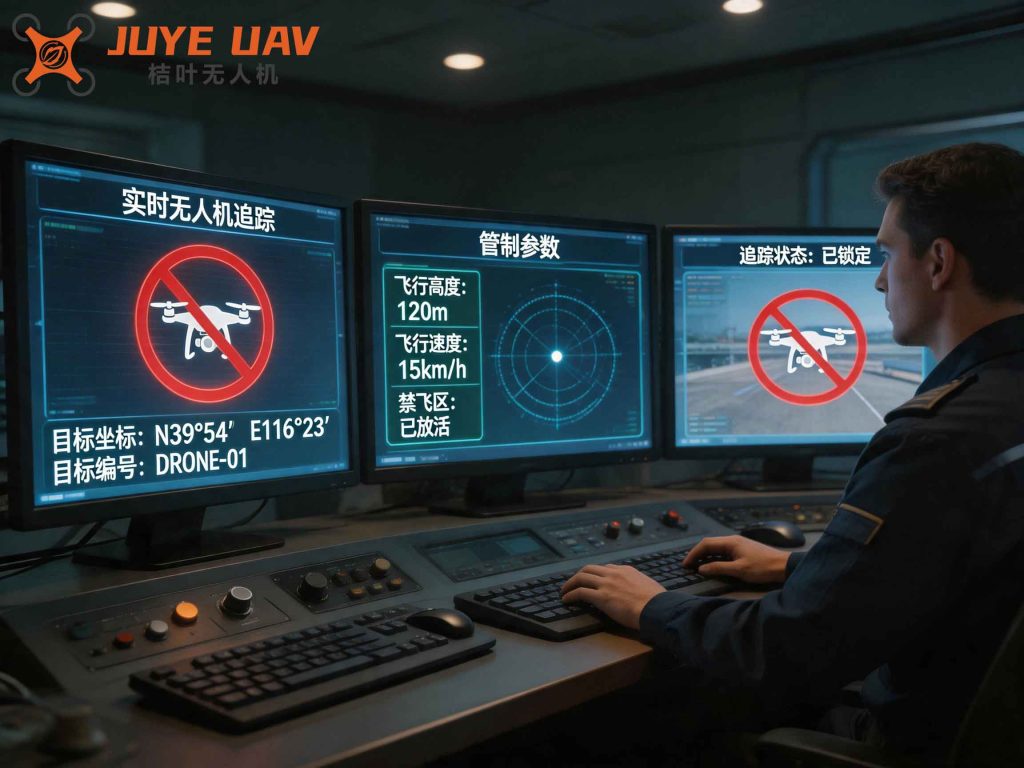
To address these challenges, drone regulation equipment must be lightweight, rapidly deployable, and highly reliable. Air-based platforms (e.g., tethered balloons or small UAVs acting as “hunter” interceptors) can provide elevated vantage points that mitigate building occlusions. However, such platforms introduce trade-offs in payload capacity and endurance. A multi-criteria decision analysis is often needed:
$$ \text{Objective} = \max_{x} \left[ w_1 \cdot \text{Detection\_range}(x) + w_2 \cdot \text{Response\_time}(x) – w_3 \cdot \text{Collateral\_risk}(x) \right] $$
where x represents a system design vector (sensor type, power, altitude), and wi are weighting factors determined by mission priorities.
4. Development Strategies and Recommendations for Drone Regulation Equipment
4.1 Strengthen Core Technology R&D and Promote Industrial Application
Investment in multi-sensor fusion, AI-based classification, and high-efficiency jamming technologies is paramount. I advocate for public-private partnerships to accelerate the transition from laboratory prototypes to field-deployable systems. For example, developing a modular detection module that combines MIMO radar, EO/IR, and RF direction-finding can significantly improve detection performance in urban canyons.
4.2 Standardization and Modularization
A major barrier to widespread adoption is the lack of interoperability. Standard interfaces—such as common data formats, power connectors, and control protocols—enable rapid integration of components from different vendors. Modular design also allows swapping detection or countermeasure “blocks” based on mission profile. This approach reduces lifecycle costs and simplifies upgrades for drone regulation networks.
4.3 Industry Chain Collaboration
Ecosystems that bring together sensor manufacturers, AI software firms, electronic warfare specialists, and system integrators are essential. I recommend forming consortia that jointly develop reference architectures and share testing facilities. Such collaboration can lower entry barriers for small enterprises and foster innovation in drone regulation equipment.
4.4 Intelligence and Automation Upgrade
Future systems must operate with minimal human intervention. Machine learning models trained on large datasets of UAV behaviors can autonomously distinguish between birds, kites, and malicious drones. Automated threat response, with pre-defined escalation protocols, reduces reaction time from minutes to seconds. A probabilistic threat assessment framework can be represented as:
$$ \text{Threat\_Level} = \sum_{i} \beta_i \cdot \text{Indicator}_i $$
where indicators include deviation from flight plan, altitude, speed, proximity to restricted zones, and detected payload signatures. The output triggers appropriate countermeasure modes.
4.5 Policy and Regulatory Framework
No technology can succeed without a supportive legal environment. Governments should mandate remote identification for all drones, establish geo-fencing standards, and create clear liability rules for drone regulation operations. Export controls on sensitive counter-UAV technologies must be balanced with the need for global collaboration against terrorism. Harmonizing international standards (e.g., through ICAO or ISO) will facilitate cross-border use of drone regulation equipment.
5. Conclusion
The evolution of drone regulation equipment must keep pace with the rapid advancement of UAV technology and the diversification of threats, including terrorist applications. Drawing from thorough demand analysis, technology benchmarking, and urban operational challenges, I have outlined a development roadmap that prioritizes soft-kill solutions, multi-sensor fusion, intelligent automation, and industrial collaboration. By embedding mathematical performance models and comparative tables, this work provides a quantitative basis for decision-making. The ultimate goal is to create resilient, scalable, and ethical drone regulation systems that safeguard public safety while enabling the beneficial use of drones. As the landscape continues to shift, continuous research and adaptive strategies will remain the cornerstone of effective drone regulation.