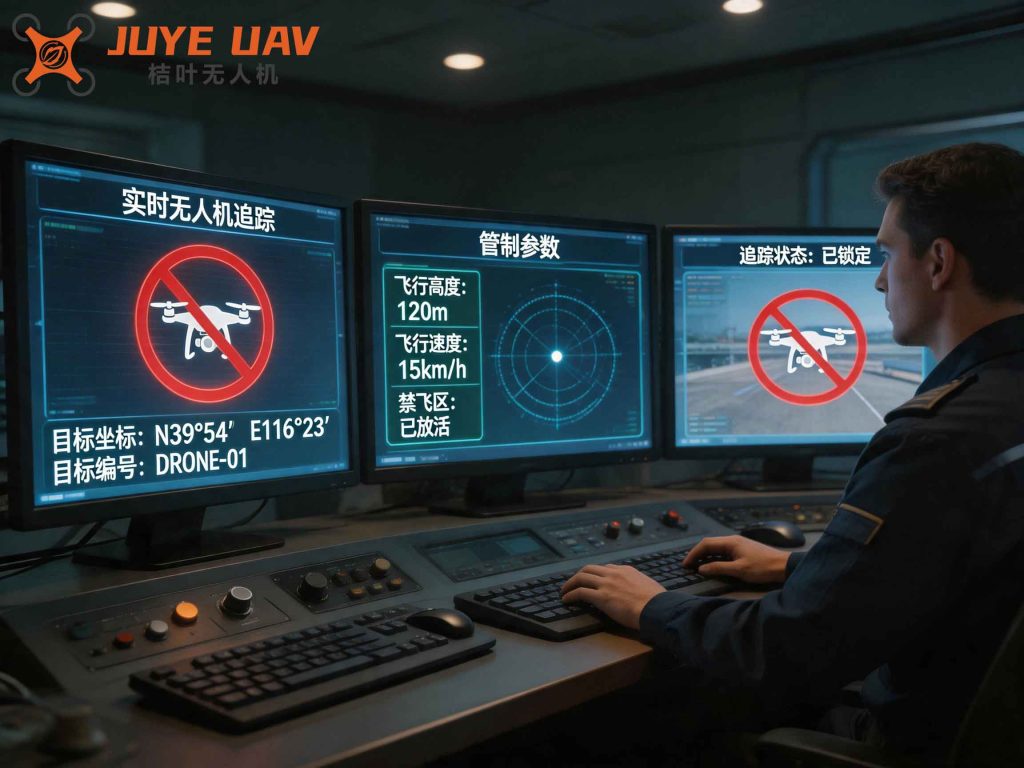
In recent years, the rapid evolution of drone technology and its applications has reshaped how we interact with low-altitude airspace. From early point-frequency radio-controlled models requiring pilot line-of-sight operation, to modern multi-sensor platforms equipped with accelerometers, barometers, gyroscopes, magnetometers, satellite positioning chips, mobile communication modules, and AI processors, drones now support autonomous waypoint navigation and even radio-silent flight. The emergence of 4G/5G-connected drones (networked UAVs) has further blurred the boundaries between traditional radio control and public mobile networks. While these advancements have given birth to the so-called low-altitude economy, they have also introduced serious threats to national security and public safety. Illegal drone operations, commonly referred to as black flights, are prevalent worldwide. Malicious actors including foreign intelligence agents and terrorists exploit drones for espionage, smuggling, and disruptive attacks. Non-standard frequency bands and proprietary communication protocols are often used in homemade drones, making detection and countermeasure increasingly challenging.
According to the Interim Regulations on the Flight Management of Unmanned Aircraft (Article 19), the state designates controlled airspace, including airspace above 120 meters AGL, prohibited zones, restricted zones, military low-altitude flight areas, and areas above eight categories of critical infrastructure. Scientific airspace allocation, effective drone regulation, and robust security measures for major events have become central concerns for stakeholders and security professionals alike. This article presents a first-person analysis of radio spectrum technologies applied to drone detection and countermeasure, examining their principles, current applications, challenges, and future directions within the framework of drone regulation.
1. Radio Spectrum Technologies for Drone Detection and Countermeasure
1.1 Fundamentals of Radio Spectrum Technology
Radio waves occupy frequencies between 3 Hz and approximately 300 GHz. Radio spectrum technology leverages these electromagnetic waves for communication, navigation, and sensing. In the drone domain, key applications include remote control, video transmission, and satellite navigation. For drone regulation, spectrum-based techniques are primarily used for detection (passive sensing) and countermeasure (active interference or spoofing).
1.2 Radio Spectrum Based Drone Detection Technologies
The following table summarizes major detection methods based on radio spectrum:
| Technology | Principle | Advantages | Limitations |
|---|---|---|---|
| Radio Spectrum Sensing (RSS) | High-sensitivity receivers capture drone telemetry and video signals; spectrum analysis extracts frequency, amplitude, phase, etc. | Passive, no emissions, real-time monitoring | Cannot detect radio-silent drones; limited by signal-to-noise ratio (SNR) |
| Software-Defined Radio (SDR) | Flexible hardware configuration via software; implements RF front-end, digital signal processing, and protocols in software. | Reconfigurable, adaptable, scalable | Requires advanced signal processing; computational complexity |
| Deep Learning for Spectrum Recognition | Train deep neural networks on drone-specific radio signatures to automate identification and classification. | High accuracy, adaptive to new drone models | Requires large training datasets; vulnerable to adversarial perturbations |
| Quantum Sensing for Spectrum | Quantum receivers exploit atomic and optical properties for ultra-sensitive signal detection. | Extreme sensitivity, small form factor | Early stage; high cost and complexity |
| Protocol Cracking | Demodulate and decode drone communication links; extract link-layer information without alerting the pilot. | Covert, can reveal both drone and controller positions | Requires reverse engineering of proprietary protocols |
| Integrated Sensing and Communication (ISAC) | Modify 5G/6G base station frames to include sensing signals; reflect weak echoes from drones for detection via time accumulation and multi-station cooperation. | Leverages existing mobile infrastructure; wide coverage | Limited by cell density; interference with normal communications |
Mathematically, the detection range of a passive spectrum sensor is governed by the radar range equation adapted for one-way link:
$$ P_r = P_t + G_t + G_r – L_p – L_s $$
where \(P_r\) is received power (dBm), \(P_t\) is transmitted power of the drone, \(G_t\) and \(G_r\) are antenna gains, \(L_p\) is path loss, and \(L_s\) is system losses. The path loss for free space is given by:
$$ L_p = 20 \log_{10}(d) + 20 \log_{10}(f) + 32.44 $$
where \(d\) is distance in km and \(f\) is frequency in MHz. For effective drone regulation, a coverage radius of several kilometers is typically required, but urban clutter and elevated noise floor can reduce this by a factor of 5–10.
1.3 Radio Spectrum Based Drone Countermeasure Technologies
| Technology | Principle | Effect on Drone | Regulatory Concerns |
|---|---|---|---|
| Communication Jamming | High-power directional or omnidirectional transmission on drone control and video frequencies (e.g., 2.4 GHz, 5.8 GHz). | Loss of link → return-to-home, land, or hover | May interfere with licensed services; requires type approval |
| Navigation Jamming & Spoofing | Transmit high-power noise on GNSS bands (GPS, GLONASS, BeiDou) or generate fake satellite signals to mislead drone’s position. | Jamming: loss of navigation; Spoofing: forced landing or diversion | Spoofing can cause unintended crashes; legal liability |
| High-Power Microwave (HPM) | Emit >100 MW peak power pulses at 300 MHz–300 GHz to burn out drone electronics. | Physical destruction of onboard circuits | Extremely powerful; collateral damage risk; not portable |
| Cognitive Radio Jamming | Deep learning identifies illegal drone signals; transmits tailored interference to specific frequency and modulation. | Selective, low collateral interference | High complexity; real-time adaptation needed |
| Dynamic Spectrum Management Jamming | Real-time spectrum monitoring allocates jamming resources to occupied but illegal frequencies. | Efficient use of spectrum | Requires fast sensing and decision algorithms |
| Protocol-Based Drone Takeover | After protocol cracking, transmit forged control commands (e.g., “return to me”) to hijack the drone. | Full control transferred to countermeasure operator | Need to know drone’s protocol; may fail with encrypted links |
2. Current Application Status of Drone Detection and Countermeasure Spectrum Technologies
2.1 Drone Detection Applications
Airport Scenarios
Airport clearance zones are the most sensitive areas for drone regulation. Passive detection technologies, primarily TDOA (Time Difference of Arrival) and AOA (Angle of Arrival), are widely deployed. These passive systems do not emit signals, avoiding interference with aviation navigation and communication bands (108–117.975 MHz, 328.6–335.4 MHz, 960–1215 MHz, etc.). Modern airport systems require multi-source fusion, automated operation, white/black lists, data traceability, and coordinated avoidance with air traffic control. Multi-station TDOA networks can achieve localization accuracy within tens of meters over several kilometers.
Power & Petrochemical Facilities
Critical infrastructure often opts for navigation spoofing for perimeter protection, but 24/7 spoofing can disrupt surrounding electromagnetic environment. A more practical approach combines passive spectrum detection (always-on) with short-duration spoofing or jamming only when a threat is confirmed. This reduces collateral interference and meets drone regulation requirements for minimal impact on legitimate radio services.
Major Event Security
High-density public events demand high reliability, stealth, and rapid deployment. Passive spectrum detection is preferred for its covert nature, often integrated with directional jammers or spoofers that activate only on target bearing. The challenge lies in handling multiple simultaneous drones (e.g., swarms) while maintaining low false alarm rates.
The following table compares detection performance metrics across these scenarios:
| Scenario | Typical Range (km) | Detection Rate (%) | False Alarm Rate (%) | Key Requirement |
|---|---|---|---|---|
| Airport | 3–10 | >95 | <5 | Zero interference with aviation bands |
| Power Plant | 1–3 | >90 | <10 | 24/7 passive monitoring |
| Major Event | 0.5–2 | >98 | <3 | Rapid deployment, covertness |
2.2 Drone Countermeasure Applications
Electromagnetic jamming remains the most deployed countermeasure, with two modes: disrupt (force landing) and drive away. Modern systems must cover 300 MHz–6 GHz to handle diverse drone models. In airport environments, jamming must avoid critical aviation frequency bands, often using notch filters or precise directional antennas.
Navigation spoofing is popular because it uses micro-power signals (milliwatts) compared to jamming (watts to kilowatts). However, spoofing can destabilize drone flight, leading to uncontrolled crashes. The risk is higher than jamming-induced failsafe behaviors (land or return).
Key Formula for Jamming Power Budget:
$$ JNR = P_j + G_j – P_s – G_s – L_{js} $$
where \(JNR\) is jamming-to-noise ratio, \(P_j\) is jammer power, \(G_j\) jammer antenna gain, \(P_s\) drone signal power, \(G_s\) drone antenna gain, and \(L_{js}\) jamming path loss. For successful disruption, JNR > 10 dB is typically required.
3. Problems in Current Drone Regulation Spectrum Technologies
3.1 Detection Problems
- Radio-silent and networked drones: Drones that do not emit any radio signals (autonomous waypoint navigation) or use 4G/5G networks (signals embedded in public traffic) cannot be detected by passive spectrum sensors.
- Coverage uncertainty: SNR is heavily degraded by ambient noise (urban environment). Actual detection range can vary 5–10x from ideal conditions.
- Incomplete drone database: Most operators only test against mainstream consumer drones (e.g., DJI Mavic, Phantom). Non-standard DIY drones or legacy models may be missed, leading to gaps in drone regulation.
- Multipath errors: AOA and TDOA accuracy suffer in urban canyons and metal-rich industrial environments, degrading localization precision needed for guided countermeasures.
3.2 Countermeasure Problems
- Legal and compliance issues: Many jammers lack type approval under new regulations (effective January 2024). Existing unapproved equipment faces decommissioning or legal challenges.
- Analog vs. digital signal sources: Low-cost analog jammers suffer from frequency drift; digital software-defined jammers are more stable but expensive.
- Frequency conflicts: Some DIY drones use unlicensed bands that overlap with licensed services (e.g., 902–928 MHz overlaps with cellular). Jamming such bands is illegal.
- Omnidirectional emission: Most off-the-shelf jammers radiate in all directions, causing unnecessary interference to legitimate users. Directional antennas reduce collateral impact but require accurate tracking.
- Spoofing safety: Navigation spoofing alters drone’s position estimate, which can cause loss of control and crash. Liability for property damage or injury is a serious concern.
4. Recommendations for Improving Drone Regulation via Spectrum Technologies
-
Fusion of multiple sensing modalities: Combine passive spectrum detection with radar (active RF), acoustic sensors, optical cameras, and AI-based video analytics. A hybrid approach can detect radio-silent drones and overcome single-sensor weaknesses. For effective drone regulation, fusion algorithms should output a unified threat track.
-
Precision countermeasure innovation: As drones adopt 4G/5G transmission, jamming such frequencies is nearly impossible without disrupting public networks. Future systems should explore cognitive jamming that uses signal intelligence to inject nulls into the drone’s spread-spectrum waveform, or protocol-level takeover that works over cellular links.
-
Strengthen industry regulation and standardization: Type approval, emission masks, and API interfaces for countermeasure devices must be standardized. A national database of approved equipment and frequency usage should be maintained to support drone regulation authorities.
-
Independent performance evaluation: Organize third-party tests using a diverse set of target drones including non-brand, non-standard, and DIY models. Develop scientific test protocols and scoring metrics. The result should be publicly available to guide procurement.
-
Research on precise radio countermeasure: Fund systematic studies on legal frameworks, technical optimization, unintended interference assessment, and standard-setting. Form interdisciplinary teams including legal experts, RF engineers, and drone pilots.
5. Conclusion
Radio spectrum technologies play a pivotal role in modern drone regulation, providing both detection and countermeasure capabilities. Passive spectrum sensing, protocol analysis, and cognitive communication offer promising avenues for covert, low-collateral detection. Jamming, spoofing, and HPM provide effective but legally and technically challenging countermeasures. The rapid proliferation of diverse drone types—including radio-silent and cellular-connected drones—demands a multi-fusion regulatory approach. Future progress hinges on standardization, independent evaluation, and targeted research to balance security needs with spectrum management and public safety. Only through continuous innovation and responsible deployment can we ensure that drone regulation keeps pace with the evolving low-altitude threat landscape.