
As a researcher deeply involved in railway safety and unmanned aerial vehicle (UAV) management, I have witnessed the rapid proliferation of drone technology across agricultural, logistics, surveying, and security sectors. While drones bring unprecedented efficiency and new solutions, they also introduce significant safety risks to railway operations. The increasing number of incidents involving drones encroaching on railway lines, colliding with infrastructure, or disrupting train services has become a pressing concern. In this article, I analyze the current state of railway-side drone regulation, identify critical gaps in legal frameworks, technical controls, and management practices, and propose actionable countermeasures. The term drone regulation will be emphasized throughout, as it underpins every aspect of ensuring railway safety in an era of expanding low-altitude airspace activities.
Overview of Drone Regulation and Railway Safety Context
Drones, or unmanned aerial vehicles, are typically classified into micro, light, small, medium, and large categories based on performance indicators like weight, speed, and payload capacity. The global drone industry has experienced explosive growth, with applications ranging from precision agriculture to infrastructure inspection. However, this growth has outpaced the development of robust drone regulation frameworks, especially concerning railway corridors. In the railway context, drones can be used legitimately for track inspection, overhead line monitoring, and emergency response, but they can also be involved in illegal activities or accidents. According to statistics, between 2018 and 2023, more than 50 safety incidents involving drones affecting railway operations were reported in China alone, with 30 occurring on high-speed railways. These incidents include drone collisions with catenary wires, crashes onto tracks, and interference with train control systems. The underlying causes are often operator error, battery depletion, or loss of control due to electromagnetic interference.
The regulatory landscape has evolved in recent years. For example, the Interim Regulations on the Flight Management of Unmanned Aerial Vehicles (Order No. 761 of the State Council) issued in 2023 provides a legal basis for classifying drones, defining no-fly zones, and establishing pilot licensing requirements. However, specific provisions for drone regulation near railway lines remain ambiguous. The Railway Safety Management Regulations (Order No. 639) prohibits flying kites or balloons within 500 meters on both sides of railway power lines, but it is unclear whether this prohibition extends to drones. Many local regulations have contradictory clauses, some completely banning drone flights near railways while others allow them under certain conditions. This patchwork of rules creates confusion for law enforcement and reduces the effectiveness of drone regulation in protecting railway assets.
| Year | Regulation / Policy | Relevance to Railway Drone Regulation |
|---|---|---|
| 2016 | Civil Aviation Administration: Air Traffic Management Measures for Civil Unmanned Aircraft Systems | Established basic air traffic rules, but no specific railway provisions. |
| 2018 | MIIT: Conditions for UAV Manufacturing Enterprises (Draft) | Required built-in geo-fencing and unique IDs, yet railway no-fly zones not mandated. |
| 2020 | Ministry of Transport: Measures for High-Speed Railway Safety Protection | Stated that drone flights near high-speed railways must comply with national regulations, essentially referencing external laws. |
| 2023 | State Council & Central Military Commission: Interim Regulations on UAV Flight Management | Designated airspace above key infrastructure (including electrified railways) as controlled airspace, but range definitions remain incomplete. |
| 2023 | Ministry of Transport: Rules on the Operation Safety Management of Civil UAVs | Detailed requirements for pilot licensing, registration, and airworthiness, but railway-specific coordination mechanisms are absent. |
From my perspective, the fundamental problem is that existing drone regulation does not adequately address the unique risks posed by railway corridors. Railways are linear infrastructure spanning hundreds or thousands of kilometers, crossing diverse terrains and jurisdictions. Unlike airports, which have well-defined protected zones, railway lines lack a uniform, scientifically determined buffer zone for drone operations. Moreover, the interaction between low-altitude drone traffic and high-speed trains introduces complex variables such as relative speeds, impact energy, and electromagnetic compatibility.
Current Challenges in Railway-Side Drone Safety Control
2.1 Conceptual Gaps in Proactive and Collaborative Management
Most current efforts focus on reactive measures—investigating incidents after they occur and punishing violators. A preventive philosophy, which is central to modern drone regulation, has not yet permeated railway operations. For instance, agricultural drones, which are increasingly used near railways for pest control and fertilization, pose a severe risk due to their large size (up to 66.5 kg takeoff mass) and heavy payloads. In 2021, a 66.5 kg agricultural drone crashed into a high-speed railway catenary, causing a power trip. Yet, there is no systematic preventive drone regulation that requires geofencing or failsafe mechanisms for such drones operating near tracks. Furthermore, a collaborative governance model involving railway authorities, civil aviation, agriculture, public security, and local governments is still nascent. Each sector operates under its own rules, with little integration of safety requirements for railway protection.
2.2 Inadequate Legal and Regulatory Frameworks
The legal hierarchy is fragmented. The Railway Law does not mention drones at all. The Railway Safety Management Regulations only cover kites and balloons, leaving drones in a legal gray area. Although the 2023 Interim Regulations empower local governments to designate controlled airspace, the actual delimitation of no-fly zones along railway lines is rarely published or enforced. Among 32 local regulations I reviewed, the definitions of restricted zones varied from 200 meters to 1000 meters from the railway boundary. Some allow drone flights if prior approval is obtained from railway transport enterprises, while others impose an absolute ban. This inconsistency undermines the credibility of drone regulation and makes it difficult for operators to comply.
| Province/City | Restricted Zone (from railway power line) | Exceptions Permitted |
|---|---|---|
| Hebei | 500 m (both sides) | No explicit exceptions; reference to national laws. |
| Shanghai | Not explicitly defined; requires approval for any flight near railway | Allowed for security, emergency, surveying, or construction with approval and notification. |
| Guangdong | 1000 m (for high-speed railways) | Allowed if operator obtains clearance from railway police and civil aviation. |
| Beijing | 800 m (within administrative boundary) | Prohibited except for state missions with rigorous approval. |
2.3 Immature Technical Countermeasures
Currently, most railway lines lack active detection and identification systems for unauthorized drones. Electronic fences, which are mandatory for many consumer drones near airports, are not implemented for railways. Manufacturers rarely include railway no-fly zones in their default geospatial databases. Counter-drone technologies such as jamming or spoofing are viewed with caution because they might interfere with train communication systems (e.g., GSM-R). This hesitation stifles innovation in drone regulation technology tailored for railways. Moreover, there is no integrated data-sharing platform where real-time flight information of drones near railways is exchanged among air traffic management, public security, and railway operators. Without such a platform, early warning and coordinated response are impossible.
2.4 Inefficient Management and Coordination
Drone reporting procedures are chaotic. For legitimate operations near railways, operators often do not know which authority to contact—railway police, local civil aviation, or the railway transport enterprise. Even when reports are made, the information is not always shared effectively. The designation of controlled airspace above critical infrastructure—as required by the 2023 Interim Regulations—has not been translated into concrete maps or geofencing databases. Furthermore, emergency response mechanisms for drone incidents are underdeveloped. The law states that local governments should integrate drone safety into emergency management systems, but in practice, railway-specific drills and protocols are rare.
Proposed Countermeasures for Enhanced Railway-Side Drone Regulation
3.1 Shift Toward a Proactive and Collaborative Safety Culture
First, I advocate for embedding a “prevention first” mindset into drone regulation for railways. This requires risk assessment methodologies that quantify the probability and consequence of drone-induced accidents. Let us define the risk R as:
$$
R = P \times C
$$
where P is the probability of a drone-related incident per unit time (e.g., per year) and C is the consequence severity (measured in financial loss, casualties, or service disruption). The probability P can be further decomposed into factors such as drone density near the line, operator error rate, and probability of technical failure. For example, if we denote λ as the average rate of drone flights per kilometer per hour within the buffer zone, and p_f as the failure probability per flight, then a simple model is:
$$
P = 1 – e^{-\lambda \cdot L \cdot T \cdot p_f}
$$
where L is the length of the railway segment and T is the time period. Such quantitative models can guide the prioritization of drone regulation measures, such as imposing stricter flight restrictions in high-density corridors.
Second, a multi-stakeholder collaborative governance mechanism must be formalized. The existing inter-ministerial joint conference on railway safety environment governance should include dedicated working groups for drone safety. Local governments, as mandated by the “double section chief” system, should incorporate drone monitoring into their regular patrols. This shared responsibility is a cornerstone of modern drone regulation.
3.2 Strengthen Legal and Regulatory Foundations
I recommend amending the Railway Safety Management Regulations to explicitly include drones in the list of prohibited low-altitude objects. The current vague language invites litigation and enforcement difficulties. A new clause should define a “railway drone safety zone” extending, say, 500 meters horizontally from the outer edge of the railway boundary (or 800 meters for high-speed lines) and vertically up to 120 meters above ground level. Within this zone, drone flights should be prohibited except under a permit issued jointly by railway authorities and civil aviation. The High-Speed Railway Safety Protection Measures should be updated accordingly to unify the standard nationwide. Furthermore, the Interim Regulations on UAV Flight Management should explicitly list railway corridors as areas requiring special authorization, and the controlled airspace maps must be published and integrated into drone flight planning apps.
| Provision Area | Proposed Requirement |
|---|---|
| Prohibited zone definition | 500 m horizontal from railway boundary; 0–120 m vertical; applies to all drones regardless of weight. |
| Permits and exceptions | Permit required for any flight; exceptions only for safety, emergency, official surveys, and infrastructure inspection by authorized entities. |
| Operator responsibility | Pilot must maintain visual line of sight; drone must have failsafe return-to-home and real-time telemetry; insurance mandatory. |
| Data sharing | Flight plans must be submitted to a central platform accessible to railway police and operators; real-time tracking required for permitted flights. |
| Penalties | Administrative fines up to ¥100,000 for violations; criminal liability for causing severe disruption or damage. |
3.3 Develop Robust Technical Safeguards
Technical innovation is critical. I propose three lines of defense:
1. On-board drone technology: Manufacturers must embed railway-specific geofencing data into all drones sold in the market. The required performance can be expressed as the probability of a drone violating the no-fly zone:
$$
P_{\text{violation}} = P(\text{position error} > \epsilon) + P(\text{flight controller malfunction})
$$
where ϵ is the maximum acceptable deviation (e.g., 10 m). Drones should be designed such that P_violation ≤ 10⁻⁶ per flight hour. This can be achieved through dual GNSS receivers, real-time kinematic positioning, and redundant control systems.
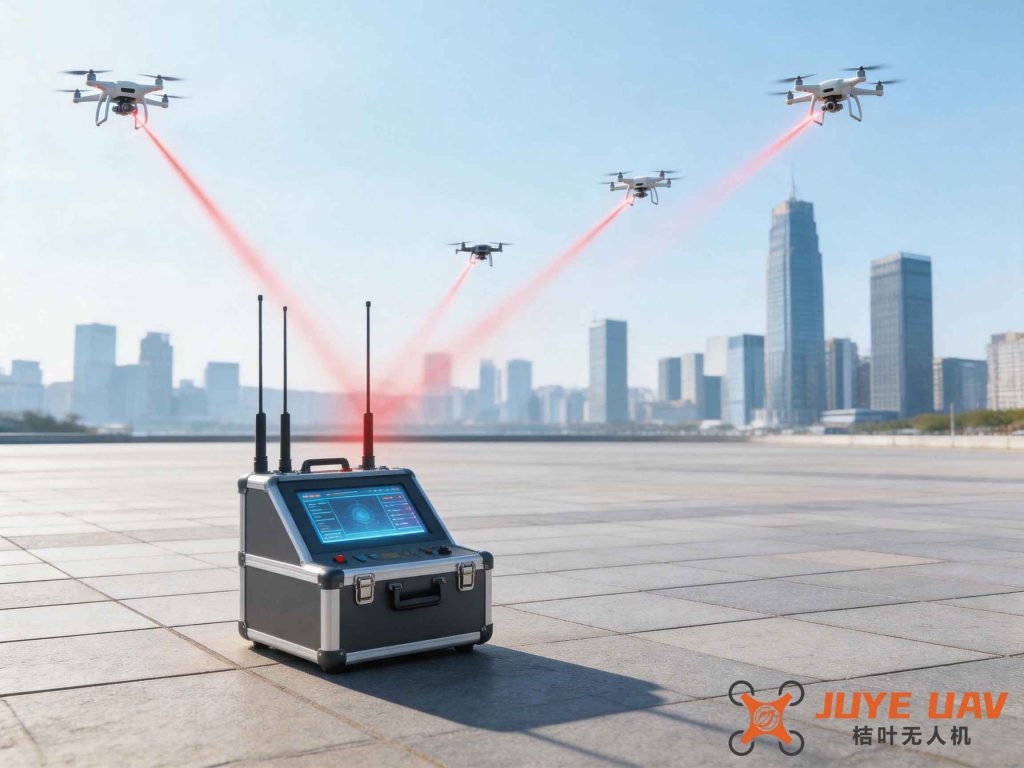
2. Ground-based detection and countermeasure systems: Railway operators should deploy passive radar, acoustic sensors, or radio frequency scanners along high-risk segments. For countermeasures, a selective jamming technique that operates only within the railway right-of-way and at frequencies far from railway communication bands (e.g., in the 2.4 GHz and 5.8 GHz bands used by most consumer drones) can be used. The interference power density S at a distance d from the jammer should satisfy:
$$
S(d) = \frac{P_t G_t}{4\pi d^2} \leq S_{\text{threshold}}
$$
where P_t is the jammer transmit power, G_t is the antenna gain, and S_threshold is the maximum allowable interference level at the train’s receiver (e.g., −100 dBm). Proper design ensures that drone regulation does not compromise train safety.
3. Integrated data platform: A unified drone management system should connect civil aviation’s UTM (Unmanned Traffic Management) with railway control centers. This platform would provide real-time alerts when a drone approaches the buffer zone. The communication latency τ must be below 100 ms to allow effective response. The probability of timely alert delivery can be modeled as:
$$
P_{\text{alert}} = \frac{1}{\tau_{\text{avg}}} e^{-\tau / \tau_{\text{avg}}}
$$
with τ_avg being the mean delay. This technical interoperability is a cornerstone of advanced drone regulation.
3.4 Improve Coordination and Human Factors
Management processes must be streamlined. I suggest establishing a single-window service for drone flight applications near railways, handled by local railway police stations but coordinated with civil aviation and agriculture departments. Standard operating procedures for permitted flights should include mandatory notification to the nearest railway station at least 24 hours in advance, with real-time tracking during the flight. Emergency response drills involving drone incidents should be conducted annually, with scenarios such as a drone strike on a catenary or a forced landing on tracks.
Human factors also play a vital role. Pilot training curricula should include a module on railway safety. For agricultural drone operators—the most frequent violators—local agricultural bureaus should partner with railway authorities to conduct safety briefings. Every drone sold should come with a printed warning about railway no-fly zones, and the drone regulation compliance should be part of the mandatory knowledge test for obtaining a drone pilot license.
| Target Group | Training Content | Frequency |
|---|---|---|
| Agricultural drone pilots | Railway hazard awareness; emergency shutdown procedures; geo-fencing usage; legal consequences of violations. | Annual, plus before first operation in new areas |
| Surveying/ inspection drone pilots | Permit application process; real-time tracking requirements; communication protocols with railway control; safe distance margins. | Initial certification and refresher every 2 years |
| Railway security staff | Drone detection equipment operation; countermeasure deployment; coordination with law enforcement; incident reporting. | Quarterly drills |
| General public and hobbyists | Basic rules of no-fly zones; penalties; safe flying practices; channels to report suspicious drones. | Public campaigns via social media and local events |
Conclusion
The intersection of drone technology and railway safety presents one of the most challenging aspects of modern drone regulation. My analysis reveals that current efforts are reactive, fragmented, and technically insufficient. To safeguard railway operations, a holistic approach is needed: one that combines robust legal definitions, proactive risk assessment, advanced counter-drone technologies, and seamless multi-agency collaboration. The proposed measures—ranging from unified buffer zones and mandatory geofencing to integrated alert platforms and enhanced pilot training—form a comprehensive strategy. Ultimately, effective drone regulation along railway corridors is not merely a matter of compliance; it is a prerequisite for sustaining public confidence in both the drone industry and the railway network. As drones continue to populate the skies, we must ensure that drone regulation evolves in tandem with technology, placing safety at the core of innovation.