
The landscape of emergency response is undergoing a profound transformation. As our cities grow denser and infrastructure becomes more complex, the frequency and severity of incidents—from towering high-rise fires to industrial accidents and natural disasters—present unprecedented challenges to fire and rescue services. The operational environment has become more hazardous, and the cost of delayed or inefficient response is measured in human lives. In this demanding context, a powerful technological ally has emerged: the Unmanned Aerial Vehicle (UAV), or drone. From my perspective as a practitioner in the field, the integration of this technology is not merely an upgrade; it is a paradigm shift in how we perceive, approach, and manage fire and rescue scenarios. This article delves into the comprehensive application of fire UAVs, exploring their technical foundations, operational advantages, and the transformative impact they have on our mission to save lives and protect property.
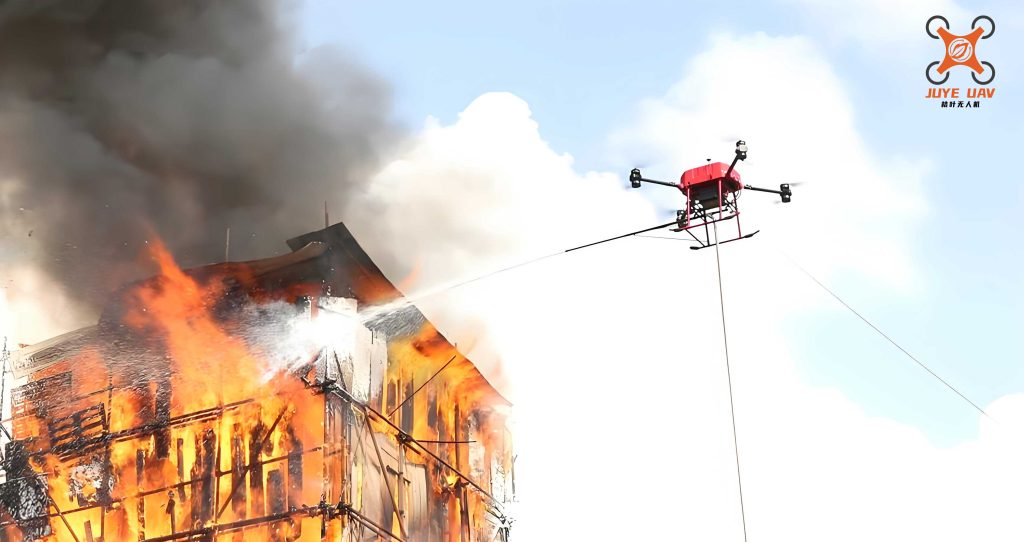
The core of a fire UAV system extends far beyond the aerial platform itself. It is a sophisticated integration of hardware and software designed for resilience and intelligence in extreme environments. A standard fire UAV system can be deconstructed into several critical subsystems, as summarized below:
| Subsystem | Primary Components | Function in Fire/Rescue Context |
|---|---|---|
| Flight Platform (Airframe) | Fuselage, motors/propellers, landing gear. | Provides the physical structure and lift. Designs are optimized for stability, payload capacity, and durability against heat/turbulence. |
| Propulsion & Power System | Electric motors with LiPo batteries; or gasoline engines. | Determines flight endurance, reliability, and operational safety. Electric systems offer simplicity and lower thermal risk, while fuel-based systems promise longer flight times. |
| Flight Control System (FCS) | Inertial Measurement Unit (IMU), GPS, barometer, onboard computer. | The “brain” of the fire UAV. It stabilizes flight, executes autonomous missions, and ensures precise navigation even in GNSS-denied environments (e.g., inside structures). |
| Sensor & Payload Suite | Visible-light camera, thermal imaging camera (TIC), gas detector, loudspeaker, payload release mechanism. | The “senses” of the operation. This is what transforms a UAV into a fire UAV, enabling scene assessment, victim detection, atmospheric monitoring, and light supply delivery. |
| Data Link & Communication | Radio transceivers, video transmitters, 4G/5G modules. | Creates the real-time command bridge. Transmits telemetry, live video, and sensor data to the Ground Control Station (GCS) and receives pilot commands. |
| Ground Control Station (GCS) | Remote controller, tablet/laptop with mission planning software, video monitors. | The operational hub. The pilot/operator controls the fire UAV, views feeds, plans flight paths, and analyzes data for decision support. |
The selection of a fire UAV platform is critical and is primarily dictated by the mission profile. The two most prevalent types in firefighting are multi-rotor and fixed-wing UAVs, each with distinct operational calculus.
For a multi-rotor fire UAV, its superior maneuverability and hover capability make it ideal for confined space operations, structural inspection, and precise payload delivery. Its maximum flight time $T_{multi}$ is largely a function of battery energy $E_{batt}$ (in Watt-hours), the average power draw $P_{avg}$ (in Watts), and a safety reserve factor $k_s$ (typically 0.2):
$$ T_{multi} = \frac{E_{batt} \cdot (1 – k_s)}{P_{avg}} $$
where $P_{avg}$ depends on the weight of the fire UAV, including its crucial payload (camera, gas sensor, etc.).
In contrast, a fixed-wing fire UAV excels in large-area reconnaissance, such as surveying wildfire perimeters or assessing flood damage. Its endurance $T_{fixed}$ is derived from aerodynamic efficiency, expressed through the lift-to-drag ratio $(L/D)$, and propulsion efficiency:
$$ T_{fixed} \propto \frac{(L/D) \cdot E_{batt}}{P_{req}} $$
where $P_{req}$ is the power required for level flight. This formulation highlights why fixed-wing platforms can cover vastly greater distances but lack the stationary observational capability of a multi-rotor fire UAV.
The true value of a fire UAV is unlocked through its unique technological advantages, which directly address the limitations of traditional ground-based operations. We can quantify some of these advantages through comparative metrics.
| Operational Challenge | Traditional Method Limitation | Fire UAV Advantage & Metric |
|---|---|---|
| Rapid Situational Awareness | Time for crews to don gear, approach, and deploy scouts is high; initial view is ground-level and obstructed. | Overhead Perspective in < 5 mins. The fire UAV provides an immediate, god’s-eye view of the incident, revealing fire spread, structural integrity, and access points. |
| Access to Hazardous Zones | Exposing personnel to collapse, flashover, toxic atmosphere, or radiation is a severe risk. | Risk Transfer. The fire UAV acts as a remote sensor, entering areas with a Risk Probability $R_p$ deemed unacceptable for human entry, where $R_p$ factors in toxicity, thermal load, and structural stability. |
| Victim Search in Complex Debris | Physical search is slow, labor-intensive, and can destabilize rubble. | Enhanced Detection Rate. Using a thermal imaging camera, the fire UAV can identify human heat signatures. The detection probability $P_d$ can be modeled as: $$ P_d = 1 – e^{-\lambda \cdot A_{scan} \cdot t} $$ where $\lambda$ is the victim signature intensity, $A_{scan}$ is the area scanned per unit time, and $t$ is search time, demonstrating exponential efficiency gains over manual search. |
| Real-time Communication & Coordination | Radio communication can be chaotic; command has a fragmented understanding of the evolving scene. | Common Operational Picture (COP). The live feed from the fire UAV creates a single, shared visual reference for all units and command, drastically improving the synchronization of tactical moves. |
The imperative for integrating fire UAV systems is driven by stark realities in modern emergency response. The proliferation of super-tall buildings, vast industrial complexes, and sprawling urban infrastructure has created scenarios where conventional fire apparatus is physically limited. For example, the maximum effective reach of the world’s most advanced aerial ladder trucks is around 60-80 meters. In a city with hundreds of buildings exceeding 100 meters, this capability gap is a constant strategic concern. The fire UAV provides the only viable means for rapid external assessment and potential intervention at these heights. Furthermore, the increasing frequency of complex, multi-hazard incidents—involving chemical, biological, radiological, or nuclear (CBRN) elements—creates environments that are immediately dangerous to life and health (IDLH). Deploying a fire UAV in such scenarios is a force multiplier that preserves the safety of the responder while still gathering critical intelligence.
In the crucible of an active incident, the applications of a fire UAV are multifaceted and decisive. The operational workflow can be conceptualized in stages:
1. Pre-engagement & Initial Reconnaissance: Upon dispatch and while en route, the fire UAV can be launched ahead of the first-due units. Its feed provides command with a “first look,” confirming the incident location, scale, and visible hazards. This allows for more accurate resource allocation and initial action plan formulation before firefighters even step off the truck.
2. Active Scene Management & Fire Attack Support: Once on scene, the fire UAV becomes an indispensable tool for the Incident Commander (IC).
- Thermal Mapping: The fire UAV equipped with a TIC can identify hot spots, trace fire spread within voids (like attics or wall spaces), and monitor the effectiveness of fire streams. The temperature data $T(x,y)$ captured across a grid over the structure can be used to generate a heat map, guiding offensive or defensive strategies.
$$ T_{map}(x,y) = \frac{1}{N} \sum_{i=1}^{N} T_i(x,y, t) $$
for $N$ sampling points over time $t$. - Search and Rescue (SAR): As mentioned, the thermal signature detection is paramount. The fire UAV can systematically scan collapsed structures, dense smoke-filled rooms, or wide-area disaster zones, tagging GPS coordinates of potential victims for rapid extraction teams.
- Hazardous Atmosphere Monitoring: With a modular gas sensor payload, the fire UAV can sample air quality at different altitudes and locations, measuring concentrations of $CO$, $H_2S$, $VOCs$, or radiation levels. This data is crucial for establishing safety zones and selecting appropriate personal protective equipment (PPE).
3. Post-incident Operations and Investigation: After the incident is stabilized, the fire UAV continues to provide value.
- Damage Assessment: High-resolution orthomosaic maps and 3D models of the scene are created from UAV-captured images. This provides precise documentation for loss assessment, recovery planning, and engineering analysis of structural failures.
- Forensic Documentation: The aerial perspective can reveal patterns of burn spread and points of origin that are not discernible from the ground, providing crucial evidence for fire investigation.
To fully realize the potential of fire UAV technology, a concerted effort must be made in three key areas: human capital, operational doctrine, and technological evolution.
1. Cultivating a Cadre of Expert Operators: A fire UAV is only as effective as its pilot and mission commander. We must move beyond basic flight training to develop true UAV Tactical Operators. This requires a structured curriculum encompassing:
– Advanced flight mechanics and emergency procedures.
– Airspace regulation and inter-agency coordination (with police, air traffic control).
– Sensor data interpretation (thermal analysis, gas concentration readings).
– Tactical integration into incident command system (ICS) protocols.
Regular, scenario-based training and rigorous certification are non-negotiable to ensure these operators perform reliably under extreme pressure.
2. Developing and Standardizing Tactical Employment Protocols: The fire UAV must be seamlessly woven into standard operating procedures (SOPs). This includes:
– Clear guidelines on when and who launches the fire UAV.
– Established communication protocols for relaying UAV-derived intelligence.
– Pre-defined flight patterns and data products for specific incident types (e.g., structural fire, HAZMAT, water rescue).
– After-action reviews focused on UAV utility to continuously refine tactics, techniques, and procedures (TTPs).
3. Advancing the Technology for the Fireground: The commercial drone market evolves rapidly, but the fire service has unique needs that drive specialized requirements for a next-generation fire UAV:
| Desired Capability | Technical Challenge | Potential Development Path |
|---|---|---|
| Extended Endurance in Hot Environments | Battery performance degrades with ambient heat; aerodynamic lift decreases in hot, thin air near fires. | Hybrid gasoline-electric propulsion; advanced battery thermal management systems; airframe designs optimized for thermal updrafts. |
| Enhanced Payload Capacity & Dexterity | Carrying heavier or multiple payloads (e.g., TIC + gas sensor + comms relay) reduces flight time and stability. | Lighter, more integrated sensor suites; strong, lightweight composite materials; cooperative UAV swarms where different platforms carry different payloads. |
| Autonomous Indoor Navigation & Mapping | GPS is unavailable; environments are dark, smoky, and dynamically changing due to fire. | SLAM (Simultaneous Localization and Mapping) algorithms using LiDAR and visual-inertial odometry; AI-trained models to recognize doors, windows, stairs, and fire spread patterns in real-time. |
| Resilient Communication in Degraded Environments | Dense steel structures and intense fire activity can block radio and video signals. | Mesh networking between multiple fire UAVs and ground nodes; use of lower-frequency bands that penetrate obstacles better; AI-powered signal prediction and routing. |
In conclusion, the integration of the fire UAV into modern fire and rescue services represents a fundamental leap forward in operational capability, safety, and efficiency. It is the embodiment of the strategic principle of gaining and maintaining information superiority on the emergency scene. From providing the first overhead glimpse of a developing crisis to guiding complex rescue operations and documenting the aftermath, the fire UAV has cemented its role as an indispensable tool. The path forward requires a committed partnership between firefighters who understand the operational art, engineers who can push the boundaries of the technology, and policymakers who will support the necessary investment and training. As we continue to refine the technology and its applications, the fire UAV will undoubtedly evolve from being a supportive asset to a central node in the networked, intelligent, and resilient emergency response systems of the future.