
We address the formation control problem for large-scale fixed-wing UAV swarms by proposing a hierarchical group-based control scheme. This scheme is designed to overcome the challenges posed by scalability, control constraints, and environmental wind disturbances inherent in fixed-wing UAV operations. Our approach divides the entire swarm into multiple disjoint groups, each with a leader-follower structure, thereby enabling distributed coordination and reducing communication complexity. We derive control laws for both leader and follower UAVs, ensuring stability and convergence under realistic constraints. Extensive numerical simulations with 100 fixed-wing UAVs validate the effectiveness of our method across a full mission scenario.
1. Introduction
Fixed-wing UAV swarms have significant potential in civilian and military applications such as disaster response, surveillance, target tracking, and environmental monitoring. Formation flight is a fundamental cooperative behavior, requiring UAVs to maintain desired relative positions while adhering to kinematic constraints like minimum/maximum airspeed and maximum yaw rate. Unlike quadrotors, fixed-wing UAVs exhibit nonholonomic dynamics and are more sensitive to wind, making formation control particularly challenging. Existing methods, such as leader-follower or virtual structure approaches, often struggle with scalability due to error accumulation in multi-layer hierarchies or high communication demands when many UAVs follow a single leader. To address these issues, we propose a distributed hierarchical group-based framework that limits the hierarchy to two layers (leader layer and follower layer) and organizes UAVs into independent groups. This structure mitigates error propagation and reduces bandwidth requirements, enabling efficient coordination of large-scale fixed-wing UAV swarms.
Our key contributions include: (1) A scalable distributed control architecture for large-scale fixed-wing UAV swarms; (2) Coordinated path following control for leaders that accounts for wind and speed/rate constraints; (3) A leader-following formation control law for followers that ensures convergence to desired relative positions; (4) Theoretical stability analysis and full-mission numerical simulations with 100 fixed-wing UAVs.
2. Problem Formulation and Hierarchical Group-Based Architecture
2.1. Control Architecture
We partition the swarm into m disjoint groups, each containing one leader and several followers. The leaders form a network with a strongly connected directed communication graph, enabling inter-group coordination. Followers only receive information from their respective leader, reducing communication overhead. The overall architecture is illustrated conceptually: leaders are responsible for path following and inter-group synchronization, while followers track their leader to maintain intra-group formation.
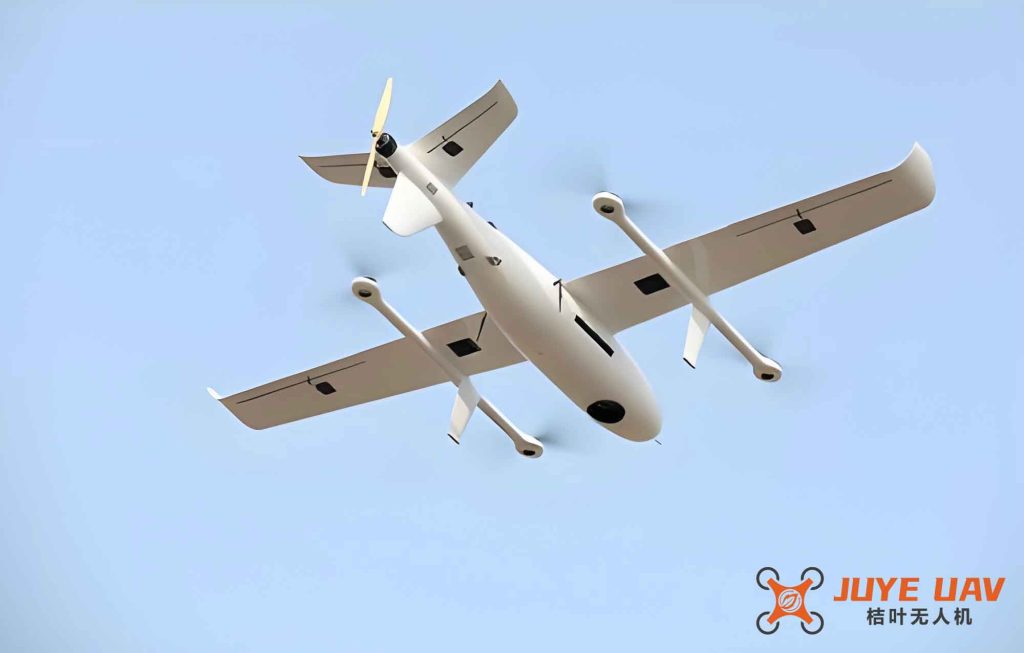
2.2. Fixed-Wing UAV Model and Constraints
Assuming constant-altitude flight, each fixed-wing UAV is modeled as:
$$ \begin{cases} \dot{x}_i = v_i \cos\theta_i + v_w \cos\theta_w, \\ \dot{y}_i = v_i \sin\theta_i + v_w \sin\theta_w, \\ \dot{\theta}_i = \omega_i, \end{cases} $$
where \((x_i,y_i)\) is the position in inertial frame, \(\theta_i\) is the heading angle, \(v_i\) is airspeed, \(\omega_i\) is yaw rate, \(v_w\) and \(\theta_w\) are wind speed and direction (assumed constant and bounded). Control constraints are:
$$ 0 < v_{\min} \le v_i \le v_{\max}, \quad |\omega_i| \le \omega_{\max}. $$
To leave margin for follower control, leaders are further restricted to:
$$ 0 < v_{l\min} \le v_i \le v_{l\max}, \quad |\omega_i| \le \omega_{l\max}, $$
with \(v_{l\max} = v_{\max} – \epsilon_v\), \(v_{l\min} = v_{\min} + \epsilon_v\), \(\omega_{l\max} = \omega_{\max} – \epsilon_\omega\).
2.3. Control Objectives
Leader problem: For m leaders with desired paths parameterized by \(\xi_i\) (e.g., path length), design control laws such that each UAV converges to its virtual target on the path, and the path parameters satisfy \(\xi_i – \xi_j \to \xi_{dij}\) (constant offset).
Follower problem: For each follower \(f\) in group \(l\), design control laws such that relative position \((x_f – x_l, y_f – y_l) \to (d_{xf}, d_{yf})\) and \(\theta_f – \theta_l \to 0\).
3. Leader Control Law: Coordinated Path Following
3.1. Single UAV Path Following
We define a Frenet-Serret frame attached to the virtual target point \(\tilde{p}_i\) on the path, with tangent angle \(\tilde{\theta}_i\). The cross-track error \(e_{di}\) and along-track error \(e_{si}\) are computed as:
$$ \begin{cases} e_{si} = (x_i – \tilde{x}_i)\cos\tilde{\theta}_i + (y_i – \tilde{y}_i)\sin\tilde{\theta}_i, \\ e_{di} = -(x_i – \tilde{x}_i)\sin\tilde{\theta}_i + (y_i – \tilde{y}_i)\cos\tilde{\theta}_i. \end{cases} $$
Let \(\bar{\theta}_i = \theta_i – \tilde{\theta}_i\). The error dynamics under wind are:
$$ \begin{cases} \dot{e}_{si} = v_i \cos\bar{\theta}_i – (1 – \kappa(\ell_i)e_{di})\dot{\ell}_i + v_w\cos(\theta_w – \tilde{\theta}_i), \\ \dot{e}_{di} = v_i \sin\bar{\theta}_i – \kappa(\ell_i)e_{si}\dot{\ell}_i + v_w\sin(\theta_w – \tilde{\theta}_i), \end{cases} $$
where \(\ell_i\) is path length to virtual target, \(\kappa(\ell_i)\) is curvature. To compensate for wind, we define a wind-induced angle \(\varpi_i = -\arcsin\left(\frac{v_w\sin(\theta_w – \tilde{\theta}_i)}{v_i}\right)\) and set the desired heading offset as \(\bar{\theta}_{di} = \varpi_i + \sigma_i\), with \(\sigma_i = -k_\pi \tanh(k_d e_{di})\) for lateral error regulation. Define \(\vartheta_i = \bar{\theta}_i – \bar{\theta}_{di}\). The control law is:
$$ \omega_i = -k_\omega \vartheta_i + \kappa(\ell_i)\dot{\ell}_i + \dot{\bar{\theta}}_{di} – \frac{k_\theta v_i e_{di}(\sin\bar{\theta}_i – \sin\bar{\theta}_{di})}{\vartheta_i}, $$
and we set \(\dot{\ell}_i = k_s e_{si} + v_i \cos\bar{\theta}_i + v_w\cos(\theta_w – \tilde{\theta}_i)\). Under suitable conditions, \(\phi_i = [e_{si}, e_{di}, \vartheta_i]^T \to 0\) asymptotically.
3.2. Coordination of Virtual Targets
To synchronize leaders’ virtual targets, we use a consensus-like law:
$$ \dot{\xi}_i = -\beta \tanh\left( \sum_{j \in \mathcal{N}_i} k_\xi (\xi_i – \xi_j – \xi_{dij}) \right) + \gamma_d, $$
where \(\mathcal{N}_i\) denotes neighbors in a strongly connected directed graph. Using Lyapunov analysis, we show that \(\xi_i – \xi_j \to \xi_{dij}\) for all \(i,j\).
3.3. Practical Implementation
To ensure control constraints are satisfied, we implement saturation functions for airspeed and yaw rate. The practical algorithm:
| Step | Action |
|---|---|
| 1 | Compute \(e_{si}, e_{di}, \bar{\theta}_i\) via (4). |
| 2 | Compute wind-related terms \(\Omega_i, \Lambda_i, \dot{\Omega}_i, \dot{\Lambda}_i\). |
| 3 | Compute \(\dot{\xi}_i\) using (15) and \(\dot{\ell}_i = (d\ell_i/d\xi_i)\,\dot{\xi}_i\). |
| 4 | Compute \(v_i\) from (21). |
| 5 | If \(v_i\) exceeds limits, saturate and recompute \(\dot{\ell}_i, \dot{\xi}_i\). |
| 6 | Compute \(\omega_i\) from (30). |
| 7 | Saturate \(\omega_i\) to \([-\omega_{l\max},\omega_{l\max}]\). |
| 8 | Update \(\xi_i\) and broadcast to neighbors. |
4. Follower Control Law: Leader-Following Formation
We define the follower’s tracking error in its body frame:
$$ \begin{bmatrix} \tilde{x}_f \\ \tilde{y}_f \\ \tilde{\theta}_f \end{bmatrix} = \begin{bmatrix} \cos\theta_f & \sin\theta_f & 0 \\ -\sin\theta_f & \cos\theta_f & 0 \\ 0 & 0 & 1 \end{bmatrix} \begin{bmatrix} x_l – x_f + d_{xf} \\ y_l – y_f + d_{yf} \\ \theta_l – \theta_f \end{bmatrix}. $$
The error dynamics are:
$$ \begin{cases} \dot{\tilde{x}}_f = \omega_f \tilde{y}_f – v_f + v_l \cos\tilde{\theta}_f, \\ \dot{\tilde{y}}_f = -\omega_f \tilde{x}_f + v_l \sin\tilde{\theta}_f, \\ \dot{\tilde{\theta}}_f = \omega_l – \omega_f. \end{cases} $$
We design the control law with saturation:
$$ \begin{cases} \omega_f = \text{Sat}\left( \omega_l + k_1\left( k_2\tilde{\theta}_f + \frac{\tilde{y}_f}{\sqrt{1+\tilde{x}_f^2+\tilde{y}_f^2}} \right),\, -\omega_{\max},\, \omega_{\max} \right), \\ v_f = \text{Sat}\left( v_l \cos\tilde{\theta}_f + k_3 \tilde{x}_f,\, v_{\min},\, v_{\max} \right). \end{cases} $$
With appropriate gains, \(\tilde{x}_f, \tilde{y}_f, \tilde{\theta}_f \to 0\) as \(t\to\infty\). Wind does not appear explicitly due to the transformation; it is implicitly handled via leader’s wind-compensated motion.
5. Simulation Results
5.1. Mission Scenario and Parameters
We simulate 100 fixed-wing UAVs divided into 10 groups (each with 1 leader and 9 followers). The mission consists of four phases: (1) formation in double-column, (2) transition to single-column through a valley, (3) spread to multiple line formations for area search, and (4) contraction to a dense grid for strike. All leaders share the same 3rd-order B-spline path with desired inter-leader distance 300 m (later reduced to 30 m). Simulation parameters are listed below.
| Parameter | Value |
|---|---|
| \(v_{\max}\) | 50 m/s |
| \(v_{\min}\) | 20 m/s |
| \(\omega_{\max}\) | 0.54 rad/s |
| \(v_w\) | 5 m/s |
| \(\theta_w\) | \(-3\pi/4\) rad |
| \(k_\pi\) | 0.2\(\pi\) |
| \(k_d\) | 0.01 |
| \(k_\omega\) | 2 |
| \(k_s\) | 0.25 |
| \(\gamma_d\) | 35 |
| \(\beta\) | 10 |
| \(k_\xi\) | 5 |
| \(k_\theta\) | 0.015 |
| \(k_1, k_2, k_3\) (followers) | 2, 0.5, 1.5 |
5.2. Leader Performance
Figure 6 (conceptual) shows the errors \(e_{si}, e_{di}, u_i\) for all 10 leaders over 500 s. All errors converge to zero, including after the desired inter-leader distance change at 326 s. This demonstrates successful coordinated path following under wind and constraints.
5.3. Follower Performance
We examine 9 followers in Group 1 during Phase 1. The tracking errors \(\tilde{x}_f, \tilde{y}_f, \tilde{\theta}_f\) converge to zero within 50 s, as shown in Figure 7 (conceptual). This confirms that the leader-following law works robustly even when the leader undergoes maneuvers.
5.4. Swarm Formation Evolution
Figures 8–11 (conceptual) illustrate the swarm at different phases: double-column, single-column, multiple line formations, and final strike grid. The UAVs maintain the desired geometries while respecting motion constraints. The control inputs (airspeed and yaw rate) for all UAVs remain within bounds throughout the mission, as shown in Figure 12 (conceptual).
6. Conclusion
We presented a distributed hierarchical group-based formation control method for large-scale fixed-wing UAV swarms. The approach effectively addresses scalability, control constraints, and wind disturbances. Leaders are coordinated via consensus-based path following, while followers track their leader with saturated control laws. Theoretical stability was analyzed, and a 100-UAV full-mission simulation validated the method. Future work will incorporate model uncertainties and collision avoidance using adaptive and distributed conflict resolution techniques.