
In this work, we present a comprehensive segmented guidance strategy for autonomous shipborne landing of fixed-wing UAVs. The proposed method addresses the inherent challenges of landing a fixed-wing unmanned aerial vehicle (fixed-wing UAV) on a rapidly moving carrier deck, including the need to maintain airspeed, the inability to brake in mid-air, and the stringent endpoint constraints imposed by the moving platform. By decomposing the landing process into transition guidance and approach guidance, we design distinct planning algorithms for each stage. The transition stage employs a finite state machine to bring the fixed-wing UAV from any initial state to a suitable position behind the moving deck. The approach stage leverages an action sampling-based planning method to generate dynamically feasible motion primitives in real time, allowing precise touchdown on the moving carrier. Both numerical and semi-physical simulations demonstrate that our strategy yields landing errors within 2 m for various initial conditions and carrier speeds.
1. Introduction
Fixed-wing UAVs offer significant advantages in endurance, speed, and payload, making them essential in modern naval operations. However, their reliance on runways for takeoff and landing limits their operational flexibility. Shipborne operations, including catapult launches and arrested landings, have been developed to overcome this limitation. For fixed-wing UAVs, autonomous landing on a moving carrier is particularly challenging due to the platform’s motion, the fixed-wing UAV’s non-holonomic constraints, and the need to maintain a minimum airspeed to generate lift. Traditional methods often rely on pre-planned glide paths and trajectory tracking, which lack the adaptability required for dynamic ship motion and variable initial conditions. In contrast, motion planning approaches that consider the fixed-wing UAV’s kinematics and dynamics in real time offer a more flexible solution. In this paper, we propose a two-stage guidance strategy that combines state-machine-based transition guidance with an action sampling approach for approach guidance, ensuring robust and precise landing of a fixed-wing UAV on a moving carrier deck.
2. Problem Formulation and Coordinate Transformations
We consider the problem of guiding a fixed-wing UAV from an arbitrary initial state (position, altitude, heading, and speed) to a precise touchdown on a moving carrier deck. The carrier is assumed to move forward along a fixed heading without lateral or turning maneuvers, which is reasonable for large naval vessels.
2.1 Fixed-wing UAV Kinematic Model
The fixed-wing UAV is modeled using the Dubins airplane formulation, which captures the essential dynamics for motion planning. The state vector is defined as \((x, y, h, \psi)^T\), where \(x, y\) are horizontal positions, \(h\) is altitude, and \(\psi\) is heading angle. The control inputs are speed \(V\) and heading rate \(\omega\). The kinematic equations are:
\[
\begin{aligned}
\dot{x} &= V \cos\psi \cos\gamma_{\text{cmd}} \\
\dot{y} &= V \sin\psi \cos\gamma_{\text{cmd}} \\
\dot{h} &= -V \sin\gamma_{\text{cmd}} \\
\dot{\psi} &= \omega
\end{aligned}
\]
where \(\gamma_{\text{cmd}}\) is the commanded flight path angle. The speed is bounded by \(V_{\min} \leq V \leq V_{\max}\), and the heading rate by \(\omega_{\min} \leq \omega \leq \omega_{\max}\). The turning radius \(R\) is derived from the fixed-wing UAV’s maximum bank angle and speed. For coordinated turns, the relationship between heading rate, speed, and bank angle \(\phi\) is given by:
\[
\dot{\psi} = \frac{g}{V} \tan\phi, \quad \phi_{\text{cmd}} = \arctan\left(\frac{V\omega_{\text{cmd}}}{g}\right)
\]
2.2 Coordinate Transformation to Carrier Frame
To simplify guidance, we transform the fixed-wing UAV’s inertial state into a carrier-centered frame. Let the carrier’s inertial position be \(\mathbf{p}_c\) and its attitude (heading) be \(\psi_c\). The transformation involves a rotation around the vertical axis by \(-\psi_c\) followed by a translation. In the carrier frame, the desired touchdown point is at the origin, and the fixed-wing UAV should approach along the negative \(x_c\)-axis with a heading aligned to the positive \(x_c\)-axis. The transformed state is:
\[
\mathbf{p}_c = \mathbf{R}(-\psi_c)(\mathbf{p}_{\text{UAV}} – \mathbf{p}_c)
\]
where \(\mathbf{R}\) is the rotation matrix. The fixed-wing UAV’s speed and heading rate in the inertial frame are used directly, as the carrier frame only affects positional and orientation targets.
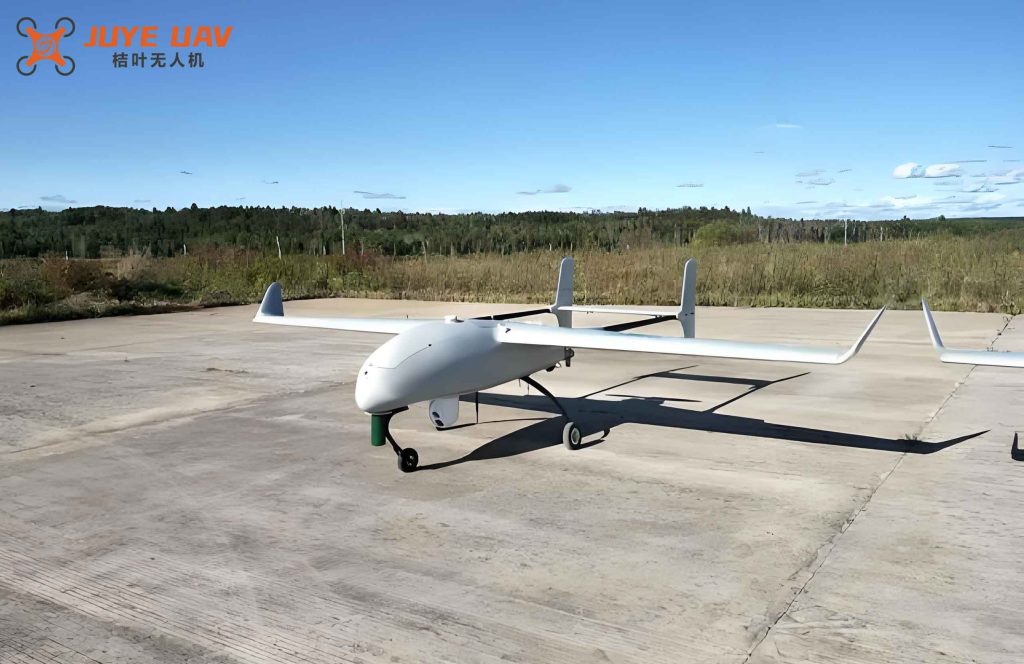
3. Segmented Guidance Strategy
We divide the landing process into two main stages: transition guidance and approach guidance. The transition stage brings the fixed-wing UAV to a region behind the carrier deck with adequate altitude and heading offset, while the approach stage performs fine-grained trajectory adjustment for touchdown.
3.1 Transition Guidance via Finite State Machine
The transition guidance uses a finite state machine (FSM) with the following states: Hover, Descend, Fly to Rear of Deck, Turn, and Go-around. Each state defines a set of commanded values for speed \(V_{\text{cmd}}\), heading rate \(\omega_{\text{cmd}}\), and flight path angle \(\gamma_{\text{cmd}}\). The transition conditions are based on the fixed-wing UAV’s altitude relative to the deck, distance to the rear of the deck, and heading alignment.
| State | Commanded Parameters | Entry Condition | Exit Condition |
|---|---|---|---|
| Hover | \(\gamma_{\text{cmd}}=0, V_{\text{cmd}}=V_{\text{loiter}}, \omega_{\text{cmd}}=0\) | Received landing command, altitude above threshold | Altitude below threshold |
| Descend | \(\gamma_{\text{cmd}}=\gamma_i, V_{\text{cmd}}=V_{\text{approach}}, \omega_{\text{cmd}}=0\) | Altitude above ideal approach altitude | Altitude within safe approach window |
| Fly to Rear | \(\gamma_{\text{cmd}}=0, V_{\text{cmd}}=V_{\text{loiter}}, \psi_{\text{cmd}}=-\pi\) (in carrier frame) | Distance to deck rear too large | Distance within threshold |
| Turn | \(\omega_{\text{cmd}}=\text{sgn}(\Delta\psi)\cdot\omega_{\max}\) | Heading error \(|\Delta\psi| > \pi/2\) | Heading error \(|\Delta\psi| \leq \pi/2\) |
| Go-around | \(\gamma_{\text{cmd}}>0, V_{\text{cmd}}=V_{\max}, \omega_{\text{cmd}}=0\) | Approach predicted to fail | Altitude regained above threshold |
The FSM ensures that the fixed-wing UAV converges to a state where the approach algorithm can operate effectively: typically a position about 1000 m behind the deck, altitude of 50–100 m, and heading roughly aligned with the carrier’s course.
3.2 Approach Guidance via Action Sampling
The approach guidance is the core contribution. In every planning cycle (e.g., every 0.05 s), we generate a dynamic window \(V_r\) consisting of feasible speed and heading rate pairs \((V, \omega)\) that satisfy kinematic limits, acceleration bounds, and a heading constraint preventing circling. The window is the intersection of three sets:
\[
\begin{aligned}
V_s &= \{(V,\omega) : V_{\min}\leq V\leq V_{\max}, \omega_{\min}\leq\omega\leq\omega_{\max}\} \\
V_d &= \{(V,\omega) : V_k + a_{\min}\Delta t \leq V \leq V_k + a_{\max}\Delta t, \\
&\qquad \omega_k + \alpha_{\min}\Delta t \leq \omega \leq \omega_k + \alpha_{\max}\Delta t\} \\
V_a &= \{(V,\omega) : |\Delta\psi| \leq \pi/2, \omega_{\Delta\psi,\min}\leq\omega\leq\omega_{\Delta\psi,\max}\}
\end{aligned}
\]
where \(\Delta\psi\) is the heading error relative to the carrier’s \(x_c\)-axis, and \(\omega_{\Delta\psi,\min}, \omega_{\Delta\psi,\max}\) ensure that the fixed-wing UAV turns toward the runway. From the sampled \((V,\omega)\) pairs, we generate motion primitives by forward integration of the kinematic model over a prediction horizon \(\Delta T\) (e.g., 2 s) with a discrete time step \(\Delta t\).
3.2.1 Motion Primitive Generation
Each primitive is a sequence of states obtained by:
\[
\begin{bmatrix}
x_{k+1}\\ y_{k+1}\\ h_{k+1}\\ \psi_{k+1}
\end{bmatrix}
=
\begin{bmatrix}
x_k + V\cos\psi_k\cos\gamma_{\text{cmd}}\Delta t\\
y_k + V\sin\psi_k\cos\gamma_{\text{cmd}}\Delta t\\
h_k – V\sin\gamma_{\text{cmd}}\Delta t\\
\psi_k + \omega\Delta t
\end{bmatrix}
\]
The flight path angle \(\gamma_{\text{cmd}}\) is updated at each planning cycle based on the fixed-wing UAV’s remaining distance and altitude, as described in the next section.
3.2.2 Cost Function for Primitive Selection
After generating all primitives, we evaluate each using a cost function that balances lateral deviation, heading error, speed error, and time-to-touchdown heuristic:
\[
J = \lambda_y J_y + \lambda_\psi J_\psi + \lambda_V J_V + \lambda_t J_t
\]
where
- \(J_y = |y|\) — lateral distance to the runway centerline (carrier frame).
- \(J_\psi = |\psi|\) — heading error relative to the carrier.
- \(J_V = |V – V_{\text{target}}|\) — deviation from a desired approach speed.
- \(J_t = |t_H – t_i|\) — difference between the heuristic time \(t_H\) and ideal descent time \(t_i\).
The heuristic time \(t_H\) is computed using a Dubins path length \(d_H\) projected onto the horizontal plane:
\[
t_H = \frac{d_H}{V\cos\gamma_{\text{cmd}} – V_c}
\]
where \(V_c\) is the carrier speed. The ideal descent time is:
\[
t_i = -\frac{h}{V\sin\gamma_i}
\]
where \(\gamma_i\) is the optimal glide slope (e.g., \(-0.07\) rad). The Dubins path length \(d_H\) is computed analytically based on the fixed-wing UAV’s current position and heading relative to the carrier origin and heading. Three cases are considered depending on whether the fixed-wing UAV is left or right of the runway and its orientation. The weights \(\lambda_y, \lambda_\psi, \lambda_V, \lambda_t\) are tuned to prioritize heading alignment and lateral accuracy in the final phase.
3.2.3 Adaptive Flight Path Angle
To compensate for varying altitude and distance, the commanded flight path angle \(\gamma_{\text{cmd}}\) is dynamically computed. If the fixed-wing UAV has sufficient remaining gliding distance (\(V\cos\gamma_i t_i < d_H + V_c t_i\)), we set:
\[
\gamma_{\text{cmd}} = \arctan\left(\frac{h}{d_H + t_H V_c}\right)
\]
Otherwise, if the fixed-wing UAV is too high relative to the distance, we command a steeper descent: \(\gamma_{\text{cmd}} = \gamma_i\) (maximum descent rate). To avoid oscillations when \(t_H \approx t_i\), we introduce hysteresis thresholds \(t_{r1}\) and \(t_{r2}\). When \(-t_{r2} < t_H – t_i < 0\), we disable the time heuristic (\(J_t=0\)) and rely on speed control to adjust the touchdown point.
4. Numerical Simulation Results
We performed extensive numerical simulations in MATLAB to validate the approach guidance algorithm. The fixed-wing UAV parameters are based on a Cessna-class aircraft: \(V_{\min}=27\) m/s, \(V_{\max}=40\) m/s, minimum turning radius \(R=160\) m, and optimal glide slope \(\gamma_i=-0.07\) rad. The carrier moves at various speeds from 3 m/s to 18 m/s, with a constant heading. We tested the following scenarios:
- Different lateral offsets (−100 m to 100 m) from the runway centerline.
- Different initial headings (−π/2 to π/2).
- Different initial altitudes (50 m to 100 m).
- Different carrier speeds (3 to 18 m/s).
- Compensation for deck heave motion (amplitude 1.52 m, frequency 0.6 rad/s) in the last 12 s.
In all cases, the fixed-wing UAV successfully touched down on the carrier within 2 m of the ideal touchdown point. The following table summarizes the touchdown errors for varying lateral offsets:
| Initial Lateral Offset (m) | UAV Touchdown Position (x, y, h) (m) | Carrier x (m) | Longitudinal Error (m) |
|---|---|---|---|
| −100 | (187.78, 0.09, 0.10) | 189.25 | −1.47 |
| −60 | (185.93, 0.09, 0.11) | 187.50 | −1.57 |
| −20 | (188.48, −0.09, 0.11) | 190.00 | −1.52 |
| 20 | (188.48, 0.09, 0.11) | 190.00 | −1.52 |
| 60 | (185.93, −0.09, 0.11) | 187.50 | −1.57 |
| 100 | (187.78, −0.09, 0.10) | 189.25 | −1.47 |
Considering the remaining altitude (~0.1 m) and the glide slope, the effective longitudinal error is reduced to less than 1 m. Similarly, for different initial headings, the maximum error was within 0.5 m. The algorithm also handled varying carrier speeds effectively, as shown in the table below:
| Carrier Speed (m/s) | UAV Touchdown (x, y, h) (m) | Carrier x (m) | Longitudinal Error (m) |
|---|---|---|---|
| 3 | (136.19, −0.05, 0.15) | 138.15 | −1.96 |
| 6 | (271.14, −0.08, 0.16) | 273.00 | −1.86 |
| 9 | (421.24, −0.09, 0.17) | 423.00 | −1.76 |
| 12 | (628.85, −0.09, 0.17) | 630.60 | −1.75 |
| 15 | (943.91, −0.09, 0.18) | 945.75 | −1.84 |
When deck heave was compensated by predicting the vertical offset at touchdown and adjusting the target altitude, the algorithm maintained lateral errors below 0.1 m and longitudinal errors about 1.5 m, well within the typical 12.2 m requirement for carrier landing.
5. Semi-Physical Simulation Results
To further validate the guidance strategy under realistic delays and communication constraints, we conducted semi-physical simulations using FlightGear as the flight dynamics engine, a Pixhawk-based autopilot (running PX4), and a ROS-based planning computer. The setup included UDP-to-serial conversion and ground control station software. The simulation scenario started with the fixed-wing UAV at 1000 ft altitude above the carrier. The carrier’s initial heading was set to 200° and its speed to 20 knots (~10.28 m/s). The entire landing process took about 204 s from receiving the landing command to touchdown.
- Transition guidance: The fixed-wing UAV first descended from 1000 ft to about 100 m altitude, then flew to the rear of the carrier deck, executed a turn to align its heading within π/2 rad of the carrier, and finally entered the approach phase.
- Approach guidance: The action sampling algorithm commanded dynamic changes in speed, heading rate, and flight path angle. At touchdown, the fixed-wing UAV’s position relative to the carrier in the carrier frame was (−0.224, −1.985, 0.086) m, with a heading error of 0.0053 rad (~0.3°). The lateral error of 1.985 m is within the 2 m requirement, and the longitudinal error was negligible after accounting for the remaining altitude.
These results confirm that the segmented guidance strategy is robust to real-world factors such as sensor noise, communication latency, and actuator dynamics. The fixed-wing UAV can autonomously land on a moving carrier under various conditions.
6. Conclusion
We have developed and validated a segmented action guidance strategy for autonomous shipborne landing of fixed-wing UAVs. By decoupling the problem into transition guidance (using a finite state machine) and approach guidance (using action sampling with dynamic windows and cost-based evaluation), the proposed method handles arbitrary initial states and carrier speeds. The transformation to a carrier frame simplifies guidance objectives. Extensive numerical and semi-physical simulations demonstrate that the fixed-wing UAV consistently touches down within a 2 m error, meeting typical carrier landing requirements. The approach is also applicable to net recovery and cable recovery operations on moving platforms, offering a flexible solution for fixed-wing UAV shipboard operations.