
In the field of unmanned systems, heterogeneous cross-domain collaboration is increasingly recognized as an effective solution to address current bottlenecks. By integrating functional redundancies and complementary capabilities across different platforms, this approach enables efficient unified deployment of diverse elements and fosters new operation modes. Our research focuses on a multi-domain fusion operation combining small fixed-wing drones and unmanned surface vessels, specifically targeting the challenging recovery process under complex environmental conditions such as sea-surface wind variations and vessel motion disturbances.
Traditional rope-hook recovery systems, due to their high structural stiffness, generate significant instantaneous impact forces when the drone engages the arresting cable, leading to unstable landing attitudes and failure to reach the desired touchdown point. To overcome these limitations, we introduce an admittance control strategy for flexible-joint robotic arms, aiming to improve the smoothness of drone recovery and prevent structural damage from excessive lateral forces. Additionally, we combine a short-time Fourier transform–fast Fourier transform (STFT-FFT) prediction algorithm with active disturbance rejection control to optimize the roll-compensation process, achieving more stable and smoother responses. Validation via simulation platforms confirms the effectiveness of the proposed admittance control strategy and compensation optimization algorithm for the rope-hook recovery system of fixed-wing drones.
The recovery system consists of a flexible-joint robotic manipulator, damping ropes, and a landing protection pad. Fixed-wing drones approach the vessel from right to left; after passing the stern, they are guided to land on the pad. The attitude compensation mechanism includes a prediction module, a controller module, an execution module, and a human–machine interaction module. The flexible-joint manipulator, composed of two links and a compliant joint, employs admittance control to follow external forces, enhancing the recovery process’s smoothness and stability. The damping rope is guided through pulleys and connected to a winch, providing excellent elasticity and damping characteristics. During drone approach, a differential GPS and a shipboard IMU acquire relative pose information in real time. The prediction algorithm estimates the target position based on real-time relative attitude data, and the active disturbance rejection control algorithm adjusts the recovery mechanism to compensate for rope-attitude variations. Human–machine interaction allows real-time monitoring of the onboard industrial computer, ensuring system adaptability to drone attitude changes and sea-wave disturbances, thereby maintaining a stable arresting attitude that enables the tail hook of the fixed-wing drones to capture the cable and decelerate smoothly onto the pad.
Admittance control adjusts the robot trajectory based on measured external forces. The control law is:
$$ F_{e x} = M_d (\ddot{x}_r – \ddot{x}) + N_d (\dot{x}_r – \dot{x}) + K_d (x_r – x) $$
where \(F_{e x}\) is the actual interaction force, \(x_r, \dot{x}_r, \ddot{x}_r\) are reference position, velocity, acceleration; \(x, \dot{x}, \ddot{x}\) are actual states; \(M_d, N_d, K_d\) are mass, damping, and stiffness parameters. The control structure comprises an outer admittance loop generating a position correction \(\Delta x\) and an inner position controller ensuring tracking.
To cope with uncertain environments and dynamic performance demands, an adaptive variable-damping admittance control is designed. The damping coefficient is dynamically adjusted as:
$$ n(t) = n_0(t) – \Delta n(t) / (\eta + \dot{e}(t)), \quad \Delta n(t) = n_p \Delta f(t) + n_d \Delta \dot{f}(t) $$
The resulting adaptive admittance model is:
$$ \Delta f(t) = m \ddot{e}(t) + n_0 \dot{e}(t) + k e(t) – n_p \Delta f(t) – n_d \Delta \dot{f}(t) $$
Stability analysis using the Hurwitz criterion yields the conditions:
$$ n_d > -\frac{n_0}{k_e}, \quad n_p > -\frac{k}{k_e} – 1 $$
The roll compensation control strategy uses a fused STFT-FFT method. The vessel’s heave motion is modeled as a sum of N harmonic components:
$$ w(t) = \sum_{i=1}^{N} [A_i \sin(2\pi f_i t + \varphi_i)] + \sigma(t), \quad t_0 \leq t \leq T $$
The STFT segments the signal, and FFT extracts spectral parameters. An extended Kalman filter updates the harmonic states and predicts the disturbance \(\Delta e\) including wave-induced height \(\Delta H_s\) and aerodynamic interference \(\Delta H_f\). The coordinate transformation from ship-fixed frame C to inertial frame D is:
$$ \begin{pmatrix} X^{D}_{M_0} \\ Y^{D}_{M_0} \\ Z^{D}_{M_0} \end{pmatrix} = \begin{pmatrix} c\alpha c\beta & c\alpha c\beta s\theta – s\alpha c\theta & c\alpha c\beta s\theta + s\alpha c\theta \\ s\alpha c\beta & c\alpha c\beta s\theta + s\alpha c\theta & c\alpha c\beta s\theta – s\alpha c\theta \\ -s\beta & c\beta s\theta & c\beta s\theta \end{pmatrix} \begin{pmatrix} X^{C}_{M_0} \\ Y^{C}_{M_0} \\ Z^{C}_{M_0} \end{pmatrix} $$
To achieve consistent cable-end height for both left and right manipulators, we require:
$$ Z^{D}_{M_R} = Z^{D}_{M_L} = Z^{D}_{M_0} + \Delta H_f $$
leading to the displacement constraints:
$$ (s\beta c\theta + s\theta)\frac{B}{2} – (s\beta c\theta – s\theta)L + c\beta c\theta H_R = \Delta e + Z^{D}_{M_0} $$
$$ -(s\beta c\theta + s\theta)\frac{B}{2} – (s\beta c\theta – s\theta)L + c\beta c\theta H_L = \Delta e + Z^{D}_{M_0} $$
where \(B\) is the base distance between arms, \(L\) is longitudinal offset from ship center, and \(H_R, H_L\) are the vertical positions of the left and right arm endpoints.
We employ an active disturbance rejection controller (ADRC) for the compensation mechanism. The ADRC consists of a tracking differentiator (TD), an extended state observer (ESO), and a nonlinear feedback compensator. The discrete forms are:
Tracking differentiator:
$$ h_{c1}(T+1) = h_{c1}(T) + h h_{c2}(T), \quad h_{c2}(T+1) = h_{c2}(T) + h \cdot \text{fhan}(h_{c1}(T)-h_c, h_{c2}(T), r_0, h_0) $$
Extended state observer:
$$ e(T) = z_{h1}(T) – h_{c1}(T) $$
$$ z_{h1}(T+1) = z_{h1}(T) + h [z_{h2}(T) – \rho_1 e(T)] $$
$$ z_{h2}(T+1) = z_{h2}(T) + h \{ z_{h3}(T) – \rho_2 \text{fal}[e(T), \eta_1, \delta] + b_k u_h(T) \} $$
$$ z_{h3}(T+1) = z_{h3}(T) – h \rho_3 \text{fal}[e(T), \eta_2, \delta] $$
Nonlinear feedback:
$$ e_{h1} = h_{c1}(T) – z_{h1}, \quad e_{h2} = h_{c2}(T) – z_{h2} $$
$$ u_0(T) = \rho_{01} \text{fal}(e_{h1}, \eta_{01}, \delta_0) + \rho_{02} \text{fal}(e_{h2}, \eta_{02}, \delta_0) $$
$$ u(T) = u_0(T) – z_{h3}(T)/b_k $$
We constructed a simulation platform using Adams software to model the recovery process. The Pierson–Moskowitz spectrum models wave energy:
$$ S(w) = \frac{0.78}{w^5} \exp\left( -\frac{3.13}{w^4 \xi_s} \right) $$
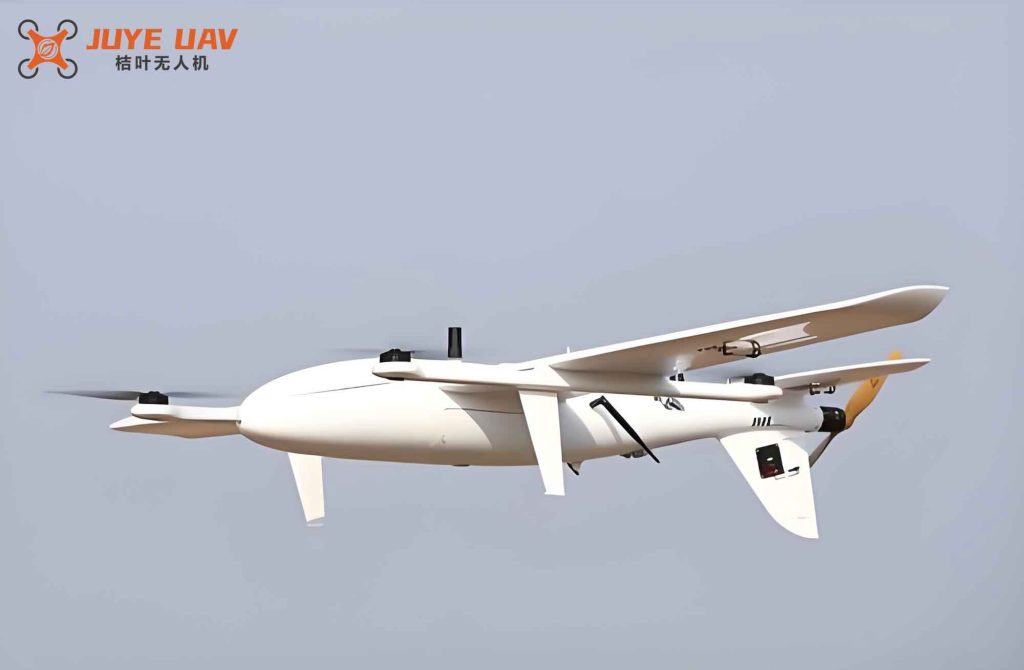
The simulation results show that during roll compensation, the forces at the left arm endpoint are nearly zero except along the cable axis, indicating stable compensation motion. When the robotic arm experiences forces due to drone hooking, the admittance controller causes the arm to comply along the contact direction. The maximum lateral forces remain below 40 N in the Y-direction and below 20 N in the X-direction, which is within the safe range for the flexible joint, thus reducing impact on the drone and ensuring structural integrity. A sea trial with a 10 kg small fixed-wing drone was performed; the system successfully recovered the drone in a single attempt, with the drone landing smoothly on the pad.
Key parameters used in the simulation are summarized in the tables below.
| Parameter | Symbol | Value | Unit |
|---|---|---|---|
| Mass coefficient | \(M_d\) | 5 | kg |
| Damping coefficient (base) | \(N_0\) | 20 | N·s/m |
| Stiffness coefficient | \(K_d\) | 100 | N/m |
| Force error proportional gain | \(n_p\) | 0.1 | – |
| Force error derivative gain | \(n_d\) | 0.02 | s |
| Environment stiffness | \(k_e\) | 500 | N/m |
| Small constant for denominator | \(\eta\) | 1×10⁻⁷ | – |
| Parameter | Symbol | Value | Unit |
|---|---|---|---|
| Fast factor (TD) | \(r_0\) | 100 | – |
| Filter factor (TD) | \(h_0\) | 0.01 | s |
| Observer gains | \(\rho_1, \rho_2, \rho_3\) | 100, 300, 1000 | – |
| Nonlinear factors (ESO) | \(\eta_1, \eta_2\) | 0.5, 0.25 | – |
| Filter factor (fal function) | \(\delta\) | 0.01 | – |
| Control gain | \(b_k\) | 1 | – |
| Nonlinear gains (feedback) | \(\rho_{01}, \rho_{02}\) | 10, 5 | – |
| Nonlinear factors (feedback) | \(\eta_{01}, \eta_{02}\) | 0.6, 1.2 | – |
| Filter factor (feedback fal) | \(\delta_0\) | 0.01 | – |
| Direction | Max force (N) |
|---|---|
| X-axis | 18.4 |
| Y-axis | 37.2 |
| Z-axis (vertical) | 12.1 |
The experimental results demonstrate that the admittance control significantly reduces torque spikes at the flexible joints, enhancing structural reliability. The combination of STFT-FFT prediction and ADRC compensation yields smoother and more accurate height tracking during roll compensation, allowing the small fixed-wing drones to land on the pad with a stable attitude. A single successful sea trial proved the effectiveness of the proposed system. This work not only validates the proposed control methods for improving the autonomous recovery stability and success rate of fixed-wing drones, but also contributes to the advancement of heterogeneous cross-domain collaboration.
In summary, we have designed an optimized rope-hook recovery system for small fixed-wing drones that integrates admittance control for compliant manipulation, adaptive damping for robustness, STFT-FFT-based wave prediction, and ADRC for attitude compensation. The system achieves safe, gentle recovery in maritime environments, effectively addressing the challenges posed by high-stiffness conventional mechanisms. Future work will focus on refining the adaptive admittance parameters online and extending the approach to larger fixed-wing drones with different dynamic characteristics.