
In this work, we address the formation control problem of large-scale fixed-wing drone swarms. Fixed-wing drones are characterized by nonholonomic constraints, bounded airspeed and yaw rate, and are often operated in outdoor environments where wind disturbances are present. To achieve scalable and robust formation flight, we propose a distributed hierarchical group-based control architecture. The entire swarm is partitioned into disjoint groups, each containing a leader and multiple followers. Leaders form a strongly connected communication network and perform coordinated path following on their desired paths, while followers in each group track their respective leader to maintain a prescribed relative geometry. We design control laws that respect the physical constraints of fixed-wing drones and account for constant wind fields. The stability of the closed-loop system is analyzed using Lyapunov theory and LaSalle’s invariance principle. A full-mission numerical simulation with 100 fixed-wing drones validates the effectiveness of the proposed approach.
1. Introduction
Large-scale swarms of fixed-wing drones have attracted significant interest due to their potential in surveillance, search-and-rescue, and environmental monitoring. Unlike quadrotors, fixed-wing drones exhibit nonholonomic dynamics and strict actuator limits (minimum/maximum airspeed and maximum yaw rate). Formation control of such systems remains challenging, especially when the swarm size grows. Traditional leader–follower methods suffer from error accumulation and communication bottlenecks when extended to large numbers. To overcome these issues, we adopt a group-based hierarchical framework: the swarm is divided into several independent groups, each with a leader that coordinates with other leaders, and followers that locally track their leader. This structure reduces communication overhead and avoids deep nesting of command chains.
2. Problem Formulation
Consider a swarm of \(N\) fixed-wing drones operating at a constant altitude. The kinematic model of each drone \(i\) in the presence of a constant wind field is given by
$$
\begin{aligned}
\dot{x}_i &= v_i \cos\theta_i + v_w \cos\theta_w,\\
\dot{y}_i &= v_i \sin\theta_i + v_w \sin\theta_w,\\
\dot{\theta}_i &= \omega_i,
\end{aligned}
$$
where \((x_i,y_i)\) is the position in the inertial frame, \(\theta_i\) is the heading angle, \(v_i\) is the airspeed, \(\omega_i\) is the yaw rate, \(v_w\) and \(\theta_w\) are wind speed and direction. The control inputs are bounded:
$$
0 < v_{\min} \le v_i \le v_{\max},\quad |\omega_i| \le \omega_{\max}.
$$
The swarm is divided into \(m\) disjoint groups. Each group has a leader (indexed as \(L_j, j=1,\dots,m\)) and a set of followers. The leaders communicate over a strongly connected directed graph. The goal is to drive the entire swarm into a desired formation while satisfying actuator constraints and compensating for wind.
2.1 Leader Control Problem
Each leader \(i\) follows a virtual target moving on a parametric path \(\Gamma_i: \{\tilde{p}_i(\xi_i): \xi_i\in\mathbb{R}\}\). Let \(\xi_i\) be the path parameter. The coordination objective is to achieve \(\xi_i – \xi_j \to \xi_{ij}^d\) for all leader pairs, where \(\xi_{ij}^d\) are constant offsets. Simultaneously, the leader must converge to its virtual target (path following).
2.2 Follower Control Problem
For a follower \(f\) in group \(l\), we require
$$
x_f – x_l \to d_x^f,\quad y_f – y_l \to d_y^f,\quad \theta_f – \theta_l \to 0,
$$
where \((d_x^f, d_y^f)\) is the desired relative position in the leader’s body frame.
3. Hierarchical Group-Based Control Architecture
The proposed architecture is illustrated in the following figure. The entire swarm is divided into multiple groups. Within each group, the leader is responsible for inter-group coordination and path following, while followers only need to track the leader.
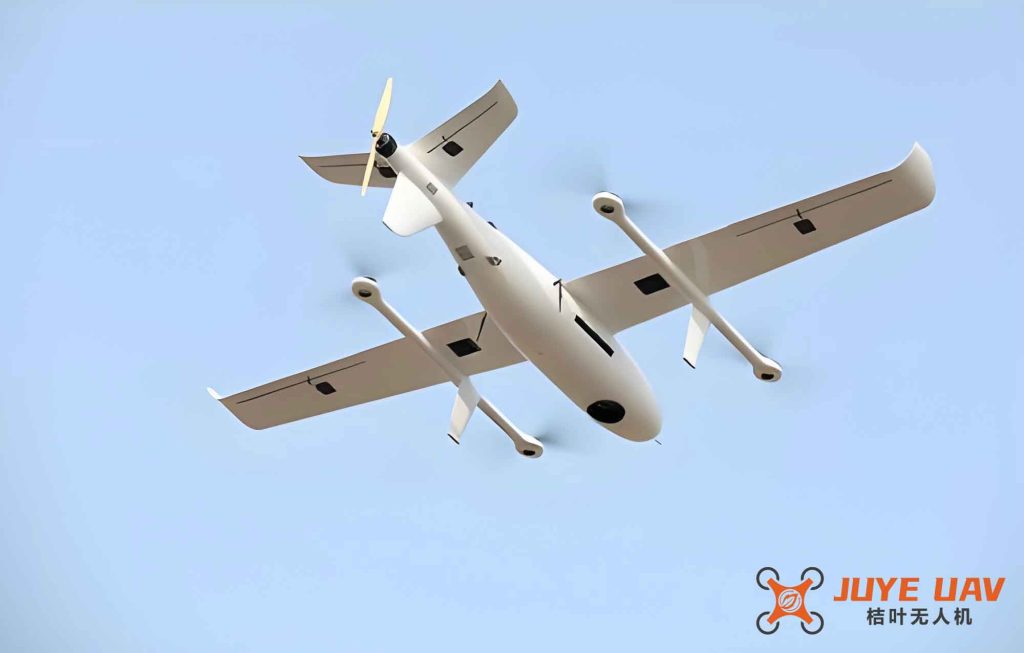
This layered design brings several advantages: (i) communication bandwidth is reduced because only leaders exchange information across groups; (ii) the control hierarchy has only two layers, avoiding error accumulation from multiple levels; (iii) path planning is simplified since only leader paths need to be designed.
4. Leader Control Law Design
4.1 Single-Leader Path Following
Define the Frenet–Serret frame attached to the virtual target \(\tilde{p}_i\). The along-track error \(e_{s_i}\) and cross-track error \(e_{d_i}\) are computed as
$$
\begin{aligned}
e_{s_i} &= (x_i-\tilde{x}_i)\cos\tilde{\theta}_i + (y_i-\tilde{y}_i)\sin\tilde{\theta}_i,\\
e_{d_i} &= -(x_i-\tilde{x}_i)\sin\tilde{\theta}_i + (y_i-\tilde{y}_i)\cos\tilde{\theta}_i,
\end{aligned}
$$
where \(\tilde{\theta}_i\) is the tangent angle of the path at \(\tilde{p}_i\). Let \(\bar{\theta}_i = \theta_i – \tilde{\theta}_i\). Under wind, the desired heading offset for path following is
$$
\bar{\theta}_i^d = \varpi_i + \sigma_i,
$$
with \(\varpi_i = -\arcsin\left( \frac{v_w\sin(\theta_w-\tilde{\theta}_i)}{v_i} \right)\) and \(\sigma_i = -k_\pi \tanh(k_d e_{d_i})\) ( \(0<k_\pi0\) ). The path-following control law is</k_\pi
$$
\dot{l}_i = k_s e_{s_i} + v_i\cos\bar{\theta}_i + v_w\cos(\theta_w-\tilde{\theta}_i),
$$
$$
\omega_i = -k_\omega\vartheta_i + \kappa(l_i)\dot{l}_i + \dot{\bar{\theta}}_i^d – k_\theta v_i \frac{e_{d_i}(\sin\bar{\theta}_i – \sin\bar{\theta}_i^d)}{\vartheta_i},
$$
where \(\vartheta_i = \bar{\theta}_i – \bar{\theta}_i^d\), \(\kappa(l_i)\) is the path curvature, and \(k_s,k_\omega,k_\theta>0\). This law guarantees asymptotic convergence of the path-following error \(\phi_i = [e_{s_i}, e_{d_i}, \vartheta_i]^\top\) to zero.
4.2 Virtual Target Coordination
The virtual targets on the paths are coordinated via a consensus-like law:
$$
\dot{\xi}_i = -\beta \tanh\left( \sum_{j\in\mathcal{N}_i} k_\xi (\xi_i – \xi_j – \xi_{ij}^d) \right) + \gamma_d,
$$
where \(\beta, k_\xi, \gamma_d >0\) and \(\mathcal{N}_i\) are the neighbors of leader \(i\) in the communication graph. Under a strongly connected graph, this law ensures \(\xi_i – \xi_j \to \xi_{ij}^d\).
4.3 Implementation with Saturation
To satisfy airspeed and yaw rate limits, we implement a practical algorithm that saturates the computed commands when limits are exceeded. Let \(v_i^{\text{cmd}}\) and \(\omega_i^{\text{cmd}}\) be from the control law; then
$$
v_i = \text{Sat}(v_i^{\text{cmd}}, v_{\max}^l, v_{\min}^l),\quad \omega_i = \text{Sat}(\omega_i^{\text{cmd}}, \omega_{\max}^l, -\omega_{\max}^l),
$$
where \(v_{\max}^l = v_{\max}-\epsilon_v, v_{\min}^l = v_{\min}+\epsilon_v, \omega_{\max}^l = \omega_{\max}-\epsilon_\omega\) provide a margin for followers. The saturation is applied in a way that prioritizes constraint satisfaction while attempting to maintain coordination.
5. Follower Control Law Design
For follower \(f\) in group \(l\), define the error vector in the follower’s body frame:
$$
\begin{bmatrix}
\tilde{x}_f \\ \tilde{y}_f \\ \tilde{\theta}_f
\end{bmatrix}
=
\begin{bmatrix}
\cos\theta_f & \sin\theta_f & 0\\
-\sin\theta_f & \cos\theta_f & 0\\
0 & 0 & 1
\end{bmatrix}
\begin{bmatrix}
x_l – x_f + d_x^f\\
y_l – y_f + d_y^f\\
\theta_l – \theta_f
\end{bmatrix}.
$$
The error dynamics are
$$
\begin{aligned}
\dot{\tilde{x}}_f &= \omega_f \tilde{y}_f – v_f + v_l \cos\tilde{\theta}_f,\\
\dot{\tilde{y}}_f &= -\omega_f \tilde{x}_f + v_l \sin\tilde{\theta}_f,\\
\dot{\tilde{\theta}}_f &= \omega_l – \omega_f.
\end{aligned}
$$
We design the follower control as
$$
\begin{aligned}
\omega_f &= \text{Sat}\left( \omega_l + k_1\left(k_2\tilde{\theta}_f + \frac{\tilde{y}_f}{\sqrt{1+\tilde{x}_f^2+\tilde{y}_f^2}}\right), -\omega_{\max}, \omega_{\max} \right),\\
v_f &= \text{Sat}\left( v_l \cos\tilde{\theta}_f + k_3 \tilde{x}_f, v_{\min}, v_{\max} \right),
\end{aligned}
$$
with gains \(k_1,k_2,k_3>0\). This law guarantees that the tracking errors \((\tilde{x}_f,\tilde{y}_f,\tilde{\theta}_f)\) converge to zero, provided the leader’s velocity and yaw rate remain within the prescribed bounds.
6. Overall Closed-Loop Analysis
Under the assumptions that the leader’s communication graph is strongly connected and the initial errors are sufficiently small, the leader control law ensures asymptotic convergence to the desired path and coordination. The follower control law then guarantees that each follower asymptotically tracks its leader. Thus, the entire swarm achieves the desired formation. When actuator saturation is invoked, the algorithm prioritizes maintaining follower tracking (intra-group formation) over perfect inter-group coordination, which is often acceptable in practice.
The following table summarizes the key parameters and gains used in our simulation.
| Parameter | Value | Description |
|---|---|---|
| \(v_{\min}\) | 20 m/s | Minimum airspeed |
| \(v_{\max}\) | 50 m/s | Maximum airspeed |
| \(\omega_{\max}\) | 0.54 rad/s | Maximum yaw rate |
| \(v_w\) | 5 m/s | Wind speed |
| \(\theta_w\) | \(-3\pi/4\) | Wind direction |
| \(k_\pi\) | 0.2π | Max heading offset |
| \(k_d\) | 0.01 | Cross-track error gain |
| \(k_\omega\) | 2 | Yaw rate damping |
| \(k_s\) | 0.25 | Along-track error gain |
| \(\gamma_d\) | 35 | Nominal path speed |
| \(\beta\) | 10 | Coordination gain |
| \(k_\xi\) | 5 | Coordination coupling |
| \(k_\theta\) | 0.015 | Heading error gain |
| \(k_1\) | 2 | Follower yaw gain |
| \(k_2\) | 1 | Follower heading weight |
| \(k_3\) | 1 | Follower airspeed gain |
7. Simulation Results
We simulate a 100 fixed-wing drone swarm (10 groups, 10 drones per group) performing a multi-phase mission: (1) formation takeoff in double-column, (2) transition to single-column to pass through a valley, (3) spread into multiple horizontal lines for area search, and (4) converge to a dense formation for target coverage. The leaders share a common B-spline path generated from waypoints. The inter-leader distance is set to 300 m initially and then reduced to 30 m during the search phase.
Figure 6 in the original reference shows that the path-following errors (along-track and cross-track) converge to zero for all leaders, and the coordination errors \(u_i\) also converge to zero even after changing the desired offset. The follower tracking errors (relative position and heading) decay to zero within the first 50 seconds.
Control inputs of all drones remain within the prescribed bounds throughout the simulation, demonstrating the effectiveness of the saturation scheme.
8. Conclusion
We have presented a hierarchical group-based formation control method for large-scale fixed-wing drone swarms. The approach decouples the control problem into leader coordination (inter-group) and follower tracking (intra-group), enabling scalability. The control laws explicitly account for wind disturbances and actuator limits. A 100-drone simulation validates the method, showing that the swarm can perform complex mission transitions while maintaining precise formation. Future work will consider adaptive strategies for model uncertainties and collision avoidance among groups.