
As the demand for unmanned aerial vehicle (UAV) logistics continues to rise, large fixed-wing drones are increasingly deployed in regional airport environments for cargo delivery. Operating in low‑altitude airspace alongside manned general aviation aircraft introduces significant conflict risks. Unlike small multi‑rotor drones, large fixed‑wing drones possess distinct kinematic and dynamic characteristics that impose strict constraints on maneuverability. This paper presents a comprehensive study on developing a real‑time conflict resolution method tailored for large fixed‑wing drones operating in the terminal area of a regional airport. By extending the classical artificial potential field (APF) algorithm, we address three fundamental issues: dynamic obstacle avoidance, unreachable target attraction, and oscillatory trajectory generation. The proposed improvements incorporate position and velocity decomposition of both repulsive and attractive forces, along with a damping term to stabilize the flight path. Simulations conducted under realistic operational parameters demonstrate that the enhanced APF method produces smooth, flyable trajectories that maintain safe separation distances while respecting the drone’s physical constraints. The results confirm that the algorithm efficiently resolves conflicts with minimal deviation from the intended route, ensuring an equivalent level of safety comparable to manned aviation.
1. Introduction
The integration of large fixed‑wing drones into shared airspace poses unique operational challenges. In the vicinity of regional airports, low‑altitude airspace is often congested with general aviation aircraft flying under visual flight rules. A drone must be able to detect potential conflicts and execute evasive maneuvers autonomously, while adhering to prescribed safety standards. Traditional conflict resolution techniques, such as geometric collision‑cone methods, A* algorithms, and rapidly exploring random trees, either lack the ability to handle dynamic environments or require substantial computational resources. The artificial potential field (APF) method, originally developed for mobile robots, offers high real‑time performance and adaptability. However, when applied to fixed‑wing drones, the classical APF suffers from deficiencies including local minima, unreachable goals, and path oscillations. This work aims to overcome these limitations by redesigning the potential field forces to suit the specific motion characteristics and operational constraints of large fixed‑wing drones in a regional airport context.
2. Problem Formulation and Basic Assumptions
We consider a scenario where a large fixed‑wing drone follows a predetermined flight path within low‑altitude airspace (below 1000 m). A manned general aviation aircraft is assumed to maintain a constant velocity and straight course during the encounter. The drone is equipped with a ground‑based radar that provides real‑time position and velocity information of the intruder. To ensure safety, the minimum horizontal separation required between aircraft is 5000 m, but considering sensor delays and communication latencies, we adopt a safety radius of 5942 m as suggested in prior research. The drone must resolve the conflict by altering its horizontal path (heading change or speed adjustment) without changing altitude, because vertical maneuvers are limited in this low‑altitude corridor. The objective is to generate a collision‑free trajectory that returns to the original planned route as quickly and smoothly as possible.
3. Fixed‑Wing Drone Kinematic Model
Unlike multi‑rotor platforms, a large fixed‑wing drone cannot stop or hover. Its motion is governed by aerodynamic forces and bank angle. During steady coordinated turns, the following equations hold:
$$
L \cos\phi = mg
$$
$$
m \frac{v^2}{r} = L \sin\phi
$$
where:
- \( m \) – mass of the drone [kg]
- \( g \) – gravitational acceleration [m/s²]
- \( v \) – airspeed [m/s]
- \( L \) – lift force [N]
- \( \phi \) – bank angle [rad]
- \( r \) – turn radius [m]
The load factor \( n = L/(mg) \) leads to the minimum turn radius constraint:
$$
r_{\min} \ge \frac{v^2}{n_{\max} g}
$$
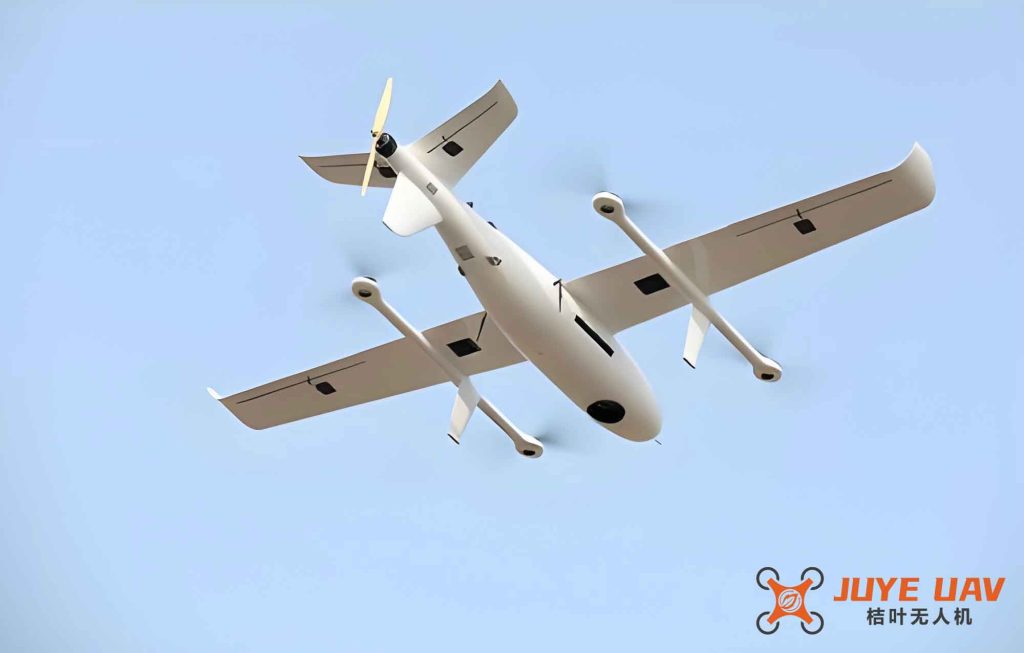
This constraint ensures that any conflict‑avoidance maneuver is physically executable by the drone. The following table summarizes the key performance parameters used in our simulations, taken from the HY100 large fixed‑wing drone (similar to the Y‑5B platform).
| Parameter | Value |
|---|---|
| Operating speed \( v_0 \) | 55 m/s |
| Maximum speed \( v_{\max} \) | 70 m/s |
| Maximum acceleration \( a_{\max} \) | 50 m/s² |
| Minimum turn radius \( r_{\min} \) | 535 m |
| Safety radius \( r_{\text{safe}} \) | 5942 m |
| Position attraction gain \( k_p^{\text{att}} \) | 0.1 |
| Velocity attraction gain \( k_v^{\text{att}} \) | 0.1 |
| Position repulsion gain \( k_p^{\text{rep}} \) | 8 × 10¹⁴ |
| Velocity repulsion gain \( k_v^{\text{rep}} \) | 4 × 10⁶ |
| Damping coefficient \( k_{\text{damp}} \) | 0.5 |
4. Improved Artificial Potential Field Method
The classical APF defines an attractive potential that pulls the robot toward the goal and a repulsive potential that pushes it away from obstacles. For a dynamic environment involving moving manned aircraft, we decompose the forces into position and velocity components.
4.1 Repulsive Force Decomposition
The repulsive force is separated into a position‑based term \( \mathbf{F}_p^{\text{rep}} \) and a velocity‑based term \( \mathbf{F}_v^{\text{rep}} \). The position repulsion acts along the line connecting the drone and the intruder, while the velocity repulsion is perpendicular to the relative velocity vector. This design ensures that the drone reacts appropriately to a fast‑approaching aircraft.
$$
\mathbf{F}_p^{\text{rep}} =
\begin{cases}
\mathbf{F}_{p1}^{\text{rep}} + \mathbf{F}_{p2}^{\text{rep}}, & \text{if } \|\mathbf{d}\| \le r_{\text{safe}} \\
0, & \text{otherwise}
\end{cases}
$$
$$
\mathbf{F}_{p1}^{\text{rep}} = -k_p^{\text{rep}} \left( \frac{1}{\|\mathbf{d}\|} – \frac{1}{r_{\text{safe}}} \right) \frac{\|\mathbf{d}_g\|^2}{\|\mathbf{d}\|^2} \frac{\partial \|\mathbf{d}\|}{\partial \mathbf{x}}
$$
$$
\mathbf{F}_{p2}^{\text{rep}} = -k_p^{\text{rep}} \left( \|\mathbf{d}\| – \frac{1}{r_{\text{safe}}} \right)^2 \|\mathbf{d}_g\| \frac{\partial \|\mathbf{d}\|}{\partial \mathbf{x}}
$$
Here, \(\mathbf{d} = \mathbf{x}_p – \mathbf{x}_{ob}\) is the relative position vector, \(\mathbf{d}_g = \mathbf{x}_p – \mathbf{x}_{goal}\) is the vector toward the goal, and \(\mathbf{x}_p\) is the drone’s current position. The velocity repulsion is defined as:
$$
\mathbf{F}_v^{\text{rep}} = -k_v^{\text{rep}} \mathbf{v}_{\text{rel}}
$$
where \(\mathbf{v}_{\text{rel}} = \mathbf{v}_u – \mathbf{v}_i\) is the relative velocity between the drone and the intruder. The total repulsive force is:
$$
\mathbf{F}_{\text{rep}} = \mathbf{F}_p^{\text{rep}} + \mathbf{F}_v^{\text{rep}}
$$
4.2 Attractive Force Decomposition
To guarantee that the drone returns to its planned path after conflict resolution, the attractive force is also split into position and velocity components:
$$
\mathbf{F}_{\text{att}} = \mathbf{F}_p^{\text{att}} + \mathbf{F}_v^{\text{att}}
$$
$$
\mathbf{F}_p^{\text{att}} = k_p^{\text{att}} \left( \mathbf{p}_g(t) – \mathbf{p}(t) \right)
$$
$$
\mathbf{F}_v^{\text{att}} = k_v^{\text{att}} \left( \mathbf{V}_0 – \mathbf{v}(t) \right)
$$
where \(\mathbf{p}_g(t)\) is the desired waypoint at time \(t\), \(\mathbf{V}_0\) is the target speed, and \(\mathbf{v}(t)\) is the current velocity. This decomposition prevents the drone from converging to a point before reaching the intended speed.
4.3 Damping Force for Oscillation Suppression
Path oscillations often occur near the goal when only attractive forces are present. We introduce a damping term proportional to the drone’s velocity opposite to its direction:
$$
\boldsymbol{\rho}_{\text{damp}} = -k_{\text{damp}} \mathbf{v}_u(t)
$$
This damping force is applied only when the drone is outside the safety radius of the intruder. The modified attractive force becomes:
$$
\mathbf{F}_{\text{att}} =
\begin{cases}
k_p^{\text{att}} (\mathbf{p}_g – \mathbf{p}) + k_v^{\text{att}} (\mathbf{V}_0 – \mathbf{v}), & \|\mathbf{d}\| \le r_{\text{safe}} \\
k_p^{\text{att}} (\mathbf{p}_g – \mathbf{p}) + k_v^{\text{att}} (\mathbf{V}_0 – \mathbf{v}) – k_{\text{damp}} \mathbf{v}_u, & \text{otherwise}
\end{cases}
$$
4.4 Total Force and Constraint Handling
The total force acting on the drone is the sum of repulsive and attractive components:
$$
\mathbf{F}_{\text{total}} = \mathbf{F}_{\text{rep}} + \mathbf{F}_{\text{att}}
$$
To account for the drone’s physical limitations, the magnitude of the total force is capped:
$$
\mathbf{F}_{\max}(t) = m a_{\max}
$$
$$
\mathbf{F}_{\text{total}}(t) =
\begin{cases}
\mathbf{F}_{\text{total}}(t), & \|\mathbf{F}_{\text{total}}(t)\| \le F_{\max}(t) \\
\frac{F_{\max}(t)}{\|\mathbf{F}_{\text{total}}(t)\|} \mathbf{F}_{\text{total}}(t), & \text{otherwise}
\end{cases}
$$
This ensures that the commanded acceleration never exceeds the drone’s capability, preserving flyability.
5. Simulation and Results
We conducted numerical simulations using MATLAB to evaluate the performance of the improved APF method. The environment replicates a regional airport low‑altitude airspace. The fixed‑wing drone starts at the origin (0, 0, 0) and must reach the target waypoint (7000, 9000, 2000) while encountering a manned aircraft flying at constant velocity. The safety radius is set to 5942 m. Both the traditional APF and the proposed improved APF are tested under identical conditions.
5.1 Trajectory Comparison
The three‑dimensional trajectories generated by both methods are shown in the figures (not reproduced here due to text format). In the XY‑plane, the improved APF produces a much smoother path with fewer abrupt heading changes. The drone utilizing the improved method avoids the intruder with a gentle turn and returns to the original route more quickly. The vertical profile remains constant at 1000 m throughout the conflict resolution, as assumed.
5.2 Distance Maintenance
The distance between the drone and the manned aircraft during the encounter is plotted over time. The improved APF consistently maintains a separation greater than the safety radius of 5942 m, whereas the traditional method sometimes approaches the boundary more closely. This demonstrates the enhanced safety margin offered by the velocity‑based repulsion component.
| Method | Minimum Distance [m] | Time of Closest Approach [s] |
|---|---|---|
| Traditional APF | 5971 | 254 |
| Improved APF | 6053 | 232 |
5.3 Speed Variation
The speed profile of the drone is shown in the results. The improved APF ensures that the speed never exceeds the maximum allowable speed of 70 m/s. In addition, the drone accelerates and decelerates smoothly, avoiding aggressive thrust changes. The traditional APF sometimes violates the speed limit due to the lack of velocity‑dependent repulsion.
| Method | Maximum Speed [m/s] | Minimum Speed [m/s] | Conflict Resolution Duration [s] |
|---|---|---|---|
| Traditional APF | 71.2 | 49.0 | 415 |
| Improved APF | 68.5 | 51.3 | 339 |
As seen in Table 3, the improved APF reduces the time needed to resolve the conflict by approximately 18 %, while keeping the speed within bounds. The faster recovery to the intended route benefits overall operational efficiency.
6. Discussion
The improvements introduced in the potential field functions address the key weaknesses of the classical APF when applied to fixed‑wing drone conflict resolution. By separating repulsion into position and velocity components, the drone gains awareness of the intruder’s motion, preventing unnecessary responses to distant but stationary obstacles and ensuring appropriate reaction to fast‑closing threats. The decomposition of attraction ensures that both position and speed are regulated, mitigating the unreachable‑goal problem. The damping term effectively eliminates residual oscillations, resulting in a smooth trajectory that respects the drone’s dynamic constraints.
The simulation results confirm that the proposed method satisfies all safety and performance requirements. The drone maintains the mandatory separation, respects maximum speed and acceleration limits, and returns to its flight path promptly. Compared to the traditional APF, the improved algorithm yields a more efficient and safer conflict resolution profile.
7. Conclusion
This paper presents an enhanced artificial potential field method for conflict resolution of large fixed‑wing drones operating in low‑altitude airspace near regional airports. The key contributions include:
- Decomposition of repulsive forces into position and velocity components to handle dynamic obstacles.
- Decomposition of attractive forces to achieve simultaneous position and speed recovery.
- Introduction of a damping term to eliminate path oscillations.
- Incorporation of physical constraints (maximum speed, acceleration, minimum turn radius) to guarantee flyability.
Simulation experiments demonstrate that the improved APF generates safe, smooth, and efficient trajectories, outperforming the traditional APF in terms of both safety and computational timeliness. The proposed methodology provides a practical solution for integrating large fixed‑wing drones into manned airspace, contributing to the realization of an integrated air‑transportation network.
Future work will extend the framework to multi‑aircraft encounter scenarios and incorporate uncertain trajectories of manned aircraft. Furthermore, real‑time hardware‑in‑the‑loop testing will be conducted to validate the algorithm under more realistic conditions.