
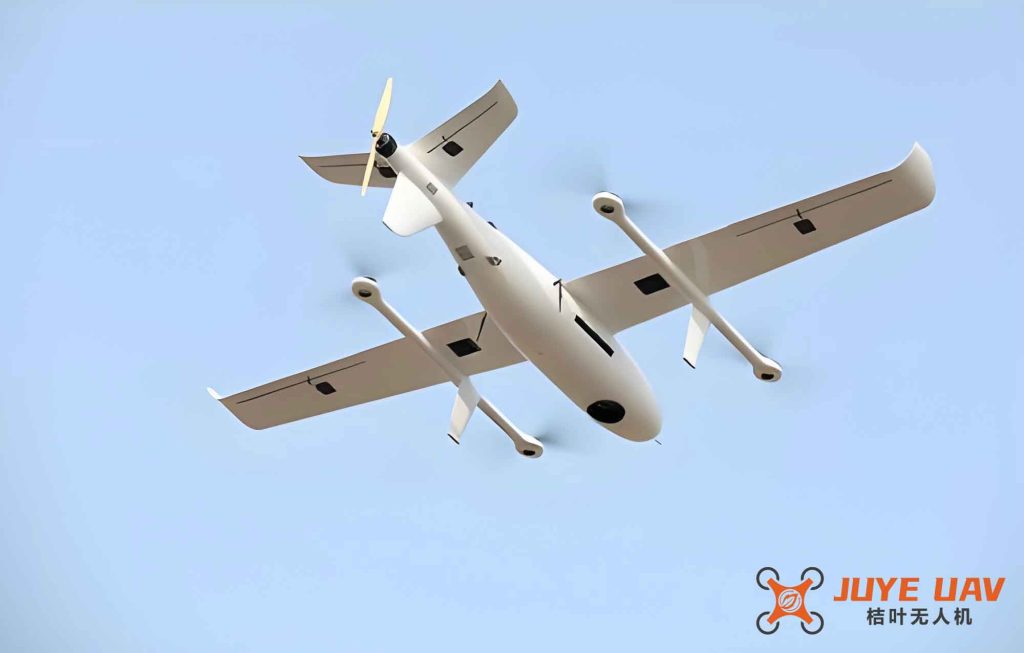
We consider a fixed-wing drone operating in complex dynamic environments. The operational effectiveness of such a fixed-wing drone is often compromised by external time-varying disturbances, sensor faults, and input/output nonlinear constraints. Specifically, sensor faults and output constraints lead to inaccuracies in measured state information. Input saturation limits the output capability of actuators. Unfavorable external disturbances degrade flight control performance. The interplay of these factors can cause the fixed-wing drone to lose control. To address this, we propose a neural network adaptive control method that integrates a state observer, a fault observer, a disturbance observer, and an auxiliary system.
We first establish an attitude dynamics model for the fixed-wing drone that accounts for the combined effects of sensor faults, external disturbances, output saturation, and input saturation. Then, we design radial basis function neural networks (RBFNNs) to construct the state observer, the fault observer, and the disturbance observer. These observers estimate unknown states, actuator faults, and external disturbances, respectively. The outputs of these three observers, combined with the states of a first-order filter and an auxiliary system, are used to design the controller. Using Lyapunov stability theory, we prove that all signals in the closed-loop system are ultimately uniformly bounded. Simulation results demonstrate that the fixed-wing drone maintains stable flight under the combined influence of external disturbances, sensor faults, input saturation, and output saturation.
Introduction
The rapid development of unmanned aerial vehicle technology has positioned fixed-wing drones as key assets for long-endurance missions such as reconnaissance, surveillance, and intelligence gathering. However, the safety and reliability of fixed-wing drones are challenged by sensor faults, input/output constraints, and external disturbances in complex environments. Sensor faults, often caused by humidity, vibration, temperature variations, or electromagnetic interference, can lead to inaccurate state information and degrade flight control performance, potentially causing severe incidents.
Researchers have proposed various methods to address sensor faults. For instance, some studies have used feature models and deep learning for sensor fault diagnosis. Others have employed nonlinear high-gain observers for actuator and sensor fault diagnosis in quadrotors. Learning-observer-based resilient fault-tolerant control schemes have been developed for quadrotors under combined sensor and actuator faults. These works highlight the importance of sensor fault research; however, the control of fixed-wing drones under sensor faults warrants further investigation.
Output saturation occurs when sensor measurements exceed their physical range due to faults, leading to discrepancies between measured and actual values. Researchers have explored various methods for handling output constraints, including consensus algorithms under output saturation, dynamic event-triggered control for saturated systems, and quantized data-driven iterative learning control. While these studies address output saturation, most focus on discrete systems, and few consider the combined effects of sensor faults and output saturation on fixed-wing drones.
Input saturation arises from physical limitations in actuators like servos and engines. When controller commands exceed saturation limits, system performance degrades, potentially leading to instability. Methods such as exponential predefined-time control for fixed-wing drones with input saturation and distributed finite-time prescribed performance control for multi-UAV systems have been developed. These studies underscore the importance of addressing input saturation.
Complex dynamic environments also introduce external disturbances that can harm control performance. Robust anti-disturbance methods, such as disturbance-observer-based control for fixed-wing drones under wind disturbances and distributed robust adaptive formation control for multi-UAV systems, have been proposed. However, existing research often treats sensor faults, external disturbances, input saturation, and output saturation separately, leaving the coupling effects among these factors underexplored.
In this work, we address the attitude control problem for fixed-wing drones under sensor faults, external disturbances, input saturation, and output saturation. Our contributions are threefold:
- We design an RBFNN-based state observer to estimate unknown state variables and handle unknown control gains.
- We construct fault and disturbance observers to estimate actuator faults and external disturbances, enabling compensation.
- We develop an attitude tracking controller using an auxiliary system, backstepping, and Lyapunov theory, ensuring that all signals in the closed-loop system are ultimately uniformly bounded.
Problem Formulation and System Model
We consider the fixed-wing drone attitude system described by:
$$ \dot{\chi}_1 = f_1(\chi_1) + g_1(\chi_1)\chi_2 $$
$$ \dot{\chi}_2 = f_2(\chi_1,\chi_2) + g_2(\chi_1,\chi_2)\tau $$
$$ y = \chi_1 $$
Here, $\chi_1 \in \mathbb{R}^3$ and $\chi_2 \in \mathbb{R}^3$ represent the attitude angle and angular rate vectors, respectively. The functions $f_1$, $f_2$ are known nonlinearities, and $g_1$, $g_2$ are known gain matrices. The control input vector is $\tau \in \mathbb{R}^3$, and $y \in \mathbb{R}^3$ is the output. Considering external disturbances, sensor faults, output saturation, and input saturation, the model becomes:
$$ \dot{\chi}_1 = f_1(\chi_1) + g_1(\chi_1)\chi_2 + d_1 $$
$$ \dot{\chi}_2 = f_2(\chi_1,\chi_2) + g_2(\chi_1,\chi_2)\text{sat}[\tau] + d_2 $$
$$ y = \text{sat}_1[\chi_1 + s] $$
In this model, $d_1, d_2 \in \mathbb{R}^3$ are external disturbances, $s \in \mathbb{R}^3$ represents sensor fault influence. The function $\text{sat}_1[\cdot]$ models output saturation, and $\text{sat}[\cdot]$ models input saturation. The saturation functions are defined as:
$$ \text{sat}_1[\xi]_i = \begin{cases} \bar{u}_{1i}, & \xi_i \geq \bar{u}_{1i} \\ \xi_i, & \bar{l}_{1i} < \xi_i < \bar{u}_{1i} \\ \bar{l}_{1i}, & \xi_i \leq \bar{l}_{1i} \end{cases} $$
$$ \text{sat}[\tau]_i = \begin{cases} \bar{u}_{2i}, & \tau_i \geq \bar{u}_{2i} \\ \tau_i, & \bar{l}_{2i} < \tau_i < \bar{u}_{2i} \\ \bar{l}_{2i}, & \tau_i \leq \bar{l}_{2i} \end{cases} $$
with $\bar{u}_{1i} > 0$, $\bar{l}_{1i} = -\bar{u}_{1i}$ for output saturation, and $\bar{u}_{2i} > 0$, $\bar{l}_{2i} = -\bar{u}_{2i}$ for input saturation.
Our objective is to design an anti-saturation tracking control method for the fixed-wing drone that ensures all signals in the closed-loop system are ultimately uniformly bounded despite the combined effects of external disturbances, sensor faults, output saturation, and input saturation.
| Assumption | Description |
|---|---|
| 1 | External disturbances $d_1, d_2$ and their derivatives are bounded. |
| 2 | The desired trajectory $\chi_{1d}$ and its derivative are known. |
| 3 | Sensor fault $s$ and its derivative are bounded, satisfying a specific linear form. |
Observer Design
State Observer Design
Since state variables are unknown due to sensor faults and output saturation, we design a state observer. For the $i$-th component of the fixed-wing drone system, we write:
$$ \dot{\chi}_{1i} = \rho_{1i}\chi_{1i} + \rho_{1i}g_{1i}(\chi_1)\chi_{2i} + d_{1i} $$
$$ \dot{\chi}_{2i} = \rho_{2i}\chi_{2i} + \rho_{2i}g_{2i}(\chi_1,\chi_2)\text{sat}[\tau_i] + d_{2i} $$
Using RBFNN approximation, we design the state observer as:
$$ \dot{\hat{\chi}}_{1i} = \rho_{1i}\hat{\chi}_{1i} + \hat{\psi}_{1i}^T\hat{\phi}_{1i}(\hat{\chi}_1,\hat{\chi}_2) + g_{1i}(\hat{\chi}_1)\hat{\chi}_{2i} + C_{1i}(\hat{\chi}_{1i} – \hat{\chi}_{1i}) $$
$$ \dot{\hat{\chi}}_{2i} = \rho_{2i}\hat{\chi}_{2i} + \hat{\psi}_{2i}^T\hat{\phi}_{2i}(\hat{\chi}_1,\hat{\chi}_2) + \hat{\Delta}_i + C_{2i}(\hat{\chi}_{2i} – \hat{\chi}_{2i}) $$
Here, $\hat{\chi}_{1i}, \hat{\chi}_{2i}$ are estimates of $\chi_{1i}, \chi_{2i}$, $\hat{\psi}_{ji}$ are weight estimates, $\hat{\phi}_{ji}$ are basis function estimates, $\hat{\Delta}_i$ is an RBFNN approximator for nonlinearities, and $C_{1i}, C_{2i}$ are observer gains.
Fault Observer Design
Sensor faults affect measurement accuracy. We design a fault observer based on the fault model. Introducing auxiliary variables $\zeta_i = s_i + \nu_i$ and $\hat{\zeta}_i$, the fault observer is:
$$ \dot{\hat{\nu}}_i = -\kappa_i\hat{\nu}_i + \kappa_i\hat{s}_i + \kappa_i\text{sat}_1[\chi_{1i}]_i + \kappa_i\tanh(\nu_i/\epsilon_i) $$
$$ \hat{s}_i = \hat{\nu}_i – \nu_i $$
where $\kappa_i > 0$ and $\epsilon_i > 0$ are design parameters. This observer effectively estimates the sensor fault $s_i$.
Disturbance Observer Design
To compensate for external disturbances $d_{1i}$ and $d_{2i}$, we design disturbance observers. For $d_{1i}$, we define $\eta_{1i} = \chi_{1i} – \iota_{1i}$ and design:
$$ \dot{\hat{\eta}}_{1i} = -\iota_{1i}\dot{\hat{\chi}}_{1i} + \iota_{1i}\left[\rho_{1i}\hat{\chi}_{1i} + \hat{\psi}_{1i}^T\hat{\phi}_{1i} + g_{1i}\hat{\chi}_{2i}\right] $$
$$ \hat{d}_{1i} = \hat{\eta}_{1i} + \iota_{1i}\hat{\chi}_{1i} $$
Similarly, for $d_{2i}$:
$$ \dot{\hat{\eta}}_{2i} = -\iota_{2i}\dot{\hat{\chi}}_{2i} + \iota_{2i}\left[\rho_{2i}\hat{\chi}_{2i} + \hat{\psi}_{2i}^T\hat{\phi}_{2i} + \hat{\Delta}_i\right] $$
$$ \hat{d}_{2i} = \hat{\eta}_{2i} + \iota_{2i}\hat{\chi}_{2i} $$
With $\iota_{1i}, \iota_{2i} > 0$, these observers ensure bounded disturbance estimation errors when the state observer errors are bounded.
Controller Design
We design an attitude tracking controller combining auxiliary systems for saturation, a first-order filter for virtual control derivative, and backstepping.
Define tracking errors $e_{1i} = \hat{\chi}_{1i} – \chi_{1di} – \xi_{1i}$ and $e_{2i} = \hat{\chi}_{2i} – \alpha_i – \xi_{2i}$, where $\chi_{1di}$ is the desired trajectory, $\xi_{1i}, \xi_{2i}$ are auxiliary system states, and $\alpha_i$ is the filter state. The auxiliary system is:
$$ \dot{\xi}_{1i} = -\tau_{1i}\xi_{1i} + g_{1i}\xi_{2i} $$
$$ \dot{\xi}_{2i} = -\tau_{2i}\xi_{2i} + \rho_{2i}\Delta_i $$
The virtual control law is:
$$ \alpha_{di} = g_{1i}^{-1}\left[-\rho_{1i}\hat{\chi}_{1i} – \hat{\psi}_{1i}^T\hat{\phi}_{1i} – k_{e1i}e_{1i} + \dot{\chi}_{1di} + \tau_{1i}\xi_{1i} – C_{1i}(\hat{\chi}_{1i} – \chi_{1i})\right] $$
A first-order filter handles the derivative of $\alpha_{di}$: $\epsilon_{\alpha i}\dot{\alpha}_i + \alpha_i = \alpha_{di}$, $\alpha_i(0) = \alpha_{di}(0)$.
The actual control law is:
$$ \tau_i = \hat{\Psi}^{-1}\left[-k_{e2i}e_{2i} – g_{1i}e_{1i} + \dot{\alpha}_i – \rho_{2i}\hat{\chi}_{2i} – \hat{\psi}_{2i}^T\hat{\phi}_{2i} – \hat{\Delta}_i – \hat{\delta}_i\tanh(e_{2i}/\epsilon) + \tau_{2i}\xi_{2i}\right] $$
where $\hat{\Psi}$ is an estimate of the control effectiveness matrix, $k_{e1i}, k_{e2i} > 0$, $\hat{\delta}_i$ is an adaptive parameter for robustness, and $\epsilon > 0$.
| Component | Parameters | Role |
|---|---|---|
| State Observer | $\rho_{1i}, \rho_{2i}, C_{1i}, C_{2i}$ | Estimate unknown states |
| Fault Observer | $\kappa_i, \epsilon_i$ | Estimate sensor faults |
| Disturbance Observer | $\iota_{1i}, \iota_{2i}$ | Estimate external disturbances |
| Auxiliary System | $\tau_{1i}, \tau_{2i}$ | Compensate for input/output saturation |
| Virtual Control | $k_{e1i}$ | Ensure attitude tracking |
| Actual Control | $k_{e2i}, \epsilon$ | Ensure overall system stability |
Stability Analysis
We use Lyapunov stability theory to prove boundedness. Consider the overall Lyapunov function candidate:
$$ V_Z = \sum_{i=1}^3 \left(V_{1i} + V_{2i} + V_{31i} + V_{32i} + V_{41i} + V_{42i}\right) $$
Each component corresponds to the state observer, fault observer, disturbance observers, error dynamics, and controller. Taking derivatives and using adaptive laws yields:
$$ \dot{V}_Z \leq -\Xi_1 V_Z + \Xi_2 $$
where $\Xi_1 > 0$ and $\Xi_2 > 0$ are constants depending on design parameters. This inequality implies that all signals in the closed-loop fixed-wing drone system are ultimately uniformly bounded. The tracking error $e_1$ and other error variables are bounded, achieving the control objective.
Simulation Results
We validate the proposed method through numerical simulations for a fixed-wing drone. The desired attitude angles are $\chi_{1d} = [\text{erf}(0.5t), 10\text{erf}(0.4t), 15\text{erf}(0.5t)]^T$ in degrees. Initial states are $\chi_1(0) = [2,0,0]^T$ deg, $\chi_2(0) = [0,0,0]^T$ deg/s, velocity $V(0)=100$ m/s, and position $P(0)=[0,0,3000]^T$ m.
External disturbance $d_1$ simulates a gust lasting 5 seconds with wind speeds $[30,20,10]^T$ m/s. The gust model uses a 1-cosine shape. $d_2$ is time-varying: $[0.2\sin(0.1t)-0.2\cos(0.4t), 0.1\sin(0.2t)-0.2\cos(0.5t), 0.3\sin(0.3t)-0.3\cos(0.5t)]^T$. Sensor faults are $s = [0.5\text{erf}(0.3t), 0.5\text{erf}(0.5t), 0.5\text{erf}(0.4t)]^T$, representing gradual degradation due to vibration and thermal shock during the fixed-wing drone’s transition from takeoff to high-speed cruise.
Observer parameters are: $\rho_{1i}=\rho_{2i}=\rho_{3i}=0.001$, $C_1=\text{diag}(0.2,0.2,0.2)$, $C_2=\text{diag}(0.5,0.5,0.5)$, $A_1=\text{diag}(10,10,10)$, $B_1=\text{diag}(2,2,2)$, $K_1=\text{diag}(5,5,5)$. Controller parameters are: $\tau_1=\text{diag}(0.5,0.5,0.5)$, $\tau_2=\text{diag}(0.3,0.3,0.3)$, $k_{e1}=\text{diag}(10,10,10)$, $k_{e2}=\text{diag}(2,2,2)$.
Simulation results demonstrate that the disturbance observer accurately estimates the gust and time-varying disturbances. The state observer effectively estimates the attitude angles despite sensor faults and output saturation. The fault observer estimates sensor faults with bounded errors, though errors are slightly larger due to the significant impact of sensor faults on attitude angles. The attitude tracking controller achieves good tracking performance for roll and pitch angles, with some overshoot in sideslip but convergence within 5 seconds. Tracking errors are bounded and converge. The control inputs are smooth and remain within saturation limits, demonstrating anti-windup capability. Comparative simulations show that our method outperforms traditional backstepping in dynamic response and convergence speed.
Conclusion
We have addressed the attitude control problem for a fixed-wing drone under the combined effects of sensor faults, external disturbances, input saturation, and output saturation. We proposed an adaptive control framework integrating RBFNN-based state, fault, and disturbance observers with an auxiliary system. The state observer and fault observer provide bounded estimation errors for unknown states and sensor faults. The disturbance observer achieves convergence of disturbance estimation errors. The controller, designed via backstepping and Lyapunov theory, ensures that all closed-loop signals are ultimately uniformly bounded. Simulation results confirm the effectiveness and robustness of the proposed method for fixed-wing drone control in challenging environments. Future work could explore extensions to time-varying asymmetric constraints or distributed control for fixed-wing drone swarms.