
The evolution of military technology in the 21st century is fundamentally reshaping the character of warfare. Among these transformative technologies, unmanned aerial vehicles (UAVs), and particularly UAV swarms, have emerged as a disruptive force due to their wide application in reconnaissance, coordinated action, and strike missions. The core strength of drone swarm technology lies in leveraging a large number of low-cost, autonomous units that operate collaboratively, significantly enhancing operational effectiveness and survivability through emergent, intelligent behaviors. This paradigm shift presents unprecedented challenges to established air defense systems, which were primarily designed to counter large, fast, and low-maneuverability targets. Consequently, exploring effective anti-drone swarm strategies has become a critical imperative for modern defense forces. This article analyzes the key technological aspects of UAV swarms, examines the limitations of traditional countermeasures, and proposes an innovative strategic framework based on the dynamic construction of the kill chain. By integrating existing technological means into a cohesive and adaptive system, this framework aims to provide a reference for building a more resilient and efficient anti-drone defense architecture.
Unmanned Aerial Vehicle Swarm Technology: An Overview
UAV swarm technology, inspired by the collective behaviors observed in natural animal groups, is rapidly altering the modern battlefield landscape. Its disruptive potential stems from achieving high levels of autonomy and coordination, which collectively boost combat capabilities. The advancement of this technology is precisely guided by tactical requirements, with several key technological pillars forming its foundation.
1. Foundational Technologies
The operational prowess of a drone swarm rests on three interconnected technological pillars: autonomous control, collaborative mechanisms, and networked information systems.
- Autonomous Control Technology: Advanced algorithms, particularly in machine learning and artificial intelligence (AI), enable UAVs within a swarm to perform independent decision-making and action. This allows for autonomous target identification, dynamic path planning, and mission execution, ensuring efficient operation within complex and contested environments.
- Collaborative Operational Mechanisms: This is the core enabler of efficient mission execution. Distributed control algorithms and adaptive communication protocols facilitate real-time information sharing and task coordination among swarm members. This collective intelligence enhances the swarm’s responsiveness to dynamic battlefield changes and overall combat efficacy.
- Networked Information Systems: Robust communication backbones, often utilizing mesh networking and multi-hop communication technologies, provide the critical information support layer. These systems ensure the rapid and resilient transmission of operational commands and sensor data across the potentially vast and dispersed swarm.
Despite their promise, drone swarm development faces significant challenges, including vulnerability to communication jamming and limitations in target recognition under complex conditions. Ongoing research is addressing these issues through adaptive spectrum management and multi-modal sensor fusion techniques to improve electronic resilience and recognition accuracy. The future trajectory points towards deeper integration with AI and the Internet of Things (IoT), enabling more intelligent mission planning and finer-grained responses to intricate battlefield scenarios.
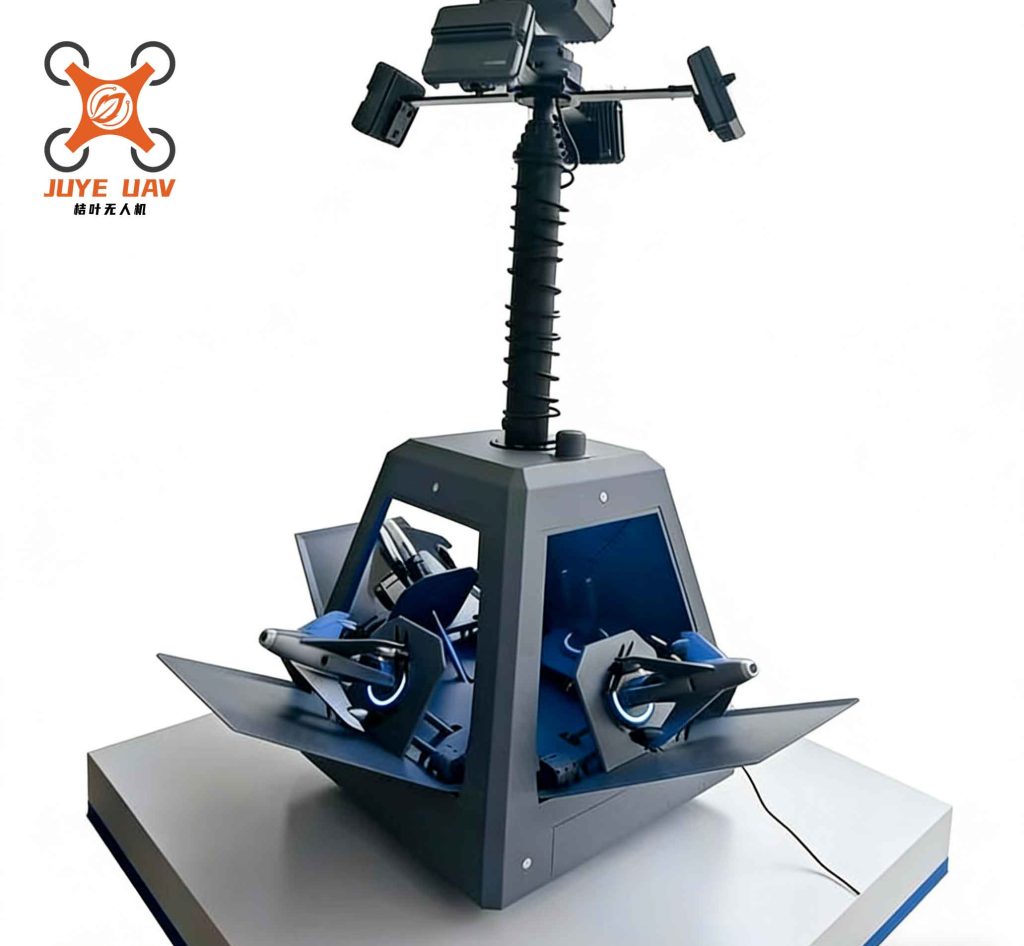
2. Global Development and Military Applications
The development of UAV swarm technology is a global endeavor, with major powers pursuing distinct yet convergent paths, reflecting its strategic importance.
- United States – Pioneering Concepts and Demonstrations: U.S. efforts are characterized by strategic foresight and innovation. Programs like Gremlins focus on the air-based launch and recovery of low-cost UAVs to enable distributed operations. The OFFSET (Offensive Swarm-Enabled Tactics) program develops swarm tactics for urban combat. Skyborg aims to create an AI “brain” for crewed and uncrewed platforms. Demonstrations such as Perdix have validated concepts of collective intelligence and adaptive behavior in large-scale swarms. These projects collectively explore the integration of swarms into multi-domain operations.
- Europe – Collaborative Research and Autonomy: European initiatives, like the European Swarm project, emphasize mission autonomy and cooperative navigation. The UK has been particularly active, conducting multiple demonstrations to verify the beyond-visual-line-of-sight flight and collaborative engagement capabilities of heterogeneous swarms.
- Russia – Tactical Innovation and Practical Application: Drawing from recent combat experience, Russia has focused on tactical applications and counter-swarm tactics. Development of systems like the Molniya (“Lightning”), designed for mass launch from airborne platforms to saturate enemy air defenses, exemplifies this approach, alongside a focus on AI-enabled independent reconnaissance and low-cost, mass-producible platforms.
- Other Nations – Growing Capabilities: Countries including Israel, Turkey, South Korea, and India are actively developing indigenous swarm capabilities through various research and development programs, indicating the global diffusion of this technology.
The overarching trend is the deep fusion of technology and tactics. Future swarms will prioritize greater autonomy, collaboration, and intelligence to adapt to fluid battlefields, while integration with traditional forces is being explored to form more comprehensive joint operational systems.
Limitations of Traditional Anti-Swarm Defenses
To appreciate the necessity for a new paradigm in anti-drone warfare, one must first understand the inherent limitations of traditional air defense systems when confronting drone swarms. These systems were conceived under a different threat model, leading to critical vulnerabilities.
- Detection and Identification Difficulties: Traditional radar systems are optimized for large radar cross-section (RCS) targets. UAV swarms, however, consist of numerous small, low-altitude, and slow-moving (“low, slow, and small”) platforms. Their minimal RCS and terrain-hugging flight profiles make them exceedingly difficult for conventional radar to detect and track reliably. The 2019 attack on Saudi Aramco facilities starkly illustrated this gap, where advanced air defenses struggled against a coordinated swarm of small drones.
- Command and Control (C2) Complexity: Traditional air defense relies on centralized, hierarchical C2 structures. This model can introduce critical decision-making delays when faced with the decentralized, rapidly evolving threat posed by a drone swarm. The swarm’s inherent redundancy and lack of a single critical node overwhelm the information processing and directive capacity of centralized systems.
- Cost-Exchange Imbalance: This is perhaps the most significant tactical challenge. Drone swarms leverage low-cost, attritable platforms. Through tactics like saturation and distributed attacks, they can force a defender to expend high-cost interceptors (e.g., missiles) at an economically unsustainable rate. The 2020 Nagorno-Karabakh conflict demonstrated this vividly, where Armenian air defense resources, including sophisticated systems, were rapidly depleted by swarms of low-cost attack drones, leading to strategic loss. U.S. projects like Perdix and Coyote explicitly explore this concept of using swarms to deceive and exhaust enemy defenses.
Redefining the Kill Chain: A Dynamic and Adaptive Construct
To effectively counter drone swarms, the traditional concept of the kill chain—a linear sequence of Find, Fix, Track, Target, Engage, and Assess (F2T2EA)—requires a fundamental re-conceptualization. The swarm’s decentralized, adaptive, and saturating nature demands a kill chain that is itself dynamic, resilient, and distributed. We propose a redefined, dynamic kill chain framework tailored for anti-drone swarm operations:
- Decentralized Detection & Fusion: Replaces the singular “Find” stage. Detection cannot rely on a single sensor type. It requires the integration of data from a multi-domain sensor grid (radar, electro-optical/infrared, acoustic, radio frequency) to provide early, comprehensive swarm warning and characterization.
- Dynamic Tracking & Localization: The “Fix” and “Track” stages merge into a continuous, adaptive process. It employs real-time data processing and robust multi-target tracking algorithms (e.g., joint probabilistic data association filters) to maintain a cohesive track on highly maneuvering and splitting swarm elements. This can be modeled as an optimization problem maintaining track continuity $C_T$ against swarm dispersion $D_s$ and sensor noise $N$:
$$ \text{Maximize } C_T = f(\text{Sensor Fusion}, \text{Algorithm Agility}) \text{ subject to constraints from } D_s, N $$ - Adaptive Decision-Making: The “Target/Decide” phase must be rapid and intelligent. It utilizes AI-driven decision support systems to analyze the fused tactical picture, predict swarm intent, and dynamically allocate resources and select engagement methods (kinetic, electronic, cyber) based on real-time threat assessment and resource status.
- Multi-Modal Engagement: The “Engage” stage expands beyond kinetic interceptors. A dynamic anti-drone kill chain must orchestrate a symphony of effects: directed-energy weapons (high-energy lasers, high-power microwaves) for cost-effective point defense, electronic warfare for disruption, and cyber capabilities to attack the swarm’s C2 network.
- Continuous Battle Damage Assessment (BDA): “Assess” becomes a continuous feedback loop. Real-time BDA, again via multi-domain sensors, is essential to determine engagement effectiveness, assess remaining swarm strength and behavior, and immediately feed this information back into the decision-making loop for subsequent actions.
Strategic Imperative for Dynamic Kill Chain Construction
The dynamic construction of this kill chain is not merely a technical adjustment but a strategic necessity driven by core operational realities and offering profound advantages.
Necessity:
- Countering Dispersion & Unpredictability: Swarms attack from multiple axes simultaneously. A dynamic kill chain can re-task sensors and effectors in real-time to respond to these distributed, evolving threats.
- Enhancing System Resilience & Survivability: A centralized C2 node is a lucrative target. A dynamically built, distributed kill chain has no single point of failure. If one node is degraded, others can reconfigure and maintain operational capability.
- Optimizing Resource Allocation: To address the cost-exchange imbalance, resources must be allocated with precision based on threat priority. Dynamic kill chain management allows for optimal resource utilization, ensuring high-value interceptors are used only when necessary, while cheaper effectors handle lower-tier threats.
Strategic Significance:
- Enhanced Tactical Flexibility: Commanders gain the ability to adapt tactics on-the-fly, maintaining initiative against a fluid adversary.
- Catalyst for Innovation & Integration: The swarm threat accelerates the adoption and fusion of new technologies (AI, machine learning, directed energy) into military systems, driven by the operational framework of the dynamic kill chain.
- Formation of New Operational Concepts: This approach necessitates a shift from linear, deterministic planning to a more flexible, network-centric, and effects-based mindset, which is crucial for future complex warfare.
A Strategic Framework for Dynamic Kill Chain Construction in Land-Based Anti-Swarm Operations
Given the prevalence of drone swarm threats in land combat environments, implementing the dynamic kill chain concept requires concrete strategies tailored to the terrestrial battlespace and leveraging available and emerging technologies. The following framework outlines key implementation strategies.
1. Multi-Domain Sensing and Intelligence Fusion Strategy
This strategy addresses the “Decentralized Detection” and “Dynamic Tracking” phases. The goal is to achieve persistent surveillance and high-fidelity tracking of “low, slow, and small” UAVs in complex terrain.
- Integrated & Optimized Sensor Grid: Fuse data from ground-based radars (including low-frequency foliage-penetrating radars), mobile acoustic arrays, electronic support measures (ESM), unmanned ground sensors, and airborne platforms (tethered aerostats, dedicated anti-drone patrol UAVs). A central fusion center employs AI for automated target recognition, behavior pattern analysis (e.g., distinguishing between reconnaissance and attack patterns), and track correlation.
- Layered Surveillance Network: Construct a tiered network: high-altitude (satellites, HALE UAVs), medium-altitude (MALE UAVs), low-altitude (small UAVs, aerostats), and terrestrial (ground sensors, soldier-worn detectors). This creates overlapping fields of view to mitigate terrain masking and counter low-altitude ingress.
- AI-Driven Fusion Core: The fusion process can be modeled as maximizing the probability of correct target identification $P(ID)$ given sensor inputs $S_i$ and environmental conditions $E$:
$$ P(ID) = g( \text{NN}(S_1, S_2, …, S_n), E ) $$
where NN represents a neural network or similar AI model trained on swarm signatures.
2. Distributed Command and Control (C2) Strategy
This enables the “Adaptive Decision-Making” phase by moving away from fragility inherent in centralization.
- Resilient, Node-Based C2 Network: Deploy multiple, mobile C2 nodes with overlapping authority and secure, resilient communication links (e.g., tactical mesh radios, low-probability-of-intercept/low-probability-of-detection waveforms). Uncrewed platforms themselves can act as communication relays or auxiliary C2 nodes.
- Elevated Unit Autonomy & AI Augmentation: Empower tactical units (e.g., a platoon or battery) with pre-defined rules of engagement and AI aids to make localized engagement decisions when higher-echelon communication is degraded. AI decision-support tools provide commanders with predictive analytics and recommended course-of-action bundles.
- Hierarchical Yet Flexible Structure: Maintain a scalable hierarchy (strategic, operational, tactical) but design C2 systems to be modular. This allows the C2 topology to “flatten” or reconfigure dynamically based on threat level and network connectivity.
3. Dynamic Resource Scheduling and Optimization Strategy
This is the operational engine that binds sensing, C2, and engagement, ensuring efficient resource use across the dynamic kill chain.
- Real-Time Asset Management System: Implement a battlefield Internet of Things (IoT) framework where all sensors, shooters, and C2 nodes report their status, location, and capability. This creates a common operational picture of friendly resources.
- Optimization-Driven Allocation: Use combinatorial optimization algorithms (e.g., mixed-integer linear programming) to solve the resource assignment problem in near real-time. The objective function might minimize the total “cost” of an engagement plan, where cost includes interceptor expense, time-to-intercept, and coverage gaps, subject to constraints like weapon range and availability.
A simplified model: Let $T_{ij}$ be the time for interceptor $i$ to engage threat $j$, $C_i$ be the cost of interceptor $i$, and $x_{ij}$ be a binary decision variable (1 if interceptor $i$ is assigned to threat $j$). The goal is:
$$ \text{Minimize } \sum_i \sum_j ( \alpha T_{ij} + \beta C_i ) x_{ij} $$
subject to constraints ensuring each threat is assigned and interceptor capacity is not exceeded. - Modular & Cross-Domain Platforms: Employ modular weapon systems (e.g., a single vehicle mounting a missile launcher, a laser, and an EW suite) that can be dynamically re-tasked. Enable cross-domain synergy, such as using ground-based EW to herd a swarm into the engagement zone of an air-based interceptor swarm.
4. Innovative Interdiction Technology and Tactics Strategy
This fulfills the “Multi-Modal Engagement” phase, providing a diverse toolkit to break the swarm at different levels.
- Layered & Synergistic Effects: Architect defense in depth:
- Long-Range Layer (Disrupt): Cyber-electronic operations (CREW) to jam navigation/communication links or inject malicious commands.
- Medium-Range Layer (Disable): High-Power Microwave (HPM) systems for area denial, frying the electronics of multiple drones simultaneously.
- Short-Range Point Defense (Destroy): High-Energy Lasers (HEL) for precise, low-cost-per-shot engagement; kinetic systems (guns, micro-missiles) for last-ditch defense.
- Active Denial: Deploy counter-swarms of defensive UAVs equipped with nets, projectiles, or EW payloads to physically or electronically neutralize threat drones.
- Swarm vs. Swarm Tactics: Develop tactics for defensive swarms, which could involve autonomous algorithms for distributed pursuit, area coverage, or protective screening of high-value assets. The interaction can be modeled using differential equations from swarm robotics or game theory.
- Signature & Protocol Exploitation: Develop systems that can rapidly identify and exploit specific vulnerabilities in commercial or military drone protocols, allowing for selective takedown or spoofing.
5. Synthesis and Implementation Architecture
The integration of these strategies forms a cohesive system. The table below summarizes how the core strategies map to the phases of the dynamic anti-drone kill chain and key enabling technologies.
| Dynamic Kill Chain Phase | Primary Enabling Strategy | Key Technologies & Tactics |
|---|---|---|
| 1. Decentralized Detection & Fusion | Multi-Domain Sensing & Fusion | Multi-sensor grid (Radar, EO/IR, RF, Acoustic), AI-based data fusion, UAV-based sensing platforms. |
| 2. Dynamic Tracking & Localization | Multi-Domain Sensing & Fusion | Advanced multi-target tracking algorithms (JPDA, MHT), sensor netting, real-time kinematic filtering. |
| 3. Adaptive Decision-Making | Distributed C2 & Resource Optimization | AI decision-support systems, distributed C2 protocols, real-time resource status tracking. |
| 4. Multi-Modal Engagement | Innovative Interdiction Tech & Tactics | Layered effects (EW, HPM, HEL, kinetic), counter-swarms, protocol exploitation. |
| 5. Continuous BDA | Multi-Domain Sensing & Fusion | Post-engagement sensor analysis, AI for damage assessment, feedback loop integration. |
| Cross-Cutting Enabler | Dynamic Resource Scheduling | Real-time asset management, combinatorial optimization algorithms, modular system design. |
Conclusion and Future Outlook
This article has examined the formidable challenge posed by UAV swarms to traditional air defense paradigms and proposed a comprehensive strategic framework centered on the dynamic construction of the kill chain. By redefining the kill chain as a resilient, adaptive, and distributed process—enabled by multi-domain sensing, distributed C2, optimized resource scheduling, and innovative interdiction technologies—defense forces can significantly enhance their ability to counter swarm threats. This framework moves beyond simply hardening existing systems and instead advocates for a new operational architecture designed for the specific characteristics of swarm warfare.
However, it is crucial to recognize that drone technology is evolving at a rapid pace. Future swarms will likely incorporate greater AI sophistication, advanced stealth materials, and heterogeneous compositions (mixing different drone types). Therefore, the strategies outlined here are not a final solution but a foundational approach that must itself remain dynamic. Continuous research, rigorous experimentation, and iterative tactical development are essential to keep pace with this evolving threat. Future efforts must delve deeper into autonomous counter-swarm algorithms, the integration of quantum sensing for improved detection, and the development of even more cost-effective and scalable hard-kill and soft-kill mechanisms. The race in anti-drone technology is a continuous cycle of measure and countermeasure, demanding persistent innovation and adaptability at the doctrinal, organizational, and technological levels.