
In this research, I focused on designing a swing actuator based on dielectric elastomer (DE) thin films to achieve oscillatory motion, specifically targeting the development of a bio-inspired butterfly drone. Dielectric elastomers are a class of electroactive polymers that can convert electrical energy into mechanical work, offering high energy density, large deformation, fast response, and lightweight properties. These characteristics make them ideal for soft robotics, including flapping-wing micro air vehicles. The butterfly drone concept mimics the natural wing motion of butterflies, enabling compact, agile flight in confined spaces. Our work systematically investigated how different actuator geometries and sizes influence the swing performance of dielectric elastomer swing actuators (DESA). By optimizing the structure, we constructed a functional butterfly drone prototype that successfully reproduced wing flapping.
Working Principle of DESA
The core of the butterfly drone is a dielectric elastomer actuator. When a voltage is applied across a DE film coated with compliant electrodes on both sides, Maxwell stress (electrostatic pressure) causes the film to contract in thickness and expand in area due to the incompressibility of the elastomer. The resulting elastic strain energy is converted from electrical input. For a DE film under a voltage \(V\) and initial thickness \(t_0\), the effective electrostatic pressure \(p\) is given by:
$$ p = \varepsilon_0 \varepsilon_r E^2 = \varepsilon_0 \varepsilon_r \left( \frac{V}{t} \right)^2 $$
where \(\varepsilon_0\) is the vacuum permittivity, \(\varepsilon_r\) is the relative permittivity of the elastomer, and \(t\) is the current thickness. Since the film is pre-stretched biaxially (300% in both directions) before being attached to a frame, the pre-strain energy balances with the bending stiffness of the frame. The DESA structure includes a rigid frame, a support rib, and the pre-stretched DE membrane with carbon-based compliant electrodes. The configuration (as shown in the schematic) allows the actuator to bend in a fixed direction, avoiding twisting.
The swing angle \(\theta_x\) is defined as the absolute difference between the bending angle before voltage application (\(\theta_1\)) and after voltage application (\(\theta_2\)):
$$ \theta_x = | \theta_1 – \theta_2 | $$
When voltage is removed, the actuator returns to its initial equilibrium state, completing one swing cycle. This principle directly enables the wing motion of the butterfly drone.
Experimental Design and Fabrication
To investigate the influence of geometry and size on the butterfly drone performance, I designed several DESAs with different shapes but identical active area (900 mm²). The shapes included square, rectangle, and isosceles triangle. All frames were cut from 0.1 mm thick PET sheets. The DE membrane used was VHB 4910 (3M, thickness 1 mm), pre-stretched equibiaxially by 300% and then attached to the frame. Compliant carbon-based electrodes were prepared by mixing 1.5 g of super-conductive carbon black (EC-600JD) with 200 mL n-heptane, followed by adding 5 g silicone oil and 5 g silicone rubber (SYLGARD 184), and finally 0.5 g curing agent. The mixture was ultrasonically dispersed for 20 min before coating. Two layers of electrodes were applied on opposite sides of the DE film with wire leads. The frame dimensions are summarized in Table 1.
| Shape | Outer dimensions (mm) | Inner dimensions (mm) | Rib dimensions (mm) |
|---|---|---|---|
| Square | 50 × 50 | 30 × 30 | 50 × 10 |
| Rectangle | 45 × 56 | 25 × 36 | 55 × 10 |
| Isosceles triangle | Base 40, height 45 | Base 40, height 45 (inner) | None (frame width 10,10,10) |
After testing the equal-area set, I selected the isosceles triangle shape for further optimization because it showed the largest swing angle. Then I varied the active area while keeping the shape constant. Three sizes were fabricated: small (510 mm²), medium (900 mm²), and large (1400 mm²). The frame for these triangles had optimized widths: bottom width 12 mm, side widths 7 mm to provide appropriate stiffness without needing a separate rib. Table 2 gives the parameters.
| Size | Base (mm) | Height (mm) | Area (mm²) | Frame widths (bottom, left, right) (mm) |
|---|---|---|---|---|
| Small | 30 | 34 | 510 | 12 × 7 × 7 |
| Medium | 40 | 45 | 900 | 12 × 7 × 7 |
| Large | 50 | 56 | 1400 | 12 × 7 × 7 |
Each configuration was replicated twice to ensure reproducibility. The voltage was supplied by a high-voltage DC power supply and gradually increased until either wrinkling occurred on the DE surface or the maximum safe voltage was reached (to avoid dielectric breakdown). The bending angles were measured using a protractor or image analysis.
Results and Discussion
Influence of Shape (Equal Area 900 mm²)
The swing behavior of square, rectangular, and triangular DESAs was compared. As voltage increased, the bending angle of all actuators increased monotonically until a plateau or breakdown. The maximum swing angle \(\theta_{\text{max}}\) and corresponding peak voltage are listed in Table 3.
| Shape | Initial angle \(\theta_1\) (°) | Final angle \(\theta_2\) (°) | \(\theta_{\text{max}}\) (°) | Peak voltage (kV) |
|---|---|---|---|---|
| Square | 82.7 | 28.3 | 54.4 | 9.0 |
| Rectangle | 118.7 | 64.5 | 54.2 | 8.0 |
| Isosceles triangle | 92.1 | 26.1 | 66.0 | 9.0 |
The triangular DESA achieved the largest swing angle of 66.0°, outperforming both the square and rectangle. This is attributed to the bending stiffness of the triangular frame being intermediate between the other two shapes. If the frame is too stiff (like square) or too flexible (like rectangle with asymmetric rib), the actuator cannot achieve large deformation. Therefore, the isosceles triangle geometry was chosen for further study and for the butterfly drone construction.
Figure 1 shows the voltage-angle curves for the three shapes.
Influence of Area for Triangular DESAs
For the isosceles triangle shape, three different active areas were tested. The results are listed in Table 4.
| Size (area mm²) | \(\theta_1\) (°) | \(\theta_2\) (°) | \(\theta_{\text{max}}\) (°) | Peak voltage (kV) |
|---|---|---|---|---|
| Small (510) | 54.0 | 40.0 | 14.0 | 10.0 |
| Medium (900) | 92.1 | 26.1 | 66.0 | 9.0 |
| Large (1400) | 142.0 | 117.5 | 24.5 | 11.0 |
The medium-area triangular DESA exhibited the largest swing angle. The small triangle had a small initial curvature and a relatively stiff frame, limiting deformation. The large triangle had a large initial curvature (142°) but the frame was too soft, causing difficulty in returning to the initial state and resulting in a small net swing. This trade-off explains why an intermediate area is optimal for maximizing swing amplitude in the butterfly drone design.
Bio-Inspired Butterfly Drone Construction
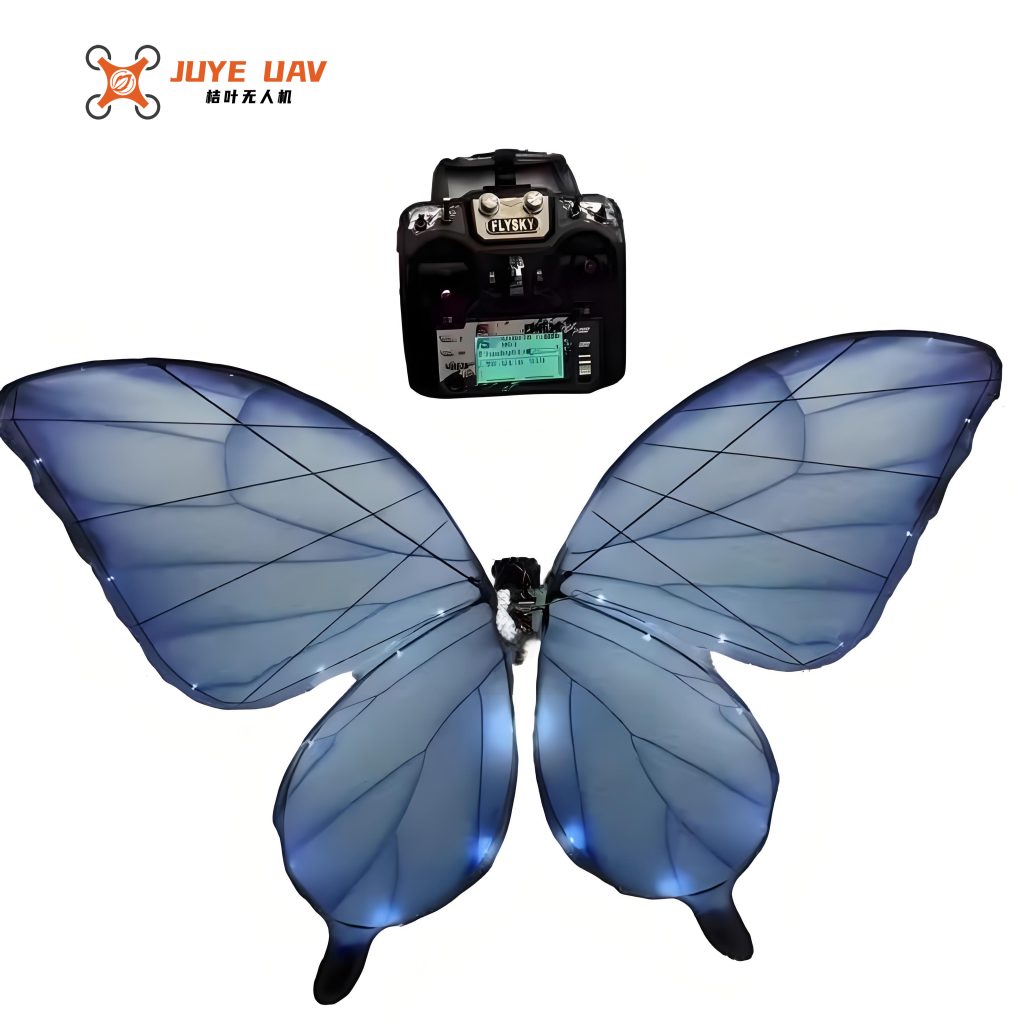
Using two medium-sized isosceles triangular DESAs (each with 900 mm² active area), I assembled a butterfly drone in a parallel configuration. The two actuators were mounted symmetrically to act as the left and right wings. When a high voltage (up to 9 kV) was applied, both wings folded inward simultaneously, mimicking the downstroke of a butterfly. Upon removing the voltage, the wings returned to the open position (upstroke). By cycling the voltage, the butterfly drone could flap its wings continuously. The initial bending state before voltage and the actuated state after voltage are shown in the image above.
This butterfly drone prototype demonstrates the feasibility of using DE actuators for flapping-wing micro air vehicles. The optimized triangular geometry provides the largest amplitude, which is crucial for generating lift and thrust. Future work will focus on improving the electrode compliance, reducing the driving voltage, and adding a lightweight power source to achieve untethered flight. The butterfly drone concept can also be extended to other bio-inspired robots such as dragonflies or hummingbirds.
Conclusion
In this study, I systematically investigated the influencing factors of a dielectric elastomer swing actuator for a butterfly drone. The results show that among equal-area square, rectangular, and isosceles triangular DESAs, the triangle achieves the largest swing angle (66.0°). For triangular DESAs with varying areas, an intermediate area (900 mm²) yields the best performance. By mounting two such actuators in parallel, I successfully built a butterfly drone that can flap its wings under electrical control. The design principles derived here provide valuable guidelines for the development of soft, lightweight flapping-wing micro air vehicles based on dielectric elastomers. The butterfly drone platform can serve as a testbed for advanced control strategies and integration into fully autonomous flying robots.