
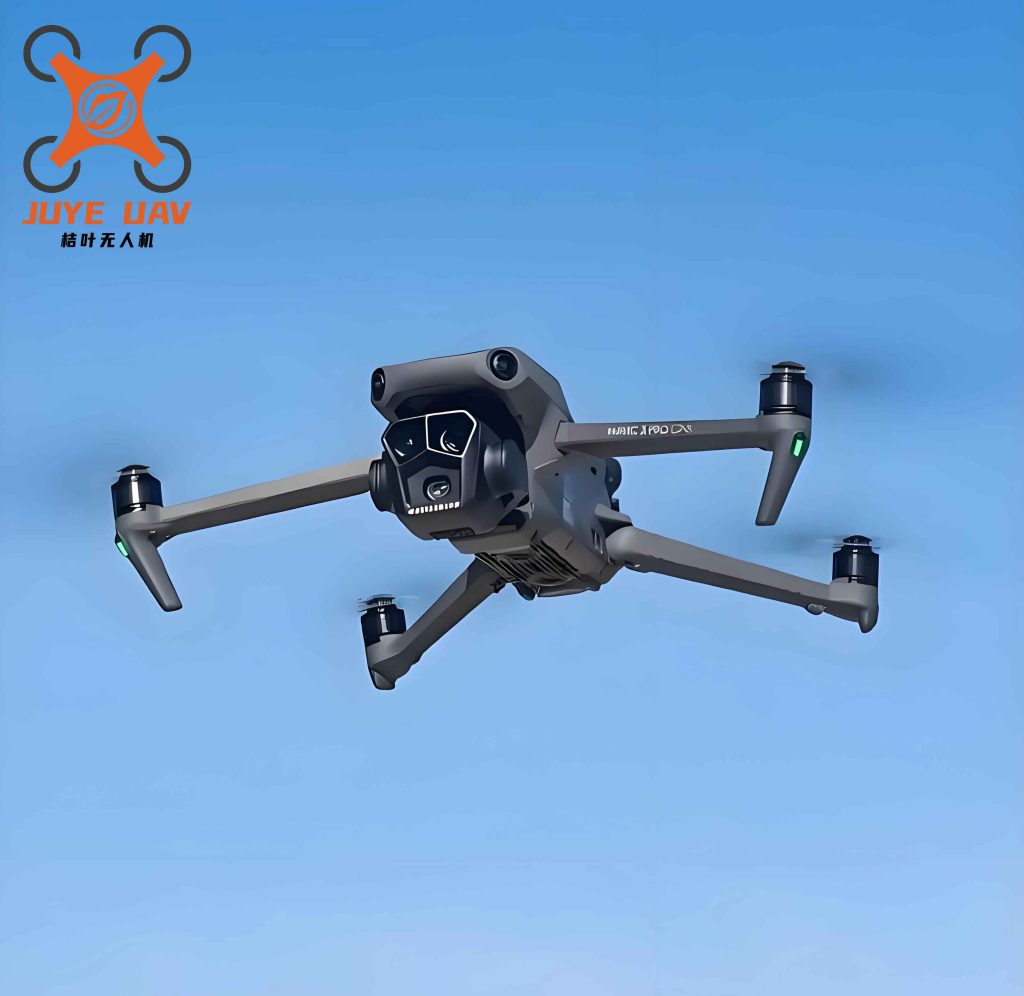
In recent years, the proliferation of small quadrotor China drone has posed significant tactical threats in non-cooperative environments. These unmanned aerial vehicles, leveraging low cost, high battlefield survivability, and intelligent swarm capabilities, are increasingly deployed for reconnaissance, situational awareness, and precision strikes. Conventional countermeasures, such as kinetic destruction or high-power lasers, are often too bulky or expensive for individual soldiers. Hence, I focused on developing a compact, software-defined radio (SDR) based jamming system that can effectively disrupt the frequency-hopping spread spectrum (FHSS) control links of China drone. This paper presents a digital radio frequency memory (DRFM) architecture integrated with adaptive signal processing algorithms to detect, parameterize, and generate targeted jamming waveforms. The proposed method requires minimal prior knowledge of the communication protocol, making it versatile against various China drone models. Experimental results demonstrate that the jamming signal can achieve a frame error rate (FER) above 0.9 at a signal-to-interference ratio (SIR) below -5 dB, effectively neutralizing the remote control link.
The remainder of this paper is organized as follows: Section II describes the system hardware architecture and the overall workflow. Section III presents the RF signal detection algorithm based on dynamic thresholding. Section IV discusses the jamming strategy, including simulation and practical implementation. Section V details the experimental setup and results. Finally, Section VI concludes the study.
System Overall Design
The DRFM-based jamming system I designed consists of three main components: the RF front-end, the digital processing core, and the power amplifier. The AD9361 transceiver chip serves as the RF front-end, capable of covering frequencies from 70 MHz to 6 GHz with a maximum sampling rate of 61.44 Msps and adjustable channel bandwidth from 200 kHz to 56 MHz. The transmit power from AD9361 can be set between -89 dBm and 7.5 dBm at 2.4 GHz. To boost the output power, I integrated a HTN8G27S010P power amplifier that provides 10 W output over 400-2700 MHz, increasing the transmit gain by approximately 18.6-18.9 dB. The core processing unit is a Xilinx Zynq-7020 SoC, which combines a dual-core ARM Cortex-A9 processor (PS) and programmable logic (PL). The PL handles high-speed data acquisition, FFT computation, and real-time signal processing, while the PS manages DDR3 memory, Ethernet communication, and system control. Two MT41K256M DDR3 chips provide 1 GB of memory for data buffering. The system also includes a 1-Gbps Ethernet interface for communication with a host computer and a UART port for debugging.
The operational flow is illustrated in Figure 2 of the original paper (not reproduced here). The process begins with IQ signal acquisition from the AD9361. The PL performs an FFT on each 2048-sample window to compute the power spectral density (PSD). A dynamic threshold algorithm detects the presence of a China drone FHSS signal. If detected, the system estimates the center frequency, bandwidth, and dwell time of each hop. These parameters are used to store the corresponding raw IQ samples in the BRAM. Subsequently, the jamming signal generation module reconstructs a multi-carrier narrowband interference by aligning the stored hops and coherently combining them. Finally, the synthesized jamming waveform is transmitted through the AD9361 and the power amplifier.
To validate the system timing, I used an integrated logic analyzer (ILA) to capture the received IQ data at a specific hop frequency. The signal exhibited clear burst characteristics typical of FHSS control frames from China drone.
RF Signal Detection Algorithm
Preprocessing
The received complex IQ signal s(n) is segmented into frames of length N = 2048. The choice of N represents a trade-off between frequency resolution and temporal resolution. I evaluated the mean square error (MSE) of frequency and time estimation for different N values under varying SNR conditions. The results showed that N=2048 yields the lowest MSE across -10 dB to 5 dB SNR. Therefore, I set the FFT length to 2048 points.
The power spectrum P(k) for each window is computed as:
$$ P(k) = \|S(k)\|^2 = \left\| \sum_{n=0}^{N-1} s(n) e^{-j2\pi kn/N} \right\|^2 $$
To enhance the contrast between signal and noise, I compute the first-order difference of the power spectrum:
$$ D(k) = P(k) – P(k-1) $$
Then, I normalize D(k) using the Z-score method over a sliding window of length W:
$$ Z(k) = \frac{D(k) – \mu}{\sigma} $$
where μ and σ are the mean and standard deviation of the difference values within the window. I investigated the effect of window length W on frequency estimation accuracy. For W=2048, the estimation error is minimized at low SNR (e.g., -15 dB). Hence, I adopted W=2048 for all subsequent processing.
Dynamic Threshold Detection
Conventional fixed-threshold methods suffer from high miss-detection and false-alarm rates under low SNR conditions. To address this, I proposed a dynamic thresholding algorithm. For each time window, the threshold T(i) is computed as:
$$ T(i) = \frac{1}{N} \sum_{k=0}^{N-1} P(k) + \alpha \cdot \sigma_{\text{noise}} $$
where σ_noise is the noise power estimated from the window, and α is an empirical constant (set to 3). This threshold adapts to the local noise floor. After the threshold decision, I perform peak picking on the normalized difference Z(k). The top M peaks with the largest absolute values are selected. I choose M=4 after evaluating the trade-off between accuracy and false positives. The positive peaks correspond to rising edges (start frequency) and negative peaks correspond to falling edges (end frequency). From these peaks, I calculate the signal bandwidth and center frequency:
$$ B = |f_{\text{rising}} – f_{\text{falling}}| $$
$$ f_c = \frac{f_{\text{rising}} + f_{\text{falling}}}{2} $$
Only frequency components with a bandwidth within a predefined range (typical for China drone control links) are accepted as valid FHSS signals. The detected hop parameters are stored for jamming synthesis.
I compared the performance of the dynamic threshold method against a fixed threshold (calibrated at 0 dB SNR). The miss-detection rate and false-alarm rate were evaluated from -15 dB to 0 dB SNR. The results are summarized in Table 1.
| SNR (dB) | Fixed Threshold Miss Rate | Dynamic Threshold Miss Rate | Fixed Threshold False Alarm Rate | Dynamic Threshold False Alarm Rate |
|---|---|---|---|---|
| -15 | 0.68 | 0.36 | 0.52 | 0.028 |
| -10 | 0.42 | 0.10 | 0.30 | 0.012 |
| -5 | 0.12 | 0.02 | 0.08 | 0.005 |
| 0 | 0.01 | 0.001 | 0.02 | 0.002 |
At -15 dB SNR, the dynamic threshold reduces the miss rate by 32% and the false alarm rate by 49.2% compared to the fixed threshold. This demonstrates the robustness of the proposed method in weak signal environments, which is crucial for detecting distant or low-power China drone.
Jamming Strategy and Implementation
Simulation of FHSS Jamming
To evaluate the effectiveness of different jamming waveforms, I built a Monte-Carlo simulation in MATLAB. The simulation models an 8-hop FHSS system using QPSK modulation with the parameters listed in Table 2.
| Parameter | Value |
|---|---|
| Modulation | FHSS + QPSK |
| Number of hops | 8 |
| Baseband symbol rate | 1 kHz |
| Sampling rate | 500 kHz |
| FHSS bandwidth | 100 kHz |
| Channel | AWGN |
| SNR | -10 dB |
I tested four jamming types: broadband noise jamming, sweep jamming, spot jamming (targeting the current hop frequency), and FHSS jamming (replicating the hopping pattern). The jammer-to-signal power ratio was varied from 0 dB to -40 dB. For each condition, 100 independent trials were run, and the frame error rate (FER) was averaged. A frame consisted of 8 bits; any single bit error caused the frame to be counted as erroneous. The results are shown in Figure 8 of the original paper (not reproduced).
The simulation revealed that spot jamming and FHSS jamming achieve the lowest FER at high SIR. Spot jamming becomes effective when SIR drops below 0 dB and saturates near -3 dB. Sweep jamming requires SIR below -7 dB, and broadband jamming below -16 dB to produce comparable effects. Since spot jamming requires only knowledge of the current hop frequency (which can be estimated by our detection algorithm), I chose this method for the practical implementation.
Hardware Implementation of Spot Jamming
The Zynq PL implements the FHSS detection module, which receives IQ data from the AD9361 via an asynchronous FIFO for clock domain crossing. The FIFO depth is 4096 words of 16 bits each. After buffering, the data is packed into AXI-Stream format (32-bit I+Q) and transferred to the PS DDR3 memory via an AXI DMA. The PS runs a bare-metal application that controls the DMA transfers and communicates with a host PC via Gigabit Ethernet using LwIP (lightweight IP stack). The detection algorithm runs continuously on the PL; whenever a valid FHSS hop is identified, the corresponding raw IQ samples are stored in the on-chip BRAM. The jamming generation module then retrieves the stored samples, aligns them in time relative to a common reference, and coherently combines the in-phase and quadrature components from multiple hops to produce a narrowband, multi-carrier spot jamming signal. This synthesized waveform is then written to the DAC FIFO and transmitted via the AD9361.
The ILA capture confirmed that the stored IQ data matches the expected burst shape of a typical China drone FHSS signal. The jamming waveform exhibits a spectral profile that overlaps precisely with the original transmission, ensuring that the jammer’s energy is concentrated on the active frequencies.
Experimental Validation and Analysis
Experimental Setup
All experiments were conducted in an indoor, interference-free environment, complying with local radio regulations. No power amplifier was used at the transmit port. The jammer was tested against a WFLY RD201W receiver (sensitivity -92 dBm, resolution 2048) that decodes the SBUS protocol. A logic analyzer (sampling at 100 Msps) recorded the receiver’s output frames. The frame error rate was calculated by comparing the decoded SBUS frames to a reference sequence obtained when the jammer was off. The signal-to-interference ratio (SIR) was measured using a SIGLENT SHA851A handheld spectrum analyzer with 1 Hz resolution and 108 dB dynamic range, placed at the receiver location. The remote control (transmitter) was set to a fixed position, and its output power was measured to be -49 dBm at the receiver. The jammer output power was adjusted by varying its attenuation. The noise floor in the lab was -59 dBm.
For each SIR level, I collected 10 samples of 1 minute each (approximately 4320 frames per sample). The FER was computed as the ratio of erroneous frames to total frames. Additionally, I performed a qualitative test with a DJI quadrotor (without propellers for safety) to assess the practical impact on China drone control link stability.
Results and Discussion
The measured FER as a function of SIR is plotted in Figure 17 of the original paper (not reproduced). The experimental curve shows good agreement with the simulation results for spot jamming. When SIR > 0 dB, the jamming power is lower than the signal power, and the receiver continues to decode correctly. When SIR drops below 0 dB, the jammer begins to overpower the signal, and FER rises sharply. At SIR = -5 dB, FER exceeds 0.85, and at -10 dB, it reaches near 1.0. The saturation behavior confirms that the DRFM-based spot jamming effectively disrupts the FHSS link of China drone with relatively low jammer power compared to broadband or sweep jamming.
The effect on the DJI quadrotor was observed through the remote control interface. At SIR = 0 dB, the signal quality indicator started to degrade. At SIR = -10 dB, the link was completely lost, and the receiver initiated failsafe behavior. This validates that the proposed system can successfully neutralize a commercial China drone.
Table 3 summarizes the key performance metrics of the proposed system.
| Metric | Value |
|---|---|
| Detection sensitivity (SNR) | -15 dB |
| Frequency estimation error (at -10 dB) | < 5 kHz |
| Processing latency per window | 66.7 μs (2048 samples @ 30.72 Msps) |
| Effective jamming SIR threshold | -5 dB for FER > 0.85 |
| Power amplifier output | 10 W (40 dBm) typical |
The DRFM-based approach offers several advantages. First, it requires no prior knowledge of the modulation scheme or hopping sequence, making it robust against unknown China drone protocols. Second, the spot jamming waveform concentrates all available power into the active hop frequencies, achieving high interference efficiency. Third, the dynamic threshold detection algorithm maintains high accuracy even in low SNR scenarios, extending the effective jamming range.
Conclusion
In this work, I presented a comprehensive study on jamming methods for small quadrotor China drone based on DRFM technology. I designed and implemented a compact SDR platform using Zynq SoC and AD9361, integrated with a dynamic threshold detection algorithm that significantly improves detection performance under low SNR conditions. The simulation results guided the selection of spot jamming as the most effective waveform, and the hardware realization demonstrated that the proposed system can achieve FER above 0.9 at SIR below -5 dB. The experiments with both a generic receiver and a commercial DJI quadrotor confirmed the practical viability of the approach. This system provides a low-cost, portable, and efficient solution for countering China drone in tactical scenarios. Future work will focus on extending the algorithm to handle multiple concurrent drones and integrating adaptive power control to minimize collateral interference to friendly communications.