
The rapid proliferation and escalating sophistication of unmanned aerial systems (UAS) have fundamentally altered the contemporary security landscape. From personal observation and analysis, it is evident that these platforms, integrating surveillance, strike, assessment, and electronic warfare capabilities, present a asymmetric challenge to traditional air defense architectures. Their affordability, precision, and operational flexibility render them a pervasive threat, capable of penetrating sophisticated防空 networks, effectively turning “air defense” into a contested “defense of the air.” This paradigm shift compels a global focus on developing, testing, and deploying effective countermeasures, making the field of anti-drone technology one of the most dynamic in modern defense.
Systematic Classification of Anti-Drone Methodologies
An anti-drone system constitutes an integrated suite designed to detect, identify, track, and negate UAS threats through various technological means. Based on their core operating principles, these systems can be categorized into three primary domains, each with distinct mechanisms and outcomes.
| Category | Core Principle | Exemplary Technologies | Intended Effect |
|---|---|---|---|
| Deception & Camouflage | Denying accurate target information to the UAS’s sensors. | Optical/Infrared/Acoustic/Electronic Signature Masking, Decoys | Reduces probability of detection/identification (PD/PID). |
| Soft-Kill (Non-Kinetic) | Disrupting the UAS’s control, navigation, or data links. | Radio Frequency (RF) Jamming, GNSS Spoofing, Cyber Takeover, Directed Energy (HPM*) | Induces loss of control, navigation error, or forced landing. Denies mission effectiveness. |
| Hard-Kill (Kinetic) | Physically destroying or disabling the UAS airframe. | Laser Weapons, Anti-UAV Missiles, Interceptor Drones, Conventional Air Defense Artillery | Complete physical neutralization of the threat. |
*HPM: High-Power Microwave
The effectiveness of a layered anti-drone approach can be conceptualized by the overall system probability of negation, PN, which depends on the sequential probabilities of detection (PD), identification (PID), tracking (PT), and engagement success (PE) for each layer:
$$ P_N = 1 – \prod_{i=1}^{n} (1 – P_{D_i} \cdot P_{ID_i} \cdot P_{T_i} \cdot P_{E_i}) $$
where \( n \) represents the number of independent defensive layers. This formula underscores the value of a multi-layered, integrated anti-drone architecture.
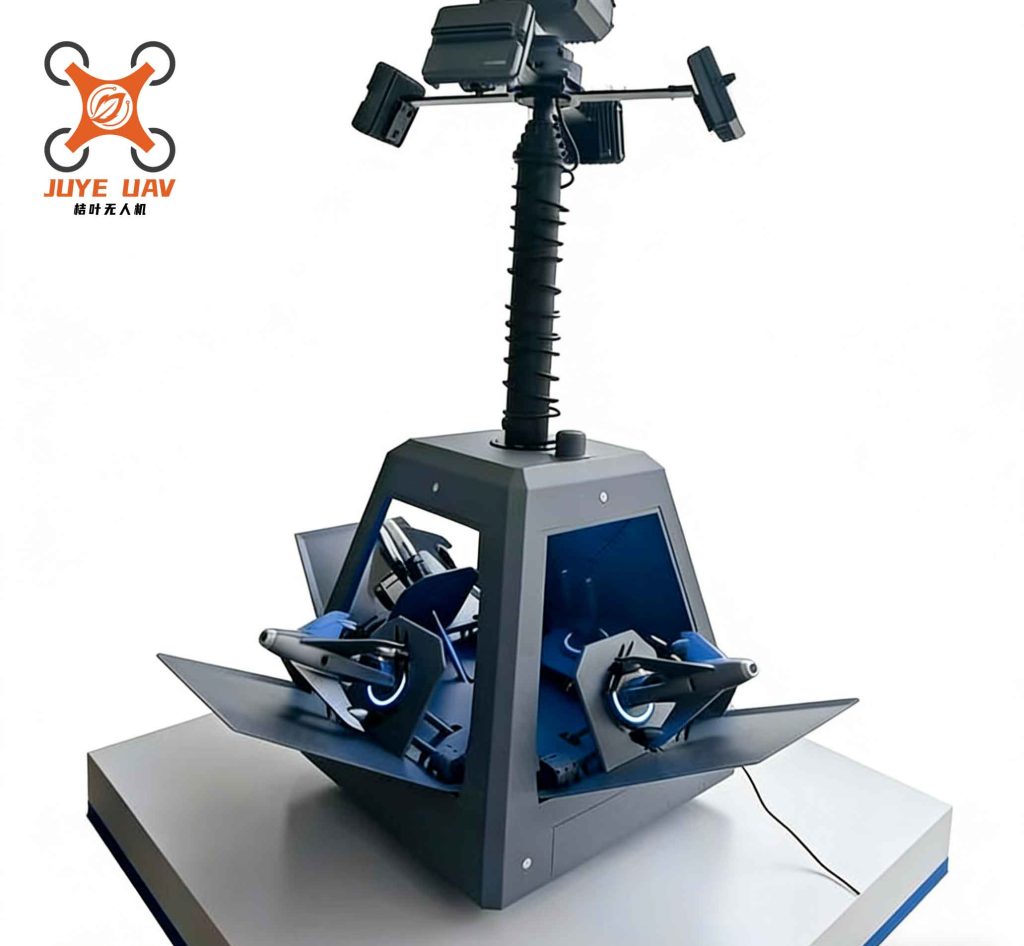
Global Development Dynamics in Anti-Drone Capabilities
The international pursuit of anti-drone solutions reflects diverse strategic priorities and industrial strengths.
United States: Institutionalization and Technological Edge
The U.S. approach is characterized by strong top-down institutionalization. The establishment of the Joint Counter-small UAS Office (JCO) and the publication of successive strategic documents (e.g., the Counter-Small UAS Strategy) aim to synchronize efforts across services. This includes mandating common systems for procurement to ensure interoperability, moving towards a “plug-and-play” ecosystem for anti-drone technologies. Technologically, the focus is on scalability and smart systems. Projects like the Tactical High-power Microwave Operational Responder (THOR) target drone swarms, while efforts in miniaturized, collaborative interceptors (e.g., small, communicable missiles) and tube-launched anti-drone UAVs carrying HPM payloads highlight trends towards network-centric and autonomous solutions.
Russia: Hybrid “Hard” and “Soft” Solutions
Russian developments showcase a parallel pursuit of kinetic and non-kinetic means. Innovations include loitering munition-based aerial denial systems designed to create persistent “shields” against swarms. In the soft-kill domain, portable electromagnetic rifles like the REX-1 provide soldier-portable disruption capabilities. Crucially, there is a significant investment in integrating artificial intelligence (AI) for automated threat detection, classification (Friend/Foe identification), and response within their anti-drone systems, aiming for rapid, crew-independent operation.
NATO and Other Key Players: Seeking Interoperability and Novel Effects
NATO’s focus is on developing a coherent, alliance-wide framework, as seen in publications like the “Integrated Counter-UAS Approach.” The goal is to foster cross-domain expertise. Other nations contribute specialized technologies. For instance, companies have developed systems that use RF techniques to non-destructively seize control of drones, landing them safely—a crucial capability for sensitive environments. Other innovations include lightweight, wearable personal anti-drone jammers and highly portable, multi-role detection radars capable of spotting both micro-UAS and personnel.
| Region/Entity | Strategic Emphasis | Representative Technology Trends | Key Challenge Addressed |
|---|---|---|---|
| United States | Doctrine, Interoperability, Scalable Effects | High-Power Microwave (Swarm), Networked Mini-Kinetics, Common C2* Systems | Swarm threats, service integration, cost-effective defense. |
| Russia | Hybrid Kill Chains, AI Integration | Loitering Aerial Mines, Portable EM Guns, AI-Powered Detection/ID | Automated response, soldier-portable capability, swarm defense. |
| Israel / Other Tech Exporters | Precision Effects, Non-Kinetic Takeover | RF Hijacking Systems, Wearable Jammers, Portable Multi-Mission Radars | Safe neutralization in crowds, personal protection, detection of low-signature drones. |
| NATO | Standardization & Integrated Multi-Domain Defense | Cross-Service Doctrine, Unified Tactical Procedures | Alliance interoperability, holistic battle-space management. |
*C2: Command and Control
Prevailing Challenges in Contemporary Anti-Drone Systems
Despite rapid progress, the anti-drone domain faces significant hurdles that impede optimal development and deployment.
1. Theoretical and Doctrinal Lag: Beyond a few leading nations, there is often a lack of comprehensive doctrine, standardized tactical manuals, and clear operational protocols for anti-drone warfare. This absence hampers effective training, command and control, and the coherent integration of systems into broader military operations.
2. Technological and Operational Limitations: Each anti-drone modality has inherent constraints. Soft-kill jammers can cause collateral electromagnetic interference in civilian areas. Kinetic solutions risk creating hazardous debris, especially if the drone is carrying explosive or chemical payloads, leading to potential secondary effects. The effectiveness of many systems can be degraded by complex urban terrain or advanced drone protocols like frequency hopping and autonomous navigation.
3. Market Fragmentation and Lack of Cohesion: The booming commercial and defense demand has spurred numerous independent developments, but often without unified technical standards. This results in systems that are not interoperable, leading to information silos, redundant development efforts, and higher life-cycle costs. The equation for total system cost often suffers from these inefficiencies:
$$ C_{total} = C_{R\&D} + C_{acquisition} + C_{integration} + C_{maintenance} $$
Where uncoordinated development inflates \( C_{integration} \) and \( C_{maintenance} \).
Future Trajectories: The Path Towards Intelligent, Multi-Dimensional Defense
The evolution of anti-drone systems points toward convergence, intelligence, and dimensional superiority.
1. Integration and System-of-Systems Fusion: Future effectiveness lies not in standalone systems but in integrated networks. The trend is toward fusing sensors (radar, RF, electro-optical, acoustic) into a common operational picture, seamlessly cueing various effectors (jammers, lasers, interceptors). This “system-of-systems” approach, governed by robust Command, Control, Communications, Computers, and Intelligence (C4I) architecture, maximizes the overall probability of negation, \( P_N \).
2. Miniaturization, Mobility, and Artificial Intelligence: As drones become smaller and more agile, countermeasures must follow. We will see increasingly portable, rapidly deployable anti-drone systems suitable for mobile units and urban operations. AI and machine learning (ML) will be central, moving from assisted to autonomous operation. AI will enable real-time sensor fusion, pattern recognition for anomalous drone behavior, predictive threat analysis, and optimal engagement allocation, especially against swarms. This leads to the concept of “intelligent vs. intelligent” warfare and “unmanned anti-drone” platforms.
3. Multi-Dimensional Warfare and the “Dimensional Advantage”: The ultimate anti-drone strategy may involve operating in domains beyond the physical and electromagnetic. This includes:
- Cyberspace: Pre-emptive attacks on drone manufacturing supply chains or control software.
- Information/Spectral Domain: Dominating the electromagnetic spectrum to deny all communications and sensing.
- Cognitive Domain: Influencing or deceiving human drone operators.
By combining capabilities across these dimensions, a defender can achieve a “dimensional advantage,” akin to a form of strategic “降维打击” (dimensionality reduction strike), overwhelming a simpler UAS threat with complex, multi-faceted effects that are difficult to counter. The future anti-drone paradigm can be modeled as a multi-objective optimization problem seeking to maximize effectiveness while minimizing cost and collateral damage across \( m \) dimensions:
$$ \text{Maximize } F(\vec{x}) = [f_1(\vec{x}), f_2(\vec{x}), … f_m(\vec{x})] $$
$$ \text{where } f_k(\vec{x}) \text{ represents performance in dimension } k \text{ (e.g., physical kill, cyber denial, EM control),} $$
$$ \text{and } \vec{x} \text{ represents the vector of deployed anti-drone assets and tactics.} $$
Conclusion
The dialectic between drone and anti-drone technology is a primary engine of innovation in aerial warfare. Each advance in UAS capability provokes a corresponding leap in countermeasure sophistication. The current trajectory, steering towards integrated, intelligent, and multi-dimensional systems, suggests that the future of air defense will be increasingly defined by autonomous network-on-network contests. The nation or alliance that most effectively synthesizes these elements—doctrine, interoperable technology, and artificial intelligence—into a cohesive anti-drone ecosystem will secure a decisive advantage in protecting its airspace against the pervasive and evolving drone threat.