
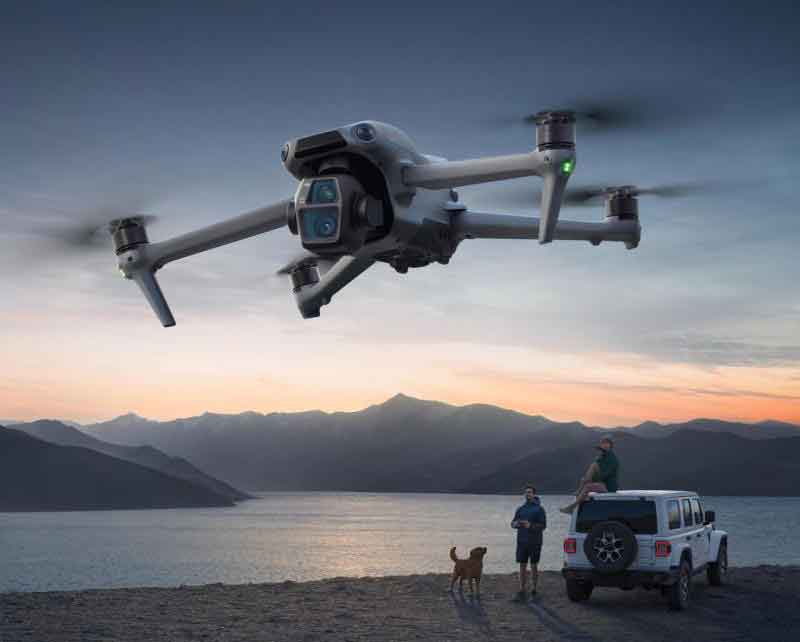
The proliferation of unmanned aerial vehicle (UAV) technology has significantly amplified concerns regarding low-altitude security. Consequently, the effective radar-based detection and identification of these unmanned drone targets has become a critical research and operational imperative. The radar echo from a typical unmanned drone is a multicomponent signal, primarily comprising returns from the relatively stable main body (e.g., the fuselage) and time-varying returns from its micro-motion components (e.g., rotors or propellers). The micro-Doppler effect induced by these moving parts serves as a crucial signature for target classification. However, in applications like inverse synthetic aperture radar (ISAR) imaging, the micro-Doppler modulation can severely defocus the image of the main body. Conversely, for micro-Doppler feature extraction, the strong body return can obscure the weaker micro-motion signatures. Therefore, the effective separation of the body and micro-motion component echoes stands as a foundational challenge for the comprehensive radar processing of unmanned drone targets.
Existing methods for echo separation can be broadly categorized into parametric, time-domain, and time-frequency domain techniques. Parametric methods, such as those based on Hough or Radon transforms, project time-frequency representations onto parameter domains but often require pre-defined motion models, leading to potential model mismatch. Time-domain approaches, including Empirical Mode Decomposition (EMD) or Variational Mode Decomposition (VMD), decompose the signal into intrinsic mode functions but can struggle with mode mixing and lack rigorous mathematical foundations for radar-specific signals. Time-frequency methods utilize statistical properties in the joint time-frequency domain but their performance is highly dependent on the concentration of the signal’s energy, which can be degraded by noise or complex motion.
Inspired by advancements in low-rank matrix recovery theory, this work proposes a novel separation framework based on the low-rank and sparse decomposition (LRSD) of a Hankel matrix constructed from the radar echo. For an unmanned drone observed by a narrowband radar over a short coherent integration time, where the main body’s motion can be approximated as uniform, the Hankel matrix corresponding to the body’s echo exhibits a low-rank structure. In contrast, the echo from rotating blades or propellers manifests as sinusoidal frequency modulations, which do not possess this low-rank property in the Hankel domain but can be considered sparse in the time-frequency domain. This inherent structural difference allows us to formulate the separation problem as one of decomposing the aggregate Hankel matrix into low-rank and sparse components. Furthermore, acknowledging the ubiquitous presence of noise in practical radar systems, we explicitly incorporate a noise term into the model, transforming it into a three-component decomposition problem.
To solve this optimization problem robustly and efficiently, we employ a Factorized Group-Sparse Regularization (FGSR) approach. Instead of directly minimizing the rank using the nuclear norm—a convex surrogate—FGSR factorizes the low-rank matrix and imposes group-sparsity penalties on its factor matrices. This method provides a tighter relaxation of the rank function compared to the nuclear norm, especially when using the Schatten-p norm with \( p = 1/2 \) or \( 2/3 \), leading to more accurate low-rank recovery. We solve the resulting non-convex optimization model using a Linearized Alternating Direction Method of Multipliers (L-ADMM) algorithm, which offers computational efficiency and reliable convergence. The effectiveness and robustness of the proposed FGSR-based method are rigorously validated through both simulated data of a multi-component unmanned drone target and real measured data from a fixed-wing unmanned drone.
1. Problem Formulation via Hankel Matrix LRSD
When a radar operates at a sufficiently high frequency, an unmanned drone target can be effectively modeled as a collection of point scatterers. The composite baseband echo signal \( s(t) \) from \( K \) scatterers can be expressed as:
$$
s(t) = \sum_{k=1}^{K} A_k(t) \exp\left\{ j2\pi \int_{0}^{t} f_k(s) ds + \phi_k \right\} + \eta(t)
$$
where \( A_k(t) \) is the reflectivity, \( f_k(t) = -\frac{2}{\lambda} \frac{d R_k(t)}{dt} \) is the instantaneous Doppler frequency (\( \lambda \) being the wavelength), \( R_k(t) \) is the instantaneous range, \( \phi_k \) is the initial phase for the \( k \)-th scatterer, and \( \eta(t) \) is additive noise. For the main body scatterers of an unmanned drone under mild maneuvering, \( f_k(t) \) can be approximated as constant, while for rotating blades, it is sinusoidal.
We discretize the received signal \( s(t) \) into \( s[n] \), \( n = 1, 2, …, M \). A short-time Fourier transform (STFT) is applied to obtain a time-frequency representation \( \mathbf{S} \in \mathbb{C}^{M \times L} \), where \( M \) is the number of frequency bins and \( L \) is the number of time frames. Critically, the STFT operation with maximum overlap (hop size = 1) can be interpreted as constructing a Hankel matrix from the 1D signal followed by a windowing and partial Fourier transform. Let \( \mathbf{s} \in \mathbb{C}^{N \times L} \) denote this Hankel matrix constructed from \( s[n] \), structured as:
$$
\mathbf{s} = \begin{bmatrix}
s[1] & s[2] & \cdots & s[L] \\
s[2] & s[3] & \cdots & s[L+1] \\
\vdots & \vdots & \ddots & \vdots \\
s[N] & s[N+1] & \cdots & s[M]
\end{bmatrix}, \quad M = N + L – 1
$$
We can then express the STFT matrix as \( \mathbf{S} = \mathbf{F} \mathbf{H} \mathbf{s} \), where \( \mathbf{F} \) is a partial Fourier matrix and \( \mathbf{H} \) is a diagonal windowing matrix.
Let \( \mathbf{s} = \mathbf{l} + \mathbf{x} \), where \( \mathbf{l} \) and \( \mathbf{x} \) are the Hankel matrices of the body and micro-motion components, respectively. Consequently, their time-frequency representations are \( \mathbf{L} = \mathbf{F} \mathbf{H} \mathbf{l} \) and \( \mathbf{X} = \mathbf{F} \mathbf{H} \mathbf{x} \), with \( \mathbf{S} = \mathbf{L} + \mathbf{X} + \mathbf{N} \), where \( \mathbf{N} \) represents noise in the time-frequency domain.
The key observation is that the Hankel matrix \( \mathbf{l} \) of the body component, consisting of a small number of constant-frequency signals, is inherently low-rank. This low-rank property is preserved through the linear operations of windowing and partial Fourier transform, implying that \( \mathbf{L} \) is also a low-rank matrix. The micro-Doppler component \( \mathbf{X} \), however, is not low-rank but is typically sparse or structured in the time-frequency domain. This leads to the following convex optimization formulation based on Robust Principal Component Analysis (RPCA):
$$
\min_{\mathbf{L}, \mathbf{X}} \|\mathbf{L}\|_* + \lambda \|\mathbf{X}\|_1 \quad \text{subject to} \quad \|\mathbf{S} – \mathbf{L} – \mathbf{X}\|_F \leq \delta
$$
where \( \|\cdot\|_* \) is the nuclear norm (sum of singular values, a convex surrogate for rank), \( \|\cdot\|_1 \) is the \( L_1 \) norm promoting sparsity, \( \lambda \) is a regularization parameter, and \( \delta \) bounds the noise energy. To handle the noise explicitly, we reformulate it as:
$$
\min_{\mathbf{L}, \mathbf{X}, \mathbf{N}} \|\mathbf{L}\|_* + \lambda \|\mathbf{X}\|_1 + \frac{\tau}{2}\|\mathbf{N}\|_F^2 \quad \text{subject to} \quad \mathbf{S} = \mathbf{L} + \mathbf{X} + \mathbf{N}
$$
where \( \tau \) is a penalty parameter.
2. Proposed Methodology: Factorized Group-Sparse Regularization
While the nuclear norm is a convex relaxation for rank, it can be suboptimal. The rank function and the nuclear norm are specific instances of the Schatten-p norm, defined for a matrix \( \mathbf{L} \) as \( \|\mathbf{L}\|_{S_p}^p = \sum_i \sigma_i^p(\mathbf{L}) \), where \( \sigma_i \) are the singular values. As \( p \to 0 \), \( \|\mathbf{L}\|_{S_p}^p \) approaches the rank. Setting \( p=1/2 \) or \( 2/3 \) provides a tighter, non-convex relaxation than the nuclear norm (\( p=1 \)). However, minimizing the Schatten-p norm directly requires costly singular value decomposition (SVD).
To address this, we employ Factorized Group-Sparse Regularization (FGSR). The core idea is to factorize the low-rank matrix \( \mathbf{L} = \mathbf{A}\mathbf{B}^T \), where \( \mathbf{A} \in \mathbb{C}^{M \times d} \), \( \mathbf{B} \in \mathbb{C}^{L \times d} \), and \( d \) is an upper bound on the rank. The rank of \( \mathbf{L} \) is then minimized by promoting column sparsity in \( \mathbf{A} \) and row sparsity in \( \mathbf{B}^T \). This is achieved by penalizing the \( L_{2,1} \) norm, defined as \( \|\mathbf{A}\|_{2,1} = \sum_{i=1}^d \|\mathbf{a}_i\|_2 \), which encourages entire columns to be zero.
The Schatten-p norm minimization can be approximated via this factorization. For \( p=1/2 \), the FGSR formulation is:
$$
\text{FGSR}_{1/2}(\mathbf{L}) = \min_{\mathbf{L}=\mathbf{A}\mathbf{B}^T} \frac{1}{2}(\|\mathbf{A}\|_{2,1} + \|\mathbf{B}\|_{2,1})
$$
For \( p=2/3 \), the corresponding relaxation is:
$$
\text{FGSR}_{2/3}(\mathbf{L}) = \min_{\mathbf{L}=\mathbf{A}\mathbf{B}^T} \frac{1}{3}(\|\mathbf{A}\|_{2,1}^2 + 2\|\mathbf{B}\|_{2,1}) \quad \text{(or a symmetric variant)}
$$
Applying the \( \text{FGSR}_{1/2} \) relaxation to our separation model yields the final optimization problem:
$$
\min_{\mathbf{A},\mathbf{B},\mathbf{X},\mathbf{N}} \frac{1}{2}(\|\mathbf{A}\|_{2,1} + \|\mathbf{B}\|_{2,1}) + \lambda \|\mathbf{X}\|_1 + \frac{\tau}{2}\|\mathbf{N}\|_F^2 \quad \text{s.t.} \quad \mathbf{S} = \mathbf{A}\mathbf{B}^T + \mathbf{X} + \mathbf{N}
$$
3. Solution via Linearized ADMM (L-ADMM)
We solve the constrained problem using the Augmented Lagrangian Method (ALM) and the Alternating Direction Method of Multipliers (ADMM). The augmented Lagrangian function is:
$$
\begin{aligned}
\mathcal{L}_{\rho_1, \rho_2}(\mathbf{A},\mathbf{B},\mathbf{X},\mathbf{N},\mathbf{Y}_1,\mathbf{Y}_2) = & \frac{1}{2}(\|\mathbf{A}\|_{2,1} + \|\mathbf{B}\|_{2,1}) + \lambda \|\mathbf{X}\|_1 + \frac{\tau}{2}\|\mathbf{N}\|_F^2 \\
& + \langle \mathbf{Y}_1, \mathbf{S} – \mathbf{A}\mathbf{B}^T – \mathbf{X} – \mathbf{N} \rangle + \frac{\rho_1}{2} \|\mathbf{S} – \mathbf{A}\mathbf{B}^T – \mathbf{X} – \mathbf{N}\|_F^2 \\
& + \langle \mathbf{Y}_2, \mathbf{L} – \mathbf{A}\mathbf{B}^T \rangle + \frac{\rho_2}{2} \|\mathbf{L} – \mathbf{A}\mathbf{B}^T\|_F^2
\end{aligned}
$$
where \( \mathbf{Y}_1, \mathbf{Y}_2 \) are Lagrange multipliers and \( \rho_1, \rho_2 > 0 \) are penalty parameters. We minimize this function alternately with respect to each variable while keeping others fixed. The sub-problem for \( \mathbf{A} \) is:
$$
\mathbf{A}^{(i+1)} = \arg\min_{\mathbf{A}} \frac{1}{2}\|\mathbf{A}\|_{2,1} + \frac{\rho_2}{2} \|\mathbf{A}\mathbf{B}^{(i)T} – \mathbf{L}^{(i)} + \frac{\mathbf{Y}_2^{(i)}}{\rho_2}\|_F^2
$$
This involves a non-smooth \( L_{2,1} \) norm and a quadratic term. We use L-ADMM, which linearizes the quadratic term around the current iterate \( \mathbf{A}^{(i)} \). The solution is then given by a group-soft-thresholding operation:
$$
\mathbf{A}^{(i+1)} = \text{GroupSoft}\left( \mathbf{A}^{(i)} – \frac{1}{\beta} \left[ \rho_2 (\mathbf{A}^{(i)}\mathbf{B}^{(i)T} – \mathbf{L}^{(i)} + \frac{\mathbf{Y}_2^{(i)}}{\rho_2})\mathbf{B}^{(i)} \right], \frac{1}{2\beta} \right)
$$
where the \( \text{GroupSoft}(\mathbf{Z}, \gamma) \) operator acts on each column \( \mathbf{z}_j \) of \( \mathbf{Z} \) as: \( \text{GroupSoft}(\mathbf{z}_j, \gamma) = \frac{\mathbf{z}_j}{\|\mathbf{z}_j\|_2} \max(\|\mathbf{z}_j\|_2 – \gamma, 0) \).
The sub-problem for \( \mathbf{X} \) is a standard \( L_1 \)-norm minimization:
$$
\mathbf{X}^{(i+1)} = \text{Soft}\left( \mathbf{S} – \mathbf{L}^{(i)} – \mathbf{N}^{(i)} + \frac{\mathbf{Y}_1^{(i)}}{\rho_1}, \frac{\lambda}{\rho_1} \right)
$$
where \( \text{Soft}(z, \gamma) = \text{sign}(z) \max(|z|-\gamma, 0) \) is the element-wise soft-thresholding operator.
The sub-problems for \( \mathbf{B}, \mathbf{L}, \mathbf{N} \) have closed-form solutions involving matrix inversions or simple linear equations. The Lagrange multipliers are updated via gradient ascent:
$$
\begin{aligned}
\mathbf{Y}_1^{(i+1)} &= \mathbf{Y}_1^{(i)} + \rho_1 (\mathbf{S} – \mathbf{L}^{(i+1)} – \mathbf{X}^{(i+1)} – \mathbf{N}^{(i+1)}) \\
\mathbf{Y}_2^{(i+1)} &= \mathbf{Y}_2^{(i)} + \rho_2 (\mathbf{L}^{(i+1)} – \mathbf{A}^{(i+1)}\mathbf{B}^{(i+1)T})
\end{aligned}
$$
The algorithm iterates until convergence, e.g., when the relative change in \( \mathbf{L} \) falls below a threshold \( \xi \). The final separated components are \( \mathbf{L} \) (body) and \( \mathbf{X} \) (micro-motion).
4. Experimental Results and Analysis
We validate the proposed method using both simulated and real radar data from an unmanned drone target. The parameters are set as follows: \( \lambda, \beta \) in the range [0.001, 0.04], \( \tau \) in [0.01, 0.1], \( \rho_1 = \rho_2 = \upsilon / \|\mathbf{S}\|_F \) with \( \upsilon \in [1,4] \), and convergence threshold \( \xi = 10^{-4} \). The factorization dimension \( d \) is set slightly above the expected rank.
4.1 Simulation with a Multi-Component Unmanned Drone Model
We simulate a Ku-band radar scenario (17 GHz) observing an unmanned drone model with 5 scatterers over 0.025 s. One scatterer represents the body with a constant radial velocity, and four represent rotating blades (length 0.33 m, speed 2100 RPM). The ideal, noise-free time-frequency representation shows distinct components. We add Gaussian white noise to achieve an SNR of 5 dB. We compare the proposed \( \text{FGSR}_{1/2} \) and \( \text{FGSR}_{2/3} \) methods against standard RPCA and Low-Complexity RPCA (LCRPCA).
The visual results demonstrate that both FGSR methods more cleanly extract the body’s constant Doppler line and more completely recover the sinusoidal micro-Doppler tracks compared to RPCA and LCRPCA, which leave more residual noise or artifacts.
| Method | Number of Iterations | Time per Iteration (s) | Total Time (s) |
|---|---|---|---|
| RPCA | 24 | 0.93 | 22.32 |
| LCRPCA | 13 | 0.78 | 10.14 |
| FGSR\(_{2/3}\) | 13 | 0.83 | 10.79 |
| FGSR\(_{1/2}\) | 10 | 0.82 | 8.20 |
To evaluate robustness, we compute the Root Mean Square Error (RMSE) between the extracted body component \( \hat{\mathbf{L}} \) and the ground truth \( \mathbf{L}_{true} \) over a range of SNRs, averaged over 100 Monte Carlo trials:
$$
\text{RMSE} = \sqrt{ \frac{1}{N_{pix}} \sum_{i=1}^{N_{pix}} ( |\hat{L}_i| – |L_{true,i}| )^2 }
$$
The results are summarized below, showing the superior performance of the FGSR methods, especially \( \text{FGSR}_{1/2} \), across most SNR levels.
| SNR (dB) | RPCA | LCRPCA | FGSR\(_{2/3}\) | FGSR\(_{1/2}\) |
|---|---|---|---|---|
| -10 | 0.452 | 0.438 | 0.231 | 0.225 |
| -5 | 0.187 | 0.179 | 0.098 | 0.092 |
| 0 | 0.112 | 0.108 | 0.065 | 0.059 |
| 5 | 0.085 | 0.082 | 0.052 | 0.045 |
| 10 | 0.071 | 0.069 | 0.046 | 0.039 |
4.2 Experiment with Real Unmanned Drone Data
We use real data of a hovering fixed-wing unmanned drone from a K-band FMCW radar (LSS-FMCWR-1.0 dataset). The time-frequency representation shows the dominant body return and weaker micro-Doppler curves from the single propeller. Applying the separation methods yields the following results. The FGSR methods again produce a cleaner body signature with less background noise and more distinct, complete micro-Doppler tracks compared to RPCA and LCRPCA. To quantitatively assess the quality of the extracted body component, we compute the Time-Frequency Spectrum Entropy (TFSE). A lower entropy indicates a more concentrated, less noisy representation.
| Method | Time-Frequency Spectrum Entropy |
|---|---|
| RPCA | 3.172 |
| LCRPCA | 3.183 |
| FGSR\(_{2/3}\) | 2.514 |
| FGSR\(_{1/2}\) | 2.347 |
The significantly lower entropy for the FGSR methods, particularly \( \text{FGSR}_{1/2} \), confirms their effectiveness in producing a more focused and denoised representation of the unmanned drone’s main body echo.
5. Conclusion
This work has presented a novel and robust framework for separating the body and micro-motion component echoes of an unmanned drone target in narrowband radar systems. By exploiting the inherent low-rank property of the main body’s echo in the Hankel matrix domain, the separation problem was formulated as a three-component low-rank, sparse, and noise matrix decomposition task. The core innovation lies in employing Factorized Group-Sparse Regularization to provide a tighter relaxation of the rank function than conventional nuclear norm minimization, leading to more accurate recovery. The associated optimization problem was solved efficiently using a Linearized ADMM algorithm.
Comprehensive experiments involving simulated multi-component unmanned drone signals and real measured FMCW radar data from a fixed-wing unmanned drone have conclusively demonstrated the effectiveness of the proposed approach. The \( \text{FGSR}_{1/2} \) and \( \text{FGSR}_{2/3} \) methods outperform standard RPCA and its low-complexity variant in terms of separation quality, noise suppression, and the clarity of the extracted micro-Doppler features. The \( \text{FGSR}_{1/2} \) variant generally showed the best performance among the tested methods. This technique provides a powerful tool for enhancing both ISAR imaging of unmanned drone bodies and the subsequent analysis of their micro-Doppler signatures for classification. Future work will explore adaptive parameter selection and the extension of this framework to handle more complex, highly maneuvering unmanned drone motions.