
The dual imperatives of green transformation and efficiency enhancement in agricultural production have starkly highlighted the constraints inherent in smallholder farming—high labor costs, elevated risks, and significant operational expenses. On one hand, the persistent outflow of young and middle-aged labor from rural areas, coupled with the rising demand for precision farm management, has exacerbated the tension between shrinking labor supply and the need for upgraded agricultural operations. On the other hand, concurrent goals such as pesticide reduction, pest control, yield stabilization, and supply security impose higher requirements for the accuracy, safety, and environmental sustainability of crop protection practices. In this context, modern agricultural technologies characterized by precision and intelligence are rapidly developing as a critical pathway to overcome traditional production constraints. The “Digital Agriculture and Rural Development Plan (2019–2025)” explicitly identifies production precision and management intelligence as key development directions, providing policy support for innovation and application in smart crop protection technologies. As a vital carrier for embedding digital technology into agricultural production, unmanned drone-based crop protection systems have gained prominence due to their advantages in efficiency, low damage, safety, and environmental friendliness, gradually becoming a frontier area for agricultural technological innovation and academic focus.
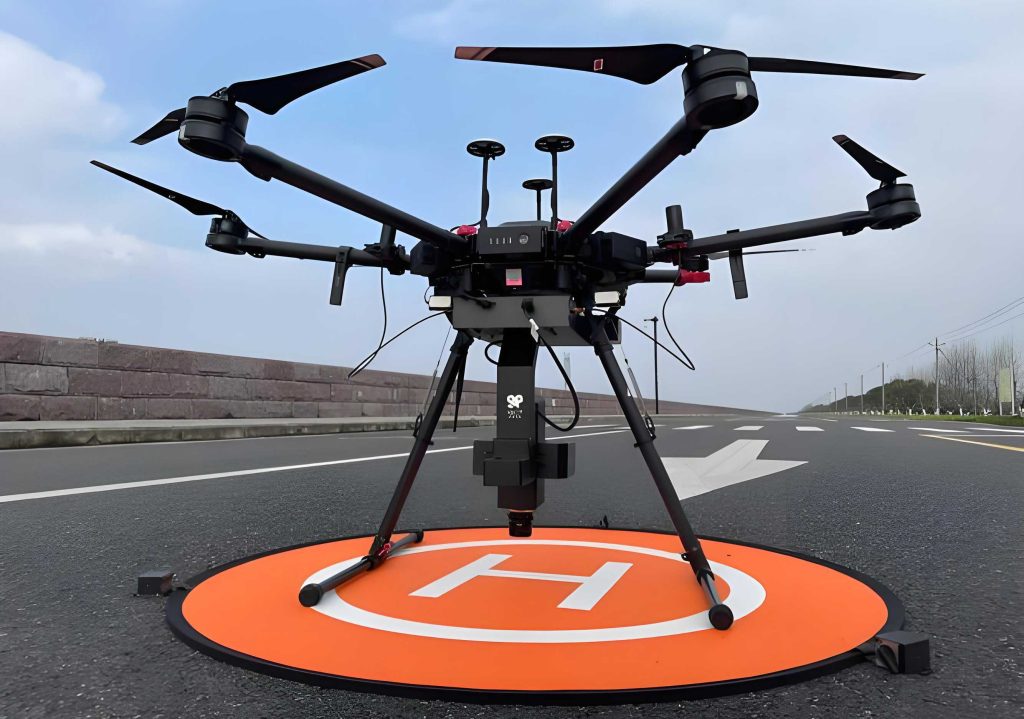
Compared to traditional plant protection machinery, unmanned drones offer distinct advantages in operational efficiency, resource allocation, and intelligent management, providing a practical technological pathway for reducing costs, increasing efficiency, and decreasing chemical usage in agriculture. Empirical data suggests that the adoption of aerial unmanned drone application for unified prevention and control can improve effectiveness by 10%–20% compared to farmers’ own methods, while reducing pesticide use by 20%–30%. Despite this promise, the pace of technology diffusion in practice often shows a mismatch with regional resource endowments and organizational capacity, leading to significant variations in the conversion efficiency of technological dividends across different geographical units. Therefore, understanding how unmanned drone crop protection technology is continuously translated into tangible income gains for farmers and how its benefits diffuse and transmit across spatial dimensions has become a pressing question for both academic research and policy implementation.
While existing literature has extensively explored the factors influencing agricultural technology adoption and its socio-economic effects, significant gaps remain concerning the economic consequences of low-altitude smart agricultural technologies like unmanned drones. Prior studies have primarily focused on traditional agronomic techniques and general agricultural mechanization. There is a need for systematic investigation into the income effects of unmanned drone technology. Furthermore, the mechanisms through which this technology promotes income growth—specifically, how it enhances farmers’ capability adaptation and expands their income channels—require deeper theoretical and empirical elaboration. Finally, research on smart agricultural technologies has largely concentrated on identifying local effects, with insufficient attention paid to potential spatial spillovers and their transmission pathways. Addressing these gaps, this article utilizes provincial panel data from China (2005–2023) and employs a two-way fixed effects model to systematically examine the impact of unmanned drone crop protection technology on farmer income, its underlying mechanisms, and its spatial spillover effects.
Theoretical Framework and Research Hypotheses
Direct Effect of Unmanned Drone Technology on Farmer Income
The theory of induced technological innovation posits that the direction of technological change is influenced by the scarcity and relative price changes of production factors. When a particular factor becomes increasingly scarce and its cost rises, innovation tends to progress toward substituting that factor. In contemporary China, the continuous outflow of rural labor has led to a tightening agricultural labor supply and rising relative wages. Pest and disease control, however, remains heavily reliant on manual labor, with operations being highly seasonal and time-sensitive. Labor shortages not only directly increase the cost of manual crop protection but also elevate the risk of missing critical application windows. Unmanned drone technology, by embedding digital recognition, intelligent control, and low-altitude operation capabilities into the pest management process, can substitute capital and technology for labor, thereby alleviating the operational pressures caused by rising labor costs and enhancing its substitutive advantage and application value.
From a practical standpoint, unmanned drone technology primarily intervenes in the crop protection segment, a critical link that directly affects yield stability and operational revenue. By entering this segment, unmanned drones enhance operational efficiency, expand coverage, and improve responsiveness to key application timings. This helps farmers complete tasks promptly during critical pest control windows, increasing the stability and controllability of the agricultural production process. Simultaneously, this technology promotes the intelligent and standardized development of crop protection operations, improving the fit between modern agricultural production and smallholder farm management, and alleviating constraints related to labor allocation, production organization, and technology application. Consequently, by optimizing the agricultural production process and boosting farm profitability, unmanned drone technology can directly contribute to increasing farmers’ income.
This leads to the first hypothesis:
$$ H1: \text{The adoption and use of unmanned drone-based crop protection technology directly increases farmers’ income.} $$
Indirect Effects and Transmission Mechanisms
Whether technology adoption translates into income growth depends not only on the technology’s inherent productivity but also on farmers’ capacity to absorb, utilize, and transform it. This analysis considers two primary indirect pathways: capability adaptation and income diversification. The former reflects the internal conditions that allow farmers to convert technological resources into actual earnings, while the latter represents the pathways through which technology extends their income sources.
Capability Adaptation Pathway: Sen’s Capability Approach suggests that an individual’s well-being is influenced not only by resource endowment but also by their ability to convert those resources into valuable outcomes. For farmers, the key to stable income growth from technology adoption lies in possessing capabilities that match the technology’s requirements, such as information acquisition, technical comprehension, and risk management. The promotion and application of unmanned drone technology continuously influence farmers’ cognitive patterns and operational behaviors. It enhances their ability to acquire, identify, and utilize information on crop growth, pest dynamics, and market conditions, shifting agricultural management from experience-based judgment to information-supported decision-making. Furthermore, integrating dynamic monitoring, comprehensive decision-making, and automated execution, unmanned drone technology increases the controllability of agricultural production, reduces decision-making complexity under uncertainty, and thereby strengthens farmers’ risk identification and bearing capacities. Enhanced capability adaptation makes it easier for farmers to translate technological advantages into operational profits.
Income Diversification Pathway: The Smile Curve theory posits that technology investment can propel value chain movement from low-value-added to high-value-added segments. Traditional smallholders often occupy the lower end of the agricultural value chain, with income heavily reliant on singular production revenue, limiting their risk resilience. The diffusion of unmanned drone technology fosters deeper agricultural division of labor and service outsourcing, generating new demand for productive services like aerial spraying, equipment leasing,托管 services, technical training, and maintenance. In this process, some farmers transition from being mere producers to engaging in technical and operational service provision, developing a dual income structure combining production and service revenues. Their position in the value chain rises, and their income sources become more diversified.
Therefore, the indirect income-enhancing effects of unmanned drone technology are realized through two main channels: enhancing farmers’ capability adaptation, which improves their ability to convert technological resources into income; and expanding service-based income channels, encouraging a shift from singular production earnings to a复合 income structure. This leads to the following hypotheses:
$$ H2: \text{Unmanned drone crop protection technology indirectly increases farmer income by enhancing their capability adaptation.} $$
$$ H3: \text{Unmanned drone crop protection technology indirectly increases farmer income by expanding their service-based income channels.} $$
In summary, unmanned drone crop protection technology empowers farmers’ income growth through both direct and indirect pathways. The direct effect stems from improved production processes and enhanced farm profitability. The indirect effects operate via increased capability adaptation and diversified income channels.
Research Design and Methodology
Model Specification
To accurately identify the causal effect of unmanned drone technology use on farmer income, a two-way fixed effects panel model is constructed:
$$ \ln(\text{Income}_{it}) = \alpha_1 + \alpha_2 \ln(\text{DCPT}_{it}) + \phi_1 \mathbf{Controls}_{it} + \sigma_i + \mu_t + \epsilon_{it} \quad (1) $$
where \(\ln(\text{Income}_{it})\) is the natural logarithm of the per capita disposable income of rural households in province \(i\) and year \(t\); \(\ln(\text{DCPT}_{it})\) is the natural logarithm of the operational area covered by agricultural aircraft (proxy for unmanned drone technology use intensity) in province \(i\) and year \(t\); \(\mathbf{Controls}_{it}\) is a vector of control variables; \(\sigma_i\) and \(\mu_t\) represent province and year fixed effects, respectively; and \(\epsilon_{it}\) is the random error term. The coefficient \(\alpha_2\) is the parameter of primary interest.
To test the proposed mediation mechanisms, the following models are employed, following established procedure:
$$ \text{Mech}_{it} = \beta_1 + \beta_2 \ln(\text{DCPT}_{it}) + \phi_2 \mathbf{Controls}_{it} + \sigma_i + \mu_t + \epsilon_{it} \quad (2) $$
$$ \ln(\text{Income}_{it}) = \gamma_1 + \gamma_2 \ln(\text{DCPT}_{it}) + \gamma_3 \text{Mech}_{it} + \phi_3 \mathbf{Controls}_{it} + \sigma_i + \mu_t + \epsilon_{it} \quad (3) $$
where \(\text{Mech}_{it}\) represents the mechanism variable (capability adaptation or income diversification).
Variable Definitions and Data
The dependent variable is Farmer Income Level (\(\ln(\text{Income})\)), measured as the natural log of per capita disposable income of rural households. The core explanatory variable, Unmanned Drone Crop Protection Technology Use Intensity (\(\ln(\text{DCPT})\)), is proxied by the natural log of the operational area of agricultural aircraft. This proxy is justified as post-2018 data shows植保 unmanned drones account for over 95% of this metric, ensuring continuity and representativeness at the provincial level. Robustness checks use the share of agricultural aircraft operational area in total sown area and the number of agricultural aircraft.
Mechanism variables are constructed as follows:
- Capability Adaptation: Measured via two proxies: Information Acquisition Ability (ln(number of rural broadband subscribers)) and Risk-bearing Capacity (ln(scale of farmers’ fixed asset investment)).
- Income Diversification: Measured by Service-based Income Expansion (ln(gross output value of agriculture, forestry, animal husbandry, and fishery services)).
Control variables include agricultural structure adjustment, agricultural scale level, socialization service level, fiscal support for agriculture, labor input, education level, average annual relative humidity, and annual sunshine hours. Data spans 2005–2023 for 30 Chinese provinces, sourced from statistical yearbooks including the China Machinery Industry Statistical Yearbook, China Meteorological Yearbook, and China Rural Statistical Yearbook.
| Variable Category | Variable | Definition | Mean | Std. Dev. |
|---|---|---|---|---|
| Dependent Variable | Farmer Income Level | Ln(Per Capita Disposable Income of Rural Households) | 9.138 | 0.674 |
| Core Explanatory Variable | Unmanned Drone Tech Use Intensity | Ln(Agricultural Aircraft Operational Area) | 3.959 | 3.008 |
| Mechanism Variables | Information Acquisition Ability | Ln(Number of Rural Broadband Subscribers) | 2.415 | 3.319 |
| Risk-bearing Capacity | Ln(Farmers’ Fixed Asset Investment Scale) | 5.147 | 1.172 | |
| Service-based Income Expansion | Ln(Gross Output Value of Agri. Services) | 4.219 | 1.414 | |
| Control Variables | Agricultural Structure Adjustment | 1 – (Agriculture Output/Total Agri. Output) | 0.475 | 0.086 |
| Agricultural Scale Level | Total Sown Area / Rural Population | 2.860 | 1.965 | |
| Socialization Service Level | Agricultural Service Output / Sown Area | 0.414 | 0.399 | |
| Fiscal Support for Agriculture | Agricultural Fiscal Expenditure / Total Expenditure | 0.107 | 0.035 | |
| Labor Input | Ln(Primary Sector Employment) | 6.240 | 1.115 | |
| Education Level | Average Years of Schooling | 9.007 | 1.053 | |
| Avg. Annual Relative Humidity | Main City Average Relative Humidity | 4.174 | 0.165 | |
| Annual Sunshine Hours | Main City Annual Sunshine Hours | 7.563 | 0.299 |
Empirical Results and Analysis
Baseline Regression Results
The baseline results, controlling for province and year fixed effects, are presented in Table 2. Both current-period and one-period lagged effects of unmanned drone technology use are examined. The coefficients for \(\ln(\text{DCPT})\) are positive and statistically significant at the 1% level across all specifications, with or without control variables. The results indicate that a one-unit increase in the log of unmanned drone operational area is associated with an approximate 10.97% increase in current-period farmer income and a 10.05% increase in the following period. This demonstrates that the income-enhancing effect of unmanned drone technology is not only immediate but also exhibits persistence, suggesting technological dividends are released continuously through deepening application, experience accumulation, and diffusion. Hypothesis H1 is preliminarily validated.
| Variable | (1) Current Effect | (2) Current Effect | (3) Lagged Effect | (4) Lagged Effect |
|---|---|---|---|---|
| Unmanned Drone Tech Use Intensity | 0.009*** (4.27) | 0.012*** (5.60) | 0.009*** (4.22) | 0.011*** (5.55) |
| Controls | NO | YES | NO | YES |
| Province FE | YES | |||
| Year FE | YES | |||
| Observations | 570 | |||
| Adj. R² | 0.994 | 0.995 | 0.994 | 0.994 |
| Note: t-statistics in parentheses; *** p<0.01, ** p<0.05, * p<0.1. | ||||
Endogeneity and Robustness Checks
To address potential reverse causality (where higher income may lead to greater technology adoption), terrain ruggedness at the provincial level interacted with year dummies is used as an instrumental variable (IV). The rationale is that terrain ruggedness is exogenous and influences the suitability for mechanized operations like unmanned drone use. The Two-Stage Least Squares (2SLS) results confirm the robustness of the baseline findings (Table 3). The first-stage F-statistic is strong (42.59), and the second-stage coefficient for \(\ln(\text{DCPT})\) remains positive and significant at the 1% level.
Further robustness tests include replacing the core explanatory variable with alternative measures (share of operational area, number of aircraft) and winsorizing the data at 1% and 3% levels to mitigate outlier influence. As shown in Table 4, the results remain consistently positive and significant, reinforcing the conclusion that unmanned drone technology robustly promotes farmer income growth.
| Variable | (1) First Stage Dep. Var.: Ln(DCPT) | (2) Second Stage Dep. Var.: Ln(Income) |
|---|---|---|
| IV: Terrain Ruggedness × Year | 0.013*** (6.53) | |
| Unmanned Drone Tech Use Intensity | 0.073*** (6.46) | |
| Kleibergen-Paap rk LM statistic (p-val) | 46.045*** [0.00] | |
| Cragg-Donald Wald F statistic {10%临界值} | 45.588 {16.380} | |
| Controls, Province FE, Year FE | YES | |
| Observations | 570 | |
| Variable | (1) Share of Op. Area | (2) Number of Aircraft | (3) Winsorize 1% | (4) Winsorize 3% |
|---|---|---|---|---|
| Alternative Core Variable / Ln(DCPT)_w | 0.009*** (4.08) | 0.021*** (8.82) | 0.012*** (5.89) | 0.009*** (3.70) |
| Controls, Province FE, Year FE | YES | |||
| Observations | 475 | 570 | 570 | 570 |
| Adj. R² | 0.995 | 0.995 | 0.995 | 0.993 |
Heterogeneity Analysis
The impact of unmanned drone technology is examined across different income types and cropping structures (Table 5). The technology significantly boosts wage income and net operating income (both at 1% level) but shows no significant effect on property income or transfer income. This indicates that the primary增收 channel is through enhancing productivity and creating new employment/service opportunities within the agricultural sphere, rather than affecting asset-based or policy-driven incomes.
Furthermore, the interaction between unmanned drone technology use and the proportion of cash crops sown is positive and significant (1% level). This suggests the income-enhancing effect is more pronounced in regions with a higher share of economically valuable crops, likely because these crops demand more precise and technical management, where the benefits of unmanned drone application in terms of quality preservation, loss reduction, and efficiency gain are more readily translated into higher revenue.
| Variable | (1) Wage Income | (2) Net Oper. Income | (3) Property Income | (4) Transfer Income | (5) Interaction: Cash Crop Share |
|---|---|---|---|---|---|
| Unmanned Drone Tech Use Intensity | 0.016*** (2.91) | 0.020*** (3.18) | -0.013 (-1.18) | 0.001 (0.06) | 0.022*** (7.03) |
| Controls, Province FE, Year FE | YES | ||||
| Observations | 570 | ||||
| Adj. R² | 0.981 | 0.935 | 0.924 | 0.935 | 0.995 |
Mechanism Analysis
The mediation analysis results are presented in Table 6. Columns (1) and (3) show that unmanned drone technology use significantly enhances both Information Acquisition Ability and Risk-bearing Capacity. When these mechanism variables are added to the income regression (Columns 2 & 4), their coefficients are positive and significant, while the coefficient for \(\ln(\text{DCPT})\) remains significant. This confirms the partial mediating role of capability adaptation, supporting Hypothesis H2.
Similarly, Column (5) shows that unmanned drone technology use promotes Service-based Income Expansion. Column (6) confirms its significant mediating role in the income equation. This validates the income diversification pathway, supporting Hypothesis H3. Thus, unmanned drone technology empowers farmers not only by making them more capable producers but also by enabling them to become service providers, thereby diversifying and increasing their income streams.
| Variable | Capability Adaptation: Info. Acquisition | Capability Adaptation: Risk-bearing | Income Diversification: Service Expansion | |||
|---|---|---|---|---|---|---|
| (1) Mech: Info | (2) Ln(Income) | (3) Mech: Risk | (4) Ln(Income) | (5) Mech: Service | (6) Ln(Income) | |
| Unmanned Drone Tech Use Intensity | 0.335*** (4.94) | 0.010*** (4.98) | 8.873*** (3.28) | 0.010*** (5.17) | 0.028** (2.33) | 0.010*** (4.75) |
| Mechanism Variable | 0.003** (2.04) | 0.000*** (5.93) | 0.069*** (6.62) | |||
| Controls, Province FE, Year FE | YES | |||||
| Observations | 570 | |||||
| Adj. R² | 0.798 | 0.995 | 0.853 | 0.995 | 0.970 | 0.995 |
Spatial Spillover Effects
The application of unmanned drone technology likely generates spatial externalities. To examine this, spatial econometric models are employed. Global Moran’s I tests under four different spatial weight matrices (contiguity, economic distance, geographical distance, economic-geographical nested) consistently show significant positive spatial autocorrelation for farmer income across all sample years (exemplified in Table 7 for selected years), indicating spatial clustering.
Diagnostic tests (LM, LR, Wald, Hausman) favor the Spatial Durbin Model (SDM) with two-way fixed effects. The SDM estimation results (Table 9) reveal a positive and significant spatial autoregressive coefficient (rho) across all matrices, confirming spatial interdependence in income growth. Crucially, the decomposition of effects shows significant positive direct effects (impact within a province) and, more importantly, significant positive indirect (spillover) effects. This indicates that the adoption and use of unmanned drone technology in one province not only raises local farmers’ income but also generates positive spillovers, boosting income in neighboring and economically/geographically proximate provinces. This spatial diffusion may occur through technology demonstration, information flow, and labor/service mobility across borders.
| Year | W1 (Contiguity) | W2 (Economic Dist.) | W3 (Geog. Dist.) | W4 (Econ-Geog. Nested) |
|---|---|---|---|---|
| 2005 | 0.581*** (5.036) | 0.377*** (4.219) | 0.454*** (5.152) | 0.277*** (5.984) |
| 2015 | 0.591*** (5.137) | 0.361*** (4.075) | 0.515*** (5.815) | 0.279*** (6.047) |
| 2023 | 0.584*** (5.113) | 0.374*** (4.239) | 0.500*** (5.696) | 0.280*** (6.111) |
| Note: Z-statistics in parentheses; *** p<0.01. All matrices show significant positive autocorrelation for all years 2005-2023. | ||||
| Variable / Effect | W1 (Contiguity) | W2 (Economic Dist.) | W3 (Geog. Dist.) | W4 (Econ-Geog. Nested) |
|---|---|---|---|---|
| Ln(DCPT) – Direct | 0.004 (1.23) | 0.012** (2.52) | 0.001 (0.45) | 0.011*** (2.60) |
| W × Ln(DCPT) | 0.020*** (4.25) | 0.012 (1.59) | 0.020** (2.30) | 0.038*** (2.69) |
| rho (spatial lag) | 0.367*** (4.30) | 0.287*** (2.64) | 0.430*** (3.75) | 0.569*** (5.53) |
| Direct Effect | 0.006* (1.90) | 0.013** (2.56) | 0.003 (1.04) | 0.015*** (2.73) |
| Indirect (Spillover) Effect | 0.032*** (4.09) | 0.022* (1.75) | 0.035*** (2.69) | 0.112* (1.86) |
| Total Effect | 0.038*** (3.96) | 0.035** (2.18) | 0.038*** (2.79) | 0.127** (1.99) |
| Controls, Province FE, Year FE | YES | |||
| Observations / Provinces | 570 / 30 | |||
Discussion and Implications
This study extends the literature on the economic effects of smart agricultural technologies by shifting focus to low-altitude intelligent equipment like unmanned drones, complementing existing work on traditional agronomic techniques. While prior micro-level studies highlight unit-area收益 gains and cost savings from unmanned drone adoption, this macro-level analysis confirms significant aggregate income effects with both contemporaneous and lagged impacts, suggesting a systemic, multi-channel influence beyond simple cost reduction.
The identification of the dual-channel “capability adaptation–income diversification” mechanism provides a nuanced theoretical explanation. It aligns with the Capability Approach’s emphasis on conversion factors and the Smile Curve’s logic of value chain upgrading, offering a fresh perspective on how smart agricultural technologies empower farmers. This moves beyond a simple productivity narrative to consider changes in farmers’ intrinsic abilities and economic opportunities.
Furthermore, the application of spatial econometrics reveals significant positive spatial spillovers from unmanned drone technology adoption. This finding enriches the spatial analysis paradigm for smart agriculture technologies, indicating that in increasingly digitalized and servitized agricultural systems, the flow of technology and service elements can foster synergistic income growth across regions, contributing to more balanced rural development.
Conclusion and Policy Recommendations
Based on provincial panel data from China (2005–2023), this study empirically examines the impact, mechanisms, and spatial effects of unmanned drone-based crop protection technology on farmer income. The main conclusions are:
- Unmanned drone technology significantly promotes farmer income growth, with robust current and lagged effects, increasing income by approximately 10.97% and 10.05%, respectively.
- Heterogeneity exists: the effect is more pronounced on wage and net operating income, and is stronger in regions with a higher share of cash crop cultivation.
- The technology operates through two key indirect channels: enhancing farmers’ capability adaptation (information acquisition and risk-bearing) and expanding their service-based income opportunities.
- Farmer income exhibits spatial clustering, and unmanned drone technology generates significant positive spatial spillovers, boosting income not only locally but also in neighboring and economically/geographically proximate regions.
These findings suggest several policy directions:
- Establish a Two-Way Feedback Mechanism: Policy tools like subsidies, training, and equipment leasing should lower adoption barriers. Simultaneously, feedback loops from farm-level pest control challenges to R&D entities should be strengthened to ensure technology supply meets on-ground production needs.
- Implement Differentiated Promotion Strategies: In regions specialized in high-value cash crops, targeted promotion and the development of crop-specific unmanned drone application protocols can maximize efficiency and income translation. Policies should also encourage the integration of technological efficiency gains with value chain extension.
- Refine the Multi-dimensional Empowerment System: Support should focus on three areas: (a) Skills: Enhance digital operation and data literacy training. (b) Risk Mitigation: Develop tailored insurance and credit products for unmanned drone-related risks. (c) Service Diversification: Actively foster agricultural socialized services to help farmers transition into service provision roles.
- Promote Regional Coordination and Synergy: Encourage cross-regional collaboration platforms for technology R&D, data sharing (e.g., pest monitoring), and standard harmonization. Improving infrastructure connectivity and coordinated governance can reduce spatial and institutional barriers to technology diffusion, allowing the dividends of unmanned drone technology to be shared more widely and equitably, supporting agricultural modernization and balanced regional development.