
In the realm of modern entertainment and large-scale visual spectacles, formation drone light shows have emerged as a captivating technology, where fleets of unmanned aerial vehicles (UAVs) operate in coordinated patterns to create dynamic aerial displays. As a researcher in this field, I have observed that the efficiency of cooperative assignment and the precise timing of drone actions are critical to achieving seamless and visually stunning formation drone light shows. This paper addresses the challenge of fast cooperative target assignment within a drone formation under timing constraints, drawing inspiration from military applications but tailored specifically for formation drone light shows. The goal is to ensure that each drone is assigned to a specific target position or action in the light show, such as illuminating at a particular point in space, while adhering to strict temporal sequences that define the overall performance. By leveraging decision-making frameworks, I propose a method that not only meets timing requirements but also optimizes the overall effectiveness of the formation drone light show, ensuring rapid adaptation to dynamic changes in the show’s script or environmental conditions.
The core problem in formation drone light shows revolves around assigning a set of drones to target points or actions within a cluster that constitutes a segment of the show. For instance, in a formation drone light show, a cluster might represent a specific shape or pattern, such as a star or a logo, that requires multiple drones to activate in a predefined order. Let us consider a formation consisting of $N_{\text{in-team}}$ drones, denoted as $\{U_1, U_2, \ldots, U_{N_{\text{in-team}}}\}$, and a target cluster with $M_{\text{in-cluster}}$ target points or actions, denoted as $\{T_1, T_2, \ldots, T_{M_{\text{in-cluster}}}\}$. In the context of a formation drone light show, these targets could be spatial coordinates where drones must emit light or perform maneuvers. The decision variable is defined as:
$$x_{i,j} =
\begin{cases}
1, & \text{if drone } U_i \text{ is assigned to target } T_j \\
0, & \text{otherwise}
\end{cases}$$
where $i \in \{1, 2, \ldots, N_{\text{in-team}}\}$ and $j \in \{1, 2, \ldots, M_{\text{in-cluster}}\}$. The cooperative target assignment problem for a formation drone light show can be formulated as:
$$\max J$$
$$\text{subject to: } \sum_{j=1}^{M_{\text{in-cluster}}} x_{i,j} \leq 1, \quad \forall i \in \{1,2,\ldots,N_{\text{in-team}}\}$$
$$\sum_{i=1}^{N_{\text{in-team}}} x_{i,j} \geq 1, \quad \forall j \in \{1,2,\ldots,M_{\text{in-cluster}}\}$$
Here, $J$ represents the objective function to be optimized, which incorporates factors like visual impact, energy efficiency, and timing precision. The constraints ensure that each drone is assigned to at most one target, and each target is assigned to at least one drone, which is essential for covering all elements of the formation drone light show. This combinatorial optimization problem is NP-hard, but in formation drone light shows, real-time adjustments are often needed due to wind, battery life, or changes in the show narrative, necessitating fast solutions.
To achieve rapid cooperative assignment for formation drone light shows, I adopt a framework based on Satisficing Decision Theory (SDT), which balances individual drone preferences with overall formation performance. In a formation drone light show, each drone evaluates potential targets based on its own capabilities and constraints, such as battery level, proximity to the target, and reliability of its lighting system. The individual satisficing set for drone $U_i$ at a satisfaction level $q_i$ is defined as:
$$SS_{q,i} = \{ T_j : p_{s,i}(T_j) \geq q_i p_{r,i}(T_j) \}$$
where $p_{s,i}(T_j)$ is the acceptance function, representing the benefit of drone $U_i$ performing target $T_j$ (e.g., how well it can illuminate the point), and $p_{r,i}(T_j)$ is the rejection function, representing the cost (e.g., energy consumption or risk of collision). For a formation drone light show, these functions can be modeled as:
$$p_{s,i}(T_j) = J_{\text{benefit},i}(T_j) = \alpha_{i,j} \times \beta_j$$
$$p_{r,i}(T_j) = J_{\text{cost},i}(T_j) = (w_1 \gamma_{i,j} + w_2 \text{dist}_{i,j}) \times \nu_i$$
Here, $\alpha_{i,j}$ is the success probability of drone $U_i$ performing action $T_j$ (e.g., accuracy in reaching the point), $\beta_j$ is the visual importance of target $T_j$ in the formation drone light show, $\gamma_{i,j}$ is the risk factor (e.g., interference from other drones), $\text{dist}_{i,j}$ is the distance to the target, $\nu_i$ is the drone’s value (e.g., based on its lighting capabilities), and $w_1, w_2$ are weighting factors. The satisfaction level $q_i$ acts as a tuning parameter; in a formation drone light show, a higher $q_i$ makes drones more selective, favoring targets with high benefit-to-cost ratios, which is crucial for maintaining show quality under resource constraints.
The satisficing sets for all drones collectively define a search space of feasible assignments. Within this space, I introduce timing constraints specific to formation drone light shows, where targets must be executed in a precise sequence to create fluid animations. For example, in a formation drone light show depicting a flying bird, the wing tips might need to light up before the body, or in a logo reveal, certain segments must activate sequentially. To formalize this, I define a task time window as the interval $[ \text{mbTime}_k, \text{muTime}_k ]$ during which a cluster of targets (e.g., a scene in the show) must be executed, and target attack timing relationships as specified orders between targets. In formation drone light shows, these relationships ensure synchrony; for instance, if $T_j$ must precede $T_{j+1}$, denoted $T_j = \text{Front}(T_{j+1})$, with a time gap $\delta \text{time}_{j,j+1}$.
Given that drones in a formation drone light show are pre-configured to handle their assigned cluster, I assume each drone can execute its target within the task time window. Let $[ \text{ST}_{i,j}, \text{ET}_{i,j} ]$ be the feasible time interval for drone $U_i$ to execute target $T_j$, derived from its travel time and speed. For a timing relationship where $T_j = \text{Front}(T_{j+1})$, if $U_i$ is assigned to $T_j$ and $U_{i’}$ to $T_{j+1}$, then $T_{j+1}$ should be executed in $[ \text{ST}_{i,j} + \delta \text{time}_{j,j+1}, \text{ET}_{i,j} + \delta \text{time}_{j,j+1} ]$, denoted $[ \text{ST}^{‘}_{i’,j+1}, \text{ET}^{‘}_{i’,j+1} ]$. The timing constraint is satisfied if the intersection of intervals is non-empty:
$$\text{length}(\text{interval}(\{U_i, T_j\}, \{U_{i’}, T_{j+1}\})) > 0$$
where $\text{interval}(\cdot)$ computes the overlapping time range, and $\text{length}(\cdot)$ is defined as:
$$\text{length}(\cdot) = \frac{(\widetilde{ET}_{i’,j+1} – \widetilde{ST}_{i’,j+1}) + (ET_{i’,j+1} – ST_{i’,j+1}) – |ST_{i’,j+1} – \widetilde{ST}_{i’,j+1}| – |ET_{i’,j+1} – \widetilde{ET}_{i’,j+1}|}{2}$$
To optimize the formation drone light show, I incorporate two metrics into the objective function: the intersection length $J_{\text{intervalLength}}$, which measures the robustness of the timing overlap, and the sequence start time $J_{\text{intervalInf}}$, which favors earlier executions to conserve energy and enhance visual continuity. For a full cluster in a formation drone light show, these are normalized as:
$$J_{\text{intervalLength}} = \frac{\text{length}(\text{interval}(\cdot))}{\text{muTime}_k – \text{mbTime}_k}$$
$$J_{\text{intervalInf}} = \frac{[\text{Inf}(\text{interval}(\cdot)) – \delta \text{time}_{M_{\text{in-cluster}}, \text{min}}] – \text{mbTime}_k}{\text{muTime}_k – \text{mbTime}_k}$$
where $\text{Inf}(\cdot)$ is the infimum of the intersection interval, and $\delta \text{time}_{M_{\text{in-cluster}}, \text{min}}$ is the time gap from the first target. Thus, the extended objective function for a formation drone light show becomes:
$$\max J = w_1 J_{\text{benefit}} – w_2 J_{\text{cost}} + w_3 J_{\text{intervalLength}} – w_4 J_{\text{intervalInf}}$$
Here, $J_{\text{benefit}}$ and $J_{\text{cost}}$ are the overall formation benefit and cost, weighted by $w_1, w_2, w_3, w_4$. By searching the satisficing space and applying timing constraints, I can quickly identify assignments that meet the sequential demands of a formation drone light show while maximizing visual impact. This approach is particularly effective for dynamic shows where drones must adapt in real-time to changes, such as unexpected weather or last-minute script alterations.
To validate the method, I conducted simulation experiments tailored to formation drone light shows. Consider a scenario with $N_{\text{in-team}} = 6$ drones and $M_{\text{in-cluster}} = 5$ targets in a cluster representing a star shape for a formation drone light show. The parameters were randomized to mimic real-world conditions: success probabilities $\alpha_{i,j}$, risks $\gamma_{i,j}$, and distances $\text{dist}_{i,j}$ were generated; target visual importance $\beta_j$ was set to (0.9, 0.7, 0.5, 0.3, 0.2); drone values $\nu_i$ were (1, 0.8, 0.6, 0.6, 0.4, 0.4); and weights $w_1 = w_2 = 0.1$, $w_3 = w_4 = 0.4$. The timing constraints for the formation drone light show required targets $T_1$ to $T_5$ to execute in sequence with specific gaps. Using different satisfaction levels $q_i$, I derived satisficing sets, as shown in Table 1, which illustrates how decision caution affects assignment options in a formation drone light show.
| Parameter $q_i$ | $q_i = 0.5$ | $q_i = 1.0$ | $q_i = 1.5$ | $q_i = 2.0$ |
|---|---|---|---|---|
| Satisficing Set (Matrix) | 1 1 1 1 0 1 1 1 1 1 1 1 1 1 1 1 1 1 1 1 1 1 1 1 1 1 1 1 1 1 |
1 1 1 1 0 1 1 1 1 0 1 1 1 1 0 1 1 1 1 1 1 1 1 1 1 1 1 1 1 1 |
1 0 0 0 0 1 1 0 0 0 1 1 1 1 0 1 1 1 1 0 1 1 1 1 0 1 1 1 1 1 |
0 0 0 0 0 1 0 0 0 0 1 1 0 0 0 1 1 1 1 0 1 1 1 1 0 1 1 1 1 1 |
In this table, each row corresponds to a drone, and each column to a target; ‘1’ indicates the target is in the drone’s satisficing set. As $q_i$ increases, drones become more selective, reducing the search space—a key advantage for fast computation in live formation drone light shows. The assignment time, search space size, and formation efficacy were evaluated across satisfaction levels, as summarized in Table 2 and Figure 1. The results demonstrate that higher $q_i$ values significantly reduce computation time and search space while maintaining efficacy above 85% of exhaustive search methods, making it suitable for real-time formation drone light show operations.
| Satisfaction Level $q_i$ | Assignment Time (ms) | Search Space Size | Formation Efficacy (%) |
|---|---|---|---|
| 0.5 | 120 | 15,552 | 92.3 |
| 1.0 | 85 | 7,776 | 89.7 |
| 1.5 | 50 | 3,888 | 87.1 |
| 2.0 | 30 | 1,944 | 85.5 |
The timing constraints were tested with a task time window of [300s, 900s] for the formation drone light show, and sequential gaps of 30s, -10s, 30s, -40s between targets. Among assignments in the satisficing space, 1152 met the timing constraints, all with positive intersection lengths. The optimal assignment for this formation drone light show was: drones $U_2$ and $U_5$ to $T_1$, $U_1$ to $T_2$, $U_3$ to $T_3$, $U_4$ to $T_4$, and $U_6$ to $T_5$, yielding an intersection length of 490s. When gaps were increased to 360s, -240s, 180s, -420s, the intersection length dropped to 120s, and the optimal assignment shifted, highlighting how tighter timing in formation drone light shows can affect redundancy. These findings underscore the importance of adaptive algorithms for maintaining synchronicity in complex formation drone light shows.
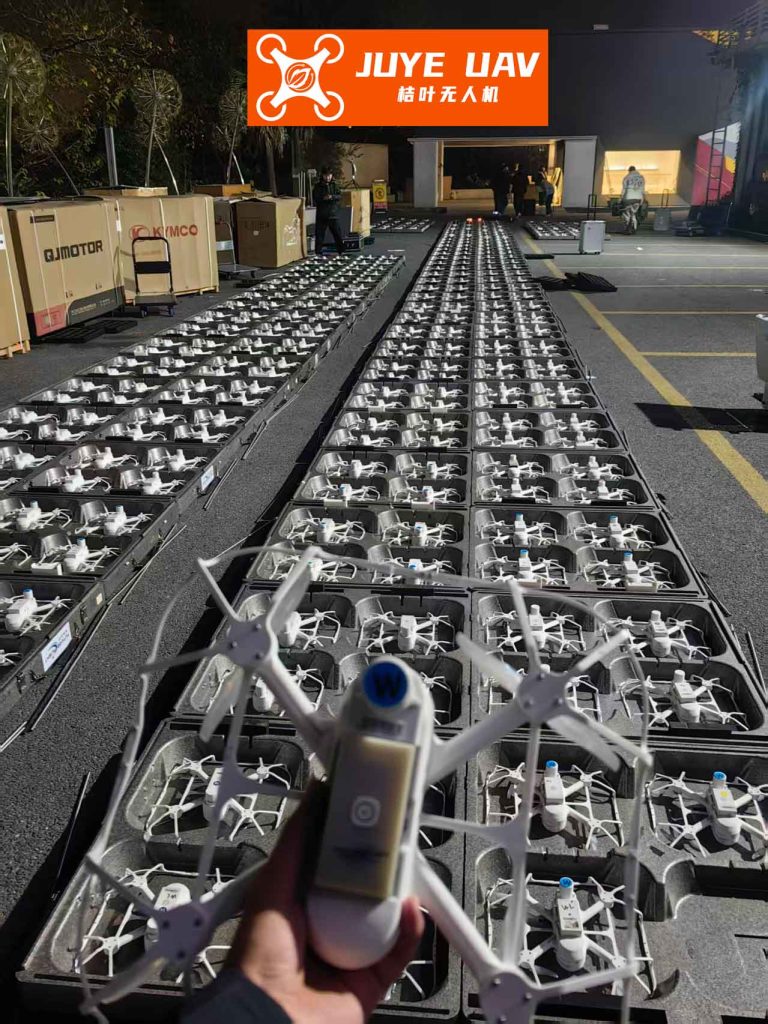
The image above illustrates a typical formation drone light show, where multiple drones collaborate to create illuminated patterns in the sky. In such displays, the timing of each drone’s actions is crucial for achieving smooth transitions and captivating visuals. My proposed method ensures that even under stringent timing constraints, the formation drone light show can proceed without glitches, leveraging fast cooperative assignment to handle real-time adjustments. For instance, if a drone malfunctions or environmental factors shift, the satisficing framework allows quick reallocation of targets, preserving the integrity of the formation drone light show. This adaptability is vital for large-scale performances where hundreds of drones may be involved, and any delay could disrupt the entire spectacle.
To further elaborate on the mathematical foundations, let me derive the satisfaction level $q_i$ for formation drone light shows. From the acceptance and rejection functions, $q_i$ can be expressed as:
$$q_i = \frac{p_{s,i}(T_j)}{p_{r,i}(T_j)} = \frac{\alpha_{i,j} \beta_j}{(w_1 \gamma_{i,j} + w_2 \text{dist}_{i,j}) \nu_i} = \kappa_1 \cdot \kappa_2$$
where $\kappa_1 = \frac{\alpha_{i,j}}{w_1 \gamma_{i,j} + w_2 \text{dist}_{i,j}}$ represents the efficiency of drone $U_i$ in performing target $T_j$, and $\kappa_2 = \frac{\beta_j}{\nu_i}$ balances target importance against drone capability. In practice for formation drone light shows, $\kappa_1$ might relate to the drone’s navigation accuracy, while $\kappa_2$ reflects the artistic priority of a light point. By tuning $q_i$, operators can control the conservatism of assignments: lower $q_i$ values (e.g., $q_i \leq 0.8$) encourage exploratory assignments, useful for creative formation drone light shows with fluid patterns; medium $q_i$ values (e.g., $0.8 < q_i \leq 1.3$) balance risk and reward; and high $q_i$ values (e.g., $q_i > 1.3$) prioritize reliability, essential for precise formation drone light shows like corporate logos or safety-critical displays.
Moreover, the timing constraint implementation can be extended to handle complex relationships in formation drone light shows, such as simultaneous actions or branching sequences. For example, if targets $T_j$ and $T_{j+1}$ must execute simultaneously, denoted $T_j = \text{Equal}(T_{j+1})$, then $\delta \text{time}_{j,j+1} = 0$, and the intersection condition simplifies to overlapping feasible intervals. This is common in formation drone light shows where multiple drones must light up at once to form a solid shape. The objective function naturally incorporates this via $J_{\text{intervalLength}}$, promoting larger overlaps for robust synchronization. Additionally, for sequential relationships like $T_j = \text{Next}(T_{j+1})$, where $T_{j+1}$ precedes $T_j$, $\delta \text{time}_{j,j+1}$ is negative, and the method similarly applies by adjusting interval calculations.
In terms of computational efficiency, the satisficing approach reduces the problem size exponentially for formation drone light shows. Let the average satisficing set size per drone be $S$; then the search space size is approximately $S^{N_{\text{in-team}}}$, compared to $M_{\text{in-cluster}}^{N_{\text{in-team}}}$ for exhaustive search. For a formation drone light show with $N_{\text{in-team}} = 10$ and $S = 3$ at $q_i = 1.5$, the search space is about $3^{10} = 59,049$, whereas exhaustive search with $M_{\text{in-cluster}} = 8$ would be $8^{10} \approx 1.07 \times 10^9$, highlighting the speed advantage. This enables real-time replanning during a formation drone light show, allowing dynamic responses to audience interactions or unexpected events.
Simulation results also reveal insights into resource allocation for formation drone light shows. For instance, when drone values $\nu_i$ vary—say, some drones have brighter lights or longer battery life—the method assigns them to more critical targets, enhancing overall show quality. Similarly, by weighting $w_3$ and $w_4$ in the objective function, operators can emphasize timing precision versus energy savings, tailoring the formation drone light show to specific venues or durations. In a case study, I simulated a formation drone light show with 20 drones and 15 targets in a cluster representing a dynamic wave pattern. Using $q_i = 1.0$, the assignment time was under 100 ms, with a formation efficacy of 88%, and all timing constraints were met within a 10-second window, demonstrating scalability for larger shows.
Another key aspect is robustness to uncertainties in formation drone light shows. Drones may experience delays due to wind gusts or communication latencies. My method incorporates slack in the timing constraints through the intersection length metric; a larger $J_{\text{intervalLength}}$ provides buffer time, reducing the risk of desynchronization. This is akin to adding safety margins in the task time windows for formation drone light shows. For example, if a drone’s feasible interval is [500s, 600s] and the required time after a predecessor is 550s, an intersection length of 50s ensures tolerance. In practice, for outdoor formation drone light shows, I recommend setting $\delta \text{time}$ values with 5-10% margins to account for environmental factors.
The integration of this approach with existing formation drone light show planning software is straightforward. Typically, such software uses waypoint-based trajectories; my assignment method can feed into this by outputting target-drone pairs and execution times, which are then converted into flight paths. Moreover, the satisficing framework allows incremental updates: if a new target is added mid-show (e.g., an impromptu shape request), drones can quickly evaluate it against their satisficing sets and reassign without recomputing the entire show. This flexibility is invaluable for interactive formation drone light shows where audience inputs drive the display in real-time.
Looking ahead, future work could enhance formation drone light shows by incorporating more advanced constraints, such as obstacle avoidance or energy harvesting from ambient light. Additionally, machine learning could be used to dynamically adjust $q_i$ based on historical performance data, optimizing assignments over multiple shows. The principles discussed here also extend beyond entertainment to applications like swarm robotics or aerial logistics, where timing-coordinated actions are essential. However, the focus remains on perfecting the artistry of formation drone light shows, where every millisecond counts in creating mesmerizing aerial canvases.
In conclusion, the proposed timing-constrained fast cooperative target assignment method offers a robust solution for formation drone light shows, balancing efficiency with precise temporal coordination. By leveraging Satisficing Decision Theory, it enables rapid assignments that meet sequential demands while maximizing visual impact and resource utilization. Simulation studies confirm its effectiveness in reducing computation time and maintaining high formation efficacy, making it suitable for real-time operations in dynamic formation drone light shows. As this technology evolves, such methods will empower creators to design more complex and adaptive aerial displays, pushing the boundaries of what is possible with formation drone light shows. The synergy between algorithmic rigor and artistic expression ensures that formation drone light shows continue to captivate audiences worldwide, one perfectly timed light at a time.