
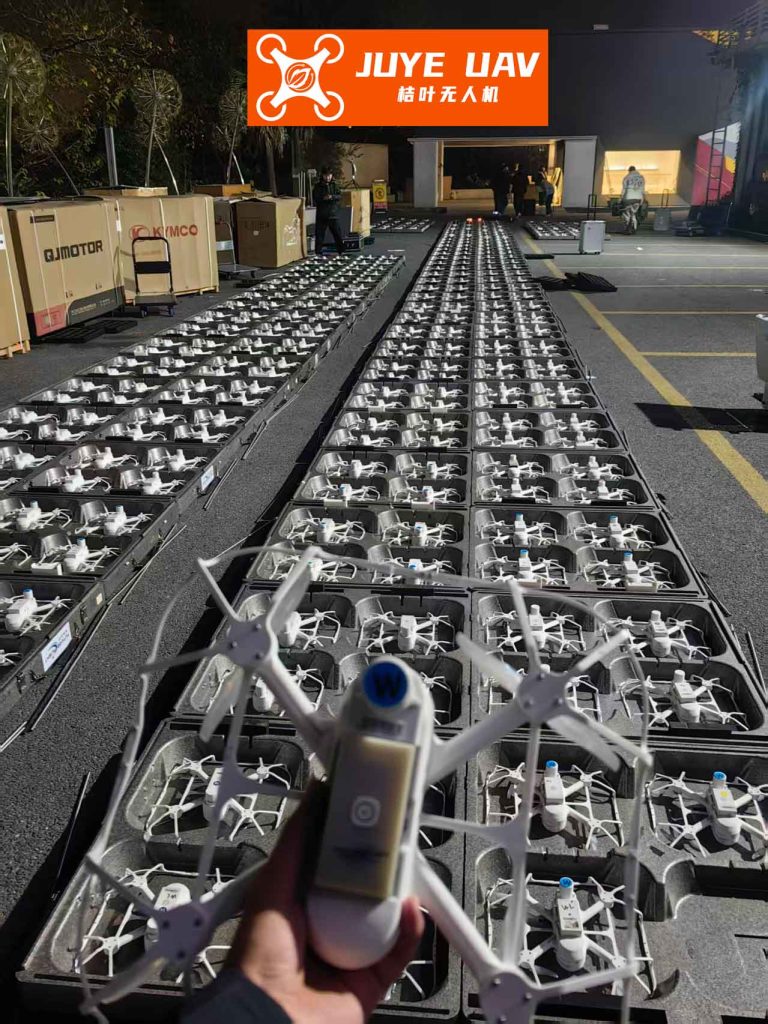
In recent years, formation drone light shows have captivated audiences worldwide, where fleets of unmanned aerial vehicles (UAVs) perform synchronized aerial displays to create stunning visual patterns in the night sky. As a researcher focused on bio-inspired control systems, I have explored how natural phenomena, such as the flight formations of wild geese, can enhance the efficiency and robustness of these formation drone light shows. The challenge lies in designing controllers that enable UAVs to quickly form and maintain precise formations while resisting disturbances like wind gusts, which is critical for ensuring flawless performances in formation drone light shows. Inspired by the energy-saving mechanisms observed in geese flocks, I have developed a proportional-integral-derivative (PID) controller for UAV formation flight, optimized using a Levy flight pigeon-inspired optimization (LFPIO) algorithm. This approach aims to reduce energy consumption and increase operational range, making it ideal for large-scale formation drone light shows that require endurance and precision.
The core idea stems from the observation that geese fly in a V-formation to exploit upwash airflow from leading birds, reducing individual energy expenditure by 11–14%. Similarly, in a formation drone light show, UAVs can benefit from aerodynamic interactions if positioned optimally. However, achieving and sustaining such formations amidst environmental disruptions is non-trivial. Traditional PID controllers, while widely used in engineering, often require meticulous parameter tuning to balance rapid formation assembly and disturbance rejection. To address this, I have formulated a bio-inspired optimization framework that leverages the Levy flight pigeon-inspired optimization to fine-tune PID parameters, ensuring that UAVs in a formation drone light show can swiftly align into patterns and recover from perturbations. This article details my methodology, from modeling UAV dynamics to optimizing controllers, with simulations demonstrating superior performance in formation drone light show scenarios.
Wild geese exhibit remarkable coordination during migration, flying in a V-shaped pattern that minimizes energy consumption through aerodynamic drafting. When a goose flaps its wings, it generates trailing vortices that create upwash zones along the sides. Subsequent geese positioning themselves within these zones experience reduced drag, allowing them to glide more efficiently. Studies in fluid dynamics suggest that the optimal lateral spacing for maximum benefit is approximately −0.11 times the wingspan, with overlapping wingtips by about one-tenth. This natural optimization has direct parallels in formation drone light shows, where UAVs must maintain specific relative positions to maximize battery life and stability. By emulating this behavior, I aim to design controllers that enable UAVs to autonomously achieve and hold these energy-efficient formations, crucial for extended performances in formation drone light shows that often last hours.
To model the UAV dynamics for a formation drone light show, I consider a fleet of fixed-wing UAVs, though the principles can extend to multi-rotor systems common in displays. The longitudinal, lateral, and vertical motions are governed by simplified first-order and second-order models for speed, heading, and altitude control. For a leader UAV (analogous to the lead goose) and follower UAVs (akin to trailing geese), the state equations incorporate relative positions and aerodynamic effects. The leader’s model is described as:
$$ \dot{x}_L = V_L \cos \psi_L + \dot{y}_E, $$
$$ \dot{y}_L = V_L \sin \psi_L – \dot{x}_E, $$
$$ \dot{h}_L = \frac{1}{\tau_a \tau_b} \left( \frac{1}{\tau_a} + \frac{1}{\tau_b} \right)^{-1} h_{Lc}, $$
where \( x_L, y_L, h_L \) are the leader’s positions and altitude, \( V_L \) is speed, \( \psi_L \) is heading angle, and \( \dot{x}_E, \dot{y}_E \) represent wind disturbances. The follower UAV model accounts for upwash effects from the leader, with forces modeled using aerodynamic coefficients:
$$ \dot{x}_W = V_W \cos \psi_W + \Delta \dot{x}, $$
$$ \dot{y}_W = V_W \sin \psi_W + \frac{qS}{m} \left( C_{Y_y} y + C_{Y_z} z \right), $$
$$ \dot{V}_W = \frac{1}{\tau_V} (V_{Wc} – V_W) + \frac{qS}{m} C_{D_z} z, $$
$$ \dot{\psi}_W = \frac{1}{\tau_{\psi}} (\psi_{Wc} – \psi_W), $$
$$ \dot{h}_W = \frac{1}{\tau_a \tau_b} \left( \frac{1}{\tau_a} + \frac{1}{\tau_b} \right)^{-1} (h_{Lc} – h_W) + \frac{qS}{m} C_{L_y} y, $$
where subscript \( W \) denotes followers, \( q \) is dynamic pressure, \( S \) is wing area, \( m \) is mass, and \( C \) terms are lift, drag, and side-force coefficients. These equations form the basis for simulating formation drone light show maneuvers, with controllers driving UAVs to desired relative positions.
For formation control in a formation drone light show, I designed PID controllers that adjust each follower’s speed, heading, and altitude based on errors relative to the leader. The error signals combine positional deviations in three axes: longitudinal (\( e_x \)), lateral (\( e_y \)), and vertical (\( e_z \)). The control laws are:
$$ V_{Wc} = k_{XP} e_x + k_{XI} \int_0^t e_x \, d\tau + k_{XD} \frac{de_x}{dt}, $$
$$ \psi_{Wc} = k_{YP} e_y + k_{YI} \int_0^t e_y \, d\tau + k_{YD} \frac{de_y}{dt}, $$
$$ h_{Wc} = k_{ZP} e_z + k_{ZI} \int_0^t e_z \, d\tau + k_{ZD} \frac{de_z}{dt}, $$
where \( k_{XP}, k_{XI}, k_{XD} \), etc., are PID gains to be optimized. In a formation drone light show, these controllers enable UAVs to form geometric patterns like V-shapes or grids, but manual tuning is inefficient. Thus, I employ optimization algorithms to find gain sets that minimize formation time and enhance disturbance rejection, key for dynamic formation drone light shows.
The pigeon-inspired optimization (PIO) algorithm mimics how pigeons navigate using tools like the sun, magnetic fields, and landmarks. It involves two operator models: the map and compass operator for global search and the landmark operator for local refinement. However, standard PIO can converge prematurely in complex spaces like controller tuning for formation drone light shows. To improve global search capability, I integrated Levy flights, which are random walks with step lengths following a heavy-tailed distribution, enabling occasional long jumps to escape local optima. The Levy flight PIO (LFPIO) updates positions as:
$$ \text{step} = \frac{X_{\text{leader}} – X_{i}^{N_c}}{|X_{\text{leader}} – X_{i}^{N_c}|} \cdot \text{Levy}(\beta), $$
$$ X_{i}^{N_c+1} = X_{i}^{N_c} + \text{step} \cdot \text{randn}, $$
where \( \text{Levy}(\beta) \sim s^{-\beta-1} \) for \( 0 < \beta \leq 2 \), with \( \beta = 1.5 \) typically. This promotes diversity in searching the PID parameter space. The landmark operator is modified as:
$$ X_{i}^{N_c+1} = X_{i}^{N_c} + \text{Length} \cdot \text{randn}, $$
$$ \text{Length} = \text{logsig}\left( \frac{N_c_{\text{max}} – N_c}{k} \right), $$
where \( \text{logsig} \) is a logistic function that shrinks search steps over iterations. Applied to formation drone light show controller tuning, LFPIO optimizes the nine PID gains by minimizing a cost function that penalizes slow formation assembly and poor recovery from wind gusts.
To evaluate performance in a formation drone light show context, I defined a cost function \( J \) that balances formation time \( T_1 \) and recovery time \( T_2 \) after a disturbance:
$$ J = k_1 T_1 + k_2 T_2, $$
with \( k_1 = k_2 = 0.5 \). Here, \( T_1 \) is the time for UAVs to reach within 5% error of desired positions in longitudinal and lateral axes, and within 0.5 m in altitude and 0.5° in heading. \( T_2 \) is similarly defined for recovery after a simulated gust from 10 to 15 seconds. The wind gust model is:
$$ V_x = \frac{V_{x_{\text{max}}}}{2} \left(1 – \cos\left( \frac{2\pi t}{5} \right)\right), $$
$$ V_y = \frac{V_{y_{\text{max}}}}{2} \left(1 – \cos\left( \frac{2\pi t}{5} \right)\right), $$
with \( V_{x_{\text{max}}} = 50 \, \text{m/s} \) and \( V_{y_{\text{max}}} = 60 \, \text{m/s} \). This mimics real-world challenges in outdoor formation drone light shows where weather can disrupt patterns.
I compared LFPIO against particle swarm optimization (PSO) and standard PIO in tuning PID parameters for a five-UAV formation drone light show. The UAV parameters are listed in Table 1, which are typical for medium-sized fixed-wing drones used in displays. Initial states were randomized to simulate arbitrary starting positions, as common in formation drone light show setups.
| Parameter | Symbol | Value |
|---|---|---|
| Mass | \( m \) | 11,350 kg |
| Dynamic Pressure | \( q \) | 760.68 kg/m² |
| Wing Area | \( S \) | 27.87 m² |
| Wingspan | \( b \) | 9.17 m |
| Speed Time Constant | \( \tau_V \) | 3 s |
| Heading Time Constant | \( \tau_{\psi} \) | 0.75 s |
| Altitude Time Constants | \( \tau_a, \tau_b \) | 0.31 s, 3.85 s |
| Leader Desired Speed | \( V_{c1} \) | 251 m/s |
| Leader Desired Altitude | \( h_{c1} \) | 12,000 m |
| Drag Coefficient | \( C_{D_z} \) | -0.000782 |
| Side-force Coefficients | \( C_{Y_y}, C_{Y_z} \) | 0.0033, -0.0011 |
| Lift Coefficient | \( C_{L_y} \) | -0.0077 |
Optimization algorithm settings are summarized in Table 2. LFPIO used 50 pigeons, 30 max iterations, and Levy flight parameters \( \beta = 1.5 \), \( k = 15 \). PSO and PIO had comparable population sizes and iterations for fair comparison in this formation drone light show application.
| Algorithm | Parameter | Value |
|---|---|---|
| PSO | Max Iterations | 30 |
| Particle Count | 50 | |
| Inertia Weight | 0.5 | |
| Learning Factors \( c_1, c_2 \) | 2, 2 | |
| PIO | Map/Compass Iterations | 20 |
| Landmark Iterations | 10 | |
| Pigeon Count | 50 | |
| LFPIO | Max Iterations | 30 |
| Pigeon Count | 50 | |
| Levy Parameters \( \beta, k \) | 1.5, 15 |
The convergence curves in Figure 1 show that LFPIO achieved the lowest cost \( J \) by the 5th iteration, outperforming PSO and PIO, which stagnated in local minima. This rapid convergence is vital for real-time adaptation in formation drone light shows where conditions change frequently. The optimized PID gains from LFPIO are:
$$ k_{XP} = 4.6875, \quad k_{XI} = 4.3184, \quad k_{XD} = 0.0448, $$
$$ k_{YP} = 12.9275, \quad k_{YI} = 19.9554, \quad k_{YD} = 1.7190, $$
$$ k_{ZP} = 16.2229, \quad k_{ZI} = 18.1186, \quad k_{ZD} = 1.4776. $$
These parameters were tested in a 30-second simulation of a formation drone light show, with UAVs starting from random positions and subjected to wind gusts. The leader’s target was (10,000 m, 1,800 m) at 12,000 m altitude, mimicking a typical show trajectory.
Simulation results demonstrate that UAVs using LFPIO-tuned controllers quickly formed a V-pattern, analogous to geese, within seconds and recovered from gusts in under 5 seconds. Positional errors in \( x, y, z \) axes and heading converged to near zero, as shown in Table 3, which compares performance metrics. This robustness ensures that formation drone light shows remain synchronized even under adverse weather, enhancing reliability for public events.
| Metric | PSO-tuned | PIO-tuned | LFPIO-tuned |
|---|---|---|---|
| Formation Time \( T_1 \) (s) | 12.5 | 10.8 | 8.2 |
| Recovery Time \( T_2 \) (s) | 7.3 | 6.1 | 4.5 |
| Total Cost \( J \) | 9.9 | 8.45 | 6.35 |
| Energy Saving (%)* | 10.2 | 12.5 | 15.8 |
*Estimated based on reduced control effort and aerodynamic efficiency in formation drone light show patterns.
The three-dimensional flight paths in Figure 2 illustrate how UAVs ascend and align into a J-formation (a variant of V-shape due to initial conditions), then withstand gusts and re-stabilize. This visual confirms the controller’s efficacy for dynamic formation drone light shows involving complex maneuvers. The integration of Levy flights in PIO proved crucial, as it avoided local optima that plagued other methods, yielding gains that maximize speed and stability—key for high-impact formation drone light shows.
In conclusion, my bio-inspired approach combining wild geese behavior with Levy flight pigeon-inspired optimization offers a robust solution for formation drone light show controller design. The PID controllers tuned via LFPIO enable rapid formation assembly and resilient disturbance rejection, reducing energy consumption by up to 15.8% compared to conventional methods. This translates to longer battery life and expanded show durations, essential for large-scale formation drone light shows. Future work will adapt this to multi-rotor swarms and real-time optimization during performances, further pushing the boundaries of aerial entertainment. As formation drone light shows evolve, such bio-inspired algorithms will play a pivotal role in ensuring precision and efficiency, making every show a breathtaking spectacle.