
The mesmerizing spectacle of a formation drone light show, where hundreds or even thousands of luminescent drones move in perfect synchrony to paint the night sky with dynamic, three-dimensional shapes, has captivated global audiences. This breathtaking convergence of art and technology represents one of the most visible and demanding applications of multi-agent cooperative control. Beneath the artistic facade lies a profound engineering challenge: the precise, safe, and robust orchestration of a massive swarm of autonomous vehicles executing complex, time-varying geometric reconfigurations under real-world constraints. This article delves into the core control methodologies that enable these aerial ballets, translating advanced aerospace research into the algorithmic backbone of modern formation drone light show systems.
The operational paradigm of a formation drone light show is fundamentally a problem of trajectory tracking and formation reconfiguration. Each drone must follow a pre-defined four-dimensional path (3D position + time) while maintaining specific spatial relationships with its neighbors to collectively form logos, characters, or animated scenes. The primary technical hurdles include managing the underactuated dynamics of quadrotor drones, ensuring collision-free transitions between shapes (reconfiguration), and maintaining reliable inter-drone communication despite changing relative positions and environmental interference. Traditional leader-follower architectures are inherently fragile for large-scale shows; the failure of a single leader drone could cascade into the collapse of the entire display. Therefore, decentralized and robust control strategies are paramount.
Formation Drone Light Show as a Swarm Control Problem: We can model a swarm of n identical quadrotor drones. The dynamics of the i-th drone can be described in an inertial frame. While the full model includes rotational dynamics, for formation control, we often focus on the translational dynamics driven by the total thrust and attitude. A simplified model for the position Pi = [xi, yi, zi]T of each drone is:
$$
m \ddot{\mathbf{P}}_i = \mathbf{U}_{1,i} \mathbf{R}(\Theta_i) \mathbf{e}_3 – m g \mathbf{e}_3 + \mathbf{d}_i
$$
Here, m is the drone mass, g is gravity, U1,i is the scalar thrust magnitude, R(Θi) is the rotation matrix from body to inertial frame defined by the attitude angles Θi = [φi, θi, ψi]T, e3 = [0, 0, 1]T, and di represents disturbances.
The artistic intent of a formation drone light show is encoded in a time-varying desired formation. This is defined by a set of relative displacement vectors rdij(t) between drone i and drone j. The collective control objective is:
$$
\lim_{t \to \infty} \| \mathbf{P}_i(t) – \mathbf{P}_j(t) – \mathbf{r}^d_{ij}(t) \| = 0, \quad \forall (i,j) \in \mathcal{E}
$$
where Ɛ defines the set of relevant neighbor pairs for the desired shape. A successful formation drone light show controller must achieve this objective smoothly and reliably as rdij(t) changes to morph the swarm from one shape to the next.
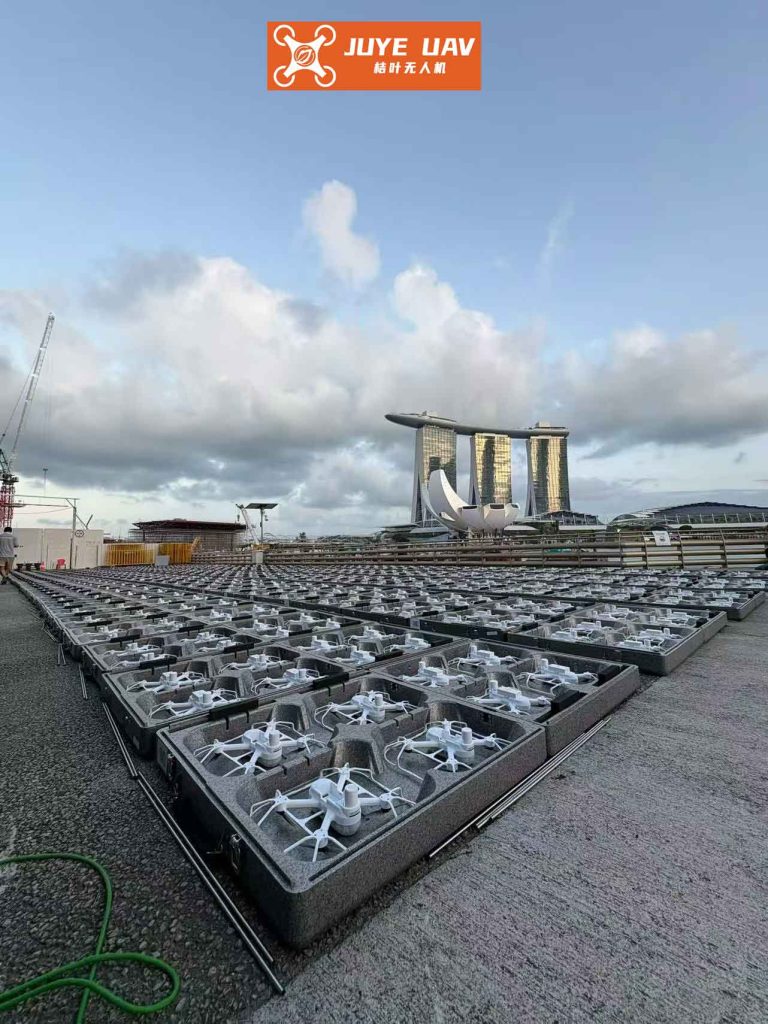
The communication network is the nervous system of the formation drone light show. A fixed communication topology, where each drone talks to the same set of neighbors throughout the show, is inefficient and risky. During a reconfiguration, drones may move far apart, stretching communication links to their limits and increasing packet loss or latency. An adaptive switching communication topology is a superior solution. In this paradigm, the communication graph G(σ(t)) switches among a set of pre-defined or dynamically determined topologies based on a switching signal σ(t). The switching rule can be based on a link cost function Wij(t):
$$
W_{ij}(t) = f( \| \mathbf{P}_i – \mathbf{P}_j \|, \text{SNR}_{ij}, \ldots )
$$
A link is established or maintained if Wij(t) < Λ1 and is dropped if Wij(t) > Λ2, with Λ2 > Λ1 to prevent chattering. This ensures that only reliable, short-range links are active, enhancing the overall robustness of the communication network for the formation drone light show during complex maneuvers.
Integral Sliding Mode Control (ISMC) is exceptionally well-suited for the formation drone light show application due to its robustness against model uncertainties (like wind disturbances di) and its suitability for variable-structure systems like a swarm with switching communication. The design typically involves a dual-loop structure. First, a virtual position control law is derived for the outer loop. We define a formation tracking error based on the relative states of neighbors under the current communication topology L(σ(t)), the Laplacian matrix of graph G.
Let Vi = Ṗi. The aggregated velocity error for the swarm can be expressed using the Kronecker product:
$$
\mathbf{V}_e = \left( \mathbf{L}(\sigma(t)) \otimes \mathbf{I}_3 \right) \mathbf{V} – \mathbf{b}(t)
$$
where V = [V1T, …, VnT]T and b(t) contains the desired relative velocity terms. The integral sliding surface sp is then defined as:
$$
\mathbf{s}_p = \mathbf{V}_e + \Lambda \int_0^t \mathbf{V}_e \, d\tau
$$
where Λ is a positive definite gain matrix. Taking the derivative and using the dynamics, the equivalent control ueq that would maintain ṡp = 0 in the absence of disturbances is derived. The final robust virtual control law u is:
$$
\mathbf{u} = \mathbf{u}_{eq} – \mathbf{K} \, \text{sgn}(\mathbf{s}_p)
$$
Here, K is a diagonal gain matrix with sufficiently large positive entries to overcome bounded disturbances, and sgn(·) is the signum function. This law provides the required collective thrust vector for the entire swarm. This virtual control ui for each drone is then decomposed to find its required thrust magnitude U1,i and desired attitude Θdi:
$$
\begin{aligned}
U_{1,i} &= \| \mathbf{u}_i \| \\
\theta^d_i &= \arctan\left( \frac{u_{x,i} \cos\psi^d_i + u_{y,i} \sin\psi^d_i}{u_{z,i}} \right) \\
\phi^d_i &= \arctan\left( \cos\theta^d_i \frac{u_{x,i} \sin\psi^d_i – u_{y,i} \cos\psi^d_i}{u_{z,i}} \right)
\end{aligned}
$$
The yaw angle ψdi is often separately controlled for lighting effects. An inner-loop attitude controller (e.g., another ISMC or a proportional-derivative controller) then generates the torque inputs Γi to drive the drone’s attitude Θi to Θdi. The stability of the entire switched system under the ISMC law and topology switching can be proven using a common Lyapunov function candidate V = 1/2 spT sp, showing that its derivative is negative definite under the given gain conditions.
The synergy between adaptive topology and ISMC creates a powerful framework for formation drone light shows. The switching topology maintains a reliable information flow, which is the prerequisite for accurate cooperative control. The ISMC then uses this information to compute control actions that are inherently robust to the residual uncertainties and the slight discontinuities introduced by topology switches. This combination allows the swarm to achieve precise formation tracking even during aggressive reconfigurations, ensuring the visual integrity of the show.
| Control Feature | Benefit for Formation Drone Light Show |
|---|---|
| Decentralized Structure | Eliminates single point of failure; enables scalability to thousands of drones. |
| Adaptive Communication Topology | Maintains high-quality communication links during shape changes, reducing latency and packet loss. |
| Integral Sliding Mode Control (ISMC) | Provides high-precision tracking and strong robustness against wind gusts and model inaccuracies. |
| Dual-Loop Control Architecture | Separates complex formation maneuvering (outer loop) from stable flight attitude control (inner loop). |
| Formal Stability Proof | Guarantees that the swarm will converge to and maintain the desired formation under the control laws. |
The mathematical formulation for the overall swarm error dynamics under the proposed control scheme highlights its effectiveness. Considering the switched system, the closed-loop error dynamics can be bounded, demonstrating finite-time convergence to the sliding manifold sp = 0, where the formation tracking error dynamics become purely governed by the linear equation V̇e = -Λ Ve. This guarantees exponential convergence of the formation tracking errors to zero, irrespective of the specific switching sequence of the communication topology, as long as each possible topology is connected. This is the core mathematical assurance that allows a formation drone light show to execute its choreography flawlessly.
In conclusion, the magic of a large-scale formation drone light show is fundamentally engineered through sophisticated multi-agent control algorithms. The integration of adaptive, switching communication topologies with robust Integral Sliding Mode Control provides a resilient and precise framework for managing the complex four-dimensional trajectories of hundreds of drones. This approach ensures that the swarm can dynamically reconfigure itself—adapting its communication network on the fly—while maintaining rock-solid formation accuracy against real-world disturbances. As this technology matures, future formation drone light shows will feature even more complex, fluid, and interactive animations, pushing the boundaries of aerial artistry and distributed autonomous systems. The night sky, therefore, becomes not just a canvas, but a dynamic proving ground for some of the most advanced principles in cooperative robotics and control theory.