
The rapid proliferation and enhanced combat efficacy of unmanned aerial vehicles (UAVs) present a profound challenge to air defense architectures globally. As a versatile weapons system integrating reconnaissance, strike, damage assessment, and electronic warfare into a single, often low-cost platform, UAVs offer distinct advantages in precision, tactical flexibility, and reduced risk to personnel. Their decisive impact in conflicts such as those in the Bekaa Valley, “Spring Shield” operations, and the Nagorno-Karabakh war has demonstrated an alarming capacity to penetrate sophisticated, high-value air defense networks, rendering them nearly obsolete. Major military powers, notably the United States Army, now classify UAVs among the top five most disruptive aerial threats. Consequently, advancing the theory, developing weapon systems, and conducting rigorous testing for counter-UAV, or anti-UAV, operations have become a paramount focus in defense circles worldwide.
The term “anti-UAV system” refers to an integrated suite of technologies designed to detect, track, identify, and ultimately negate a UAV threat through a combination of soft-kill and hard-kill measures. Based on their operational mechanism, these systems are generally categorized into three primary types. The following table summarizes their characteristics, advantages, and limitations.
| Category | Core Principle | Example Technologies | Key Advantages | Primary Limitations |
|---|---|---|---|---|
| Deception & Camouflage | Denying target acquisition by presenting false or obscured signatures. | Optical/Infrared/Acoustic/Electronic Camouflage, Decoys | Passive defense; lowers probability of detection. | Effectiveness varies with sensor sophistication; does not neutralize the UAV itself. |
| Soft-Kill (Jamming & Interference) | Disrupting the UAV’s control, navigation, or data links to induce loss of control. | GNSS Jammers, Radio Frequency (RF) Spoofers, Data Link Jammers, Directed Energy (HPM) | Non-kinetic; lower collateral damage; effective against swarms. | Potential for electromagnetic interference in civilian areas; range limitations. |
| Hard-Kill (Destruction) | Physically destroying the UAV through kinetic or directed energy impact. | Laser Weapons, Anti-UAV Missiles, “Drone-Hunting” UAVs, Conventional Air Defense Guns | Definitive neutralization; immediate threat removal. | Risk of collateral damage from falling debris; higher cost per engagement; challenged by dense swarms. |
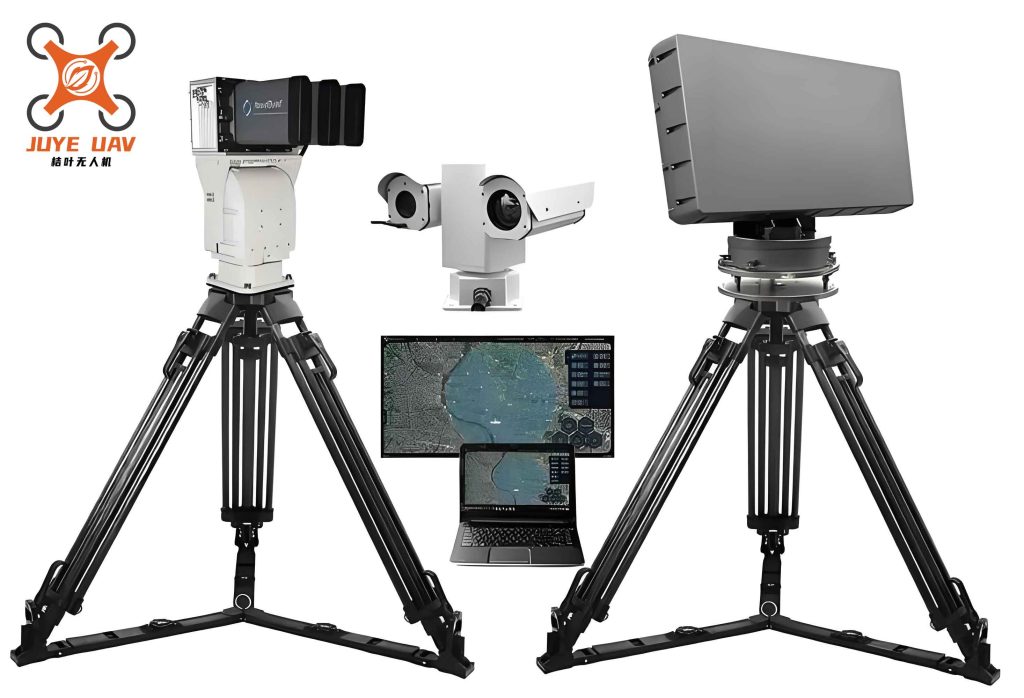
The operational effectiveness of an anti-UAV engagement often hinges on the ability to detect and track the threat at sufficient range. Key sensor performance can be modeled by the radar range equation, adapted for small, low-radar-cross-section (RCS) targets like UAVs:
$$P_r = \frac{P_t G_t G_r \lambda^2 \sigma}{(4\pi)^3 R^4 L}$$
Where \(P_r\) is the received power, \(P_t\) is the transmitted power, \(G_t\) and \(G_r\) are the transmit and receive antenna gains, \(\lambda\) is the wavelength, \(\sigma\) is the target’s RCS, \(R\) is the range to the target, and \(L\) represents system losses. This equation highlights the extreme challenge: a small UAV’s \(\sigma\) can be as low as \(0.001 \, \text{m}^2\), requiring high power or advanced signal processing to achieve adequate detection range \(R\).
Global Development Dynamics in Anti-UAV Technology
The global landscape for anti-UAV system development is characterized by intense competition and diverse strategic approaches, from top-down doctrinal development to rapid commercial innovation.
United States: Integrated Strategy and Technological Prowess
The U.S. approach emphasizes strong doctrinal foundations and joint integration. The Department of Defense’s 2021 Counter-Small Unmanned Aircraft Systems (C-sUAS) Strategy and the establishment of the Joint C-sUAS Office (JCO) aim to synchronize efforts across services. The JCO has sanctioned specific systems for procurement and is developing common standards to ensure interoperability, moving towards a “plug-and-play” architecture for new technologies. Funding reflects this priority, with significant R&D and procurement budgets allocated annually.
Technologically, the focus is on scalability and smart systems. Examples include the Tactical High-power Microwave Operational Responder (THOR), designed to disable UAV swarms with broad-beam microwaves, and the “MORFIUS” UAV—a tube-launched, recoverable drone carrying a High-Power Microwave (HPM) payload for counter-swarm missions. The trend is toward intelligent, networked effects. A conceptual model for a cooperative interceptor swarm against a UAV swarm can be described by an engagement ratio \(E_r\):
$$E_r(t) = \frac{N_I(t) \cdot P_{kill|I}}{N_U(t) \cdot P_{kill|U}}$$
Here, \(N_I(t)\) and \(N_U(t)\) are the numbers of interceptors and hostile UAVs at time \(t\), while \(P_{kill|I}\) and \(P_{kill|U}\) are their respective conditional probabilities of defeating a target. The goal of smart anti-UAV systems is to maximize \(E_r\) through superior coordination (\(P_{kill|I}\)) and targeting efficiency.
Russia: Combined “Hard” and “Soft” Kill Solutions
Russian developments showcase a balanced portfolio. On the hard-kill side, innovations include loitering munition-based aerial minefields that create persistent kill zones. For soft-kill, systems like the REX-1 electromagnetic rifle provide portable, directed-jamming capability. A significant push involves integrating artificial intelligence (AI) for automated threat classification and response. AI-driven anti-UAV systems utilize neural networks for sensor fusion and decision-making, reducing the operator’s cognitive burden. The detection and identification process can be framed as an optimization problem for the AI classifier:
$$\min_{\theta} \left[ \sum_{i=1}^{N} \mathcal{L}(f_{\theta}(x_i), y_i) + \lambda \Omega(\theta) \right]$$
Where \(f_{\theta}(x_i)\) is the AI model’s prediction (e.g., “friend,” “foe,” or “neutral”) for sensor input \(x_i\), \(y_i\) is the true label, \(\mathcal{L}\) is the loss function, \(\Omega(\theta)\) is a regularization term, and \(\lambda\) controls regularization strength. This enables rapid, accurate identification crucial for autonomous or semi-autonomous engagement.
NATO and Other Nations: Collaboration and Specialization
NATO’s focus is on developing holistic, alliance-wide frameworks. Publications like the “Integrated Counter-UAS Solutions” handbook analyze the threat across eight operational domains (e.g., Air Defense, Cyber, EW) and advocate for layered, integrated defense. Meanwhile, individual member states and other countries are producing niche, high-end solutions.
| Country/Entity | System/Technology | Core Capability | Notable Feature |
|---|---|---|---|
| Israel | EnforceAir (D-Fend Solutions) | RF Cyber Takeover | Seizes control and forces safe landing of UAV. |
| Israel | Skylock Wearable System | Portable Detection & Jamming | Man-portable, ~1.5 kg, 1 km range. |
| Turkey | Retinar Radar (Meteksan) | Portable UAV Detection | Ku-band radar, 40 kg total, detects small UAVs at ~2.3 km. |
| NATO (JAPCC) | Counter-UAS Working Group | Doctrinal & Capability Integration | Cross-domain expertise to build full-spectrum defense. |
Current Challenges in Anti-UAV System Development
Despite rapid progress, the field faces significant hurdles that impede the realization of a fully effective, ubiquitous anti-UAV capability.
1. Doctrinal and Strategic Gaps: Beyond a few leading nations, a coherent, top-down strategic vision for anti-UAV warfare is often lacking. The absence of standardized tactics, techniques, and procedures (TTPs), joint operational concepts, and dedicated training pipelines hinders the effective integration of these systems into the broader force structure and the development of a cohesive operational art for countering UAVs.
2. Technical and Operational Limitations: Every technology carries inherent trade-offs. The effectiveness of jamming systems, for instance, is governed by factors like link margin and can be countered with frequency hopping or autonomous navigation. The jamming-to-signal ratio \((J/S)\) required at the target UAV receiver must exceed a certain threshold \(\gamma\):
$$ \frac{J}{S} = \frac{P_j G_j G_{r(UAV)} \lambda^2 R_s^2 L_s}{P_s G_s G_{r(UAV)} \lambda^2 R_j^2 L_j} = \frac{P_j G_j R_s^2 L_s}{P_s G_s R_j^2 L_j} > \gamma $$
Where subscripts \(j\) and \(s\) denote jammer and friendly signal parameters, and \(R\) is the respective range. This shows how proximity \((R_j)\) and power \((P_j)\) are critical. Furthermore, kinetic solutions risk dangerous secondary effects from falling debris or dispersed payloads (e.g., explosives, chemical agents). Detection remains challenging in cluttered urban environments or against very low-RCS, low-altitude UAVs.
3. Market Fragmentation and Lack of Integration: The booming commercial and defense market has led to a proliferation of systems with proprietary standards, creating interoperability nightmares. This “vendor lock-in” stifles the creation of a unified, layered anti-UAV system-of-systems. The lack of common data protocols and open architectures prevents the seamless sharing of track data, electronic order of battle, and engagement status across different platforms and echelons, leading to inefficiency, capability gaps, and increased costs.
Future Trends: The Path to a Mature Anti-UAV Ecosystem
The trajectory of anti-UAV systems points toward greater integration, intelligence, and multi-dimensionality, fundamentally reshaping aerial defense paradigms.
1. System Integration and Networked Layered Defense: The future lies not in standalone “silver bullet” systems, but in integrated, resilient networks. This involves fusing data from disparate sensors (radar, EO/IR, RF, acoustic) into a common operational picture (COP). A command and control (C2) system would then dynamically assign the optimal effector (laser, jammer, interceptor) based on threat type, environment, and rules of engagement. This can be conceptualized as an optimization function for the C2 system:
$$\max_{a \in A} \left[ \mathbb{E} \left( \sum_{t=0}^{T} \gamma^t R(s_t, a_t) \right) \right]$$
Where \(A\) is the set of possible actions (e.g., assign effector X, maintain track), \(R(s_t, a_t)\) is the reward for taking action \(a_t\) in state \(s_t\) (threat type, battery level, weather), and \(\gamma\) is a discount factor. The goal is the optimal policy for threat neutralization across the defended area.
2. Miniaturization, Mobility, and Artificial Intelligence: As UAVs become smaller and more agile, countermeasures must follow suit. The future will see more man-portable, vehicle-mounted, and UAV-based anti-UAV platforms. AI will be the central nervous system, enabling:
- Predictive Analysis: Using pattern-of-life data to predict launch points and flight paths.
- Automatic Target Recognition (ATR): Rapid classification of UAV type and intent from sensor feeds.
- Swarm vs. Swarm Tactics: Deploying autonomous anti-UAV drone swarms that can outmaneuver and overwhelm hostile swarms, true “unmanned vs. unmanned” combat.
3. Multi-Domain Operations and “Dimensional” Superiority: The most profound shift will be expanding the anti-UAV battle beyond the physical and electromagnetic spectra into the cyber and cognitive domains. A future comprehensive anti-UAV strategy would engage an adversary’s UAV fleet across all these dimensions simultaneously:
| Domain | Anti-UAV Action | Desired Effect |
|---|---|---|
| Physical/Kinetic | Directed Energy, Interceptors | Physical destruction of the UAV platform. |
| Electromagnetic | Jamming, Spoofing, HPM | Disruption of control, navigation, and data links. |
| Cyberspace | Malware Injection, GPS Spoofing, C2 Hacks | Corruption of UAV software/firmware, false data. |
| Cognitive | Deception, PSYOPS targeting operators | Inducing operator error, distrust in the system. |
This multi-domain approach creates a “dilemma saturation” for an adversary, making it impossible to defend against all vectors of attack simultaneously, thereby achieving a form of operational and strategic “overmatch.”
Conclusion
The dialectic between UAV and anti-UAV technology is a quintessential manifestation of the principle of contradiction driving progress. Each leap in UAV capability—be it in autonomy, swarming, or stealth—provokes a corresponding advance in countermeasures, from AI-driven detection to networked soft-kill systems. This arms race is not merely about incremental improvements but is catalyzing a fundamental transformation in the character of warfare. The ultimate outcome will be the emergence of intelligent, multi-domain defense networks that are as adaptive and resilient as the threats they are designed to defeat. The nation or alliance that most effectively synthesizes these technologies into a coherent, layered anti-UAV ecosystem will gain a decisive advantage in the future security landscape.