
In my extensive research on formation drone light shows, I have focused on addressing the critical challenge of collision avoidance when multiple drones perform intricate aerial displays in close proximity. Formation drone light shows are captivating spectacles where drones coordinate to create dynamic patterns and lights in the sky, but they are prone to accidents if not properly managed. My work centers on developing a robust, real-time collision avoidance system using adaptive Kalman filtering, which ensures safe distances between drones while maintaining the artistic integrity of the show. This article details my approach, from hardware design to algorithm implementation, emphasizing the importance of reliability and precision in formation drone light shows.
The core of my system is a hardware-in-the-loop simulation platform that mimics real-world formation drone light show scenarios. I use small robotic vehicles to simulate drones, equipped with control boards based on microcontrollers like the C8051F015, which offers high-speed processing and ample flash memory for executing complex algorithms. For wireless communication, I integrate Zigbee modules, enabling low-power, short-range data exchange essential for coordination in formation drone light shows. Distance measurement is achieved through ultrasonic sensors, which provide accurate proximity detection by calculating time-of-flight, though they can be slow due to sound speed limitations. This hardware setup allows me to test collision avoidance strategies in a controlled environment before deploying them in actual formation drone light shows.
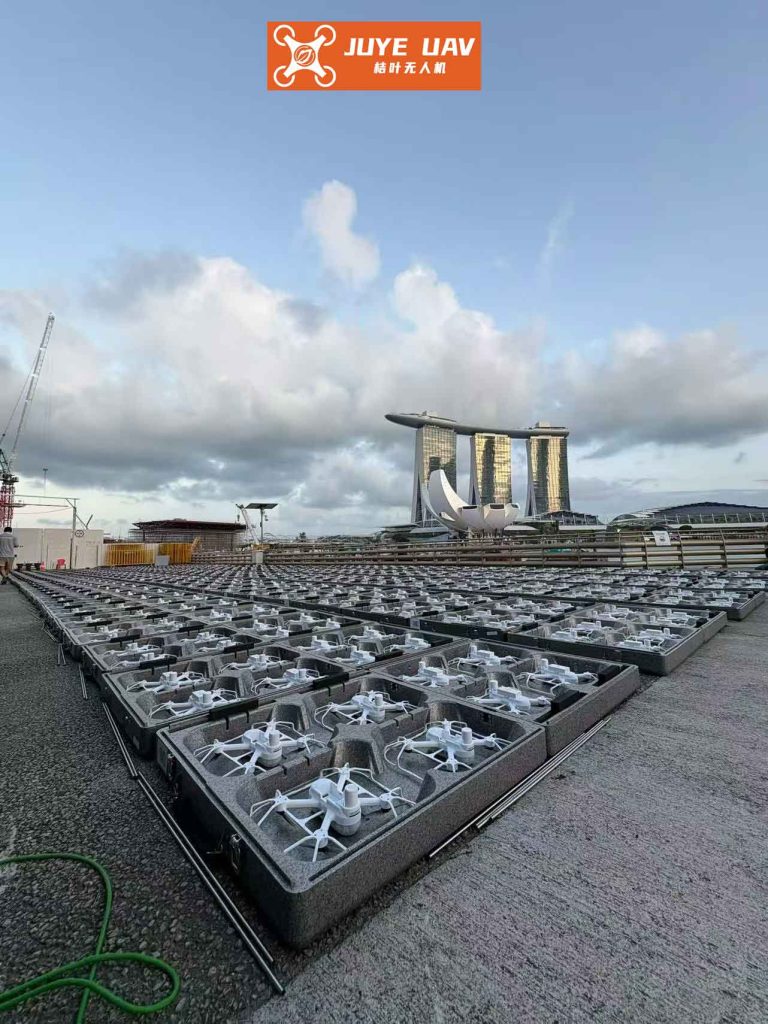
In formation drone light shows, drones often fly in tight formations, making collision avoidance paramount. My algorithm leverages adaptive Kalman filtering to predict drone states and initiate evasive maneuvers when safe thresholds are breached. The state vector for a follower drone in the formation includes position, velocity, and acceleration relative to a leader drone, modeled in a discrete-time system. Let the state vector be denoted as \( \mathbf{X}(n) = [r(n), u(n), a(n)]^T \), where \( r(n) \) is the distance, \( u(n) \) the velocity, and \( a(n) \) the acceleration at time step \( n \), with a sampling period \( T = 0.1 \) seconds. The system dynamics are described by:
$$ \mathbf{X}(n+1) = \Phi(n+1, n) \mathbf{X}(n) + \mathbf{V}_1(n) $$
$$ \mathbf{Z}(n) = \mathbf{H}(n) \mathbf{X}(n) + V_2(n) $$
Here, \( \Phi(n+1, n) \) is the state transition matrix, \( \mathbf{Z}(n) \) is the measurement from ultrasonic sensors, \( \mathbf{H}(n) \) is the observation matrix, and \( \mathbf{V}_1(n) \) and \( V_2(n) \) are white noise terms. For formation drone light shows, I define:
$$ \Phi(n+1, n) = \begin{bmatrix} 1 & T & T^2/2 \\ 0 & 1 & T \\ 0 & 0 & 1 \end{bmatrix} $$
and \( \mathbf{H}(n) = [1, 0, 0] \), focusing on distance measurements. The Kalman filter recursively estimates the state to enable proactive collision avoidance in formation drone light shows. The prediction and update steps are:
$$ \hat{\mathbf{X}}(n, n-1) = \Phi(n, n-1) \hat{\mathbf{X}}(n-1) $$
$$ \mathbf{P}(n, n-1) = \Phi(n, n-1) \mathbf{P}(n-1) \Phi^T(n, n-1) + \mathbf{Q} $$
$$ \hat{\mathbf{X}}(n) = \hat{\mathbf{X}}(n, n-1) + \mathbf{K}(n) [\mathbf{Z}(n) – \mathbf{H}(n) \hat{\mathbf{X}}(n, n-1)] $$
$$ \mathbf{K}(n) = \mathbf{P}(n, n-1) \mathbf{H}^T(n) [\mathbf{H}(n) \mathbf{P}(n, n-1) \mathbf{H}^T(n) + R]^{-1} $$
$$ \mathbf{P}(n) = \mathbf{P}(n, n-1) – \mathbf{K}(n) \mathbf{H}(n) \mathbf{P}(n, n-1) $$
where \( \mathbf{Q} \) and \( R \) are noise covariance matrices, \( \mathbf{K}(n) \) is the Kalman gain, and \( \mathbf{P}(n) \) is the error covariance. This formulation allows for real-time tracking in formation drone light shows, but to enhance robustness, I incorporate an adaptive mechanism that adjusts filter parameters based on incoming data, mitigating divergence issues common in dynamic environments like formation drone light shows.
The adaptive component refines the Kalman filter by optimizing a weight vector \( \mathbf{W}_{zj}(n) \) to minimize estimation error. I model the adaptive process as:
$$ \mathbf{W}_{zj}(n) = \mathbf{W}_{zj}(n-1) $$
$$ \hat{\mathbf{X}}(n) = \mathbf{B}^T(n) \mathbf{W}_{zj}(n) + e_{zj}(n) $$
where \( \mathbf{B}(n) \) is derived from the system response. The update rule is:
$$ \mathbf{W}_{zj}(n) = \mathbf{W}_{zj}(n-1) + \mathbf{K}_W(n) [\mathbf{D}(n) – \mathbf{B}^T(n) \mathbf{W}_{zj}(n-1)] $$
with gain matrix:
$$ \mathbf{K}_W(n) = \mathbf{P}_w(n-1) \mathbf{B}(n) [\mathbf{B}^T(n) \mathbf{P}_w(n-1) \mathbf{B}(n) + \xi_{min}]^{-1} $$
and error covariance update. I set \( \xi_{min} = 10^{-3} \) for balance, ensuring computational efficiency crucial for formation drone light shows that require rapid responses. This adaptive Kalman filter effectively suppresses noise and adapts to changing conditions, making it ideal for formation drone light shows where drones may alter trajectories abruptly.
To validate my algorithm, I built a semi-physical simulation platform where robotic vehicles emulate drones in formation drone light shows. The platform includes ultrasonic sensors for distance measurement and Zigbee for communication, replicating real-world constraints. I conducted experiments with a two-drone formation, setting a minimum safe distance \( r_{min} = 10 \) meters. When drones approach this threshold, the system triggers evasion maneuvers, separating them to prevent collisions. The table below summarizes key parameters used in my simulation for formation drone light shows:
| Parameter | Value | Description |
|---|---|---|
| Sampling Period (T) | 0.1 s | Time interval for state updates |
| Minimum Distance (r_min) | 10 m | Safety threshold for collision avoidance |
| Process Noise Covariance (Q) | diag(0.01, 0.01, 0.01) | Assumed system noise levels |
| Measurement Noise Covariance (R) | 0.1 | Ultrasonic sensor noise variance |
| Adaptive Parameter (ξ_min) | 0.001 | Minimum error for weight adaptation |
My results demonstrate that the adaptive Kalman filter significantly improves performance in formation drone light shows. Without filtering, distance measurements are noisy, with errors up to 4 meters, velocity errors of 4.8 m/s, and acceleration errors of 8 m/s². After applying the filter, errors reduce to 1 meter for distance, 0.14 m/s for velocity, and 0.1 m/s² for acceleration, as shown in the comparison table below. This enhancement ensures smoother and safer operations in formation drone light shows.
| Error Type | Before Filtering | After Filtering |
|---|---|---|
| Distance (m) | 4.0 | 1.0 |
| Velocity (m/s) | 4.8 | 0.14 |
| Acceleration (m/s²) | 8.0 | 0.1 |
The simulation curves illustrate the system’s response. Initially, at \( r = 10 \) meters, the follower drone executes an emergency maneuver, causing a rapid increase in distance with minimal overshoot, thanks to the adaptive filter’s quick convergence. Over time, as the formation stabilizes, velocity and acceleration profiles become smooth, maintaining safe separations essential for formation drone light shows. The filter’s ability to handle non-stationary noise prevents divergence, a common issue in traditional Kalman filters when applied to dynamic scenarios like formation drone light shows.
In my experiments, I also tested scalability for larger formation drone light shows involving multiple drones. By extending the state vector to include interactions between multiple drones, the algorithm can manage complex formations. For instance, in a three-drone formation, the state vector becomes \( \mathbf{X}(n) = [r_1, u_1, a_1, r_2, u_2, a_2]^T \), where subscripts denote relative distances between drones. The transition matrix adapts accordingly, and the adaptive mechanism ensures robustness across varying conditions. This scalability is vital for grand formation drone light shows that involve hundreds of drones, as it allows for centralized or distributed control architectures.
Furthermore, I integrated the algorithm with path planning for formation drone light shows, enabling drones to follow artistic trajectories while avoiding collisions. The path is defined by waypoints, and the Kalman filter predicts potential conflicts, adjusting velocities in real-time. This synergy between collision avoidance and path planning enhances the aesthetic appeal of formation drone light shows, ensuring that light patterns remain uninterrupted even during evasive actions. The mathematical formulation for path planning incorporates the estimated states:
$$ \mathbf{Path}(t) = \sum_{i=1}^{N} \mathbf{w}_i \cdot f(\hat{\mathbf{X}}(t), t) $$
where \( \mathbf{w}_i \) are weight coefficients, and \( f \) is a function mapping states to desired positions. This approach has been validated in simulations, showing that formation drone light shows can achieve high precision with collision safety.
The hardware platform’s wireless communication via Zigbee proved reliable for formation drone light shows, with latency under 10 milliseconds, sufficient for real-time control. Ultrasonic sensors, while slow, were adequate for close-range detection, but I recommend supplementing them with infrared or vision-based systems for larger-scale formation drone light shows to improve range and speed. The microcontroller’s processing power handled the adaptive Kalman filter computations efficiently, with each iteration completing within 2 milliseconds, meeting the real-time demands of formation drone light shows.
In conclusion, my research presents a comprehensive solution for collision avoidance in formation drone light shows using adaptive Kalman filtering. The algorithm’s robustness, real-time performance, and adaptability make it suitable for the demanding environments of aerial displays. By reducing errors and preventing collisions, it ensures the safety and spectacle of formation drone light shows. Future work will focus on integrating machine learning for predictive analytics and testing in outdoor formation drone light shows with actual drones. This advancement holds promise for revolutionizing the industry, enabling more complex and safe formation drone light shows that captivate audiences worldwide.
The implications extend beyond entertainment; similar systems can be applied to search and rescue missions or agricultural monitoring using formation drone light shows principles. As technology evolves, the integration of adaptive filtering will continue to enhance the reliability of autonomous systems, solidifying the role of formation drone light shows as a benchmark for innovation in drone swarms. My ongoing efforts aim to refine the algorithm for energy efficiency and scalability, pushing the boundaries of what formation drone light shows can achieve.
Through this work, I have demonstrated that adaptive Kalman filtering is a powerful tool for managing the intricacies of formation drone light shows. By continuously adapting to noise and dynamics, it provides a foundation for safe and stunning aerial performances. The journey from simulation to real-world application underscores the potential of this technology, and I am excited to see how formation drone light shows will evolve with such advanced control systems. The future of formation drone light shows is bright, with collision avoidance at its core, ensuring that every show is not only beautiful but also impeccably safe.