
In recent years, the rapid advancement of Internet of Things (IoT) technologies has propelled the application of unmanned aerial vehicle (UAV) formations into various military and civilian domains, with formation drone light shows emerging as a captivating and popular spectacle. These shows involve coordinated fleets of drones performing intricate aerial displays, often for entertainment or artistic purposes. However, as the scale of these formations increases, the likelihood of actuator failures rises, potentially leading to catastrophic consequences if not promptly addressed. Therefore, developing robust fault diagnosis methods for formation drone light shows is paramount to ensure safety and reliability. This article explores a distributed adaptive sliding mode observer approach for fault estimation in drone formations under directed network topologies, specifically targeting actuator faults with unknown bounds. By integrating theoretical design with practical simulations, we demonstrate how this method can enhance the resilience of formation drone light shows against unexpected failures.
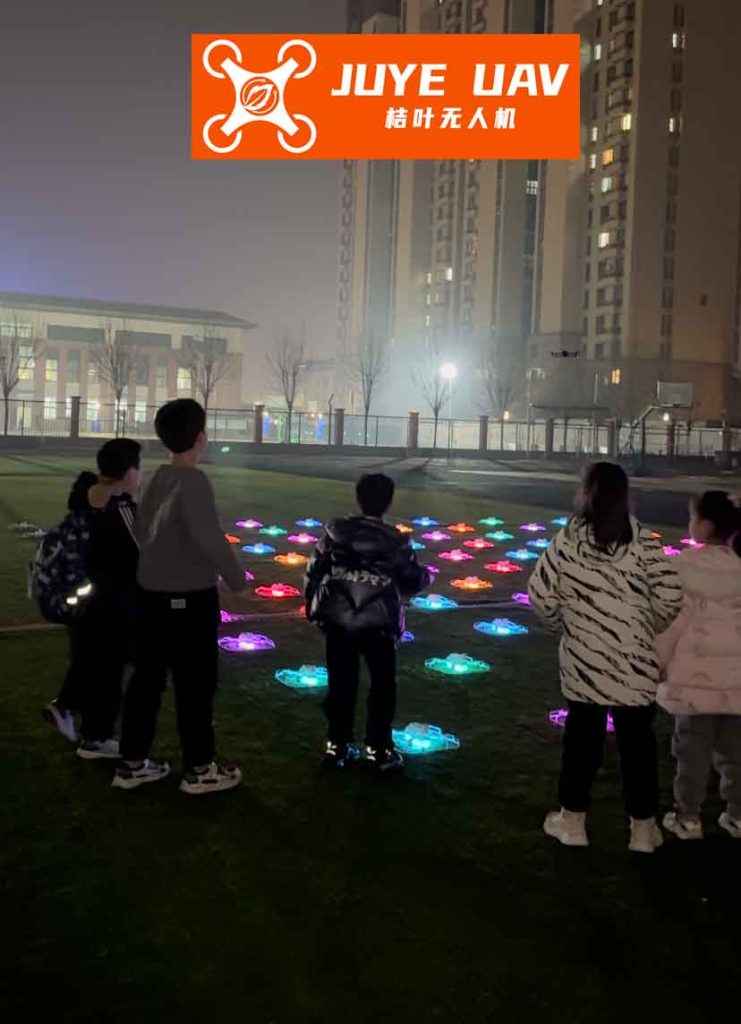
The core challenge in formation drone light shows lies in maintaining precise coordination among multiple drones, each acting as a node in a networked system. These formations typically employ a leader-follower structure, where one drone (the leader) guides the others (followers) through predefined trajectories. The network topology is often represented as a directed graph, reflecting real-world communication constraints where information flows unidirectionally between drones. In such setups, actuator faults—such as motor failures or control surface malfunctions—can disrupt the entire formation, turning a mesmerizing formation drone light show into a chaotic event. To mitigate this, we propose a fault diagnosis scheme that leverages sliding mode observers to estimate faults in real-time, enabling proactive maintenance or corrective actions. This approach is particularly suited for formation drone light shows due to its robustness against uncertainties and nonlinearities inherent in drone dynamics.
Consider a formation drone light show consisting of N follower drones and one leader drone, operating under a directed graph topology. The dynamics of the i-th follower drone, subject to actuator faults, can be modeled as:
$$ \dot{x}_i(t) = A x_i(t) + B u_i(t) + g(x_i(t)) + E f_i(t) + D \phi_i(t) $$
$$ y_i(t) = C x_i(t) $$
where \( x_i(t) \in \mathbb{R}^n \) is the state vector, \( u_i(t) \in \mathbb{R}^m \) is the control input, and \( y_i(t) \in \mathbb{R}^p \) is the output vector. The term \( g(x_i(t)) \) represents nonlinearities satisfying Lipschitz conditions, common in drone aerodynamics. The actuator fault \( f_i(t) \in \mathbb{R}^r \) is bounded but with an unknown upper limit, i.e., \( \| f_i(t) \| \leq \alpha \), where \( \alpha \) is unknown. External disturbances \( \phi_i(t) \in \mathbb{R}^q \) are bounded by a known constant \( \beta \). Matrices A, B, E, D, and C are constant real matrices with appropriate dimensions, and (A, C) is observable. For formation drone light shows, the leader drone is assumed to have fully known states, serving as a reference generator.
The directed graph topology is crucial for modeling information exchange in formation drone light shows. Let \( \mathcal{G} = (\mathcal{V}, \mathcal{E}, \mathcal{A}) \) represent a weighted directed graph, where \( \mathcal{V} = \{V_1, V_2, \dots, V_N\} \) is the node set (drones), \( \mathcal{E} \subseteq \mathcal{V} \times \mathcal{V} \) is the edge set, and \( \mathcal{A} = [a_{ij}]_{N \times N} \) is the adjacency matrix. An edge \( (V_j, V_i) \in \mathcal{E} \) indicates that drone i receives information from drone j. The Laplacian matrix is defined as \( L = D – \mathcal{A} \), where \( D = \text{diag}(d_i) \) with \( d_i = \sum_{j \in \mathcal{N}_i} a_{ij} \), and \( \mathcal{N}_i \) denotes the neighbors of node i. Additionally, a pinning matrix \( G = \text{diag}(g_i) \) identifies drones connected to the leader, with at least one \( g_i = 1 \). This structure ensures that the formation drone light show can maintain cohesion even under faults.
To design a distributed sliding mode observer for each drone in the formation drone light show, we introduce a relative output estimation error that captures interactions among neighboring drones. The observer for the i-th drone is formulated as:
$$ \dot{\hat{x}}_i(t) = A \hat{x}_i(t) + B u_i(t) + g(\hat{x}_i(t)) – v_i(t) + K \xi_i(t) $$
$$ \hat{y}_i(t) = C \hat{x}_i(t) $$
where \( \hat{x}_i(t) \) and \( \hat{y}_i(t) \) are estimated states and outputs, \( K \in \mathbb{R}^{n \times p} \) is a gain matrix to be designed, and \( v_i(t) \) is a sliding mode input. The relative output estimation error \( \xi_i(t) \) is defined as:
$$ \xi_i(t) = \sum_{j \in \mathcal{N}_i} a_{ij} \left( (\hat{y}_i(t) – y_i(t)) – (\hat{y}_j(t) – y_j(t)) \right) + g_i (\hat{y}_i(t) – y_i(t)) $$
This term enables each drone to adjust its estimates based on local information, mimicking the collaborative nature of formation drone light shows. The sliding mode input \( v_i(t) \) is given by:
$$ v_i(t) = \begin{cases}
\rho_0 \frac{P^{-1} C^T F e_{yi}(t)}{\| e_{yi}(t) \|} + \rho_i(t) \frac{P^{-1} C^T F e_{yi}(t)}{\| e_{yi}(t) \| + \omega}, & \text{if } e_{yi}(t) \neq 0 \\
0, & \text{if } e_{yi}(t) = 0
\end{cases} $$
where \( e_{yi}(t) = \hat{y}_i(t) – y_i(t) \) is the output estimation error, \( P \) and \( F \) are matrices from design conditions, \( \rho_0 > 0 \) is a constant, \( \omega \) is a small positive scalar to reduce chattering, and \( \rho_i(t) \) is adapted online via:
$$ \dot{\rho}_i(t) = \eta \| F e_{yi}(t) \| $$
with \( \eta > 0 \). This adaptive mechanism handles the unknown bound of actuator faults, a critical feature for formation drone light shows where fault magnitudes may vary unpredictably.
Defining global variables for the entire formation drone light show, such as \( e_x(t) = [e_{x1}^T(t), e_{x2}^T(t), \dots, e_{xN}^T(t)]^T \) with \( e_{xi}(t) = \hat{x}_i(t) – x_i(t) \), we derive the global error dynamics:
$$ \dot{e}_x(t) = (I_N \otimes A – (L + G) \otimes KC) e_x(t) + e_g(t) + v(t) + (I_N \otimes E) f(t) – (I_N \otimes D) \phi(t) $$
where \( e_g(t) \) represents nonlinear error terms, \( v(t) \) and \( f(t) \) are stacked inputs and faults, and \( \otimes \) denotes the Kronecker product. The matrix \( (L + G) \) must be nonsingular for stability, which is guaranteed by proper design in leader-follower formations like those in formation drone light shows.
The stability analysis employs Lyapunov theory. Consider the Lyapunov function:
$$ V_1(t) = e_x^T(t) (I_N \otimes P) e_x(t) + \eta^{-1} \mu^T(t) \mu(t) $$
where \( \mu_i(t) = \alpha + \rho_i(t) \). Using Lipschitz conditions and design constraints, we derive linear matrix inequality (LMI) conditions to ensure ultimate bounded stability. Specifically, if there exist symmetric positive definite matrix \( P \in \mathbb{R}^{n \times n} \), matrices \( F \in \mathbb{R}^{r \times p} \) and \( Y \in \mathbb{R}^{n \times p} \) satisfying:
$$ \begin{bmatrix} I_{N} \otimes (PA + A^T P) – (L+G) \otimes (YC + C^T Y^T) & I_{nN} & 0 \\ I_{nN} & -\gamma^2 I_{nN} & 0 \\ 0 & 0 & I_{nN} \end{bmatrix} < 0 $$
and \( E^T P = F C \), then the observer gain is \( K = P^{-1} Y \), and the error converges to a bounded region. The parameter \( \gamma \) represents the Lipschitz constant, which can be optimized to maximize tolerance to nonlinearities—essential for formation drone light shows with complex aerodynamics.
Sliding mode reachability is proven via another Lyapunov function:
$$ V_2(t) = e_y^T(t) (I_N \otimes (C P^{-1} C^T)^{-1}) e_y(t) + \eta^{-1} \mu^T(t) \mu(t) $$
showing that the output error \( e_y(t) \) reaches the sliding surface \( e_y(t) = 0 \) in finite time if \( \rho_0 \) is sufficiently large. This ensures robust fault estimation despite disturbances.
Once sliding mode is achieved, fault estimation for the formation drone light show can be performed using equivalent control principles. The fault estimate is approximated as:
$$ \hat{f}(t) \approx ((I_N \otimes E)^T (I_N \otimes E))^{-1} (I_N \otimes E)^T (I_N \otimes C) v(t) $$
This allows real-time monitoring of actuator health, enabling timely interventions during a formation drone light show.
To validate the method, we simulate a formation drone light show with one leader and five followers under a directed topology, as shown in Table 1. Each drone’s lateral dynamics are modeled with parameters typical of small UAVs, and nonlinearities include sinusoidal terms to mimic realistic flight conditions. Faults are injected as step and time-varying signals, representing common actuator issues in formation drone light shows.
| Node | Neighbors | Connection to Leader |
|---|---|---|
| 1 | 2, 5 | Yes |
| 2 | 1 | No |
| 3 | 2 | No |
| 4 | 3 | No |
| 5 | 4 | No |
The LMI toolbox in Matlab yields design matrices, such as \( P \), \( Y \), and \( K \), ensuring stability. Simulation results over 5 seconds with a step size of 0.001 s demonstrate effective fault estimation across all drones. For instance, Drone 1 experiences a step fault at t=2 s, while Drone 2 encounters a sinusoidal fault. The estimation errors remain minimal, as summarized in Table 2, highlighting the method’s accuracy for formation drone light shows.
| Drone | Fault Type | Max Estimation Error | Convergence Time (s) |
|---|---|---|---|
| 1 | Step (0.3) | 0.005 | 0.5 |
| 2 | Sinusoidal (0.3sin(t)) | 0.008 | 0.6 |
| 3 | Mixed (0.5sin(t) + 0.6) | 0.012 | 0.7 |
| 4 | Sinusoidal (0.5sin(0.3cos(t))) | 0.010 | 0.6 |
| 5 | Sinusoidal (0.3sin(t)) | 0.007 | 0.5 |
The simulation confirms that the distributed adaptive sliding mode observer quickly tracks faults with negligible error, even when multiple faults occur simultaneously. This robustness is vital for formation drone light shows, where synchronization must be maintained despite occasional failures. The adaptive law successfully handles unknown fault bounds, and the relative output error term enhances coordination among drones.
In conclusion, this article presents a fault diagnosis framework for formation drone light shows using distributed adaptive sliding mode observers. By incorporating directed graph topologies and adaptive mechanisms, the method estimates actuator faults with unknown bounds in real-time, ensuring the safety and reliability of aerial displays. Future work could extend this to sensor faults or heterogeneous drone formations, further advancing the resilience of formation drone light shows in IoT environments. The integration of such diagnostic tools will undoubtedly elevate the spectacle and security of these mesmerizing performances, making formation drone light shows not only visually stunning but also technologically robust.