
As an enthusiast and researcher in the field of aerial robotics, I have always been fascinated by the mesmerizing spectacle of formation drone light shows. These displays, where multiple drones coordinate to create dynamic light patterns in the sky, represent a convergence of advanced technologies in unmanned aerial vehicles (UAVs), computer vision, and real-time control systems. In this article, I will delve into the intricacies of formation drone light show, covering its underlying principles, mathematical models, and practical implementations. The keyword “formation drone light show” will be central to our discussion, as it encapsulates the essence of synchronized aerial performances that are revolutionizing entertainment, advertising, and even artistic expression.
The concept of formation drone light show involves a fleet of drones operating in unison to display coordinated light effects. Each drone is equipped with LED lights and precise positioning systems, allowing for the creation of complex three-dimensional shapes and animations. From my experience, the success of such shows relies heavily on robust communication networks, efficient path planning algorithms, and adaptive control strategies. Over the years, I have observed how these shows have evolved from simple linear patterns to intricate, storytelling-driven displays that captivate audiences worldwide. In this exploration, I aim to provide a detailed technical perspective, enriched with mathematical formulations and comparative analyses, to shed light on the engineering marvel behind formation drone light show.
At the heart of any formation drone light show is the coordinated movement of drones in a defined airspace. This requires each drone to know its exact position relative to others and to the global reference frame. Typically, GPS and inertial measurement units (IMUs) are used for localization, but in dense formations, additional sensors like ultra-wideband (UWB) radios may enhance accuracy. The dynamics of a single drone can be modeled using Newton’s equations of motion. For instance, let the state vector of the \(i\)-th drone at time \(k\) be represented as:
$$ \mathbf{X}_i^k = [x_i^k, y_i^k, z_i^k, \dot{x}_i^k, \dot{y}_i^k, \dot{z}_i^k]^T $$
where \(x_i^k, y_i^k, z_i^k\) denote the position coordinates, and \(\dot{x}_i^k, \dot{y}_i^k, \dot{z}_i^k\) represent the velocities in three-dimensional space. The discrete-time state transition equation for a drone under constant acceleration assumptions can be written as:
$$ \mathbf{X}_i^{k+1} = \mathbf{F} \mathbf{X}_i^k + \mathbf{G} \mathbf{w}_i^k $$
Here, \(\mathbf{F}\) is the state transition matrix, \(\mathbf{G}\) is the control input matrix, and \(\mathbf{w}_i^k\) is the process noise accounting for uncertainties. For a formation drone light show, the key challenge is to ensure that all drones follow predefined trajectories while maintaining safe distances. This is often achieved through decentralized control laws, where each drone adjusts its motion based on local information from neighbors. A common approach uses consensus algorithms, where the desired velocity for drone \(i\) is computed as:
$$ \mathbf{v}_i^{desired} = \sum_{j \in \mathcal{N}_i} (\mathbf{p}_j – \mathbf{p}_i) + \alpha (\mathbf{v}_j – \mathbf{v}_i) $$
where \(\mathcal{N}_i\) is the set of neighboring drones, \(\mathbf{p}_i\) and \(\mathbf{v}_i\) are the position and velocity vectors, and \(\alpha\) is a tuning parameter. This ensures cohesion and alignment in the formation, critical for a flawless formation drone light show.
To manage the light effects in a formation drone light show, each drone’s LED intensity and color must be synchronized with its position and the overall animation timeline. This can be modeled as a time-varying function \(I_i(t, \mathbf{X}_i(t))\), where \(I_i\) represents the light intensity for drone \(i\) at time \(t\). In practice, this is pre-programmed into a central controller that sends commands via wireless links. However, to handle real-time adjustments due to wind or other disturbances, adaptive algorithms are employed. One method involves using Kalman filtering to estimate the drone’s state and predict its future position, thereby adjusting light commands proactively. For a nonlinear system like a drone, the unscented Kalman filter (UKF) is often preferred. The UKF algorithm uses sigma points to approximate the state distribution. Given a state vector \(\mathbf{x}\) with mean \(\bar{\mathbf{x}}\) and covariance \(\mathbf{P}\), the sigma points are computed as:
$$ \mathcal{X}^0 = \bar{\mathbf{x}}, \quad \mathcal{X}^i = \bar{\mathbf{x}} + \left( \sqrt{(n + \lambda) \mathbf{P}} \right)_i, \quad \mathcal{X}^{i+n} = \bar{\mathbf{x}} – \left( \sqrt{(n + \lambda) \mathbf{P}} \right)_i $$
for \(i = 1, \dots, n\), where \(n\) is the state dimension, and \(\lambda\) is a scaling parameter. These points are then propagated through the nonlinear dynamics to update the state estimate. This technique is invaluable in formation drone light show for maintaining accuracy in challenging environments.
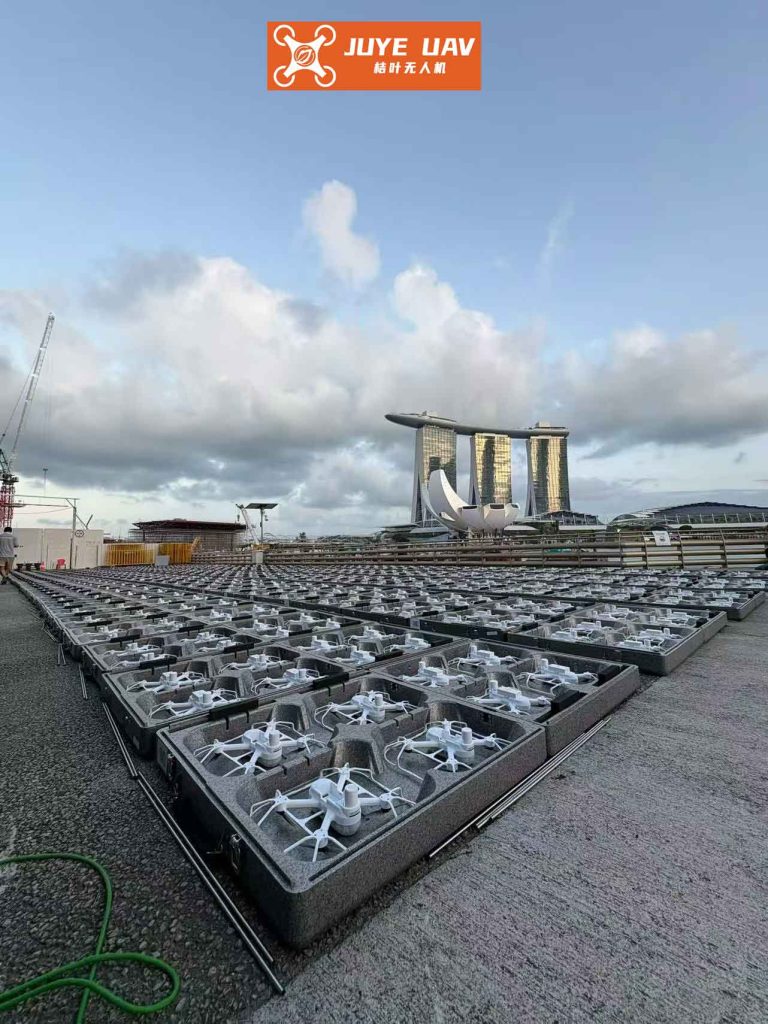
The visual impact of a formation drone light show is greatly enhanced by the spatial arrangement of drones. To design these formations, geometric transformations are applied. For example, a swarm might form a rotating cube in the sky. The coordinates of each drone relative to the formation center can be derived using rotation matrices. If we denote the center as \(\mathbf{c}(t)\) and the rotation angle as \(\theta(t)\), the position of drone \(i\) in a planar formation is:
$$ \mathbf{p}_i(t) = \mathbf{c}(t) + \mathbf{R}(\theta(t)) \mathbf{d}_i $$
where \(\mathbf{d}_i\) is the fixed offset in the body frame, and \(\mathbf{R}(\theta)\) is the 2D rotation matrix:
$$ \mathbf{R}(\theta) = \begin{bmatrix} \cos\theta & -\sin\theta \\ \sin\theta & \cos\theta \end{bmatrix} $$
For three-dimensional shapes, such as spheres or helices, more complex parametric equations are used. This mathematical foundation allows choreographers to program intricate patterns for formation drone light show, ensuring that each drone moves along a smooth trajectory while avoiding collisions.
In terms of communication, a formation drone light show relies on a robust network to exchange state information and control commands. Typically, a mesh network topology is employed, where each drone acts as a node that can relay data to others. This redundancy mitigates the risk of single-point failures. The data rate required depends on the number of drones and the update frequency. For a show with \(N\) drones, each transmitting its state (e.g., position, velocity, battery level) at \(f\) Hz, the total data throughput can be estimated as:
$$ D = N \times S \times f $$
where \(S\) is the size of each state packet in bits. In practice, \(D\) might range from several kbps to Mbps, necessitating efficient protocols like TDMA or FDMA. Table 1 summarizes typical parameters for a mid-scale formation drone light show.
| Parameter | Value | Description |
|---|---|---|
| Number of Drones (N) | 100 | Total drones in the formation |
| Update Frequency (f) | 10 Hz | Rate of state transmission |
| State Packet Size (S) | 256 bits | Includes position, velocity, light status |
| Total Data Throughput (D) | 256 kbps | Calculated as \(N \times S \times f\) |
| Battery Life | 20 minutes | Typical flight time per drone |
| Maximum Speed | 10 m/s | Safe speed for close formations |
Another critical aspect is energy management. Drones in a formation drone light show must conserve battery to sustain the performance duration. The power consumption \(P_i\) of drone \(i\) can be modeled as a function of its thrust \(T_i\), velocity \(\mathbf{v}_i\), and light intensity \(I_i\):
$$ P_i = c_1 T_i^{3/2} + c_2 \|\mathbf{v}_i\|^2 + c_3 I_i $$
where \(c_1, c_2, c_3\) are constants derived from empirical data. To optimize overall show time, path planning algorithms minimize the total energy expenditure across the fleet. This often involves solving a constrained optimization problem:
$$ \min_{\{\mathbf{p}_i(t)\}} \sum_{i=1}^N \int_{t_0}^{t_f} P_i(t) \, dt $$
subject to collision avoidance constraints \(\|\mathbf{p}_i(t) – \mathbf{p}_j(t)\| > d_{\text{safe}}\) for all \(i \neq j\), and boundary conditions. Such optimizations are computationally intensive but essential for large-scale formation drone light show events.
From a control theory perspective, the formation drone light show can be viewed as a multi-agent system with shared objectives. The overall system stability is analyzed using Lyapunov functions. For instance, consider a formation where drones aim to maintain a desired relative distance \(d_{ij}^*\) between neighbors. The error for drone \(i\) with respect to drone \(j\) is defined as \(e_{ij} = \|\mathbf{p}_i – \mathbf{p}_j\| – d_{ij}^*\). A potential function \(V\) is constructed:
$$ V = \sum_{(i,j) \in \mathcal{E}} \frac{1}{2} e_{ij}^2 $$
where \(\mathcal{E}\) is the set of edges in the communication graph. By designing control laws that make \(\dot{V} \leq 0\), asymptotic stability of the formation can be guaranteed. This ensures that the formation drone light show remains coherent even under external disturbances.
In practice, software tools are used to simulate and plan formation drone light show. These tools incorporate physics engines to model drone dynamics, wind effects, and communication delays. They allow designers to visualize the show beforehand and adjust parameters for optimal performance. For example, the trajectory for each drone is often represented as a Bézier curve for smoothness. A Bézier curve of degree \(n\) is defined by control points \(\mathbf{P}_0, \mathbf{P}_1, \dots, \mathbf{P}_n\):
$$ \mathbf{B}(t) = \sum_{i=0}^n \binom{n}{i} (1-t)^{n-i} t^i \mathbf{P}_i, \quad t \in [0,1] $$
By assigning each drone a set of such curves, complex animations can be created. The synchronization of light changes with these trajectories is then timed using global clocks, often synchronized via GPS timestamps. This precision is what makes modern formation drone light show so captivating.
As formation drone light show technology advances, new applications emerge. Beyond entertainment, they are used in search and rescue operations for signaling, in agriculture for crop monitoring with coordinated lighting, and in cultural events to tell stories. The scalability of these systems is impressive; recent shows have involved thousands of drones, all operating in harmony. However, challenges remain, such as regulatory issues regarding airspace, safety concerns, and environmental factors like wind and rain. In my work, I have found that adaptive control algorithms, similar to those used in target tracking, can mitigate some of these issues. For example, if a drone deviates from its path due to a gust, the system can dynamically reassign roles to neighbors to fill the gap, maintaining the illusion of the formation drone light show.
To illustrate the performance metrics of different formation drone light show algorithms, Table 2 compares three common approaches: centralized control, decentralized consensus, and hybrid methods.
| Algorithm Type | Scalability | Robustness to Failures | Communication Overhead | Suitability for Large Shows |
|---|---|---|---|---|
| Centralized Control | Low | Low (single point of failure) | High | Not suitable |
| Decentralized Consensus | High | High | Medium | Excellent |
| Hybrid Methods | Medium | Medium | Medium | Good for mid-scale shows |
The decentralized approach is often favored for formation drone light show because it aligns with the distributed nature of drone swarms. Each drone runs local algorithms based on information from nearby drones, reducing latency and increasing resilience. This is akin to the cooperative detection methods mentioned in the reference, but adapted for aesthetic purposes rather than surveillance.
Looking ahead, the future of formation drone light show is bright. With advancements in AI, drones could autonomously adapt their patterns in real-time based on audience reactions or environmental cues. Machine learning algorithms could optimize energy usage and formation shapes dynamically. Moreover, integration with augmented reality (AR) could create immersive experiences where virtual and real elements blend seamlessly. As a researcher, I am excited by the potential for formation drone light show to become interactive, allowing spectators to influence the display via smartphones or gestures.
In conclusion, formation drone light show is a multidisciplinary field that combines robotics, control theory, computer graphics, and wireless communication. From mathematical modeling to practical implementation, every aspect requires careful consideration to ensure a stunning and safe performance. Through this article, I have shared insights into the key technologies and challenges, emphasizing the importance of coordination and adaptability. As we continue to innovate, formation drone light show will undoubtedly push the boundaries of what is possible in aerial entertainment and beyond, captivating audiences with ever more dazzling displays.