
In recent years, formation drone light shows have captivated global audiences, transforming the night sky into dynamic canvases for artistic and commercial displays. As a researcher focused on aerial networking, I have been deeply involved in developing robust systems that enable hundreds, even thousands, of drones to operate in precise harmony. The core challenge lies not just in creating beautiful patterns, but in ensuring reliable, real-time coordination without dependency on continuous ground control. This article explores a comprehensive technical framework combining distributed self-localization and a dynamic Time Division Multiple Access (TDMA) protocol, specifically tailored for the demanding environment of formation drone light shows. The goal is to achieve high-precision positioning and low-latency communication, which are fundamental for maintaining intricate formations and ensuring safety during these spectacular performances.
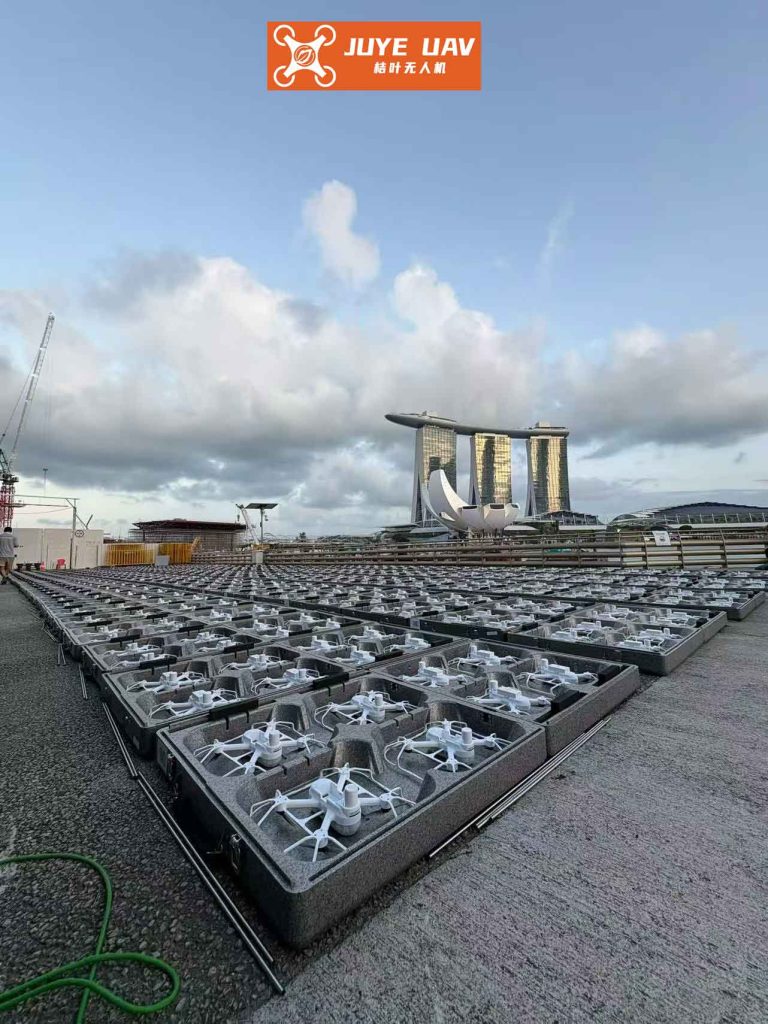
The architecture of a modern formation drone light show is essentially a large-scale mobile ad-hoc network (MANET). Each drone is an autonomous node that must know its position relative to others and exchange data—such as trajectory adjustments and lighting commands—with minimal delay. Traditional star-topology systems, where a central ground station controls all drones, are inadequate for large-scale shows due to limited range, single points of failure, and lack of resilience. Therefore, we advocate for a decentralized approach where drones self-organize, leveraging peer-to-peer communication. In this context, accurate real-time positioning is the foundation. For a formation drone light show, we cannot rely on equipping every unit with expensive, high-precision Global Navigation Satellite Systems (GNSS) like GPS, especially considering cost scalability and potential signal occlusion in dense urban settings where shows are often held. Our proposed solution uses a subset of anchor drones with GNSS capabilities to provide reference points for the entire swarm.
The distributed self-localization mechanism is inspired by ad-hoc positioning systems but adapted for the three-dimensional, dynamic nature of a formation drone light show. Let us assume a swarm of N drones. A proportion p (typically between 10% and 20%) are designated as anchor nodes. These anchors know their absolute coordinates (e.g., from GNSS) and periodically broadcast their identity and position. The remaining drones, which are more numerous and cost-effective, estimate their own positions by measuring distances to multiple anchors. For a 3D space, a minimum of four non-coplanar anchors is required. Distance measurement often uses the Received Signal Strength Indicator (RSSI), which provides a low-complexity, low-cost method suitable for the relatively short and clear-line-of-sight ranges in a formation drone light show. The RSSI-based distance d is modeled as:
$$P(d) = P_0 – 10n \log_{10}\left(\frac{d}{d_0}\right)$$
Here, \(P(d)\) is the received signal strength in dBm at distance \(d\), \(P_0\) is the reference power at a known distance \(d_0\), and \(n\) is the path-loss exponent, typically between 2 and 4 for open aerial environments. Once a drone measures distances \(d_1, d_2, d_3, d_4\) to four anchors at coordinates \((X_i, Y_i, Z_i)\), it solves a system of equations to estimate its own position \((x, y, z)\):
$$
\begin{aligned}
d_1^2 &= (X_1 – x)^2 + (Y_1 – y)^2 + (Z_1 – z)^2 \\
d_2^2 &= (X_2 – x)^2 + (Y_2 – y)^2 + (Z_2 – z)^2 \\
d_3^2 &= (X_3 – x)^2 + (Y_3 – y)^2 + (Z_3 – z)^2 \\
d_4^2 &= (X_4 – x)^2 + (Y_4 – y)^2 + (Z_4 – z)^2
\end{aligned}
$$
This nonlinear system can be solved iteratively or via linearization techniques. The mean squared error (MSE) of the estimated position \((x_e, y_e, z_e)\) compared to the true position \((x_0, y_0, z_0)\) is a key performance metric:
$$\epsilon^2 = E[(x_e – x_0)^2 + (y_e – y_0)^2 + (z_e – z_0)^2]$$
In a simulated formation drone light show environment spanning 10 km × 10 km × 500 m with 100 randomly placed nodes, we analyzed the impact of anchor ratio p on localization error. The results, summarized below, show that an anchor ratio of 10-20% offers a good balance between cost and precision, achieving errors around 40-55 meters. While this may seem large, for a formation drone light show where drones maintain separations of tens of meters, this precision is sufficient for coarse relative positioning, especially when combined with other sensors like inertial measurement units (IMUs) for refinement.
| Anchor Ratio (p) | Mean Localization Error (m) | Remarks |
|---|---|---|
| 5% | ~75 | High error, insufficient for tight formations |
| 10% | ~52 | Viable for most formation drone light show patterns |
| 15% | ~46 | Good balance, recommended for dynamic shows |
| 20% | ~42 | Improved accuracy but higher cost |
| 25% | ~40 | Diminishing returns, cost increases significantly |
Accurate positioning is only one half of the equation; the other is reliable and timely communication. In a formation drone light show, drones must continuously exchange state information—position, velocity, battery status, and lighting commands—to adjust formation and synchronize light effects. The communication protocol must handle high node density, mobility, and bursty traffic without collisions or excessive delays. Traditional fixed TDMA assigns each drone a dedicated time slot in a repeating frame. While collision-free, it suffers from low channel utilization because slots allocated to idle drones are wasted. For a formation drone light show, where traffic patterns can be unpredictable (e.g., sudden formation changes or emergency alerts), fixed TDMA is inefficient. On the other hand, purely random access protocols like CSMA/CA cause high latency and collisions under heavy load, which is unacceptable for real-time control in a formation drone light show.
We have developed a dynamic TDMA (D-TDMA) protocol that synergizes the predictability of fixed allocation with the flexibility of contention. The protocol is designed specifically for the closed-loop control needs of a formation drone light show. The core innovation is the introduction of priority-based slot contention and dynamic slot multiplexing. Each drone is assigned a primary slot in a frame of N slots (where N is the maximum number of drones in the show). However, drones with urgent data can contend for unused slots or even slots owned by others based on priority. Priority is determined by the immediacy of the task. For a formation drone light show, the highest priority is given to safety-critical messages, such as collision avoidance alerts when inter-drone distance falls below a threshold \(d_s\). We define priority levels (1 being highest) as a function of distance d between two drones:
$$
\text{Priority} =
\begin{cases}
1, & 0 < d \leq d_s \\
2, & d_s < d \leq 2d_s \\
\vdots & \vdots \\
K, & (K-1)d_s < d \leq K d_s
\end{cases}
$$
Here, \(d_s\) is the minimum safe separation distance, which for a formation drone light show might be set to 5-10 meters considering positioning errors and aerodynamic effects. The protocol’s operation per time slot is structured into phases, as illustrated in the frame format below.
| Phase | Duration (Symbols) | Purpose |
|---|---|---|
| Anchor Broadcast Reception | Fixed (e.g., 2 bytes) | Drones listen for anchor position updates for localization refresh. |
| Listening Phase | Fixed | Primary owner checks if slot is free; others listen for Request-to-Send (RTS). |
| Contention Phase | Variable (Dynamic) | If multiple drones contend, they use a backoff algorithm based on priority. |
| Position Broadcast | Fixed (e.g., 2 bytes) | Winning drone broadcasts its latest position to neighbors. |
| Data Transmission | Variable (Dynamic) | Winning drone transmits its payload (e.g., commands, status). |
The listening phase is crucial. If the primary owner of a slot has data to send, it transmits an RTS immediately and proceeds, preempting others. If not, other drones with data can attempt to seize the slot. When multiple non-owners contend, they include their priority in the RTS. The highest priority wins; if priorities are equal, they enter a contention phase using a modified binary exponential backoff algorithm. The backoff time \(T_{\text{backoff}}\) is computed as:
$$T_{\text{backoff}} = N_{\text{Random}} \times T_{\text{slot_time}}$$
where \(T_{\text{slot_time}}\) is the duration of a mini-slot defined by the physical layer, and \(N_{\text{Random}}\) is a pseudo-random integer uniformly drawn from \([0, L]\). The parameter L is adjusted based on network density—for a dense formation drone light show, L might be small to reduce latency. This mechanism ensures that high-priority traffic, such as emergency maneuvers in a formation drone light show, gets immediate access, while lower-priority traffic (e.g., routine status updates) fairly shares remaining capacity.
To validate our integrated system of distributed localization and D-TDMA, we conducted extensive simulations using OPNET Modeler, a leading network simulation tool. We modeled a formation drone light show scenario with 40 drones moving at speeds of 5-10 m/s (typical for precise aerial displays) in a 3D airspace of 1 km × 1 km × 100 m. This scale is representative of a medium-sized formation drone light show. Anchor nodes comprised 15% of the fleet. Each drone generated packets following a Poisson process with an average rate of 10 packets/second, simulating command and control traffic. Packet size was 2 kbits, and the channel data rate was set to 2 Mbps, consistent with typical Wi-Fi-based drone links. We compared our D-TDMA against a baseline fixed TDMA (F-TDMA) protocol. The key performance metrics were packet delivery ratio (PDR) and end-to-end (ETE) delay, both critical for the smooth operation of a formation drone light show.
The simulation results clearly demonstrate the advantages of D-TDMA. The packet delivery ratio for F-TDMA plateaued around 78%, primarily due to slot wastage when drones had no data. In contrast, D-TDMA achieved a PDR of over 96%, as shown in the data below. This 18+ percentage point improvement is vital for a formation drone light show, where dropped packets could lead to formation drift or unsynchronized lights. Similarly, the average ETE delay for F-TDMA was about 220 ms, while D-TDMA reduced it to approximately 180 ms. This 40 ms reduction enhances the responsiveness of the swarm, allowing quicker reaction to new commands or environmental disturbances during a formation drone light show.
| Protocol | Packet Delivery Ratio (PDR) | Average End-to-End Delay | Channel Utilization | Suitability for Formation Drone Light Show |
|---|---|---|---|---|
| Fixed TDMA (F-TDMA) | ~78% | ~220 ms | Low (~30-40%) | Poor for dynamic, high-traffic shows |
| Dynamic TDMA (D-TDMA) | ~96% | ~180 ms | High (~70-85%) | Excellent for real-time, adaptive shows |
The enhanced performance stems from D-TDMA’s ability to dynamically reallocate slots. In a formation drone light show, traffic is often bursty—for instance, during a transition between complex shapes like a swirling galaxy or a corporate logo. Drones involved in the transition may need to exchange more data temporarily. D-TDMA allows these high-traffic nodes to borrow unused slots from idle neighbors, achieving load balancing. Moreover, the priority mechanism ensures that safety messages, such as those triggered by a drone detecting an unexpected obstacle during a formation drone light show, are transmitted with minimal latency, preserving the integrity and safety of the entire display.
However, implementing such a system in a real-world formation drone light show presents additional challenges. Clock synchronization across drones is essential for TDMA. We leverage the anchor nodes, which have GNSS receivers, to disseminate synchronization signals during the anchor broadcast phase. This provides coarse synchronization adequate for the slot boundaries. Fine synchronization can be achieved through protocol-based adjustments. Another consideration is scalability. As the number of drones in a formation drone light show increases to thousands, the frame length N would grow, potentially increasing latency. To address this, we can implement clustering, where the swarm is divided into smaller groups, each running D-TDMA locally, with gateway drones handling inter-cluster communication. This hierarchical approach is promising for mega formation drone light shows.
Furthermore, localization accuracy can be enhanced by sensor fusion. While RSSI provides a baseline, incorporating data from IMUs (accelerometers and gyroscopes) and vision-based relative positioning (using onboard cameras) can reduce error to sub-meter levels. This is particularly important for ultra-tight formations in advanced formation drone light shows, where drones may fly within meters of each other. We can model the fused position estimate using a Kalman filter that combines RSSI-based range measurements, IMU dead reckoning, and occasional anchor updates. The state vector \(\mathbf{x}\) might include position and velocity:
$$\mathbf{x}_k = [x_k, y_k, z_k, \dot{x}_k, \dot{y}_k, \dot{z}_k]^T$$
The prediction and update steps follow standard Kalman filter equations, improving robustness against RSSI fluctuations caused by environmental factors in outdoor formation drone light shows.
Looking ahead, the integration of machine learning could optimize slot allocation in D-TDMA. By predicting traffic patterns based on the formation drone light show’s choreography, the protocol could proactively assign slots, reducing contention overhead. For example, if a segment of the show involves a rapid expansion of the formation, drones on the periphery might be allocated more slots in advance. This predictive dynamic TDMA (PD-TDMA) would represent a significant evolution, making formation drone light shows even more efficient and reliable.
In conclusion, the success of a large-scale formation drone light show hinges on seamless autonomous coordination. Our proposed framework—combining cost-effective distributed self-localization using a subset of anchor drones and a dynamic TDMA protocol with priority-based contention—provides a solid technical foundation. Simulations confirm substantial improvements in packet delivery and latency over static approaches. As formation drone light shows continue to grow in scale and complexity, advancing these underlying technologies will be crucial. Future work will focus on real-world testing, scalability solutions, and integrating additional sensors for centimeter-level precision, ultimately enabling ever more breathtaking and reliable aerial spectacles.