
Designing and executing a breathtaking, synchronized formation drone light show is a complex technological challenge that extends far beyond simple waypoint navigation. The core of a reliable and dynamic performance lies in computing trajectories that respect the inherent physics of the drones, ensure their safety, and achieve the desired visual spectacle. In my research, I address this fundamental problem by formulating and solving the trajectory optimization problem for a quadrotor formation, providing a robust foundation for offline planning of intricate formation drone light show sequences.
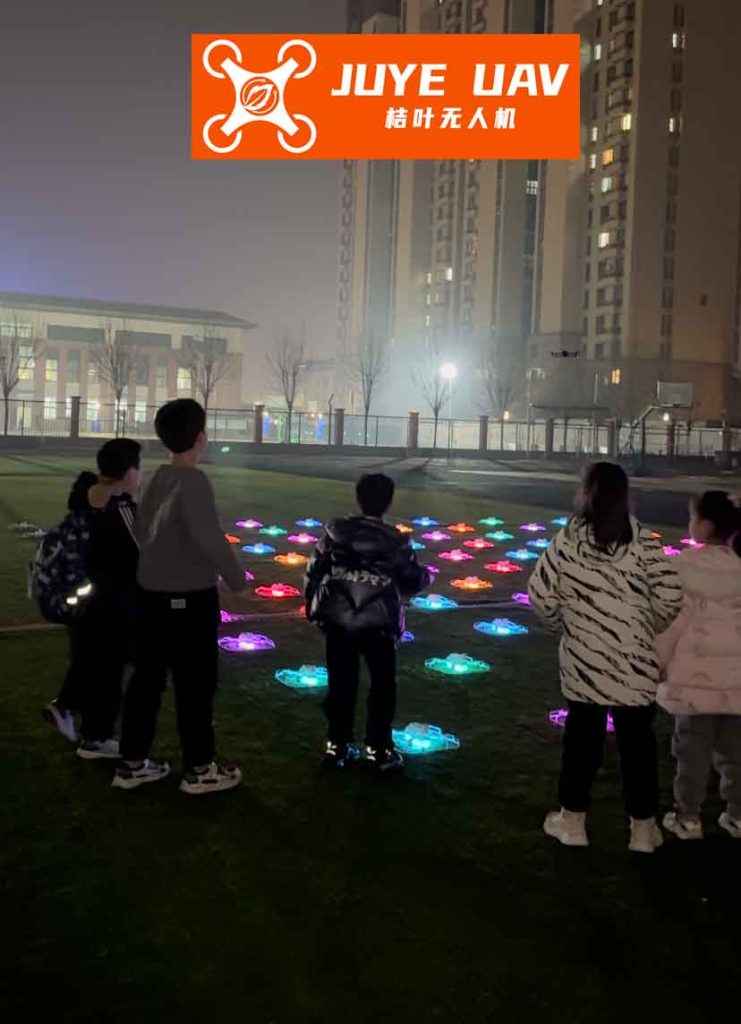
A formation drone light show is not merely a collection of individual flights; it is a coordinated aerial ballet where the state of each drone is critically interdependent to maintain geometric patterns and avoid collisions. Traditional path planning methods often treat drones as simple mass points, neglecting their full six-degree-of-freedom (6-DoF) dynamics, actuator limits, and state constraints. This simplification can lead to trajectories that are dynamically infeasible or overly aggressive for the onboard controller to track precisely, resulting in unstable formations or, worse, mid-air collisions. Therefore, my work focuses on generating optimized trajectories that are inherently feasible, satisfying all system constraints from the planning stage.
System Modeling and Parameter Identification
The first step in trajectory optimization is to have an accurate mathematical model of the quadrotor agent. I employ the Newton-Euler formulation to derive the nonlinear dynamics. Two coordinate frames are defined: the inertial world frame $W$ and the body-fixed frame $B$ attached to the drone’s center of mass. The system state is described by 12 variables: position $\mathbf{P} = [x, y, z]^T$, velocity $\mathbf{V} = [v_x, v_y, v_z]^T$, attitude (Euler angles) $\mathbf{\Theta} = [\phi, \theta, \psi]^T$, and angular velocity $\mathbf{\Omega} = [p, q, r]^T$.
Under standard assumptions (rigid, symmetric structure; low-speed flight negating aerodynamic effects), the 6-DoF dynamics are derived from force and moment balance. For trajectory optimization purposes and assuming small attitude angles, the relationship $\mathbf{\Omega} \approx \dot{\mathbf{\Theta}}$ holds. The final simplified nonlinear model is given by:
$$
\begin{aligned}
\dot{x} &= v_x, \quad \dot{y} = v_y, \quad \dot{z} = v_z \\
\dot{v}_x &= \frac{U_1}{m} (\cos\phi \sin\theta \cos\psi + \sin\phi \sin\psi) \\
\dot{v}_y &= \frac{U_1}{m} (\cos\phi \sin\theta \sin\psi – \sin\phi \cos\psi) \\
\dot{v}_z &= \frac{U_1}{m} (\cos\phi \cos\theta) – g \\
\dot{\phi} &= p, \quad \dot{\theta} = q, \quad \dot{\psi} = r \\
\dot{p} &= \frac{l U_2}{I_x} + \frac{(I_y – I_z)}{I_x} q r \\
\dot{q} &= \frac{l U_3}{I_y} + \frac{(I_z – I_x)}{I_y} p r \\
\dot{r} &= \frac{U_4}{I_z} + \frac{(I_x – I_y)}{I_z} p q
\end{aligned}
$$
Here, $m$ is the mass, $g$ is gravity, $l$ is the arm length from the center to a motor, and $I_x, I_y, I_z$ are moments of inertia. The control inputs $\mathbf{U} = [U_1, U_2, U_3, U_4]^T$ are related to the squared rotational speeds of the four rotors, $\boldsymbol{\omega}^2 = [\omega_1^2, \omega_2^2, \omega_3^2, \omega_4^2]^T$, via the control allocation matrix:
$$
\begin{bmatrix} U_1 \\ U_2 \\ U_3 \\ U_4 \end{bmatrix} =
\begin{bmatrix}
k_F & k_F & k_F & k_F \\
0 & -k_F l & 0 & k_F l \\
k_F l & 0 & -k_F l & 0 \\
k_M & -k_M & k_M & -k_M
\end{bmatrix}
\begin{bmatrix} \omega_1^2 \\ \omega_2^2 \\ \omega_3^2 \\ \omega_4^2 \end{bmatrix}
$$
where $k_F$ and $k_M$ are the thrust and torque coefficients, respectively. For my specific platform used in this formation drone light show research, I obtained parameters through direct measurement and software analysis, summarized in the table below.
| Parameter | Symbol | Value | Unit |
|---|---|---|---|
| Mass | $m$ | 0.625 | kg |
| Arm Length | $l$ | 0.1275 | m |
| Thrust Coefficient | $k_F$ | 2.103 $\times 10^{-6}$ | N/(rad²/s²) |
| Torque Coefficient | $k_M$ | 2.091 $\times 10^{-8}$ | Nm/(rad²/s²) |
| Moment of Inertia (x) | $I_x$ | 2.3 $\times 10^{-3}$ | kg·m² |
| Moment of Inertia (y) | $I_y$ | 2.4 $\times 10^{-3}$ | kg·m² |
| Moment of Inertia (z) | $I_z$ | 2.6 $\times 10^{-3}$ | kg·m² |
Problem Formulation for Formation Flight
My objective is to optimize the trajectories for a formation of $N$ identical quadrotors (e.g., $N=6$ for a basic pattern) to execute a segment of a formation drone light show. This is posed as an optimal control problem (OCP). For each drone $i$, the state vector is $\mathbf{X}^i = [x^i, y^i, z^i, v_x^i, v_y^i, v_z^i, \phi^i, \theta^i, \psi^i, p^i, q^i, r^i]^T$ and the control vector is $\mathbf{U}^i = [U_1^i, U_2^i, U_3^i, U_4^i]^T$.
Performance Index (Cost Function): For a formation drone light show aiming to execute rapid, synchronized maneuvers, minimum-time trajectories are often desired to maximize dynamic performance. Therefore, I choose the total mission time as the objective to minimize:
$$ J = t_f $$
where $t_f$ is the common final time for the entire formation.
Boundary Conditions: These define the start and end of the show segment. All drones begin and end in a hover (zero velocity and angular velocity). Their initial and final positions define the pattern transition. For example:
$$
\mathbf{X}^i(t_0) = [x_0^i, y_0^i, z_0^i, 0, 0, 0, 0, 0, 0, 0, 0, 0]^T
$$
$$
\mathbf{X}^i(t_f) = [x_f^i, y_f^i, z_f^i, 0, 0, 0, *, *, *, 0, 0, 0]^T
$$
where final yaw angle $\psi_f^i$ may be free (*) depending on the next maneuver in the formation drone light show sequence.
Path Constraints: These are critical for safety and feasibility in a formation drone light show.
- State Constraints: Physical limits on flight volume, speed, and attitude to ensure stable flight.
$$
\begin{aligned}
& \mathbf{P}_{min} \leq \mathbf{P}^i(t) \leq \mathbf{P}_{max} \\
& \mathbf{V}_{min} \leq \mathbf{V}^i(t) \leq \mathbf{V}_{max} \\
& \mathbf{\Theta}_{min} \leq \mathbf{\Theta}^i(t) \leq \mathbf{\Theta}_{max} \\
& \mathbf{\Omega}_{min} \leq \mathbf{\Omega}^i(t) \leq \mathbf{\Omega}_{max}
\end{aligned}
$$ - Control Input Constraints: Limits on motor thrust and torque, derived from the maximum rotor speed $\omega_{max}$.
$$
\begin{aligned}
0 &\leq U_1^i \leq 4 k_F \omega_{max}^2 \\
|U_2^i|, |U_3^i| &\leq k_F l \omega_{max}^2 \\
|U_4^i| &\leq 2 k_M \omega_{max}^2
\end{aligned}
$$ - Collision Avoidance Constraints: The most crucial constraint for a formation drone light show. A simple but effective “soft” safety domain constraint is enforced between every pair of drones $(i, j)$:
$$
\begin{aligned}
|x^i(t) – x^j(t)| &\geq d_{safe} \\
|y^i(t) – y^j(t)| &\geq d_{safe} \\
|z^i(t) – z^j(t)| &\geq d_{safe}
\end{aligned}
\quad \forall t, \quad i \neq j
$$
where $d_{safe}$ is the minimum allowed separation (e.g., 0.5 m).
hp-Adaptive Pseudospectral Method
Solving the described OCP for a multi-agent system is challenging. I employ the direct transcription method, specifically the hp-adaptive pseudospectral method, which is highly efficient for problems with complex constraints like those in a formation drone light show.
The core idea is to transcribe the continuous-time OCP into a finite-dimensional Nonlinear Programming (NLP) problem. The hp method combines the high accuracy of global polynomial approximation (the p method) with the flexibility of local mesh refinement (the h method).
1. Time Domain Transformation: The time horizon $t \in [t_0, t_f]$ is mapped to the computational domain $\tau \in [-1, 1]$ via:
$$ \tau = \frac{2t – (t_f + t_0)}{t_f – t_0} $$
2. Discretization and Approximation: The transformed time interval is divided into $K$ mesh intervals. Within each interval, the state and control profiles are approximated using Lagrange interpolating polynomials based on Legendre-Gauss (LG) collocation points:
$$
\mathbf{X}^k(\tau) \approx \sum_{j=0}^{N_k} \mathbf{X}_{j}^k L_j^k(\tau), \quad \mathbf{U}^k(\tau) \approx \sum_{j=1}^{N_k} \mathbf{U}_{j}^k \tilde{L}_j^k(\tau)
$$
where $N_k$ is the polynomial degree in the $k$-th interval, and $L_j^k$ are the Lagrange basis polynomials.
3. Dynamics Constraint Transcription: The derivative of the state approximation at the LG collocation points is computed using a differentiation matrix $\mathbf{D}^k$. The system dynamics are then enforced as algebraic constraints at these points:
$$
\sum_{j=0}^{N_k} D_{ij}^k \mathbf{X}_j^k – \frac{t_f – t_0}{2} f(\mathbf{X}_i^k, \mathbf{U}_i^k, \tau_i^k) = 0, \quad i = 1, …, N_k
$$
This is a key step that converts differential equations into algebraic constraints.
4. Adaptive Refinement (hp-Strategy): After an initial solution, the method checks for accuracy. The residual of the dynamics or path constraints is evaluated at the midpoint of each mesh interval. If the error exceeds a specified tolerance, the interval is refined.
- h-refinement: The problematic interval is subdivided into smaller segments while keeping a low polynomial degree. This is effective for handling non-smooth control profiles or sudden constraint activations (like near-collision avoidance maneuvers in a formation drone light show).
- p-refinement: The polynomial degree $N_k$ within the interval is increased. This is efficient for smoothing out errors in already smooth segments of the trajectory.
The algorithm automatically chooses between h- and p-refinement based on the local solution curvature, leading to an optimal distribution of discretization points. This adaptability is essential for efficiently solving the complex, constrained problem of a multi-drone formation drone light show without manual tuning.
The transcribed NLP, which includes all the dynamics, boundary, and path constraints for all drones, is then solved using a robust solver like SNOPT (Sparse Nonlinear OPTimizer).
Simulation Analysis and Results
I demonstrate the method for a formation of $N=6$ quadrotors performing a coordinated translational maneuver, a fundamental building block for any formation drone light show. The drones start in a 2×3 grid and must transition to an identical grid shifted in 3D space, arriving simultaneously in minimum time while respecting all constraints.
| Constraint Type | Values / Bounds |
|---|---|
| State Bounds | $|v_x|,|v_y|,|v_z| \leq 5 \text{ m/s}$, $|\phi|,|\theta| \leq 20^\circ$, $|p|,|q|,|r| \leq 1.7 \text{ rad/s}$ |
| Control Bounds | $0 \leq U_1 \leq 21.03 \text{ N}$, $|U_2|,|U_3| \leq 0.67 \text{ Nm}$, $|U_4| \leq 0.105 \text{ Nm}$ |
| Safety Distance | $d_{safe} = 1.0 \text{ m}$ |
The hp-adaptive pseudospectral method successfully solved this problem. The optimal formation flight time was found to be $t_f^* = 7.87$ seconds. The resulting trajectories are dynamically feasible and satisfy all hard constraints.
Key Observations:
1. Smooth State Trajectories: The position and velocity profiles for all drones are smooth and continuous, indicating a flyable path essential for a stable formation drone light show.
2. Control Feasibility: All control inputs $U_1$ to $U_4$ for every drone remain strictly within their specified bounds throughout the maneuver. There are no saturation points, ensuring the low-level attitude controller has sufficient authority.
3. Guaranteed Collision Avoidance: The minimum pairwise distance between any two drones during the entire flight was maintained above the 1.0 m safety margin. The following table shows the minimum recorded distance for several drone pairs, confirming the effectiveness of the constraints.
| Drone Pair (i, j) | Minimum Distance (m) |
|---|---|
| (1, 2) | 2.15 |
| (1, 3) | 1.98 |
| (2, 4) | 1.22 |
| (3, 6) | 1.87 |
4. Adaptive Mesh: The hp method automatically generated a non-uniform discretization mesh. It placed more collocation points (higher polynomial degree or finer segmentation) during phases of higher maneuver intensity, such as the initial acceleration and final deceleration, and fewer points during steady cruise. This adaptive process was crucial for achieving high accuracy with a relatively low total number of optimization variables, making the solution of this six-drone formation drone light show problem computationally tractable.
Conclusion
In this work, I have presented a comprehensive framework for offline trajectory optimization of quadrotor formations, with direct application to the design of sophisticated formation drone light show choreography. By rigorously modeling the 6-DoF drone dynamics and incorporating critical state, control, and inter-agent collision constraints, the formulated optimal control problem ensures that the generated trajectories are not only visually planned but also dynamically feasible and safe.
The hp-adaptive pseudospectral method proved to be an exceptionally powerful tool for this task. Its ability to automatically balance solution accuracy and computational cost through adaptive mesh refinement is ideal for handling the complex, constrained nature of multi-drone trajectory optimization. The simulation results for a six-drone formation validate the approach, producing a smooth, minimum-time, collision-free trajectory that respects all physical actuator limits.
This methodology provides a solid foundation for planning complex formation drone light show sequences. Future work will focus on integrating this offline planner with robust model predictive control (MPC) for real-time disturbance rejection during live performances, and extending the formulation to handle dynamic shape morphing and closed-loop geometric patterns that define the most advanced aerial displays.