
The captivating spectacle of a synchronized formation drone light show has emerged as a powerful medium for artistic expression and large-scale public entertainment. These awe-inspiring displays, where hundreds or thousands of unmanned aerial vehicles (UAVs) act in concert to create dynamic, illuminated shapes in the night sky, represent a pinnacle of multi-agent system coordination. The core technological challenge underpinning this application is reliable, scalable, and robust formation drone light show control. This article presents a distributed control strategy based on edge Laplacian consensus theory, designed to achieve precise geometric formations for UAV swarms while explicitly handling model nonlinearities and environmental disturbances, directly addressing the real-world demands of a professional formation drone light show.
The shift from centralized to distributed control paradigms is crucial for the scalability and reliability of large-scale formation drone light show operations. In a distributed framework, each drone makes decisions based on limited information exchanged with its neighbors, eliminating single points of failure and enabling graceful degradation. Consensus algorithms, where agents agree upon a common state value through local interactions, provide a natural foundation for achieving synchronized maneuvers essential for a cohesive formation drone light show. This work leverages the edge Laplacian formulation, a powerful graphical tool that transforms the formation control problem into a stability analysis problem for the edges (i.e., the relative states between drones) of the communication network.
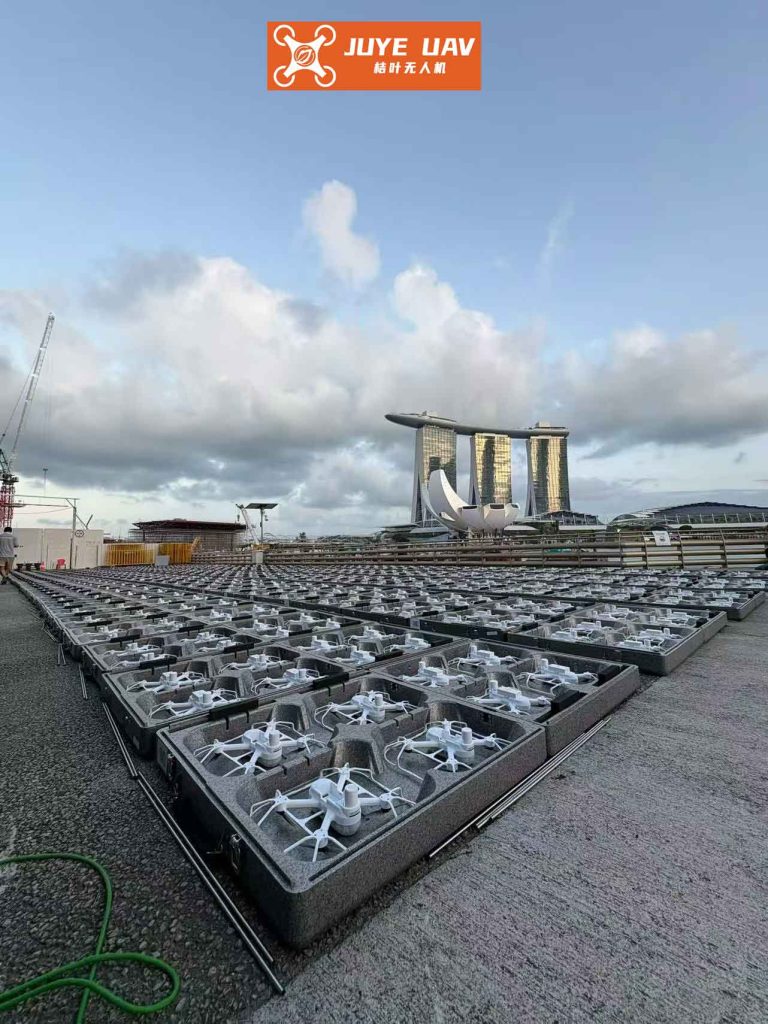
We consider a fleet of $n$ fixed-wing UAVs, a common platform for outdoor formation drone light show due to their endurance. The kinematic model for the $i$-th UAV, equipped with inner-loop autopilots for speed, heading, and altitude, and subject to bounded disturbances, is given by:
$$
\begin{align}
\dot{x}_i &= v_i \cos(\psi_i), \\
\dot{y}_i &= v_i \sin(\psi_i), \\
\dot{v}_i &= \alpha_v (v_i^c – v_i) + \delta_i^v, \\
\dot{h}_i &= v_i^h, \\
\dot{\psi}_i &= \omega_i, \\
\dot{v}_i^h &= \alpha_h (\omega_i^{h,c} – v_i^h) + \delta_i^{h},
\end{align}
$$
where $(x_i, y_i, h_i)$ is the 3D position, $v_i$ is the horizontal speed, $\psi_i$ is the yaw angle, and $v_i^h$ is the vertical (climb) speed. The control inputs are the commanded horizontal speed $v_i^c$, yaw rate $\omega_i$, and vertical speed command $\omega_i^{h,c}$. The terms $\delta_i^v$ and $\delta_i^{h}$ represent unknown but bounded disturbances acting on the horizontal and vertical dynamics, respectively, modeling wind gusts or model imperfections—a critical consideration for outdoor formation drone light show stability. The positive constants $\alpha_v, \alpha_h$ are autopilot parameters. Practical constraints for a safe formation drone light show include:
$$
\begin{align}
& v_{\min} \leq v_i \leq v_{\max}, \quad a_{\min} \leq \dot{v}_i \leq a_{\max}, \\
& v^h_{\min} \leq v_i^h \leq v^h_{\max}, \quad a^h_{\min} \leq \dot{v}_i^h \leq a^h_{\max}.
\end{align}
$$
The primary control objective is to achieve a predefined 3D formation pattern while synchronizing velocity and heading. Formally, for any pair of drones $(i, j)$, we require:
$$
\lim_{t \to \infty} (x_i – x_j) = s_{ij}^x, \quad \lim_{t \to \infty} (y_i – y_j) = s_{ij}^y, \quad \lim_{t \to \infty} (h_i – h_j) = s_{ij}^h,
$$
$$
\lim_{t \to \infty} (\psi_i – \psi_j) = 0, \quad \lim_{t \to \infty} (v_i – v_j) = 0, \quad \lim_{t \to \infty} (v_i^h – v_j^h) = 0,
$$
where $s_{ij}^x, s_{ij}^y, s_{ij}^h$ are the desired constant separation offsets defining the formation drone light show shape.
Graph Theory and Edge Laplacian Preliminaries
The communication or sensing topology among the $n$ drones is modeled as a directed graph $\mathcal{G} = (\mathcal{V}, \mathcal{E})$, where $\mathcal{V} = \{1,…, n\}$ is the node set and $\mathcal{E} \subseteq \mathcal{V} \times \mathcal{V}$ is the edge set with $m$ edges. The incidence matrix $E \in \mathbb{R}^{n \times m}$ encodes the graph connectivity: $[E]_{ik} = +1$ if node $i$ is the terminal node of edge $k$, $[E]_{ik} = -1$ if it is the initial node, and $0$ otherwise. The standard node Laplacian is $L_n = E E^\top$.
The edge Laplacian $L_e \in \mathbb{R}^{m \times m}$ is defined as $L_e = E^\top E$. A key property is that $L_e$ and $L_n$ share the same non-zero eigenvalues. For a graph containing a directed spanning tree, $L_e$ is positive semi-definite. This formulation allows us to analyze consensus and formation problems through the lens of edge dynamics, which represent the relative states between agents. Defining the stacked vector of edge states for the x-position as $\boldsymbol{x}^e = E^\top \boldsymbol{x}$ and the desired formation offsets as $\boldsymbol{s}^e_x$, the formation error on the edges is $\tilde{\boldsymbol{x}}^e = \boldsymbol{x}^e – \boldsymbol{s}^e_x$. The dynamics of this error are central to our control design.
Control Design via Feedback Linearization and Backstepping
The nonlinear model (1) is first transformed into a simpler, decoupled form using feedback linearization. We define virtual control inputs for the horizontal plane:
$$
u_i^x = \alpha_v (v_i^c – v_i) \cos(\psi_i) – v_i \omega_i \sin(\psi_i), \\
u_i^y = \alpha_v (v_i^c – v_i) \sin(\psi_i) + v_i \omega_i \cos(\psi_i).
$$
With these, the horizontal dynamics can be rewritten as two double-integrator systems subject to matched disturbances $\eta_i^x, \eta_i^y$:
$$
\begin{align}
\dot{x}_i &= v_i^x, & \dot{v}_i^x &= u_i^x + \eta_i^x, \\
\dot{y}_i &= v_i^y, & \dot{v}_i^y &= u_i^y + \eta_i^y,
\end{align}
$$
where $v_i^x = v_i \cos(\psi_i)$ and $v_i^y = v_i \sin(\psi_i)$. The vertical channel $(h_i, v_i^h)$ already has a similar double-integrator structure. This decoupling allows us to design identical control laws for the x, y, and h subsystems, a modular approach highly beneficial for programming a formation drone light show.
We now detail the control design for the x-subsystem; the y and h subsystems follow identically. Let $\tilde{x}_i^e = \sum_{j \in \mathcal{N}_i} (x_i – x_j – s_{ij}^x)$ represent a local formation error. The global edge-based error is $\tilde{\boldsymbol{x}}^e = E^\top \boldsymbol{x} – \boldsymbol{s}^e_x$. Its dynamics are:
$$
\dot{\tilde{\boldsymbol{x}}}}^e = \boldsymbol{v}^e_x, \quad \dot{\boldsymbol{v}}^e_x = \boldsymbol{u}^e_x + \boldsymbol{\eta}^e_x,
$$
where $\boldsymbol{v}^e_x = E^\top \boldsymbol{v}_x$, and $\boldsymbol{u}^e_x, \boldsymbol{\eta}^e_x$ are the stacked virtual inputs and disturbances on the edges. The control objective is to stabilize $(\tilde{\boldsymbol{x}}^e, \boldsymbol{v}^e_x)$ to zero.
We employ the backstepping technique. First, treat $\boldsymbol{v}^e_x$ as a virtual control for the $\tilde{\boldsymbol{x}}^e$ subsystem. A desired virtual control is chosen as $\boldsymbol{\alpha}_x = -k_1^s L_e \tilde{\boldsymbol{x}}^e + \boldsymbol{1} v^d_x$, where $v^d_x$ is the desired formation flight speed in the x-direction and $k_1^s > 0$. Define the velocity error $\boldsymbol{z}_x = \boldsymbol{v}^e_x – \boldsymbol{\alpha}_x$. The complete error dynamics become:
$$
\begin{align}
\dot{\tilde{\boldsymbol{x}}}}^e &= \boldsymbol{\alpha}_x + \boldsymbol{z}_x = -k_1^s L_e \tilde{\boldsymbol{x}}^e + \boldsymbol{1} v^d_x + \boldsymbol{z}_x, \\
\dot{\boldsymbol{z}}_x &= \boldsymbol{u}^e_x + \boldsymbol{\eta}^e_x + k_1^s L_e \boldsymbol{v}^e_x.
\end{align}
$$
Consider the composite Lyapunov function candidate:
$$
V_x = \frac{1}{2} (\tilde{\boldsymbol{x}}^e)^\top P \tilde{\boldsymbol{x}}^e + \frac{1}{2} \boldsymbol{z}_x^\top \boldsymbol{z}_x,
$$
where $P$ is a symmetric positive definite matrix satisfying the Lyapunov equation $P L_e + L_e^\top P = Q$, with $Q > 0$. This matrix $P$ exists for a connected graph. The derivative of $V_x$ is:
$$
\dot{V}_x = -\frac{k_1^s}{2} (\tilde{\boldsymbol{x}}^e)^\top Q \tilde{\boldsymbol{x}}^e + (\tilde{\boldsymbol{x}}^e)^\top P \boldsymbol{z}_x + \boldsymbol{z}_x^\top \left( \boldsymbol{u}^e_x + \boldsymbol{\eta}^e_x + k_1^s L_e \boldsymbol{v}^e_x \right).
$$
To ensure robustness against the bounded disturbance $\boldsymbol{\eta}^e_x$, we design a control law with a discontinuous term:
$$
\boldsymbol{u}^e_x = -k_2^s \boldsymbol{z}_x – P \tilde{\boldsymbol{x}}^e – k_1^s L_e \boldsymbol{v}^e_x – \rho \text{sgn}(\boldsymbol{z}_x),
$$
where $k_2^s > 0$ and $\rho \ge \| \boldsymbol{\eta}^e_x \|_\infty$ is a known bound on the disturbance. Substituting this control law yields:
$$
\dot{V}_x \le -\frac{k_1^s \lambda_{\min}(Q)}{2} \|\tilde{\boldsymbol{x}}^e\|^2 – k_2^s \|\boldsymbol{z}_x\|^2 + \boldsymbol{z}_x^\top \boldsymbol{\eta}^e_x – \rho \boldsymbol{z}_x^\top \text{sgn}(\boldsymbol{z}_x).
$$
Since $\boldsymbol{z}_x^\top \boldsymbol{\eta}^e_x \le \|\boldsymbol{z}_x\|_1 \rho$, it follows that $\dot{V}_x \le -\frac{k_1^s \lambda_{\min}(Q)}{2} \|\tilde{\boldsymbol{x}}^e\|^2 – k_2^s \|\boldsymbol{z}_x\|^2$. This guarantees global asymptotic stability of the origin $(\tilde{\boldsymbol{x}}^e, \boldsymbol{z}_x) = (\boldsymbol{0}, \boldsymbol{0})$ according to Lyapunov theory.
Translating this edge-based control law back to node-based inputs for each drone $i$ yields the final distributed formation protocol for the x-axis:
$$
\begin{aligned}
u_i^x = &-k_2^s z_i^x – \sum_{j \in \mathcal{N}_i} P_{ij} (x_i – x_j – s_{ij}^x) \\
&- k_1^s \sum_{j \in \mathcal{N}_i} (v_i^x – v_j^x) – \rho \, \text{sgn}(z_i^x),
\end{aligned}
$$
where $z_i^x$ is the $i$-th component of the transformed velocity error. Identical laws $u_i^y$ and $u_i^h$ are applied for the y and h subsystems, with $v^d_h = 0$ for altitude holding. These virtual inputs are then converted back into the actual drone commands $v_i^c$, $\omega_i$, and $\omega_i^{h,c}$ using the inverse of the feedback linearization transform. This distributed algorithm ensures that each drone in the formation drone light show only requires information from its neighbors to compute its control action.
| Methodology | Key Principle | Advantages | Challenges for Large-Scale Shows |
|---|---|---|---|
| Leader-Follower | Designated leader(s) are tracked by followers. | Simple concept, easy to implement. | Single point of failure (leader), poor scalability. |
| Virtual Structure | Drones act as particles in a rigid moving frame. | Precise geometric formation, coherent group motion. | Centralized computation of the virtual structure trajectory. |
| Behavior-Based | Weighted combination of basic behaviors (e.g., avoid collision, maintain formation). | High robustness, flexible reaction to environment. | Difficult to analyze mathematically, unpredictable emergent behavior. |
| Consensus-Based (This Work) | Agreement on relative states through local interaction. | Fully distributed, high scalability, strong theoretical guarantees. | Requires careful graph connectivity analysis, tuning of consensus gains. |
Numerical Simulation of a Formation Drone Light Show
To validate the proposed edge Laplacian consensus controller, we simulate a formation drone light show with four fixed-wing UAVs aiming to achieve a stable triangular pyramid formation. The directed communication topology ensures information flow necessary for consensus. The key simulation parameters and initial conditions are summarized below.
| Parameter / State | UAV 1 | UAV 2 | UAV 3 | UAV 4 | Units |
|---|---|---|---|---|---|
| Initial (x, y, h) | (400, 150, 1000) | (600, 200, 300) | (500, 950, 800) | (500, 300, 600) | m |
| Initial (v, $\psi$, $v^h$) | (20, 0.25, 0) | (50, 0.30, 0) | (30, 0, 0) | (20, 0.125, 0) | m/s, rad, m/s |
| Disturbance Bound ($\rho$) | $0.1 \cdot (v_i)^2$ (horizontal), $0.1 \cdot (v_i^h)^2$ (vertical) | – | |||
| Autopilot Gains ($\alpha_v, \alpha_h$) | 0.2, 0.8447 | – | |||
| Speed Limits ($v_{\min}, v_{\max}$) | >0, 200 | m/s | |||
The desired 3D formation is defined by the following inter-agent offsets, which create a pyramid shape suitable for a formation drone light show:
$$
\begin{aligned}
& s_{12}^x = -500m, \, s_{12}^y = -400m, \, s_{12}^h = -100m, \\
& s_{13}^x = -500m, \, s_{13}^y = 0m, \, s_{13}^h = -100m, \\
& s_{14}^x = -500m, \, s_{14}^y = -400m, \, s_{14}^h = -100m.
\end{aligned}
$$
The control gains are selected as $k_1^s = 4$, $k_2^s = 2$, and $\rho=4$ to satisfy the stability conditions derived from the Lyapunov analysis. The desired common horizontal speed is $v^d = 100$ m/s. The simulation results, depicted in the figures below, demonstrate the effectiveness of the proposed controller.
The 3D trajectory plot shows the four UAVs starting from dispersed initial positions and converging smoothly to the prescribed pyramid formation while moving forward. The x and y position plots demonstrate that the relative distances between drones converge exponentially to the desired offsets $s_{ij}^x$ and $s_{ij}^y$. Crucially, the horizontal speed and climb speed plots confirm that all drones achieve velocity consensus, synchronizing at the desired common speeds. The yaw angle plot shows the heading angles converging to a common value, ensuring coordinated flight direction. Despite the presence of simulated aerodynamic disturbances proportional to the square of the velocity, the formation remains stable and precise, showcasing the controller’s robustness—an indispensable feature for a real-world formation drone light show operating in variable wind conditions.
| Performance Metric | Observation | Implication for Formation Drone Light Show |
|---|---|---|
| Formation Convergence Time | Steady-state achieved within ~25 seconds from random initials. | Allows for efficient transition between different shapes in a dynamic show. |
| Steady-State Formation Error | Error converges to zero asymptotically per theory. | Ensures sharp, well-defined visual shapes in the sky. |
| Robustness to Disturbances | Formation maintained under bounded velocity-dependent disturbances. | Enables reliable outdoor performances in mild wind conditions. |
| Control Input Smoothness | Inputs remain within predefined actuator limits. | Guarantees feasibility and safety for physical drone platforms. |
Conclusion and Future Perspectives
This article has presented a robust distributed control framework for multi-UAV formation flight, with direct application to the demanding domain of professional formation drone light show. By integrating feedback linearization, edge Laplacian consensus theory, and backstepping control design, we have developed an algorithm that guarantees asymptotic stability of the desired geometric formation and velocity synchronization, even in the presence of realistic bounded disturbances. The fully distributed nature of the protocol ensures scalability and fault tolerance, critical for managing the hundreds of drones involved in modern formation drone light show displays.
The simulation of a four-UAV pyramid formation validates the theoretical results, demonstrating precise convergence and robust performance. Future work will focus on extending this approach to handle more complex and dynamic aspects of a formation drone light show. Key directions include: 1) Investigating time-varying or switching communication topologies to allow drones to dynamically change their information links for reconfiguration or fault recovery. 2) Integrating collision avoidance constraints directly into the consensus-based control law to ensure absolute safety during dense packing and complex maneuvers. 3) Developing online adaptation mechanisms for the disturbance bound $\rho$ to further enhance performance in uncertain environments. Advancements in these areas will continue to push the boundaries of what is possible, enabling ever more complex and reliable aerial performances.