
In recent years, the increasing frequency of natural disasters worldwide has highlighted the critical need for emergency communication systems. When earthquakes, wildfires, or hurricanes strike, local infrastructure such as base stations is often damaged, leading to communication breakdowns that hinder rescue efforts. In such scenarios, unmanned aerial vehicle (UAV) formations have emerged as a promising solution due to their high mobility, flexibility, and collaborative capabilities. These formation drone light shows, inspired by collective behaviors like those of bees, can operate in clustered modes to perform tasks efficiently. However, traditional wireless communication methods face challenges like spectrum scarcity, interference, and connectivity issues in dynamic environments. Ultraviolet (UV) light communication, with its advantages of high security, all-weather operation, and low probability of interception, offers a potential alternative. By integrating UV communication into UAV formations, we can enhance data transmission reliability in emergency scenarios. But UV links suffer from high path loss, making energy-efficient routing crucial to prolong the operational time of these formation drone light shows. In this article, I propose a novel routing optimization algorithm, Rcomp JAYA LEACH (RJLEACH), which combines the Low Energy Adaptive Clustering Hierarchy (LEACH) protocol with the JAYA intelligent optimization algorithm. This approach aims to improve the effective mission duration of UV communication-based formation drone light shows by optimizing cluster head election and inter-cluster routing. Through simulations, I demonstrate that RJLEACH significantly extends network lifetime and enhances energy utilization compared to classical methods, providing valuable time for disaster relief and emergency communication tasks.
The concept of formation drone light shows involves multiple UAVs operating in coordinated patterns, often for entertainment or surveillance purposes. In emergency contexts, these formations can be repurposed to create ad-hoc networks for data collection and communication. Using UV light for communication adds a layer of security and robustness, as UV signals are less susceptible to eavesdropping and interference. However, the high attenuation of UV light over distance necessitates careful energy management to prevent premature node death. To address this, I build upon the LEACH protocol, a popular clustering algorithm for wireless sensor networks, by incorporating a competitive radius mechanism and a discrete JAYA (DJAYA) algorithm for route optimization. The result is RJLEACH, which balances energy consumption across nodes and finds optimal routing paths, thereby extending the lifespan of the formation drone light show network. In the following sections, I detail the system model, algorithm design, and simulation results, emphasizing how this approach can transform UAV formations into resilient communication platforms.
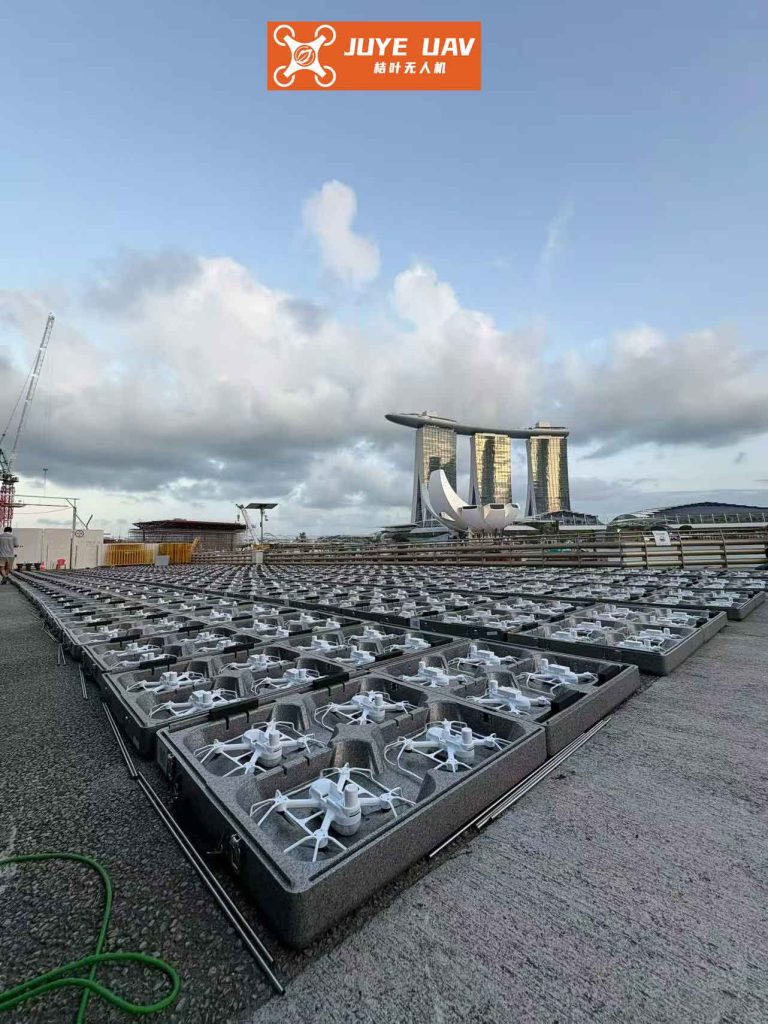
To model the UV communication UAV formation, I consider a clustered architecture where the network is divided into multiple clusters, each with a cluster head that manages member nodes and relays data to a leader UAV. This leader acts as the control center, processing information and issuing commands. The formation drone light show operates in a planar area, with all UAVs flying at the same altitude and maintaining consistent velocity and direction. The clustering process is cyclical, with rounds consisting of cluster head election, node association, and data transmission. This model reduces redundant links and balances energy loads, which is essential for prolonging the network’s operational time in a formation drone light show. For UV communication, I focus on non-line-of-sight (NLOS) links due to obstacles like debris or smoke in disaster zones. The path loss for UV signals can be approximated by a simplified formula, which I incorporate into the energy consumption model. The key parameters for the system are summarized in Table 1, including initial energy, transmission costs, and UV-specific factors like wavelength and angles.
| Parameter | Value |
|---|---|
| UV wavelength λ (nm) | 266 |
| Initial energy E₀ (J) | 300 |
| Transmission energy per bit E_T (mJ) | 8 |
| Reception energy per bit E_R (mJ) | 8 |
| Data fusion energy per bit E_DA (mJ) | 0.8 |
| Transmitter elevation angle θ₁ (°) | 40 |
| Receiver elevation angle θ₂ (°) | 40 |
| Beam divergence ϕ₁ (°) | 30 |
| Field of view ϕ₂ (°) | 30 |
| Path loss factor ξ | 1.69 × 10⁸ |
| Path loss exponent α | 1.3498 |
| Data packet size per round (bits) | 5000 |
| Control packet size per round (bits) | 400 |
The UV communication link model is based on NLOS scattering, where signals are reflected by atmospheric particles. The path loss L for a UV link depends on the distance r between transmitter and receiver, as well as angles like elevation and divergence. For distances under 1 km, a simplified model is used:
$$L = \xi r^\alpha$$
where ξ is the path loss factor and α is the path loss exponent, both derived from empirical studies. This model allows for efficient computation of energy consumption in the formation drone light show. The energy dissipated due to path loss E_L when transmitting data is given by:
$$E_L = E_T \left(1 – \frac{1}{L}\right)$$
where E_T is the energy per bit for transmission. For sending k bits of data over distance r, the total transmission energy E_TX and reception energy E_RX are:
$$E_{TX}(k) = k (E_T + E_L)$$
$$E_{RX}(k) = k E_R$$
Additionally, cluster heads perform data fusion to reduce redundancy, consuming energy E_c for m member nodes:
$$E_c(m, k) = (m + 1) k E_{DA}$$
These equations form the basis of the energy consumption model, which is critical for optimizing routing in a formation drone light show.
The RJLEACH algorithm improves upon classical LEACH by introducing a competitive radius during cluster head election and using DJAYA for inter-cluster routing optimization. In each round, nodes become candidate cluster heads based on a threshold T(n):
$$T(n) = \begin{cases}
\frac{p}{1 – p \left( N \mod \left( \frac{1}{p} \right) \right) }, & \text{if } n \in G \\
0, & \text{otherwise}
\end{cases}$$
where p is the desired percentage of cluster heads, N is the current round number, and G is the set of nodes that haven’t been cluster heads recently. To ensure uniform distribution, each candidate cluster head s_i has a competitive radius R_i defined as:
$$R_i = \left(1 – r_c \frac{d_{\max} – d_{i,\text{leader}}}{d_{\max} – d_{\min}} \right) R_0$$
Here, r_c is a control parameter, d_max and d_min are the maximum and minimum distances to the leader, d_{i,leader} is the distance from s_i to the leader, and R_0 is the maximum competition radius. Candidates with overlapping radii form a neighbor set, and the node with the highest residual energy becomes the cluster head. This process reduces energy variance among nodes, a key aspect for maintaining a balanced formation drone light show.
For inter-cluster communication, if a cluster head is within a distance threshold D_max from the leader, it transmits directly; otherwise, it uses relay nodes. The goal is to find an optimal route that minimizes distance while maximizing residual energy. The fitness function for a route with k relay nodes is:
$$\text{Fitness} = \min \left( d_i + (-E_{\text{rest}}) \right)$$
where d_i is the total route distance and E_rest is the sum of residual energies of nodes on the route. The DJAYA algorithm optimizes this by iteratively updating routes based on current, best, and worst solutions in the population. The steps are: initialize parameters, evaluate fitness, select candidates using random numbers and trend parameters, generate new routes via path transformation, accept better solutions, and repeat until convergence. This approach efficiently explores the solution space, ensuring robust routing for the formation drone light show.
I conducted simulations to evaluate RJLEACH’s performance. The UAV formation consisted of 100 nodes randomly deployed in a 200 m × 200 m area, with parameters as in Table 1. The algorithm was compared to classical LEACH and variants with individual modules. Key metrics included network lifetime, energy variance, and number of alive nodes. The results are summarized in Table 2, showing that RJLEACH outperforms others in extending the time to first node death and half-node death.
| Algorithm | Time to First Node Death (rounds) | Time to Half Nodes Death (rounds) | Average Energy Variance |
|---|---|---|---|
| Classical LEACH | 740 | 870 | 130.29 |
| LEACH + Rcomp module | 915 | 921 | 32.11 |
| LEACH + DJAYA module | 760 | 910 | 90.62 |
| RJLEACH (full) | 975 | 990 | 29.46 |
The impact of the distance threshold D_max was analyzed, with optimal performance at D_max = 100 m. Similarly, using 2 relay nodes provided the best results, as fewer nodes led to suboptimal routes and more caused resource waste. Node density also affected performance: in larger areas (e.g., 400 m × 400 m), network lifetime decreased due to longer communication distances, emphasizing the need for efficient routing in dense formation drone light shows. The cluster head distribution under RJLEACH was more uniform than LEACH, reducing isolated nodes and balancing loads. Energy variance plots showed that RJLEACH maintained lower variance over time, indicating balanced energy consumption. The average residual energy remained higher in RJLEACH, prolonging the formation drone light show’s effective mission duration.
To further illustrate, I derived the path loss for UV communication based on the NLOS model. The received energy E_R for a UV link can be expressed as:
$$E_R = \frac{E_T k_s P(\mu) A_r V \sin^4 \theta_s \exp\left[ -\frac{k_e r}{\sin \theta_s} (\sin \theta_1 + \sin \theta_2) \right]}{2\pi r^4 \sin^2 \theta_2 \left(1 – \cos \frac{1}{2} \phi_1 \right)}$$
where k_s is the scattering coefficient, k_e is the extinction coefficient, P(μ) is the scattering phase function, A_r is the receiver area, V is the scattering volume, and angles are as defined earlier. For simplicity, this is reduced to the power-law model L = ξ r^α. The scattering volume V is approximated as:
$$V = \frac{1}{3} \pi (D_1^2 h_1 – D_2^2 h_2)$$
with D_1 = h_1 φ_1/2, h_1 = r_1 + r_2 φ_2, D_2 = h_2 ϕ_1/2, and h_2 = r_1 – r_2 ϕ_2. These formulas underpin the energy calculations for UV links in the formation drone light show.
In terms of computational complexity, RJLEACH has a time complexity of O(R_max × max(n, n_c × N × I_max)), where R_max is the maximum rounds, n is the number of nodes, n_c is candidate cluster heads, N is population size, and I_max is DJAYA iterations. This is higher than LEACH’s O(R_max × n) but justified by the performance gains. The DJAYA algorithm’s parameters, such as search trend values PST1 and PST2 set to 0.5, ensure a balance between exploration and exploitation. The use of TDMA for intra-cluster communication reduces conflicts and delays, which is vital for real-time operations in a formation drone light show.
The advantages of RJLEACH are evident in emergency scenarios where UAV formations must operate for extended periods. By reducing energy variance by 77.39% compared to LEACH, it ensures that nodes deplete energy more evenly, preventing early network fragmentation. The time to first node death increased by 31.8%, and to half-node death by 13.8%, allowing the formation drone light show to maintain functionality longer. This is crucial for tasks like aerial surveillance or relay communication in disasters. Moreover, the integration of UV communication enhances security, making the system less vulnerable to interference—a key consideration for formation drone light shows in contested environments.
In conclusion, I have presented RJLEACH, a routing optimization algorithm for UV communication in UAV formations. By combining competitive radius-based clustering with JAYA-inspired route search, it significantly improves energy efficiency and network lifetime. The simulations confirm its superiority over classical methods, making it a valuable tool for emergency communication systems. Future work could explore dynamic environments or multi-objective optimization to further enhance the resilience of formation drone light shows. As UAV technology advances, such algorithms will play a pivotal role in enabling robust, long-lasting aerial networks for diverse applications.