
In my years of research and exploration in the field of unmanned aerial systems, I have witnessed a remarkable evolution in drone technology, particularly in the realm of formation drone light shows. These spectacular displays, where hundreds or even thousands of drones synchronize to create intricate aerial patterns and illuminations, represent a pinnacle of engineering innovation. However, beneath the mesmerizing visuals lies a complex web of challenges, primarily centered around collision avoidance and control technologies. This article delves into the current state and future trajectories of these technologies, emphasizing their critical role in ensuring the safety and reliability of formation drone light shows. Throughout this discussion, I will repeatedly highlight the unique demands of formation drone light shows, as they push the boundaries of what is possible in coordinated flight.
The core of any successful formation drone light show is the ability to maintain precise spatial relationships between drones while dynamically adapting to environmental obstacles and internal disturbances. From my perspective, this requires a multifaceted approach integrating advanced control algorithms, robust communication networks, and intelligent sensing systems. The primary objective is to guarantee that during a show, no drone collides with another or with static or dynamic obstacles in the airspace, all while preserving the intended artistic formation. This is not merely a technical hurdle; it is a fundamental requirement for public safety and commercial viability. The term “formation drone light show” encapsulates this synergy of art and technology, where every maneuver must be flawlessly executed.
To understand the technological foundations, let’s consider the basic principles of multi-drone cooperative formation flight. In a typical formation drone light show, each drone acts as an autonomous agent that must follow a pre-planned trajectory while reacting in real-time to deviations. The control architecture often employs a combination of centralized planning and decentralized execution. A central computer, often ground-based, calculates the overall show pattern and assigns initial paths. However, each drone is equipped with onboard processors that handle local obstacle avoidance and minor trajectory adjustments. This hybrid model is crucial for scalability and resilience. The mathematical representation of a drone’s position in a formation can be given by:
$$ \vec{p}_i(t) = \vec{p}_c(t) + R(\theta(t)) \cdot \vec{r}_i $$
Here, $\vec{p}_i(t)$ is the position of the i-th drone at time $t$, $\vec{p}_c(t)$ is the position of the formation’s geometric center, $R(\theta(t))$ is a rotation matrix accounting for the formation’s orientation, and $\vec{r}_i$ is the fixed offset of drone $i$ within the formation. For a formation drone light show, these parameters are dynamically updated to create flowing shapes and transitions.
The current research landscape for drone formation obstacle avoidance and control is rich with various methodologies. In my analysis, I categorize them into several key approaches, each with strengths and weaknesses pertinent to formation drone light shows. The table below summarizes these primary techniques:
| Approach | Core Principle | Advantages for Light Shows | Limitations for Light Shows |
|---|---|---|---|
| Artificial Potential Field (APF) | Drones are guided by virtual attractive forces to goals and repulsive forces from obstacles/other drones. | Computationally efficient; allows smooth, real-time path adjustments. | Risk of local minima (drones getting stuck); can cause oscillations in dense formations. |
| Model Predictive Control (MPC) | Optimizes a future sequence of control inputs over a time horizon to avoid collisions while tracking a path. | Excellent for proactive collision avoidance; handles constraints well. | High computational load, challenging for very large swarms. |
| Geometric and Graph-Based Methods (e.g., Voronoi, DUBINS curves) | Partitions airspace or plans paths based on geometric constraints to ensure separation. | Provides guaranteed collision-free paths in open 2D/3D space. | Less adaptable to highly dynamic, cluttered environments typical in urban light shows. |
| Bio-Inspired Methods (e.g., Flocking, Optical Flow) | Imitates bird flocking behavior or insect vision systems for decentralized coordination. | Highly scalable and robust to individual failures; natural emergent behavior. | Difficult to precisely control artistic patterns; may lack absolute positional accuracy. |
| Virtual Structure and Leader-Follower | Drones maintain rigid relative positions within a virtual moving frame or relative to a leader drone. | Simplifies control for maintaining complex shapes, ideal for static formations in shows. | Vulnerable to single-point failure (leader); inflexible for rapid formation changes. |
For formation drone light shows, the challenge intensifies due to the extreme density of drones. In a high-density formation drone light show, the inter-drone distance can be less than a few meters. Traditional APF methods often fail here because the repulsive forces between drones can create chaotic chain reactions, destabilizing the entire formation. My research has focused on modifying the APF function to address this. A common improved repulsive potential function can be defined as:
$$ U_{rep}(\vec{p}) = \begin{cases}
\frac{1}{2} \eta \left( \frac{1}{D(\vec{p})} – \frac{1}{D_0} \right)^2 \cdot \left\| \vec{p} – \vec{p}_{goal} \right\|^n, & \text{if } D(\vec{p}) \le D_0 \\
0, & \text{if } D(\vec{p}) > D_0
\end{cases} $$
Here, $\eta$ is a scaling constant, $D(\vec{p})$ is the distance to the nearest obstacle or drone, $D_0$ is the influence distance of the repulsive field, $\vec{p}_{goal}$ is the goal position, and the factor $\left\| \vec{p} – \vec{p}_{goal} \right\|^n$ ensures the repulsive force diminishes as the drone approaches its target, thus solving the “unreachable goal” issue. This adjustment is vital for a formation drone light show where drones must reach precise light-point positions in the sky.
Another critical aspect is inter-drone collision avoidance. During a formation drone light show, drones are not just avoiding static obstacles but also each other, especially during complex reconfigurations. I have explored the use of velocity obstacles and reciprocal velocity avoidance (RVO) principles. The core idea is that each drone selects a velocity that lies outside the velocity obstacle region defined by the relative motions of its neighbors. The condition for a candidate velocity $\vec{v}_A$ of drone A to be collision-free with drone B for a time window $\tau$ is:
$$ \left\| \vec{p}_A + \vec{v}_A \tau – (\vec{p}_B + \vec{v}_B \tau) \right\| \geq r_A + r_B $$
where $\vec{p}$ denotes position, $\vec{v}_B$ is the estimated velocity of drone B, and $r$ are the safety radii. This pairwise check must be performed for all nearby drones, making it computationally intensive but highly effective for dynamic avoidance in a formation drone light show.
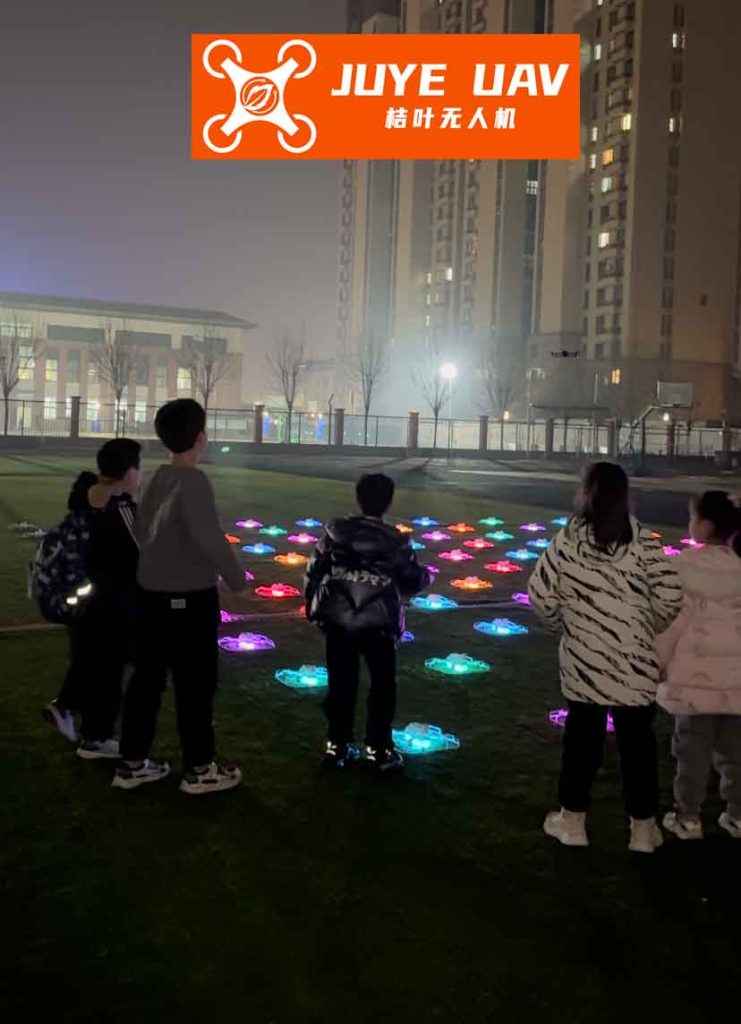
The visual spectacle of a formation drone light show, as hinted in the image, relies entirely on this flawless coordination. Each point of light is a drone holding its position with centimeter-level accuracy, often under windy conditions or near structures that create turbulent airflows. This introduces the problem of disturbance rejection. Control algorithms must compensate for these external forces. A common approach uses PID controllers augmented with state estimators like Kalman filters. The dynamics of a quadcopter drone can be simplified for horizontal plane control as:
$$ m \ddot{x} = u_x – k_d \dot{x} + d_x $$
$$ m \ddot{y} = u_y – k_d \dot{y} + d_y $$
where $m$ is mass, $(x, y)$ are horizontal coordinates, $u$ are control inputs (thrust components), $k_d$ is a drag coefficient, and $d$ represents external disturbances (e.g., wind). The controller’s job in a formation drone light show is to compute $u_x$ and $u_y$ to track the desired trajectory $x_d(t), y_d(t)$ while minimizing the effect of $d$. An integral term in the PID controller helps reject steady-state disturbances, crucial for maintaining static positions in a formation.
Looking at the current trends, one pressing issue is dense formation obstacle avoidance. In a tight formation drone light show, the swarm itself becomes a moving obstacle field. Inspired by bird flocking and the “optical flow” hypothesis, some researchers propose a perceptual model where drones maintain separation based on the apparent angular velocity of neighbors rather than absolute distance. This can be modeled by maintaining a constant time-to-collision (TTC). If $\theta$ is the angular size of a neighboring drone, then the condition $\dot{\theta} \leq \theta / \tau_{min}$ ensures avoidance, where $\tau_{min}$ is a minimum allowed TTC. This method shows promise for dense formation drone light shows as it is more biologically plausible and less sensitive to exact distance measurements.
Furthermore, the integration of machine learning is revolutionizing formation control. I am particularly interested in reinforcement learning (RL) agents trained to navigate in simulated dense swarms. An RL agent for a drone in a formation drone light show learns a policy $\pi(s)$ that maps the state $s$ (own position, neighbor positions, goal) to an action $a$ (velocity change). The reward function $R$ might be:
$$ R = w_1 \cdot \text{(goal proximity)} – w_2 \cdot \text{(collision penalty)} – w_3 \cdot \text{(energy use)} – w_4 \cdot \text{(formation deviation)} $$
where $w_i$ are weighting factors. After training in billions of simulated episodes, such agents can exhibit highly robust and cooperative behaviors, potentially outperforming traditional algorithms in complex formation drone light show scenarios with unexpected obstacles.
Communication is the nervous system of any formation drone light show. Loss or delay of data packets can lead to catastrophic failures. Current systems often use mesh radio networks with TDMA (Time Division Multiple Access) protocols. The reliability of a link in an urban environment, full of interference, is a major concern. The signal-to-interference-plus-noise ratio (SINR) for a drone receiving from a ground station or another drone is:
$$ \text{SINR} = \frac{P_t G_t G_r / L(d)}{N_0 + \sum_{j \neq i} P_j / L(d_j)} $$
Here, $P_t$ is transmit power, $G$ are antenna gains, $L(d)$ is path loss at distance $d$, $N_0$ is noise power, and the denominator includes interference from other drones ($P_j$). For a large formation drone light show, managing this interference is critical. Techniques like frequency hopping, directional antennas, and adaptive power control are essential. The table below compares communication strategies relevant to large-scale shows:
| Communication Strategy | Description | Suitability for Large Light Shows |
|---|---|---|
| Centralized Radio Control (2.4/5.8 GHz) | A single ground station broadcasts commands to all drones. | Low latency for small swarms; becomes a bottleneck and single point of failure for large swarms (>100 drones). |
| Distributed Mesh Networking | Drones relay messages to each other, creating a self-healing network. | Highly scalable and robust; increased latency and complexity in routing. |
| Hybrid Cellular (4G/5G) | Drones connect to the cellular network for command and control. | Excellent coverage in urban areas; dependent on network congestion and may have higher latency. |
| Precision Time Protocol (PTP) Synchronization | Ensures microsecond-level time sync across the swarm for coordinated maneuvers. | Absolutely critical for any formation drone light show to maintain perfect timing of light changes and movements. |
As we push towards more ambitious formation drone light shows involving thousands of units, new challenges emerge. One is the “shadowing” effect in dense urban canyons, where GPS signals are degraded or lost. Redundant navigation systems combining GPS, inertial measurement units (IMUs), and ultra-wideband (UWB) local positioning are necessary. The position estimate $\hat{\vec{p}}$ from a sensor fusion filter like an Extended Kalman Filter (EKF) can be represented by its covariance matrix $P$, which must remain small. The innovation here is to use the drones themselves as anchors for relative positioning, creating an ad-hoc localization network specifically for the formation drone light show.
Another future direction is the handling of dynamic obstacles, such as birds or unauthorized drones entering the show airspace. This requires real-time detection and classification using onboard cameras or radar, followed by cooperative swarm reconfiguration. The reaction must be swift and globally optimal to avoid a cascade of collisions. Imagine a formation drone light show suddenly needing to morph around an intruding object—this is the next frontier. Potential solutions involve distributed optimization algorithms where each drone solves a local version of a global path planning problem, sharing intentions with its immediate neighbors. A simplified consensus algorithm for adjusting velocity might be:
$$ \vec{v}_i^{desired}(k+1) = \vec{v}_i^{nominal} + \gamma \sum_{j \in N_i} (\vec{v}_j(k) – \vec{v}_i(k)) + \beta \cdot \vec{F}_{obstacle,i} $$
where $N_i$ is the set of neighbors, $\gamma$ and $\beta$ are gains, and $\vec{F}_{obstacle,i}$ is a avoidance vector from local sensors. This enables emergent, cohesive avoidance behavior essential for a resilient formation drone light show.
Energy efficiency is also paramount for longer-duration formation drone light shows. Trajectory planning must consider battery consumption. The power draw of a drone is roughly proportional to the thrust required, which is a function of velocity and acceleration. An energy-optimal path between two points for a formation might be found by minimizing the cost functional:
$$ J = \int_{t_0}^{t_f} \left( \alpha \|\vec{a}(t)\|^2 + \beta \|\vec{v}(t)\|^2 + \gamma \right) dt $$
subject to collision constraints. Here, $\vec{a}$ is acceleration, $\vec{v}$ is velocity, and the constants weight different energy contributions. Solving this for an entire swarm is a massive optimization problem, but approximate solutions can significantly extend show duration, making commercial formation drone light show operations more viable.
In conclusion, the technology behind formation drone light shows is a fascinating and rapidly advancing field. From my viewpoint, the convergence of control theory, robotics, communication engineering, and artificial intelligence is what makes these aerial ballets possible. The key phrase—formation drone light show—is more than just a description; it is a benchmark for testing the limits of autonomous coordination. The current research, as I have outlined, provides a solid foundation, but challenges in dense formation avoidance, disturbance rejection, and scalability remain. As we develop more sophisticated algorithms and hardware, future formation drone light shows will become even more complex, resilient, and breathtaking, solidifying their place as a quintessential fusion of technology and art. The journey to perfect the formation drone light show continues to drive innovation, promising not only better entertainment but also paving the way for applications in logistics, surveillance, and disaster response, where similar formation and avoidance technologies are crucial.