
Since the Wright brothers achieved flight in 1903, I have witnessed the rapid evolution of aircraft from rudimentary machines to sophisticated military assets. In my analysis, I explore the current technological status of military aircraft and project future trends, emphasizing the transformative role of advanced systems. The journey from World War I’s reconnaissance planes to today’s stealth fighters underscores a paradigm shift driven by innovation. This article delves into the classifications, key technologies, and emerging directions, with a particular focus on the rise of military drones as a game-changer in modern warfare.
Military aircraft are defined as planes used by air forces, armies, and navies to execute military missions. Based on their roles, I categorize them into several types, as summarized in the table below. This classification helps in understanding their diverse applications and technological requirements.
| Type | Primary Role | Key Characteristics |
|---|---|---|
| Fighter (Air Superiority) | Dominate airspace, engage in air-to-air combat | High performance, expensive, multi-role capabilities |
| Attack Aircraft | Close air support, ground attacks | Durable, lightweight, optimized for low-altitude missions |
| Interceptor | Intercept and destroy enemy aircraft | High speed, rapid response, specialized for defense |
| Bomber | Strategic bombing, missile launches | Large payload, long-range, often used for tactical strikes |
| Trainer | Pilot training, skill development | Adaptable for low-intensity combat, dual-control systems |
| Reconnaissance | Surveillance, intelligence gathering | Equipped with sensors, largely replaced by military drones |
| Transport | Logistics, troop movement, cargo delivery | High capacity, limited combat ability, versatile designs |
| Electronic Warfare & Early Warning | Electronic intelligence, command and control | Advanced avionics, used for jamming and communication |
| Aerial Refueler | Mid-air refueling of other aircraft | Extra fuel storage, specialized equipment for extended missions |
The primary missions of military aircraft encompass air superiority, ground support, and non-combat roles. In my view, these missions are underpinned by technological advancements that enhance effectiveness. For air-to-air combat, the focus is on achieving dominance through superior maneuverability and weaponry. The air-to-ground mission involves precise strikes using guided munitions, while reconnaissance relies on sensors like synthetic aperture radar. Electronic warfare capabilities, such as jamming enemy defenses, have become critical, and transport operations enable rapid deployment. Aerial refueling extends operational range, often expressed by the equation for endurance: $$ E = \frac{F}{C} $$ where \( E \) is endurance, \( F \) is fuel capacity, and \( C \) is fuel consumption rate. This highlights how technology optimizes mission profiles.
Modern military aircraft benefit from a suite of advanced technologies that have evolved since World War II. I will break these down into key areas, using formulas and tables to illustrate progress. First, aerodynamics has been revolutionized by computational fluid dynamics (CFD), which solves the Navier-Stokes equations for airflow: $$ \rho \left( \frac{\partial \mathbf{v}}{\partial t} + \mathbf{v} \cdot \nabla \mathbf{v} \right) = -\nabla p + \mu \nabla^2 \mathbf{v} + \mathbf{f} $$ where \( \rho \) is density, \( \mathbf{v} \) is velocity, \( p \) is pressure, \( \mu \) is viscosity, and \( \mathbf{f} \) is body force. This enables designs like supercritical wings that reduce drag. Second, airframe advancements include composite materials, which improve strength-to-weight ratios. The stress-strain relationship for composites can be modeled as: $$ \sigma = E \epsilon $$ where \( \sigma \) is stress, \( E \) is Young’s modulus, and \( \epsilon \) is strain. Third, propulsion systems have seen leaps in efficiency, with thrust-to-weight ratios now exceeding 8 for engines like those in fifth-generation fighters. The thrust equation for jet engines is: $$ T = \dot{m} (v_e – v_0) + (p_e – p_0)A_e $$ where \( T \) is thrust, \( \dot{m} \) is mass flow rate, \( v_e \) is exit velocity, \( v_0 \) is free-stream velocity, \( p_e \) is exit pressure, \( p_0 \) is ambient pressure, and \( A_e \) is exit area. Fourth, avionics integrate data fusion and glass cockpits, enhancing situational awareness. Fifth, stealth technology reduces radar cross-section (RCS) through shaping and materials, with RCS approximated by: $$ \text{RCS} = \frac{4\pi A^2}{\lambda^2} $$ for simple shapes, where \( A \) is area and \( \lambda \) is wavelength. Sixth, weapons and navigation systems, such as GPS-guided missiles, have increased precision.
To summarize these technologies, I present a table comparing key advancements across decades:
| Technology Area | 1950s-1960s | 1970s-1990s | 2000s-Present |
|---|---|---|---|
| Aerodynamics | Subsonic focus, basic wing designs | Supersonic capabilities, CFD introduction | Stealth shaping, drag optimization, CFD maturity |
| Propulsion | Turbojets with afterburners | High-bypass turbofans, improved efficiency | Thrust vectoring, low observable features |
| Avionics | Analog systems, basic radar | Digital integration, early data links | Network-centric systems, AI-assisted decision-making |
| Stealth | Minimal considerations | Initial shaping techniques | Advanced RAM, integrated design for low RCS and IR signature |
| Weapons | Unguided bombs, early missiles | Laser-guided munitions, improved missiles | Precision GPS weapons, long-range engagement capabilities |
The evolution of fighter aircraft generations exemplifies these trends. First-generation jets relied on turbojet propulsion for subsonic dogfights, while second-generation introduced afterburners for supersonic flight. Third-gen fighters emphasized maneuverability with improved aerodynamics, and fourth-gen integrated advanced avionics. Fifth-generation platforms, like the F-35, combine stealth, sensor fusion, and network connectivity. In my assessment, the progression highlights a shift from sheer speed to survivability and multi-role versatility. For instance, the kinematic performance of fighters can be described by the energy-maneuverability theory, where specific excess power \( P_s \) is given by: $$ P_s = \frac{(T – D)V}{W} $$ with \( T \) as thrust, \( D \) as drag, \( V \) as velocity, and \( W \) as weight. This equation underpins agility improvements over time.
Looking ahead, I project several future trends for military aircraft. First, adjustments in operational concepts have shifted from large-scale conflicts to asymmetric warfare, including counter-terrorism. This demands adaptable platforms that can operate in diverse threat environments. Second, the high development and acquisition costs of advanced systems, such as fifth-generation fighters, are reducing fleet sizes, favoring quality over quantity. The cost-effectiveness ratio \( C \) can be expressed as: $$ C = \frac{\text{Capability}}{\text{Cost}} $$ where maximizing \( C \) drives procurement decisions. Third, new threats from advanced surface-to-air missiles necessitate enhanced survivability features. For example, the probability of survival \( P_s \) against missiles depends on stealth and countermeasures: $$ P_s = 1 – P_d \cdot P_k $$ with \( P_d \) as detection probability and \( P_k \) as kill probability. Fourth, the rapid advancement of military drone technology is reshaping the battlefield. Military drones, or unmanned aerial vehicles (UAVs), are increasingly replacing manned aircraft in roles like reconnaissance, surveillance, and strike missions. Their proliferation is due to lower costs, reduced risk to personnel, and evolving autonomy. I believe that military drones will become ubiquitous in future conflicts, offering persistent intelligence and scalable attack options. The autonomy of these military drones can be modeled with control algorithms like PID: $$ u(t) = K_p e(t) + K_i \int_0^t e(\tau) d\tau + K_d \frac{de(t)}{dt} $$ where \( u(t) \) is control input, \( e(t) \) is error, and \( K_p, K_i, K_d \) are gains. This enables precise navigation and mission execution.
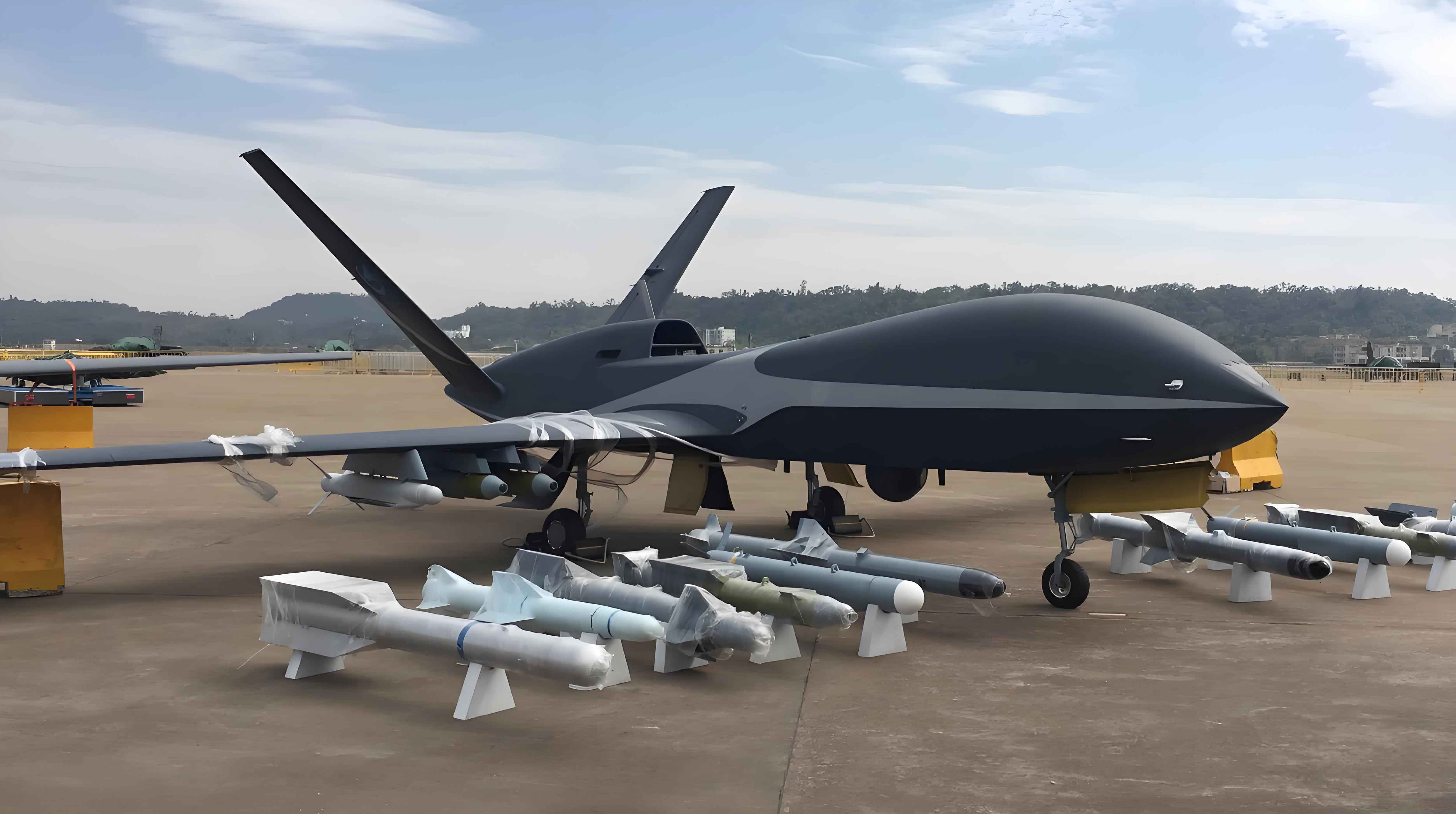
As seen in the image above, military drones represent a transformative leap in aerial warfare. Their integration into networks allows for swarming tactics, where multiple military drones coordinate autonomously. The effectiveness of a swarm can be quantified by metrics like coverage area \( A_c \): $$ A_c = N \cdot \pi r^2 $$ for \( N \) military drones with sensor range \( r \). This scalability makes military drones ideal for overwhelming enemy defenses. Furthermore, advancements in artificial intelligence are enabling military drones to perform complex tasks, such as target recognition and dynamic mission planning. In my view, the future will see a blend of manned and unmanned teams, with military drones handling high-risk missions while manned aircraft provide command and control. The trend toward military drones is accelerating due to their adaptability in electronic warfare and precision strikes.
Fifth, new airborne weapon systems, like long-range air-to-air missiles and miniaturized guided bombs, are extending engagement ranges and reducing aircraft vulnerability. For instance, the maximum range \( R_{\text{max}} \) of a missile can be approximated by: $$ R_{\text{max}} = \frac{v^2}{g} \sin(2\theta) $$ for ballistic trajectories, where \( v \) is launch velocity, \( g \) is gravity, and \( \theta \) is launch angle. This allows fighters to engage targets beyond visual range, emphasizing survivability over close-in maneuverability. In network-centric warfare, information fusion from multiple sources, including military drones, enhances situational awareness. The overall system effectiveness \( E \) can be modeled as: $$ E = \alpha \cdot S + \beta \cdot C $$ where \( S \) is sensor quality, \( C \) is communication reliability, and \( \alpha, \beta \) are weighting factors. This underscores the importance of integrated architectures.
To illustrate future directions, I provide a table contrasting traditional manned aircraft with emerging military drone capabilities:
| Aspect | Traditional Manned Aircraft | Military Drones (UAVs) |
|---|---|---|
| Cost | High acquisition and maintenance | Lower cost, expendable in some scenarios |
| Risk to Personnel | Pilots at risk in combat zones | No onboard crew, reduced human loss |
| Endurance | Limited by human fatigue (e.g., 8-10 hours) | Extended missions (e.g., 24+ hours) with refueling |
| Stealth and Survivability | Depends on design and countermeasures | Smaller size, lower RCS, often more survivable |
| Autonomy | Pilot-controlled, with some automation | High autonomy, AI-driven decision-making |
| Mission Flexibility | Multi-role but constrained by human factors | Rapid reconfiguration for diverse roles |
| Network Integration | Part of networked systems | Seamless integration into swarms and grids |
In conclusion, I assert that military aircraft technology has leaped forward since World War II, but evolving operational concepts and missile threats are transforming modern air combat. The rise of military drones is pivotal, with these unmanned systems gradually supplanting traditional manned platforms in many roles. For contemporary military aircraft, survivability often outweighs maneuverability, driven by stealth, electronic warfare, and network-centric approaches. As I look to the future, continued innovation in propulsion, materials, and AI will further blur the lines between manned and unmanned flight. Military drones, in particular, will dominate discussions, offering scalable solutions for global security challenges. The ongoing integration of military drones into defense strategies underscores a paradigm where technology adapts to asymmetric threats, ensuring air power remains a decisive factor in conflicts worldwide.
To encapsulate key technological relationships, I present a formula for overall military aircraft effectiveness \( OEE \): $$ OEE = \sum_{i=1}^n w_i T_i $$ where \( T_i \) represents technology factors (e.g., stealth, propulsion, avionics) and \( w_i \) their respective weights based on mission requirements. This holistic view emphasizes the synergy of advancements. As military drones evolve, their impact will be reflected in such models, reshaping procurement and tactical doctrines. In my analysis, the future battlefield will be increasingly autonomous, with military drones at the forefront, challenging traditional notions of aerial superiority and driving continuous technological adaptation.