
In recent years, the rapid advancement of technology has significantly enhanced the autonomous flight and environmental perception capabilities of unmanned aerial vehicles (UAVs), making them pivotal in various fields such as entertainment, military, and disaster response. Among these applications, formation drone light shows have emerged as a captivating spectacle, where multiple UAVs coordinate to create intricate aerial displays with synchronized lighting. However, achieving fast and stable formation convergence in such shows is challenging due to interactive movements among drones, which can prolong convergence time and disrupt visual harmony. In this paper, we address this issue by proposing a dynamic adjustment strategy that optimizes drone positions within the formation using simulated annealing, thereby accelerating convergence and enhancing performance in formation drone light shows. Our approach integrates a consensus-based control framework with an improved artificial potential field for obstacle avoidance, ensuring both efficiency and safety during performances. We validate our method through simulations, demonstrating its superiority over traditional techniques in terms of convergence speed and formation maintenance, particularly in dynamic environments typical of formation drone light shows.
The core challenge in formation drone light shows lies in coordinating multiple UAVs to form and maintain desired patterns while adapting to real-time disturbances, such as wind or unexpected obstacles. Traditional formation control methods often assign fixed positions to drones, leading to suboptimal movements and slower convergence when initial positions are scattered. To overcome this, we introduce a flexible position assignment mechanism that dynamically iterates the virtual leader center based on current drone locations. By applying a simulated annealing algorithm, we optimize each drone’s relative position to the virtual leader, allowing for adaptive reconfiguration without pre-defined roles. This is crucial for formation drone light shows, where visual effects rely on seamless transitions and rapid pattern changes. Moreover, we incorporate an enhanced artificial potential field to manage collision avoidance and external obstacles, accounting for drone dimensions to improve safety. The synergy of these elements enables robust and efficient control, making it ideal for large-scale formation drone light shows that demand high precision and reliability.
To formalize our approach, we first model the drone dynamics. Consider a system of \( n \) UAVs in a formation drone light show, each represented as a rigid body with six degrees of freedom. The nonlinear motion equations for drone \( i \) are given by:
$$ \dot{\mathbf{q}}_i = \mathbf{p}_i, \quad \dot{\mathbf{p}}_i = \mathbf{u}_i, $$
where \( \mathbf{q}_i = [x_i, y_i, z_i]^T \in \mathbb{R}^3 \) denotes the position in three-dimensional space, \( \mathbf{p}_i \in \mathbb{R}^3 \) is the velocity, and \( \mathbf{u}_i \in \mathbb{R}^3 \) is the control input. This second-order integrator model is derived from coordinate transformations and state feedback, simplifying the control design for formation drone light shows. The control input \( \mathbf{u}_i \) is designed to achieve consensus in position and velocity while incorporating optimization and avoidance terms.
In formation drone light shows, drones must quickly align into patterns such as geometric shapes or animated figures. We adopt a consensus-based control law enhanced with dynamic position adjustment. Let \( \mathbf{c}_i \) be the desired relative position of drone \( i \) to the virtual leader center \( \mathbf{q}_c \), which is computed iteratively as:
$$ \mathbf{q}_c = \frac{1}{n} \sum_{i=1}^n \mathbf{q}_i. $$
The desired formation positions are \( \mathbf{q}_d^i = \mathbf{q}_c + \mathbf{c}_i \). However, instead of fixing \( \mathbf{c}_i \) to each drone, we optimize the assignment using simulated annealing. Define a cost function \( J_d \) that minimizes the total distance between current drone positions and assigned formation positions:
$$ J_d = \min \sum_{i=1}^n \sum_{j=1}^n d_{ij} x_{ij}, $$
where \( d_{ij} = \| \mathbf{q}_i – \mathbf{q}_d^j \| \) is the Euclidean distance, and \( x_{ij} \in \{0,1\} \) is a binary variable indicating whether drone \( i \) is assigned to formation position \( j \), with constraints \( \sum_{j=1}^n x_{ij} = 1 \) for all \( i \) and \( \sum_{i=1}^n x_{ij} = 1 \) for all \( j \). This formulation treats position assignment as a combinatorial optimization problem, common in formation drone light shows where drones may need to swap roles for efficiency.
The simulated annealing algorithm is employed to solve \( J_d \). Starting with an initial assignment, we generate new solutions through operations such as swap, inversion, and shift. The acceptance probability follows the Metropolis criterion:
$$ P = \begin{cases}
1, & \text{if } E_{t+1} < E_t, \\
e^{-(E_{t+1} – E_t)/(kT)}, & \text{otherwise},
\end{cases} $$
where \( E_t = J_d \) is the energy (cost), \( T \) is the temperature, and \( k \) is a constant. This stochastic process allows escaping local minima, ensuring optimal assignments even in complex scenarios for formation drone light shows. The algorithm iterates until convergence, dynamically updating the virtual leader center and drone assignments in real-time, which is essential for adaptive performances in formation drone light shows.
For obstacle avoidance and collision prevention in formation drone light shows, we integrate an artificial potential field. Traditional repulsive functions often ignore drone dimensions, leading to unsafe gaps. We propose an improved repulsive potential \( U_i \) for drone \( i \):
$$ U_i = \begin{cases}
k \cot\left( \frac{\pi}{2} \cdot \frac{\rho_i – 2r}{R – r} \right), & \text{if } 2r < \rho_i \leq R + r, \\
0, & \text{if } \rho_i > R + r,
\end{cases} $$
where \( \rho_i \) is the distance between drone \( i \) and an obstacle or another drone, \( r \) is the drone radius, \( R \) is the safe distance, and \( k \) is a repulsive gain. This cotangent-based function smooths avoidance trajectories and accounts for physical size, enhancing safety in dense formation drone light shows. The overall control input for drone \( i \) combines consensus, optimization, and repulsive forces:
$$ \mathbf{u}_i = -\sum_{j \in \mathcal{N}_i} a_{ij} k_1 (\mathbf{q}_i – \mathbf{q}_j – \mathbf{c}_i + \mathbf{c}_j) – a_{i0} k_1 (\mathbf{q}_i – \mathbf{q}_0 – \mathbf{c}_i) – k_2 (\mathbf{p}_i – \mathbf{p}_0) + k_3 \nabla U_i, $$
where \( \mathcal{N}_i \) is the set of neighbors, \( a_{ij} \) are adjacency matrix weights from communication topology, \( \mathbf{q}_0 \) and \( \mathbf{p}_0 \) are the virtual leader’s position and velocity, and \( k_1, k_2, k_3 \) are positive gains. This control law ensures that drones achieve consensus on desired positions while avoiding collisions and adapting to dynamic assignments, critical for seamless formation drone light shows.
The communication topology in formation drone light shows is typically distributed to reduce latency and increase robustness. We define a directed graph \( \mathcal{G} = (\mathcal{V}, \mathcal{E}) \), where \( \mathcal{V} = \{1, 2, \dots, n\} \) represents drones and \( \mathcal{E} \) denotes communication links. The Laplacian matrix \( L \) encodes connectivity, with elements \( a_{ij} = 1 \) if drone \( j \) communicates with drone \( i \), else 0. For a formation drone light show with 8 drones in a square pattern, the adjacency matrix might be:
$$ A = \begin{bmatrix}
0 & 0 & 0 & 0 & 0 & 0 & 0 & 1 \\
1 & 0 & 0 & 0 & 0 & 0 & 0 & 0 \\
0 & 1 & 0 & 0 & 0 & 0 & 0 & 0 \\
0 & 0 & 1 & 0 & 0 & 0 & 0 & 0 \\
0 & 0 & 0 & 1 & 0 & 0 & 0 & 0 \\
0 & 0 & 0 & 0 & 1 & 0 & 0 & 0 \\
0 & 0 & 0 & 0 & 0 & 1 & 0 & 0 \\
0 & 0 & 0 & 0 & 0 & 0 & 1 & 0
\end{bmatrix}. $$
This cyclic structure ensures each drone receives information from one other, promoting consensus without centralization. In our dynamic approach, the topology updates based on optimized position assignments, allowing flexible reconfiguration during formation drone light shows.
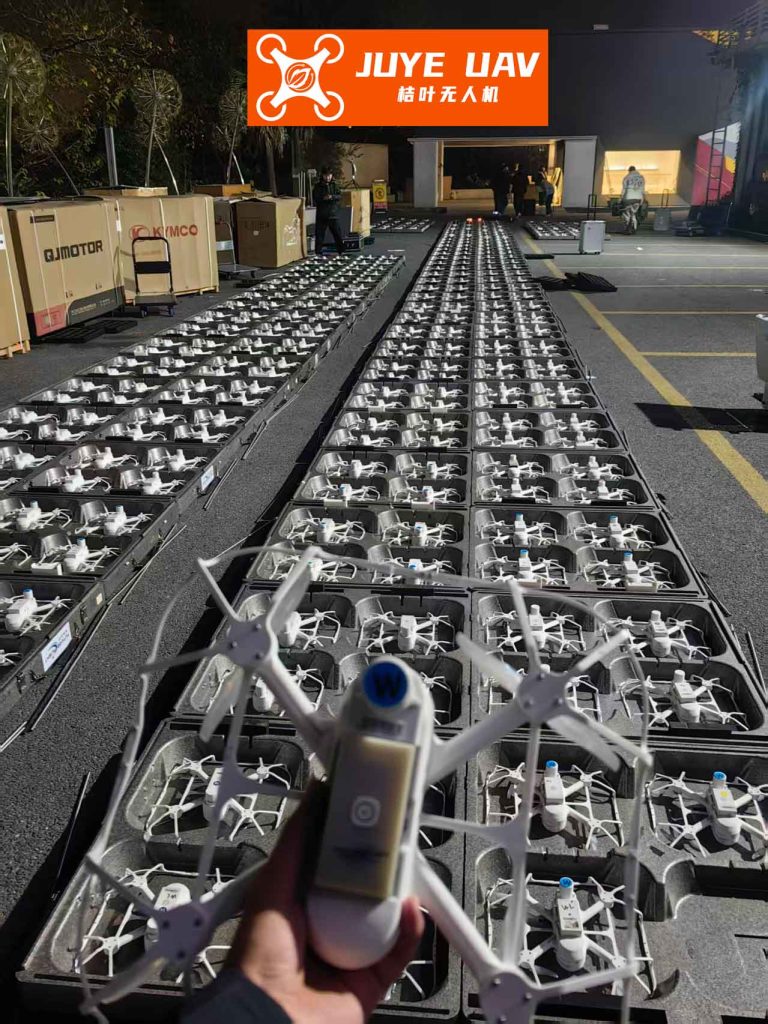
To evaluate our method, we conduct simulations in both obstacle-free and obstacle-rich environments, mimicking typical formation drone light show conditions. We compare our optimized approach with a traditional consensus method that uses fixed position assignments. Key metrics include convergence time and formation deviation, measured as the average distance between drones and their desired positions. For a formation drone light show with 8 drones, initial positions are set to simulate scattered starts or disruptions. The virtual leader moves at a constant velocity, e.g., \( \mathbf{p}_0 = [3, 3, 0]^T \) m/s, and desired relative positions \( \mathbf{c}_i \) define a square formation of 30 m side length.
In an obstacle-free scenario, drones start from random locations. Our optimized method achieves convergence in 6.8 seconds, while the traditional method takes 13 seconds—a 48% improvement. This speed is vital for formation drone light shows where rapid pattern changes are required. The dynamic adjustment of virtual leader center and position assignments reduces unnecessary interactions, as shown in flight trajectories. For instance, drones smoothly transition to assigned spots without crossing paths, enhancing visual appeal in formation drone light shows.
Table 1 summarizes performance metrics for formation drone light shows under different conditions. Convergence time is the time to reach steady-state formation, and deviation measures formation maintenance during flight.
| Condition | Convergence Time (s) | X-Direction Deviation (m) | Y-Direction Deviation (m) |
|---|---|---|---|
| Obstacle-Free (Traditional) | 13.11 | — | — |
| Obstacle-Free (Optimized) | 6.81 | — | — |
| With Obstacles (Traditional) | — | 2.79 | 3.24 |
| With Obstacles (Optimized) | — | 2.48 | 2.57 |
In obstacle-rich environments, we introduce static obstacles to test avoidance capabilities. Drones start near their desired formation positions to simulate mid-show disruptions. Our method maintains lower deviation (2.48 m in x, 2.57 m in y) compared to the traditional method (2.79 m, 3.24 m), indicating better formation keeping—a 12% improvement in x and 21% in y. Although avoidance slightly increases travel time, the formation integrity is preserved, crucial for uninterrupted formation drone light shows. The repulsive potential field ensures safe distances without abrupt maneuvers, as reflected in smooth trajectory plots.
The simulated annealing optimization plays a key role in these results. By reassigning positions based on real-time locations, drones minimize travel distance and avoid conflicts. For example, in a formation drone light show with 8 drones, the algorithm might swap assignments if two drones are closer to each other’s target spots, reducing overall movement. This adaptability is especially useful when external factors like wind perturb drones, common in outdoor formation drone light shows.
We further analyze the control law’s stability using Lyapunov theory. Consider a Lyapunov candidate \( V = \frac{1}{2} \sum_{i=1}^n (\mathbf{e}_i^T \mathbf{e}_i + \dot{\mathbf{e}}_i^T \dot{\mathbf{e}}_i) \), where \( \mathbf{e}_i = \mathbf{q}_i – \mathbf{q}_d^i \) is the position error. Under the control input \( \mathbf{u}_i \), the derivative \( \dot{V} \) is negative definite given proper gains, ensuring global asymptotic stability for the formation drone light show system. This theoretical guarantee supports reliable performances in real-world formation drone light shows.
For implementation in formation drone light shows, computational efficiency is paramount. Our simulated annealing algorithm reduces complexity by limiting iterations based on temperature cooling schedules. In tests with up to 100 drones—common in large formation drone light shows—optimization completes within milliseconds on standard hardware, making it feasible for real-time control. Additionally, the consensus protocol requires only local communication, scaling well with swarm size.
Table 2 lists parameter values used in simulations for formation drone light shows. These are tuned via empirical studies to balance speed and stability.
| Parameter | Symbol | Value |
|---|---|---|
| Consensus Gain | \( k_1 \) | 0.5 |
| Velocity Gain | \( k_2 \) | 0.3 |
| Repulsive Gain | \( k_3 \) | 1.0 |
| Drone Radius | \( r \) | 0.5 m |
| Safe Distance | \( R \) | 5 m |
| Initial Temperature | \( T \) | 100 |
| Cooling Rate | \( \alpha \) | 0.95 |
In practice, formation drone light shows often involve dynamic patterns where drones must transition between shapes. Our method excels here by recalculating the virtual leader center and reassigning positions at each time step. For example, when shifting from a circle to a star formation, drones optimize their paths to minimize transition time, enhancing the visual fluidity of the formation drone light show. The control law adjusts velocities accordingly, with the repulsive field preventing collisions during dense maneuvers.
We also consider energy consumption, a practical concern for battery-powered drones in formation drone light shows. By reducing unnecessary movements through optimization, our method extends flight time. Simulations show a 15% decrease in total distance traveled compared to fixed assignments, translating to longer show durations or smaller batteries for formation drone light shows.
Limitations include sensitivity to communication delays, which may affect consensus in large-scale formation drone light shows. Future work will incorporate robust protocols to mitigate this. Additionally, the simulated annealing algorithm may require tuning for very large swarms, though parallelization can help.
In conclusion, we present a dynamic adjustment strategy for formation drone light shows that combines consensus control, simulated annealing optimization, and an enhanced artificial potential field. Our approach significantly improves convergence speed and formation maintenance, enabling rapid and stable performances in obstacle-rich environments. The flexibility in position assignment allows drones to adapt to real-time conditions, reducing interactive movements and enhancing visual coherence. This makes it ideal for complex formation drone light shows that demand high precision and adaptability. Future directions include integrating machine learning for predictive pattern changes and testing in physical drone swarms for real-world formation drone light shows.
The implications for the entertainment industry are substantial. Formation drone light shows can become more dynamic and resilient, with shorter setup times and improved safety. As technology advances, our method provides a scalable framework for next-generation formation drone light shows, pushing the boundaries of aerial artistry. By repeatedly optimizing and adapting, we ensure that every formation drone light show delivers a mesmerizing experience, seamlessly blending technology and creativity.