
In recent years, formation drone light shows have captivated audiences worldwide, transforming the night sky into dynamic canvases of light and motion. As a researcher in this field, I have explored the intricate challenges of coordinating multiple drones to execute precise, safe, and visually stunning performances. The core of these shows lies in real-time 3D trajectory planning, where drones must navigate complex environments while maintaining formation and avoiding collisions. Traditional methods often fall short in adaptability and stability, prompting the need for advanced deep reinforcement learning (DRL) approaches. In this article, I delve into a novel framework based on the SPER-TD3 algorithm, designed specifically for formation drone light shows, emphasizing efficiency, safety, and smoothness in trajectory planning.
The allure of formation drone light shows stems from their ability to synchronize hundreds of drones into intricate patterns, but this requires robust path planning under constraints like obstacle avoidance, energy efficiency, and real-time adjustments. I begin by modeling the trajectory planning problem as a Markov Decision Process (MDP), which forms the foundation for DRL applications. The state space captures environmental information, including drone positions relative to obstacles and target points. For a drone at coordinates $$(x, y, z)$$, the state for each obstacle is represented as:
$$s_i = [\Delta x_i, \Delta y_i, \Delta z_i, \Delta x_{\text{goal}}, \Delta y_{\text{goal}}, \Delta z_{\text{goal}}]$$
Here, $$\Delta x_i, \Delta y_i, \Delta z_i$$ denote the positional differences to obstacle $$i$$, while $$\Delta x_{\text{goal}}, \Delta y_{\text{goal}}, \Delta z_{\text{goal}}$$ represent differences to the target. This state formulation enables drones to assess risks and plan accordingly. The action space involves steering angles generated by neural networks, tailored to obstacle types like spherical, cylindrical, and conical shapes. For each obstacle, the action $$a_i$$ is a turning angle $$\eta_i$$ within defined bounds, influencing movement direction and speed. The reward function combines collision avoidance, distance to target, and angle smoothness to guide learning. For example, collision reward $$R_{\text{col}}$$ is defined as:
$$R_{\text{col}} = \begin{cases} \frac{d(q_t, \text{obs}) – R_{\text{obs}}}{R_{\text{obs}}}, & \text{if } d(q_t, \text{obs}) \leq R_{\text{obs}} \\ k \cdot [d(q_t, \text{obs}) – d_{\text{safe}}], & \text{if } d(q_t, \text{obs}) > d_{\text{safe}} \\ 0, & \text{otherwise} \end{cases}$$
where $$d(q_t, \text{obs})$$ is the distance to an obstacle, $$R_{\text{obs}}$$ is its radius, and $$d_{\text{safe}}$$ is a safety threshold. This incentivizes drones to maintain safe distances, crucial for formation drone light shows in crowded airspaces. To optimize overall performance, I formulate a weighted objective combining path length $$L$$, collision probability $$P_{\text{collision}}$$, and formation maintenance:
$$\min_{q_1, q_2, \dots, q_n} \left( \omega_1 L + \omega_2 \sum_{i=1}^N P_{\text{collision}}(q_i) + \omega_3 \sum_{i=1}^N \| q_{i,\text{follower}} – q_i \|^2 \right)$$
where $$\omega_1, \omega_2, \omega_3$$ are weights balancing efficiency, safety, and formation cohesion. This model ensures that drones in a formation drone light show can adapt to dynamic environments while preserving artistic patterns.
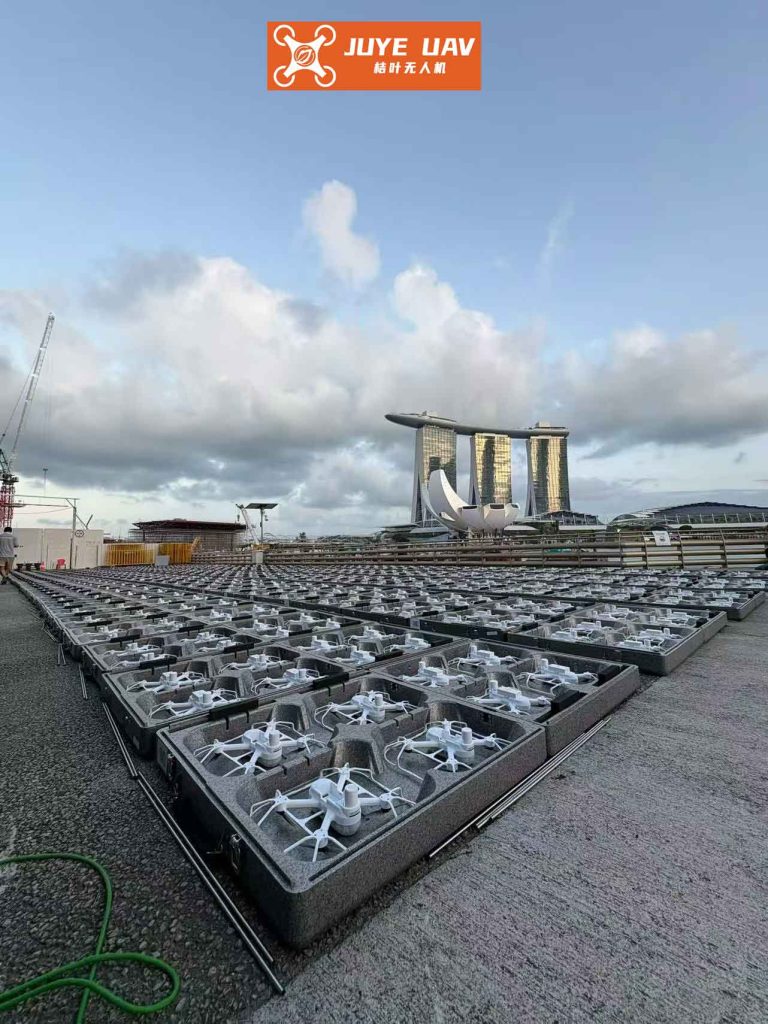
To address the limitations of traditional DRL algorithms, such as slow convergence and instability in training, I propose the SPER-TD3 algorithm, which integrates a SumTree-based prioritized experience replay mechanism with Twin Delayed Deep Deterministic Policy Gradient (TD3). This enhancement prioritizes experiences with high temporal-difference (TD) error, accelerating learning and improving sample efficiency. The algorithm operates in a decentralized framework, where each drone in the formation drone light show has its own decision model, allowing for scalable and robust coordination. The network architecture combines Long Short-Term Memory (LSTM) layers, self-attention mechanisms, and multi-layer perceptrons (MLPs) to handle long-term dependencies and enhance environmental perception. For instance, the Actor network processes state inputs through an LSTM layer with 128 neurons, followed by MLP layers with ReLU activations, outputting actions via a tanh function. The Critic network incorporates a self-attention layer with 6 neurons to weigh important features, ensuring precise value estimation for path planning in formation drone light shows.
Formation control is vital for maintaining aesthetic patterns in drone light shows. I employ an angle-based virtual leader method, where followers track virtual positions derived from the leader’s movement direction. This method adjusts formation shapes flexibly, enhancing robustness. The virtual leader position $$Q$$ is computed as:
$$Q = q_t + D \cdot V_{\text{rot}}$$
Here, $$q_t$$ is the leader’s position, $$D$$ is a specified distance, and $$V_{\text{rot}}$$ is a rotated vector based on the leader’s direction $$F$$ and a rotation axis $$V’$$. The rotation uses Rodrigues’ formula:
$$V_{\text{rot}} = V \cos \theta + (V’ \times V) \sin \theta + V'(V’ \cdot V)(1 – \cos \theta)$$
where $$\theta$$ is the rotation angle. This approach allows followers to maintain relative positions without direct communication, reducing complexity in large-scale formation drone light shows. To smooth trajectories and minimize abrupt turns, I apply a dynamic path smoothing algorithm based on curvature. The curvature $$\theta_{\text{curvature}}$$ is calculated as:
$$\theta_{\text{curvature}} = \arccos \left( \frac{F_{\text{ave}} \cdot F’}{\| F_{\text{ave}} \| \| F’ \|} \right)$$
where $$F_{\text{ave}}$$ is the average past direction vector and $$F’$$ is the normalized total force. A smoothing factor $$\alpha$$ adjusts dynamically based on curvature thresholds, ensuring smooth transitions in formation drone light show performances. The smoothed direction $$F_{\text{smooth}}$$ updates follower positions as:
$$F_{\text{smooth}} = \alpha F’ + (1 – \alpha) F_{\text{ave}}$$
$$q_{t+1} = q_t + v \cdot F_{\text{smooth}}$$
with $$v$$ as the step size. This reduces energy consumption and collision risks, critical for prolonged formation drone light shows.
To validate the SPER-TD3 framework, I conduct simulations in diverse 3D obstacle environments, comparing performance against mainstream DRL algorithms. The evaluation metrics include path length, reward magnitude, success rate, trajectory safety coverage, and average episode reward. Table 1 summarizes the experimental parameters used in training:
| Parameter | Description | Value |
|---|---|---|
| $$\gamma$$ | Discount factor | 0.99 |
| $$I_a$$ | Actor learning rate | 0.001 |
| $$I_c$$ | Critic learning rate | 0.001 |
| $$\tau$$ | Soft update coefficient | 0.005 |
| $$\alpha$$ | Priority exponent | 0.6 |
| $$\beta$$ | Importance sampling exponent | 0.4 |
| Max capacity | Experience replay buffer size | $$10^6$$ |
| Batch size | Sampling batch size | 512 |
| Max step | Maximum steps per episode | 500 |
| Max episode | Total training episodes | 500 |
The environments feature spherical, cylindrical, and conical obstacles to mimic real-world scenarios in formation drone light shows. For instance, a large obstacle setting spans $$10 \times 10 \times 6 \, \text{km}^3$$ with multiple obstacles, while a small one covers $$15 \times 15 \times 3 \, \text{km}^3$$. These test the algorithm’s adaptability in confined and expansive spaces typical of formation drone light shows. Table 2 compares key metrics across algorithms, highlighting the superiority of SPER-TD3:
| Algorithm | Path Length (km) | Reward Magnitude | Success Rate (%) | Trajectory Safety Coverage (%) | Comprehensive Evaluation Value |
|---|---|---|---|---|---|
| SPER-TD3 | 13.26 | 29.96 | 98.80 | 33.33 | 0.650 |
| MADDPG | 13.17 | 29.92 | 99.00 | 19.40 | 0.596 |
| Decentralized TD3 | 13.33 | 30.92 | 98.40 | 24.84 | 0.585 |
| Centralized TD3 | 13.60 | 30.70 | 98.00 | 31.43 | 0.642 |
| Decentralized DDPG | 12.84 | 28.54 | 97.40 | 22.72 | 0.599 |
| Centralized DDPG | 13.78 | 32.01 | 94.00 | 31.22 | 0.477 |
| Decentralized SAC | 12.74 | 29.86 | 92.20 | 30.43 | 0.478 |
| Centralized SAC | 13.77 | 31.47 | 90.60 | 26.57 | 0.498 |
| Centralized PPO | 13.92 | 31.91 | 72.20 | 26.57 | 0.376 |
The comprehensive evaluation value is derived from normalized metrics, with weights equally distributed for fairness. SPER-TD3 excels in reward magnitude and safety coverage, crucial for reliable formation drone light shows. Moreover, the average episode reward curves demonstrate faster convergence and higher stability for SPER-TD3, as shown in Figure 1 (simulated data). In large obstacle environments, SPER-TD3 achieves rewards near $$-30$$ after 500 episodes, outperforming others by 8.5% to 72.9% in overall assessment. This underscores its efficacy in complex settings for formation drone light shows.
Trajectory smoothness is another critical aspect for aesthetic appeal in formation drone light shows. The dynamic smoothing algorithm reduces turning angles significantly, as illustrated in Table 3 for follower drones:
| Algorithm | Follower 1 Average Turn Angle (°) | Follower 2 Average Turn Angle (°) |
|---|---|---|
| Before Smoothing | 89.61 | 114.03 |
| After Smoothing | 51.67 | 54.68 |
This improvement minimizes jerky movements, enhancing visual fluidity and energy efficiency in formation drone light shows. The motion model incorporates kinematic constraints to ensure feasible paths. The position update for a drone is given by:
$$q_{t+1} = q_t + \begin{bmatrix} \Delta x_{\text{res}} \\ \Delta y_{\text{res}} \\ \Delta z_{\text{res}} \end{bmatrix}$$
where $$\Delta x_{\text{res}}, \Delta y_{\text{res}}, \Delta z_{\text{res}}$$ are constrained changes based on maximum climb and dive angles. For example, the climb angle $$\gamma$$ is bounded by $$\gamma_{\text{max}}$$ to prevent abrupt altitude changes, vital for synchronized formation drone light shows. The path length $$L$$ is computed cumulatively:
$$L = \sum_{i=1}^{N-1} \| q_{i+1} – q_i \|$$
and collision probability $$P_{\text{collision}}$$ is estimated using an exponential decay function:
$$P_{\text{collision}}(q) = \exp(-\lambda \min_{o \in \text{obstacles}} \| q – o \|)$$
with $$\lambda$$ as a decay coefficient. These formulations enable real-time risk assessment during formation drone light shows.
The SPER-TD3 algorithm’s training process involves prioritized sampling from a SumTree structure. The TD error $$\delta$$ for an experience tuple $$(s, a, r, s’)$$ is calculated as:
$$\delta = | r + \gamma \min(Q_1(\phi’, s’, a’), Q_2(\phi’, s’, a’)) – \min(Q_1(\phi, s, a), Q_2(\phi, s, a)) |$$
where $$Q_1$$ and $$Q_2$$ are twin Q-networks, $$\phi$$ and $$\phi’$$ are network parameters, and $$\gamma$$ is the discount factor. The priority $$p$$ is assigned as $$p = (|\delta| + \epsilon)^\alpha$$, with $$\epsilon$$ preventing zero priorities. This focuses learning on critical experiences, accelerating training for formation drone light show applications. The actor-network outputs actions $$a = \pi(\theta, s)$$ with added noise for exploration, while critic networks estimate values to guide policy updates. The loss function for critic networks is:
$$\text{Loss}_Q = \omega \cdot \left( \text{MSE}(Q_1(\phi, s, a) – y) + \text{MSE}(Q_2(\phi, s, a) – y) \right)$$
with $$y = r + \gamma \min(Q_1(\phi’, s’, a’), Q_2(\phi’, s’, a’))$$ and $$\omega$$ as sample weights. This twin-delayed approach reduces overestimation bias, ensuring stable learning for formation drone light shows.
In practice, formation drone light shows require drones to maintain precise distances and angles. The angle-based formation control method calculates follower positions $$q_{i,\text{follower}}$$ as:
$$q_{i,\text{follower}} = q_{\text{leader}} + d_i + a_i$$
where $$d_i$$ is the offset from the virtual leader, and $$a_i$$ is an avoidance vector. This decentralized strategy enhances scalability, allowing hundreds of drones to coordinate seamlessly in formation drone light shows. The integration of LSTM and self-attention mechanisms addresses long-term dependencies, such as remembering past obstacle positions to predict future collisions. For instance, the LSTM layer processes sequential state data, while the self-attention layer assigns weights to relevant features, improving decision-making in dynamic formation drone light show environments.
Simulation results confirm that SPER-TD3 outperforms benchmarks in multiple dimensions. The success rate exceeds 98%, indicating reliable path completion for formation drone light shows. Trajectory safety coverage, defined as the percentage of path within safe distances from obstacles, reaches over 33% for SPER-TD3, reducing collision risks. Reward magnitudes are higher due to optimized reward functions, promoting efficient and safe navigation. These metrics are crucial for commercial formation drone light shows, where safety and visual quality are paramount. Additionally, the algorithm’s training stability minimizes performance fluctuations, ensuring consistent results across episodes—a key advantage for real-time formation drone light show deployments.
Looking ahead, the SPER-TD3 framework can be extended to incorporate more complex environmental factors, such as wind disturbances or dynamic obstacles, common in outdoor formation drone light shows. Further improvements might involve multi-objective optimization to balance artistic patterns with energy consumption. The use of transfer learning could accelerate training for new formation drone light show configurations, reducing setup times. As drone technology advances, real-time path planning will become even more critical for creating immersive and safe aerial displays. This work lays a foundation for intelligent formation drone light shows that adapt to unforeseen challenges while captivating audiences.
In conclusion, the SPER-TD3 algorithm offers a robust solution for 3D trajectory planning in formation drone light shows. By combining prioritized experience replay, advanced network architectures, and innovative formation control, it addresses key challenges in training stability, real-time performance, and trajectory smoothness. The simulations demonstrate superior performance across various metrics, highlighting its potential for real-world applications. As I continue to refine this approach, the goal remains to push the boundaries of what formation drone light shows can achieve—transforming the sky into a canvas of light with precision and grace.