
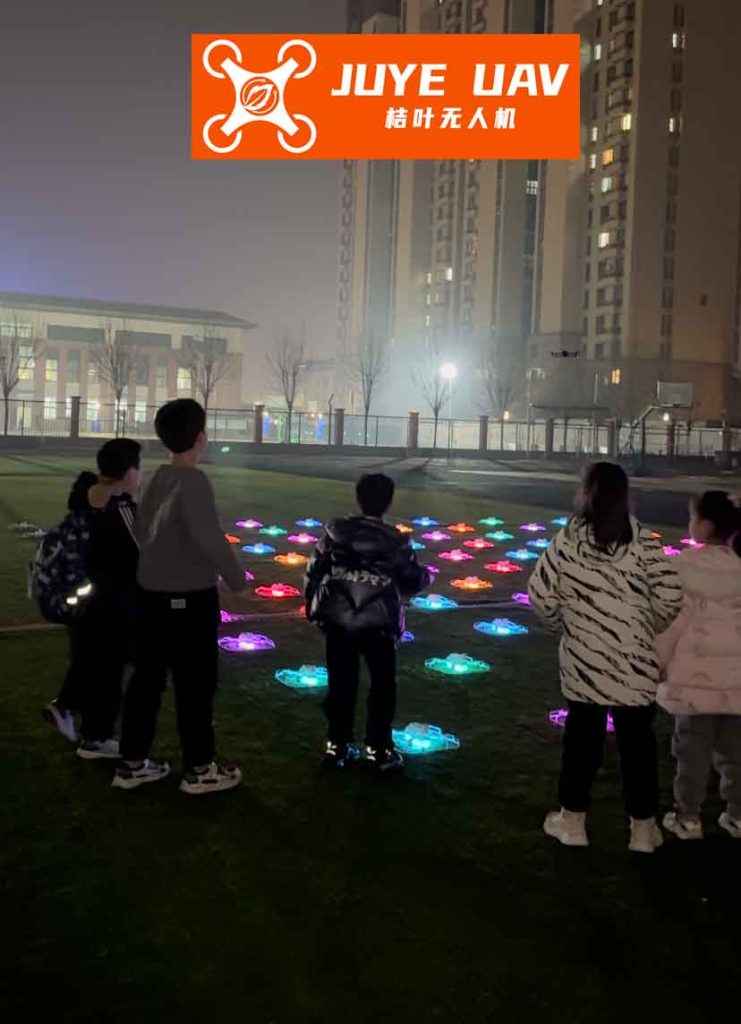
The captivating spectacle of a formation drone light show represents one of the most visually striking applications of multi-agent coordination. Hundreds, sometimes thousands, of unmanned aerial vehicles (UAVs) must move in precise synchrony to create dynamic, luminous patterns in the night sky. This task transcends mere artistic expression, presenting profound challenges in distributed control theory. The core problem lies in achieving and maintaining a desired geometric formation while all agents follow a common trajectory, despite real-world impediments like unreliable communication. In a large-scale drone light show, continuous, high-frequency data exchange between every drone is neither practical nor efficient, leading to significant communication burdens and resource drain. Furthermore, the wireless links are prone to random delays and packet drops due to environmental interference, which can destabilize the carefully choreographed swarm. This article explores advanced control strategies that enable a robust and resource-efficient formation drone light show, focusing specifically on overcoming random communication delays and noise using event-triggered mechanisms.
The foundation of any multi-drone system is its communication network, modeled mathematically by graph theory. Consider a swarm of $N$ drones. The communication topology is represented by a directed graph $\mathcal{G} = \{\mathcal{V}, \mathcal{E}, \mathcal{A}\}$, where $\mathcal{V} = \{1, 2, …, N\}$ is the node set, $\mathcal{E} \subseteq \mathcal{V} \times \mathcal{V}$ is the edge set, and $\mathcal{A} = [a_{ij}] \in \mathbb{R}^{N \times N}$ is the adjacency matrix. An edge $(j, i) \in \mathcal{E}$ exists if drone $i$ can receive information from drone $j$, in which case $a_{ij} > 0$; otherwise, $a_{ij} = 0$. It is assumed that $a_{ii} = 0$. The set of neighbors transmitting to drone $i$ is $\mathcal{N}_i = \{j \in \mathcal{V} : (j, i) \in \mathcal{E}\}$. The in-degree matrix is $\mathcal{D} = \text{diag}(d_i)$ with $d_i = \sum_{j \in \mathcal{N}_i} a_{ij}$. The graph’s Laplacian matrix, fundamental to consensus and formation protocols, is defined as $\mathcal{L} = \mathcal{D} – \mathcal{A}$.
The kinematic model for each drone in the formation is crucial. For a planar formation drone light show where altitude is held constant, the dynamics of the $i$-th drone can be described by a double-integrator model, accounting for its airspeed and ambient wind. Let $\mathbf{p}_i(t) = [x_i(t), y_i(t)]^T \in \mathbb{R}^2$ and $\mathbf{v}_i(t) = [v_{x_i}(t), v_{y_i}(t)]^T \in \mathbb{R}^2$ denote its position and velocity vectors, respectively. The simplified dynamics are:
$$
\dot{\mathbf{p}}_i(t) = \mathbf{v}_i(t), \quad \dot{\mathbf{v}}_i(t) = \mathbf{u}_i(t) \boldsymbol{\mu}(t)
$$
where $\mathbf{u}_i(t) \in \mathbb{R}$ is the scalar control input (related to thrust magnitude), and $\boldsymbol{\mu}(t) \in \mathbb{R}^2$ is a time-varying vector incorporating the drone’s fixed heading angle $\theta_i$ and the constant wind vector $(\upsilon_w, \theta_w)$:
$$
\boldsymbol{\mu}(t) =
\begin{bmatrix}
\frac{\upsilon_i \cos\theta_i + \upsilon_w \cos\theta_w}{m_i} \\[6pt]
\frac{\upsilon_i \sin\theta_i + \upsilon_w \sin\theta_w}{m_i}
\end{bmatrix}.
$$
Here, $m_i$ is the mass, and $\upsilon_i$ is the airspeed magnitude. For a homogeneous swarm in uniform wind, $\boldsymbol{\mu}(t)$ can be treated as a known, bounded parameter for control design.
The control objective for the drone light show is formation tracking. We define a time-varying formation offset $\mathbf{d}_i(t) \in \mathbb{R}^2$ for each drone relative to a virtual center. The goal is to design a distributed controller such that:
$$
\lim_{t \to \infty} \|\mathbf{p}_j(t) – \mathbf{d}_j(t) – (\mathbf{p}_i(t) – \mathbf{d}_i(t))\| = 0, \quad \text{and} \quad \lim_{t \to \infty} \|\mathbf{v}_j(t) – \mathbf{v}_i(t)\| = 0
$$
for all $i, j \in \mathcal{V}$. Effectively, the drones must maintain their relative positions within the formation shape while converging to a common collective velocity. Achieving this with continuous communication is wasteful. Therefore, we employ an event-triggered control (ETC) strategy. Each drone $i$ has its own sequence of triggering instants $\{t_k^i\}_{k=0}^{\infty}$. Control updates and transmissions to neighbors occur only at these self-determined times $t_k^i$, significantly reducing channel access and computation.
The primary disturbance in a large-scale outdoor formation drone light show is random communication delay. We model the arrival of neighbor information with a stochastic delay $\tau(t)$. Its occurrence is described by a Bernoulli distributed random variable $\beta(t)$:
$$
\beta(t) =
\begin{cases}
1, & \text{with probability } c \quad \text{(delay occurs)}, \\
0, & \text{with probability } 1-c \quad \text{(no delay)},
\end{cases}
$$
where $c \in [0,1]$ and $\mathbb{E}\{\beta(t)\} = c$. When $\beta(t)=1$, the received state information from neighbors is outdated by a constant delay $\tau > 0$. The control input for drone $i$ is therefore:
$$
\begin{aligned}
\mathbf{u}_i(t) &= k \sum_{j \in \mathcal{N}_i} a_{ij} \Big[ \big(\mathbf{p}_j(t_k^{‘j}) – \mathbf{d}_j \big) – \big(\mathbf{p}_i(t_k^i) – \mathbf{d}_i \big) \Big] \\
&+ k \sum_{j \in \mathcal{N}_i} a_{ij} \Big[ \mathbf{v}_j(t_k^{‘j}) – \mathbf{v}_i(t_k^i) \Big] + k \sigma_i n_i(t) \\
&+ \beta(t) k \sum_{j \in \mathcal{N}_i} a_{ij} \Big[ \big(\mathbf{p}_j(t_k^{‘j}-\tau) – \mathbf{d}_j \big) – \big(\mathbf{p}_i(t_k^i-\tau) – \mathbf{d}_i \big) \Big] \\
&+ \beta(t) k \sum_{j \in \mathcal{N}_i} a_{ij} \Big[ \mathbf{v}_j(t_k^{‘j}-\tau) – \mathbf{v}_i(t_k^i-\tau) \Big],
\end{aligned}
$$
where $k>0$ is the control gain, $t_k^{‘j}$ is the latest trigger time of neighbor $j$, $\sigma_i n_i(t)$ models communication channel noise (with $n_i(t)$ as white noise), and the terms multiplied by $\beta(t)$ are the delayed corrective signals.
To analyze the closed-loop system, we define the formation tracking error states. Let $\mathbf{p}_d(t)$ and $\mathbf{v}_d(t)$ be the desired position and velocity of the virtual formation center. We define:
$$
\tilde{\mathbf{p}}_i(t) = \mathbf{p}_i(t) – \mathbf{p}_d(t) – \mathbf{d}_i, \quad \tilde{\mathbf{v}}_i(t) = \mathbf{v}_i(t) – \mathbf{v}_d(t).
$$
The objective is now equivalent to driving $\tilde{\mathbf{p}}_i(t)$ and $\tilde{\mathbf{v}}_i(t)$ to zero for all $i$. The measurement error for drone $i$ between triggering instants is:
$$
\mathbf{e}_{p_i}(t) = \tilde{\mathbf{p}}_i(t_k^i) – \tilde{\mathbf{p}}_i(t), \quad \mathbf{e}_{v_i}(t) = \tilde{\mathbf{v}}_i(t_k^i) – \tilde{\mathbf{v}}_i(t), \quad t \in [t_k^i, t_{k+1}^i).
$$
By stacking states and errors for all drones into vectors $\boldsymbol{\delta}(t) = [\tilde{\mathbf{p}}^T(t), \tilde{\mathbf{v}}^T(t)]^T$ and $\mathbf{e}(t) = [\mathbf{e}_p^T(t), \mathbf{e}_v^T(t)]^T$, the closed-loop dynamics can be written as a stochastic delayed differential equation:
$$
d\boldsymbol{\delta}(t) = \big[\mathbf{A} \boldsymbol{\delta}(t) + \beta(t)\mathbf{B} \boldsymbol{\delta}(t-\tau) + \mathbf{B}\mathbf{e}(t) + \beta(t)\mathbf{B}\mathbf{e}(t-\tau) \big]dt + \mathbf{C} d\mathbf{w}(t),
$$
where $\mathbf{A}, \mathbf{B}, \mathbf{C}$ are constant matrices constructed from $\mathcal{L}$, $k$, $\boldsymbol{\mu}$, and $\sigma_i$, and $\mathbf{w}(t)$ is a standard Wiener process.
The event-triggering condition is central to resource management. Each drone $i$ checks the following distributed condition:
$$
\|\mathbf{e}_i(t)\|^2 > \rho_i \|\boldsymbol{\delta}_i(t)\|^2,
$$
where $\rho_i > 0$ is a designed parameter. The control is updated (triggered) only when this inequality holds. This ensures transmissions occur only when the local error grows too large relative to the state, guaranteeing a bounded performance level while minimizing updates. A critical property to verify is the exclusion of Zeno behavior, meaning an infinite number of triggers cannot occur in finite time. For the designed trigger, it can be proven that the inter-event time $T_k^i = t_{k+1}^i – t_k^i$ has a positive lower bound $h > 0$, given by:
$$
h = \frac{\sqrt{\rho}}{(1+\sqrt{\rho})\|\mathbf{M}\|},
$$
where $\|\mathbf{M}\|$ is a system norm. This guarantees the implementability of the protocol.
The stability analysis of the stochastic, delayed, event-triggered system is conducted using Lyapunov-Krasovskii functionals and Linear Matrix Inequality (LMI) techniques. Consider the following candidate functional:
$$
V(t) = \boldsymbol{\delta}^T(t) \mathbf{P} \boldsymbol{\delta}(t) + \int_{t-\tau}^{t} \boldsymbol{\delta}^T(s) \mathbf{Q} \boldsymbol{\delta}(s) ds,
$$
where $\mathbf{P} \succ 0$ and $\mathbf{Q} \succ 0$ are positive definite matrices to be determined. Applying the Itô formula and taking expectations, the stochastic differential of $V(t)$ is obtained. Using the triggering condition $\|\mathbf{e}(t)\|^2 \leq \rho \|\boldsymbol{\delta}(t)\|^2$ and the properties of the Bernoulli variable $\beta(t)$, we can derive sufficient conditions for mean-square practical stability.
The core stability result can be summarized as the following theorem: The multi-drone system under the event-triggered control protocol with random delay achieves the desired formation if there exist positive definite matrices $\mathbf{P}$, $\mathbf{Q}$ and positive scalars $\epsilon_1, \epsilon_2, \epsilon_3, \epsilon_4$ such that the following Linear Matrix Inequalities (LMIs) are feasible:
$$
\begin{aligned}
&\begin{bmatrix}
-\mathbf{Q} & \epsilon_1 \mathbf{I} & \epsilon_2 c \mathbf{I} & \epsilon_4 c \rho \mathbf{I} \\
* & -\epsilon_1 \mathbf{I} & \mathbf{0} & \mathbf{0} \\
* & * & -\epsilon_2 c \mathbf{I} & \mathbf{0} \\
* & * & * & -\epsilon_4 c \rho \mathbf{I}
\end{bmatrix} \prec 0, \\
&\begin{bmatrix}
-\mathbf{Q} & \mathbf{P}\mathbf{A} & \epsilon_1 \mathbf{I} & c\mathbf{P}\mathbf{B} & \mathbf{P}\mathbf{B} & \epsilon_3 \rho \mathbf{I} & c\mathbf{P}\mathbf{B} \\
* & -\epsilon_1 \mathbf{I} & \mathbf{0} & \mathbf{0} & \mathbf{0} & \mathbf{0} & \mathbf{0} \\
* & * & -\epsilon_1 \mathbf{I} & \mathbf{0} & \mathbf{0} & \mathbf{0} & \mathbf{0} \\
* & * & * & -\epsilon_2 \mathbf{I} & \mathbf{0} & \mathbf{0} & \mathbf{0} \\
* & * & * & * & -\epsilon_3 \rho \mathbf{I} & \mathbf{0} & \mathbf{0} \\
* & * & * & * & * & -\epsilon_3 \rho \mathbf{I} & \mathbf{0} \\
* & * & * & * & * & * & -\epsilon_4 \mathbf{I}
\end{bmatrix} \prec 0.
\end{aligned}
$$
Solving these LMIs numerically provides valid controller gains $(k)$ and trigger parameters $(\rho)$ that guarantee the swarm’s convergence, making the formation drone light show robust to the specified uncertainties.
To illustrate the performance, consider a numerical simulation of a four-drone formation for a small-scale light show. The communication topology is a directed cycle. The drones aim to form a diamond shape while moving. Key simulation parameters are summarized below:
| Parameter | Symbol | Value |
|---|---|---|
| Control Gain | $k$ | 1.2 |
| Trigger Parameter | $\rho$ | 0.8 |
| Delay Probability | $c$ | 0.6 |
| Constant Delay | $\tau$ | 0.1 s |
| Wind Speed | $\upsilon_w$ | 2 m/s |
| Noise Intensity | $\sigma_i$ | 0.1 (for all i) |
The simulation results demonstrate convergence. The position and velocity errors between drones approach zero, confirming formation achievement and velocity consensus. The event-triggered mechanism drastically reduces communication: over a 10-second flight, the number of controller updates per drone is typically between 35-45, compared to several thousand required by a time-triggered controller running at 100 Hz. The following table contrasts key performance metrics between the proposed event-triggered control (ETC) and a baseline continuous/time-triggered control (TTC) under the same conditions.
| Performance Metric | Event-Triggered Control (ETC) | Time-Triggered Control (TTC at 100Hz) |
|---|---|---|
| Total Control Updates (per drone) | ~40 | 1000 |
| Communication Resource Usage | Very Low | Very High |
| Final Formation Error (RMSE) | < 0.05 m | < 0.02 m |
| Convergence Time | ~6.8 s | ~5.8 s |
| Robustness to Delay | High (Explicitly Compensated) | Lower (May Diverge) |
Furthermore, the impact of the delay probability $c$ is notable. Counter-intuitively, for a fixed delay $\tau$, a higher probability $c$ (e.g., 0.6) can sometimes lead to faster convergence (~6.8 s) compared to a lower probability $c=0.2$ (~11 s) in this specific setup, as the consistent presence of the delayed feedback term can provide additional damping. This highlights the complex interplay between stochastic delays and control dynamics in a formation drone light show.
In conclusion, the integration of an event-triggered mechanism with stochastic delay compensation provides a powerful framework for orchestrating a reliable and efficient formation drone light show. The proposed control protocol significantly reduces the required communication bandwidth and computational load by updating control signals only when necessary, a critical advantage for swarms involving hundreds of drones. The formal stability guarantees, derived via LMIs, ensure that the artistic formation is maintained even in the presence of realistic random communication latencies and environmental noise. This approach makes large-scale, robust aerial displays more feasible and paves the way for even more complex and dynamic drone light show performances in the future. The theoretical and numerical results confirm that intelligent, resource-aware control is not just an optimization but a necessity for the next generation of synchronized aerial spectacles.