
As I delve into the evolving world of digital art, I find myself captivated by the transformative role of unmanned aerial vehicles, or drones. What began as a tool for aerial photography and surveillance has blossomed into a vibrant medium for creative expression, redefining the boundaries of art. In this exploration, I aim to share my insights on how drones are not just machines but collaborators in artistic endeavors, particularly through the mesmerizing spectacle of drone light shows. The convergence of technology and art has never been more palpable, and as I reflect on recent developments, I see drones painting the skies with light, challenging traditional forms, and opening new avenues for human creativity.
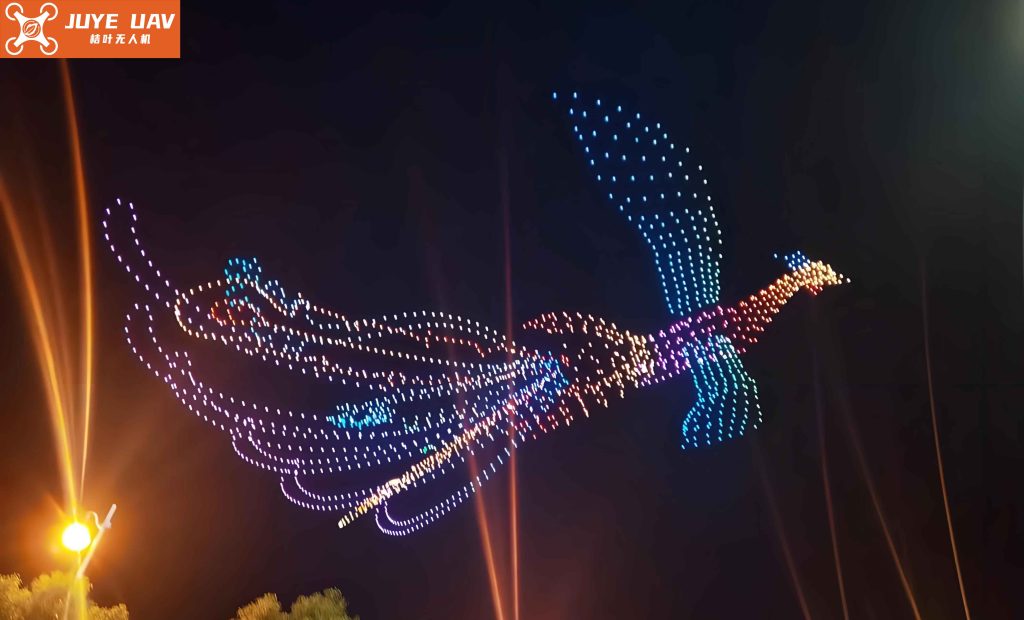
The concept of a drone light show has rapidly gained traction, captivating audiences worldwide with its ability to transform the night sky into a dynamic canvas. I recall one of the earliest large-scale performances, where a fleet of drones adorned with LED lights orchestrated a poetic display against the backdrop of a majestic mountain. This drone light show simulated the blooming and falling of cherry blossoms, with each drone acting as a pixel in a grand, three-dimensional animation. The synchronization of movement and light was not merely a technical feat but an artistic statement, blurring the lines between nature and technology. Such performances exemplify how drone light shows can evoke emotions and tell stories, much like traditional art forms but with a futuristic twist.
To understand the mechanics behind these displays, I have studied the control systems that enable precise coordination. A drone light show relies on sophisticated algorithms to manage the position and timing of each drone. For instance, the position of a drone in a formation can be modeled using vector mathematics. Let $$ \vec{p}_i(t) $$ represent the position vector of the i-th drone at time t, and the overall formation is controlled by a set of differential equations that ensure minimal error. The goal is to maintain a desired pattern, which can be expressed as:
$$ \min \sum_{i=1}^{N} \| \vec{p}_i(t) – \vec{d}_i(t) \|^2 $$
where $$ \vec{d}_i(t) $$ is the desired position for drone i, and N is the total number of drones. This optimization is crucial for creating seamless visuals in a drone light show, as any deviation can disrupt the illusion. Ground control software processes these calculations in real-time, often using GPS signals for localization. In my research, I have compiled key parameters that define a successful drone light show, as shown in the table below.
| Parameter | Typical Value | Importance |
|---|---|---|
| Number of Drones | 30 to 100+ | Determines scale and complexity of patterns |
| LED Lights per Drone | Up to 550 | Enhances brightness and color variation |
| Flight Duration | 10-20 minutes | Balances performance length and battery life |
| Wind Speed Tolerance | < 6 m/s | Ensures stability and safety |
| Control System | GPS-based with software algorithms | Precises coordination for dynamic formations |
The evolution of drone light shows reached a milestone when a tech giant orchestrated a performance with a record number of drones, setting a new benchmark in the field. This drone light show featured hundreds of units flying in unison, forming intricate logos and shapes that responded to classical music. It was a testament to how drone technology has advanced, making such displays more accessible and reliable. I see this as a pivotal moment where art and innovation intersect, pushing the limits of what is possible in live performances. The drone light show not only entertained but also sparked conversations about sustainability, as it offers an eco-friendly alternative to fireworks, reducing pollution and fire hazards.
Beyond the spectacle of drone light shows, I have explored how drones are being repurposed for more subversive forms of art. One intriguing application is in graffiti, where artists use drones to reach previously inaccessible surfaces. I experimented with this concept myself, attaching paint cans to a drone to create spontaneous marks on canvases. The challenge lies in controlling the drone’s movements to produce intentional designs, as the dynamics of flight introduce variables like wind resistance and payload weight. The force exerted by the paint spray can be modeled as $$ F = k \cdot v $$, where k is a constant and v is the velocity of the drone, affecting its trajectory. This form of expression raises questions about authority and public space, as drones enable artists to bypass physical barriers, though it often blurs the line between art and vandalism.
In gallery settings, drones have been embraced as autonomous painters, collaborating with humans to produce abstract works. I had the opportunity to work with a quadcopter equipped with acrylic paint, programming it to follow specific paths on a canvas. The resulting pieces were raw and unpredictable, reflecting the machine’s “subconscious” in a way that echoes psychological tests like the Rorschach inkblots. The process involves algorithms for path planning, where the drone’s motion is defined by parametric equations. For example, a spiral pattern can be generated using:
$$ x(t) = r(t) \cos(t), \quad y(t) = r(t) \sin(t) $$
with $$ r(t) $$ increasing over time. This technical approach contrasts with the organic nature of art, yet it yields fascinating outcomes that challenge our perceptions of creativity. As I refine these methods, I aim to develop drones that can mimic human brushstrokes with greater fidelity, potentially aiding artists with disabilities by translating eye movements into paintings.
The integration of drones into digital art also involves collaborative projects at research institutions. I studied a system where drones replicate human drawings through motion tracking, using Wi-Fi signals to transmit pen strokes to a computer that controls the drone’s flight. This technology relies on coordinate transformations to scale drawings proportionally. If a human draws a line from point A to B, the drone’s path is calculated as:
$$ \vec{p}_{\text{drone}} = M \cdot \vec{p}_{\text{human}} $$
where M is a scaling matrix. While still in its infancy, this approach promises to democratize art by allowing anyone to create large-scale works without physical constraints. I envision a future where drone light shows and painting drones become commonplace in public art installations, fostering interactive experiences that engage communities.
To summarize the advancements in drone artistry, I have analyzed various case studies and technical specifications. The table below compares different applications of drones in art, highlighting their unique features and challenges.
| Application | Key Technology | Artistic Impact | Common Challenges |
|---|---|---|---|
| Drone Light Show | LED lights, GPS control, swarm algorithms | Creates immersive, large-scale visual spectacles | Weather dependency, synchronization issues |
| Drone Graffiti | Paint sprayers, remote control, open-source software | Enables political and social commentary in public spaces | Legal concerns, precision in spraying |
| Drone Painting | Path planning, motion tracking, AI algorithms | Produces abstract or replicated artworks autonomously | Stability in flight, color blending techniques |
| Interactive Installations | Eye-tracking, brain-computer interfaces | Allows for inclusive art creation for disabled individuals | Latency in response, calibration requirements |
As I continue my journey into this field, I am struck by the rapid pace of innovation. The drone light show, in particular, has evolved from a niche novelty to a mainstream attraction, with companies investing in R&D to enhance its capabilities. I have participated in workshops where we developed formulas for optimizing battery usage during performances. The energy consumption of a drone in a light show can be approximated by:
$$ E = \int P(t) \, dt $$
where P(t) is the power function dependent on flight maneuvers and LED usage. By minimizing E, we can extend show durations and reduce costs, making drone light shows more sustainable. This technical aspect intertwines with artistic vision, as longer performances allow for more complex narratives.
Looking ahead, I believe drones will redefine the very essence of art. The drone light show is just the beginning; we are seeing drones used in dance performances, where they interact with human dancers, and in architectural projections, where they map light onto buildings. The potential for personalized art is immense, with drones capable of generating unique patterns based on audience input. I have prototyped a system where a drone light show responds to sound waves, with the amplitude modulating the drone’s altitude according to:
$$ h(t) = A \cdot \sin(2\pi f t) + h_0 $$
where h(t) is the height, A is the amplitude from sound, f is frequency, and h_0 is a base height. Such interactivity bridges the gap between creator and viewer, fostering a shared experience.
In conclusion, my exploration of drones in digital art has revealed a landscape rich with possibility. From the awe-inspiring drone light show that paints the sky to the intimate drone paintings that challenge authorship, these machines are not just tools but partners in creativity. As technology advances, I anticipate more seamless integrations, where drones become extensions of human imagination. The journey is ongoing, and I am excited to witness how artists and engineers will collaborate to push boundaries further, ensuring that the drone light show remains a symbol of innovation and beauty in the digital age.