
As I stood on the edge of the school field, the cold night air biting at my cheeks, I felt a surge of anticipation. This was the moment we had been working toward for months—a drone light show designed not just for spectacle, but to inspire young minds in a remote mountainous region. The journey began with a simple letter from a student, expressing a dream to work with drones and witness a drone light show firsthand. That letter sparked an initiative that would bridge over a thousand kilometers, bringing technology, education, and hope to a community where such opportunities are rare. In this article, I will share my firsthand experience organizing and executing this educational outreach, delving into the technical aspects, pedagogical impacts, and the profound emotional resonance of using drone light shows as a tool for empowerment.
The core of our project was to design a drone light show that could be transported and deployed in a resource-limited setting. We selected 20 lightweight, programmable drones capable of synchronized flight. Each drone was equipped with LED lights and GPS for precision positioning. The performance was choreographed using swarm algorithms, which I will explain in detail later. To ensure safety and reliability, we conducted extensive simulations prior to the event. Below is a table summarizing the key parameters of our drone light show system:
| Parameter | Value | Description |
|---|---|---|
| Number of Drones | 20 | Used for formation and light patterns |
| Flight Duration | 15 minutes per show | Including takeoff, performance, and landing |
| LED Color Range | RGB (16 million colors) | Allows dynamic light effects |
| Control Range | 500 meters | Via ground station with fail-safes |
| Formation Accuracy | ±0.5 meters | Ensured by RTK-GPS and onboard sensors |
| Choreography Software | Custom Python-based | Generates flight paths and light sequences |
| Power Source | Lithium-polymer batteries | Each drone has 2200mAh capacity |
The journey to the remote school was logistically challenging. We traveled by high-speed rail and then by road, carrying all equipment in ruggedized cases. Upon arrival, we set up in the school’s newly built computer lab, which housed dozens of new PCs. This facility became our base for the educational workshop preceding the drone light show. The workshop aimed to introduce students to drone technology, basic programming, and the principles behind drone light shows. We used a hands-on approach: students placed drones on a mat with QR codes for positioning and wrote simple code blocks to control drone movements. Their eyes lit up with curiosity as they saw their commands make drones hover and spin indoors—a precursor to the grand outdoor drone light show.
To quantify the educational impact, we designed a brief curriculum. The table below outlines the session structure and learning outcomes:
| Session | Topic | Activities | Key Learning Objectives |
|---|---|---|---|
| 1 | Introduction to Drones | Lecture, drone demos | Understand drone components and applications |
| 2 | Basic Programming | Block coding on computers | Write simple scripts for drone flight |
| 3 | Physics of Flight | Experiments with propellers | Learn about lift, thrust, and aerodynamics |
| 4 | Light Show Design | Simulation software | Create virtual drone light show patterns |
| 5 | Hands-on Practice | Drone操控 in lab | Gain confidence in operating drones safely |
The technical heart of our drone light show lies in the swarm control algorithms. Each drone’s position in 3D space is governed by a set of differential equations. For a formation of \( n \) drones, we model their dynamics using a coupled system. Let \( \mathbf{p}_i(t) = (x_i, y_i, z_i) \) be the position of drone \( i \) at time \( t \), and \( \mathbf{v}_i(t) \) its velocity. The control law for maintaining formation while tracking a desired trajectory \( \mathbf{p}_d(t) \) is given by:
$$ \dot{\mathbf{v}}_i = -k_p (\mathbf{p}_i – \mathbf{p}_d) – k_v \mathbf{v}_i + \sum_{j \neq i} \left[ \alpha (\mathbf{p}_j – \mathbf{p}_i) – \beta \frac{\mathbf{p}_j – \mathbf{p}_i}{\|\mathbf{p}_j – \mathbf{p}_i\|^3} \right] $$
Here, \( k_p \) and \( k_v \) are positive gain constants for position and velocity tracking, respectively. The summation term represents inter-drone interactions: \( \alpha \) is an attraction coefficient to maintain cohesion, and \( \beta \) is a repulsion coefficient to avoid collisions. This ensures smooth, synchronized movements essential for a captivating drone light show. Additionally, the light intensity \( I_i \) for each drone is programmed to vary with time and formation shape. If \( \mathbf{c}(t) \) is the centroid of the formation, the light color can be a function of radial distance:
$$ I_i(t) = I_{\text{max}} \cdot \exp\left(-\frac{\|\mathbf{p}_i(t) – \mathbf{c}(t)\|^2}{2\sigma^2}\right) $$
where \( I_{\text{max}} \) is the maximum brightness and \( \sigma \) controls the falloff. These equations were implemented in real-time software, allowing us to create dynamic patterns like dragons, birds, and geometric shapes during the drone light show.
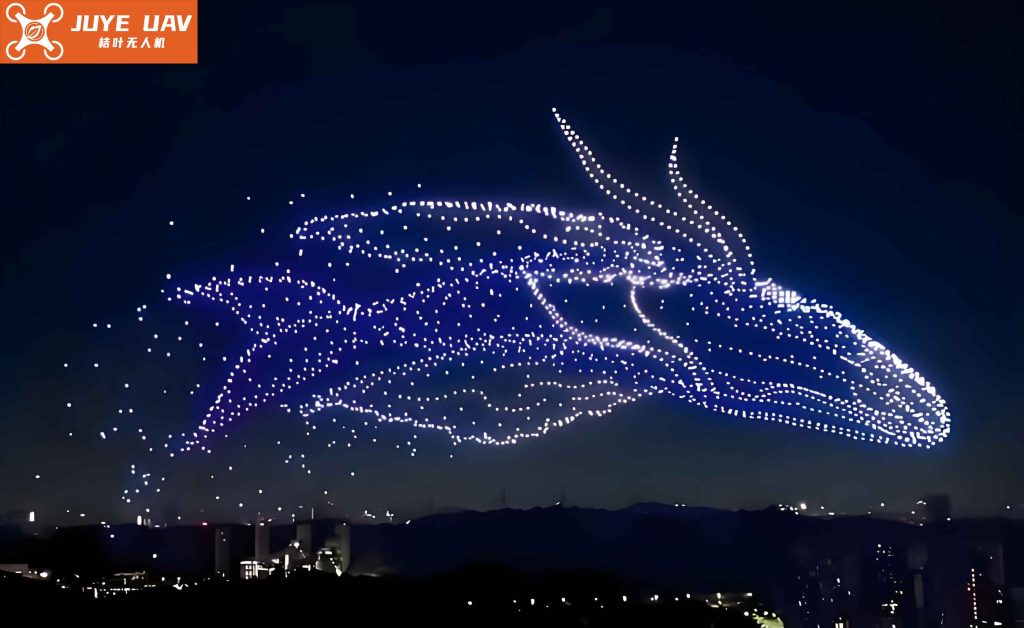
The evening of the main event was unforgettable. As dusk fell, over a thousand students and teachers gathered on the school field, bundled against the chill. We launched the drones, and they ascended into the dark sky, their LEDs painting vibrant trails. The drone light show began with a serpentine “dragon” undulating across the heavens, followed by a majestic “eagle” with outstretched wings, and then a “rooster” standing tall—all created through precise coordination. Each transformation drew gasps and cheers from the crowd. The drone light show was not just a visual feast; it was a narrative of aspiration, mirroring the students’ dreams of soaring beyond their mountainous confines. After the first 10-minute segment, the students clamored for more, undeterred by the cold. We quickly recalibrated and performed another sequence, prolonging the magic.
To assess the impact of the drone light show and workshop, we collected anonymous feedback from participants. The table below summarizes the responses, highlighting the motivational and educational effects:
| Survey Question | Positive Response Rate | Qualitative Insights |
|---|---|---|
| Did the drone light show inspire interest in technology? | 98% | Many expressed desire to pursue STEM fields |
| Was the hands-on workshop effective? | 95% | Students felt more confident in programming |
| How likely are you to explore drones further? | 92% | Plans to join online courses or clubs |
| Did the event change your career aspirations? | 85% | Increased interest in engineering and aviation |
| Overall satisfaction with the experience | 99% | Described as “unforgettable” and “dream-like” |
The emotional resonance was profound. One student shared, “Seeing the drone light show in person made me realize that technology can be beautiful and accessible. It solidified my goal to study engineering.” Another said, “I never thought I’d witness such a spectacle at my school. It felt like my dreams were taking flight with those drones.” These reflections underscore how a drone light show can transcend entertainment, becoming a catalyst for ambition and self-belief in underserved communities.
From a pedagogical perspective, integrating drone light shows into education offers multidisciplinary benefits. It blends physics, mathematics, computer science, and art. For instance, students can learn about coordinate geometry by designing formations. Consider a simple circular formation of radius \( R \) with \( n \) drones. The position of the \( k \)-th drone can be parameterized as:
$$ \mathbf{p}_k(t) = \left( R \cos\left(\frac{2\pi k}{n} + \omega t\right),\, R \sin\left(\frac{2\pi k}{n} + \omega t\right),\, h(t) \right) $$
where \( \omega \) is the angular velocity and \( h(t) \) the altitude function. By tweaking these parameters, students explore concepts like periodic motion and 3D transformations. Furthermore, the light patterns involve color theory and algorithms for smooth transitions. We introduced a basic model for color mixing using RGB values, where the output color \( C \) for a drone at time \( t \) is a linear combination:
$$ C(t) = \alpha_R(t) \cdot \mathbf{R} + \alpha_G(t) \cdot \mathbf{G} + \alpha_B(t) \cdot \mathbf{B} $$
with coefficients \( \alpha_R, \alpha_G, \alpha_B \in [0,1] \) programmed to change over time. This mathematical framework makes the drone light show a practical application of algebra and programming.
Logistically, organizing such an event required careful planning. We developed a risk assessment matrix and contingency protocols. For example, weather conditions like wind speed \( w \) could affect flight stability. We used a threshold model: if \( w > w_{\text{max}} \), the show would be postponed. The maximum allowable wind speed was derived from drone specifications:
$$ w_{\text{max}} = \sqrt{\frac{T_{\text{max}} – mg}{0.5 \rho C_D A}} $$
where \( T_{\text{max}} \) is the maximum thrust, \( m \) is drone mass, \( g \) is gravity, \( \rho \) is air density, \( C_D \) is drag coefficient, and \( A \) is cross-sectional area. By educating students on these factors, we emphasized the importance of safety and precision in real-world engineering—a key lesson beyond the dazzle of the drone light show.
The long-term vision of this initiative is to establish a sustainable program. We left behind educational materials, including software simulators and lesson plans, so teachers could continue exploring drone light shows and related technologies. Additionally, we are exploring partnerships to donate drones and computing resources. The goal is to nurture a pipeline of talent from remote areas into tech fields, using the drone light show as an engaging entry point. Future events might involve students designing their own shows, fostering creativity and technical skills simultaneously.
Reflecting on the experience, I am struck by how a single drone light show can ignite countless sparks of curiosity. The journey from a letter to a luminous sky表演 taught me that education is not just about imparting knowledge but about opening doors to possibilities. The drone light show served as a metaphor: each drone, like each student, has unique potential, and when synchronized toward a common goal, they create something greater than the sum of parts. As I packed up the equipment, I felt a deep sense of fulfillment, knowing that we had planted seeds of dream and determination that would grow long after the drones landed.
In conclusion, this project demonstrates the transformative power of technology-driven education. By leveraging the allure of drone light shows, we can bridge geographical and socioeconomic gaps, inspiring the next generation of innovators. The formulas, tables, and firsthand accounts shared here underscore the multifaceted nature of such endeavors. As we look to the future, I am committed to expanding this model, bringing more drone light shows to更多 communities, because every child deserves to see their dreams light up the sky.