
In recent years, the rapid advancement of drone technology has revolutionized both military and civilian sectors, offering unprecedented capabilities in reconnaissance, logistics, and surveillance. However, this proliferation has also introduced significant low-altitude security challenges, particularly from “low, slow, and small” (LSS) drones. These drones, characterized by their minimal radar cross-section, low flight altitudes, and agile maneuverability, pose a formidable threat to critical infrastructures such as military bases, airports, and government facilities. As a researcher focused on security systems, I have observed an urgent need for robust anti-drone defense mechanisms. This review aims to synthesize multi-dimensional anti-drone technical means and propose a layered defense architecture for key areas, integrating detection, countermeasures, and coordination to enhance security. The increasing frequency of drone intrusions—ranging from espionage to physical attacks—underscores the necessity of developing comprehensive anti-drone strategies. Through this analysis, I hope to contribute to the evolving field of anti-drone technology, offering insights that bridge theoretical frameworks and practical applications.
LSS drones exhibit unique attributes that complicate traditional defense approaches. Their low flight altitudes, typically below 1,000 meters, allow them to exploit terrain masking and avoid detection by conventional radar systems. The small radar cross-section (RCS), often just a few square centimeters, makes them nearly invisible to standard surveillance equipment. Additionally, these drones utilize diverse signal protocols, including Wi-Fi, Bluetooth, and satellite navigation like GPS or BeiDou, which can be encrypted to evade interception. Their rapid ascent capabilities—reaching tens of meters in seconds—reduce reaction times for defense systems, while their机动灵活性 enables complex maneuvers such as hovering and sharp turns in confined spaces. From my perspective, these features collectively render LSS drones a pervasive threat, capable of executing covert operations with minimal cost. For instance, in military contexts, they can conduct reconnaissance on sensitive installations or deploy payloads for attacks, whereas in civilian settings, they risk disrupting aviation operations or compromising nuclear facility security. The affordability of drones further exacerbates these risks, as malicious actors can easily acquire and modify them. Thus, understanding these characteristics is fundamental to designing effective anti-drone solutions.
To address these threats, a multi-faceted approach to anti-drone technology is essential. I will analyze various technical means, categorizing them into detection, communication suppression, navigation spoofing, physical destruction, and integrated countermeasures. Each category offers distinct advantages and limitations, which I summarize in the following table to provide a clear comparison.
| Technology Category | Key Principles | Advantages | Limitations | Typical Anti-Drone Applications |
|---|---|---|---|---|
| Detection (Radar) | Uses electromagnetic waves to detect objects based on reflected signals; advanced systems employ phased-array or millimeter-wave radar for higher resolution. | Long-range coverage, all-weather operation, suitable for wide-area surveillance. | Struggles with small RCS targets, prone to clutter in low-altitude environments, and may have high false alarm rates. | Early warning in perimeter zones; often integrated into multi-sensor networks. |
| Detection (Electro-Optical) | Relies on infrared thermal imaging or visible-light cameras to capture drone signatures based on heat or visual features. | High precision and resolution, effective for identification and tracking, passive operation reduces detectability. | Limited by weather conditions (e.g., fog, rain), shorter range compared to radar, and requires line-of-sight. | Target verification in defense zones; used in conjunction with radar for enhanced accuracy. |
| Detection (Acoustic) | Analyzes acoustic signatures from drone propellers using microphone arrays; employs signal processing for localization. | Passive and covert, immune to electromagnetic interference, effective in urban environments. | Short detection range (typically under 1 km), sensitive to ambient noise, and less effective for high-altitude drones. | Supplemental detection in crowded areas; useful for close-range anti-drone monitoring. |
| Detection (Radio Frequency) | Monitors communication and navigation signals (e.g., Wi-Fi, GPS) to identify and locate drones through spectral analysis. | High sensitivity to RF emissions, can detect encrypted signals, provides real-time tracking. | May be ineffective against drones with silent modes or non-standard protocols, and can be jammed by other RF sources. | Signal interception in electronic warfare scenarios; often paired with jamming systems. |
| Communication Suppression | Employs RF jamming to disrupt control links between drones and operators, or GPS jamming to interfere with navigation systems. | Non-kinetic, reduces collateral damage, effective against commercially available drones. | May affect legitimate communications, limited against autonomous drones, and requires precise frequency targeting. | Soft-kill measures in defense zones; used to force drone landings or returns. |
| Navigation Spoofing | Generates false satellite signals (e.g., fake GPS coordinates) to mislead drone navigation and divert them from protected areas. | Covert and precise, can redirect drones without physical damage, adaptable to multiple navigation systems. | Complex to implement against advanced encryption, may be detected by drone anti-spoofing mechanisms, and requires continuous signal generation. | Deception-based anti-drone tactics; applied in layered defense to confuse intruders. |
| Physical Destruction | Utilizes directed-energy weapons (e.g., lasers, high-power microwaves) or kinetic methods (e.g., net guns, interceptors) to disable drones. | Immediate and decisive, eliminates threat permanently, effective against hardened targets. | Risk of collateral damage, high energy consumption, and may be cost-prohibitive for large-scale deployment. | Hard-kill solutions in core zones; employed as a last resort for high-threat scenarios. |
| Integrated Countermeasures | Combines multiple technologies into a unified system, leveraging sensor fusion and automated decision-making for coordinated responses. | Enhanced resilience and adaptability, optimized resource allocation, reduces response time through automation. | High complexity in integration, requires robust command-and-control infrastructure, and may be vulnerable to cyber-attacks. | Comprehensive anti-drone defense networks; ideal for critical infrastructure protection. |
From my analysis, the effectiveness of these anti-drone technologies can be quantified using mathematical models. For example, the detection probability for radar systems can be expressed using the Swerling model for fluctuating targets. The probability of detection \(P_d\) is given by:
$$P_d = 1 – \left(1 + \frac{SNR}{N}\right)^{-N}$$
where \(SNR\) is the signal-to-noise ratio and \(N\) represents the number of integrated pulses. This formula highlights how increasing SNR through advanced radar designs improves anti-drone detection capabilities. Similarly, for communication suppression, the jamming effectiveness \(J_e\) can be modeled as:
$$J_e = \frac{P_j G_j}{P_s G_s} \cdot \frac{B_s}{B_j}$$
where \(P_j\) and \(P_s\) are the jamming and signal powers, \(G_j\) and \(G_s\) are the antenna gains, and \(B_s\) and \(B_j\) are the bandwidths. This underscores the importance of power management in anti-drone jamming systems. In physical destruction, the energy required \(E_r\) to disable a drone via laser can be estimated as:
$$E_r = \frac{m c_p \Delta T}{A \alpha t}$$
where \(m\) is the drone mass, \(c_p\) is specific heat capacity, \(\Delta T\) is the temperature increase needed for damage, \(A\) is the target area, \(\alpha\) is absorption coefficient, and \(t\) is exposure time. Such equations inform the design of efficient anti-drone weapons.
Building on these technical means, I propose a hierarchical defense architecture for key areas, structured into three concentric zones: alert zone, defense zone, and core zone. This layered approach optimizes resource allocation and response strategies, ensuring comprehensive anti-drone coverage. The alert zone, extending several kilometers from the protected site, focuses on early detection using multi-source sensors like radar, electro-optical, and acoustic devices. Its primary goal is to identify potential drone threats and relay data to a central command system. The defense zone, spanning hundreds of meters to a few kilometers, integrates soft-kill and hard-kill anti-drone measures, such as jamming and directed-energy weapons, to neutralize intruders before they reach critical areas. The core zone, encompassing the innermost几百米, deploys high-precision interception tools like laser defenses or net-based capture systems for final protection. Coordination across these zones is facilitated through robust communication networks and automated command-and-control (C2) systems, enabling real-time data fusion and dynamic task assignment. This architecture not only enhances situational awareness but also allows for scalable anti-drone responses tailored to threat levels.
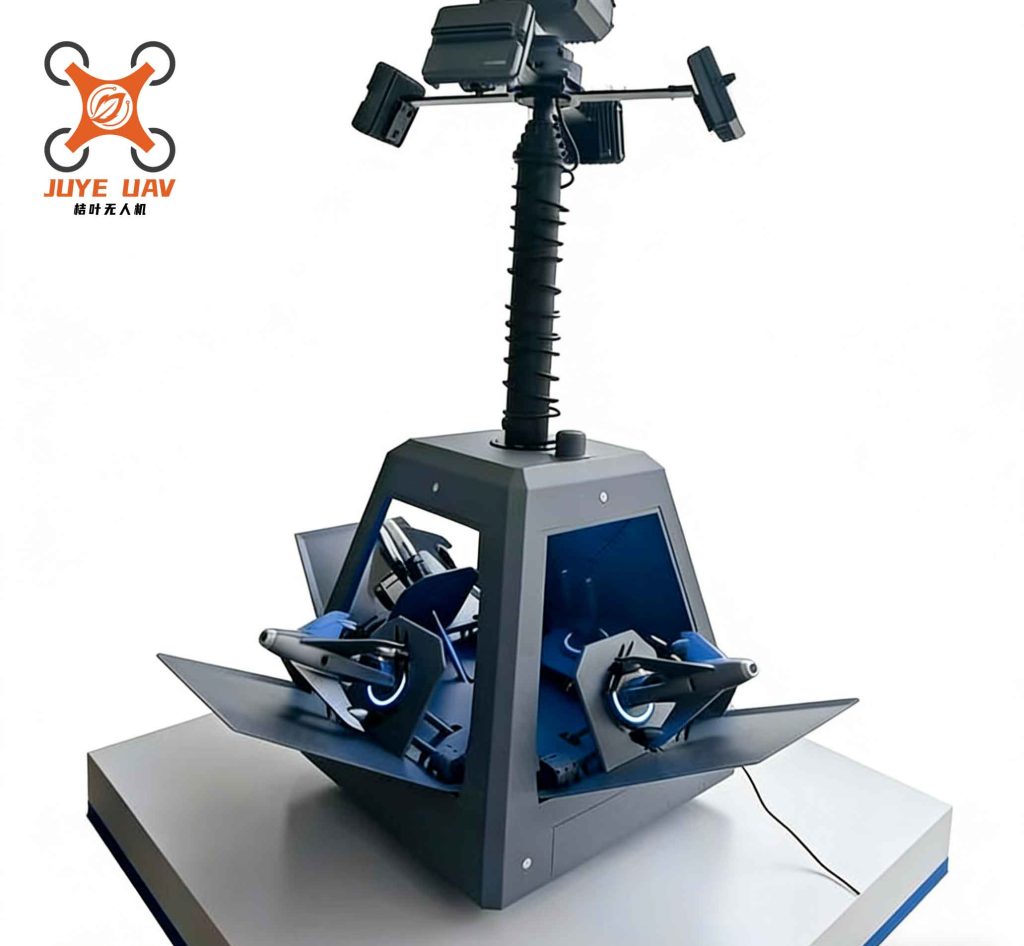
The synergy within this anti-drone defense system relies on advanced technologies. For instance, artificial intelligence (AI) algorithms can process sensor data to classify drones and predict their intent, while 5G communications ensure low-latency information exchange between zones. To illustrate the operational flow, consider a scenario where a drone intrusion occurs: sensors in the alert zone detect the target and compute its trajectory using kinematic equations, such as:
$$\vec{r}(t) = \vec{r}_0 + \vec{v}_0 t + \frac{1}{2} \vec{a} t^2$$
where \(\vec{r}(t)\) is the position vector, \(\vec{v}_0\) is initial velocity, and \(\vec{a}\) is acceleration. This data is fed into the C2 system, which assesses the threat and activates appropriate anti-drone measures in the defense zone, like jamming the drone’s control frequency. If the drone persists, core zone defenses engage with pinpoint accuracy. This multi-layered strategy maximizes the probability of successful interdiction while minimizing false alarms and collateral damage—a critical aspect of modern anti-drone operations.
Despite these advancements, current anti-drone systems face several challenges. From my perspective, technical limitations include the limited fusion between different anti-drone means, leading to information gaps and delayed responses. For example, radar and electro-optical sensors may not seamlessly share data in cluttered environments, reducing detection reliability. Additionally, the evolving nature of drone technology, such as the use of stealth materials or adaptive communication protocols, outpaces existing countermeasures. System architecture issues also arise, particularly in coordinating between zones during rapid drone incursions; resource allocation algorithms must be optimized to handle swarm attacks, where multiple drones overwhelm defenses. Human factors, like operator proficiency and inadequate training, further compromise anti-drone effectiveness. Moreover, regulatory and ethical concerns, such as interference with legitimate air traffic or privacy violations, complicate deployment. These problems underscore the need for continuous innovation in anti-drone research.
To address these challenges, key technologies must be prioritized. AI and machine learning are paramount for enhancing anti-drone detection and decision-making. Deep learning models, such as convolutional neural networks (CNNs), can improve target recognition from sensor feeds, with accuracy metrics expressed as:
$$\text{Accuracy} = \frac{TP + TN}{TP + TN + FP + FN}$$
where \(TP\), \(TN\), \(FP\), and \(FN\) represent true positives, true negatives, false positives, and false negatives, respectively. Quantum technology offers promise for secure communications and advanced sensing in anti-drone networks; quantum radar, for instance, could exploit entanglement to detect LSS drones with unprecedented precision. 5G and edge computing enable real-time data processing at defense nodes, reducing latency in anti-drone responses. Furthermore, multi-technology fusion—combining radar, acoustic, and RF detection—can be modeled using Bayesian inference to update threat probabilities:
$$P(H|E) = \frac{P(E|H) P(H)}{P(E)}$$
where \(H\) is the hypothesis of a drone threat and \(E\) is evidence from sensors. This approach boosts robustness in complex environments. Materials science also contributes through lightweight, high-energy lasers for portable anti-drone weapons.
Looking ahead, the future of anti-drone defense systems will be shaped by trends toward intelligence, integration, and networking. AI-driven autonomy will enable self-learning anti-drone systems that adapt to new threats in real-time. Integrated platforms will merge anti-drone capabilities with broader security infrastructures, such as air traffic management or cyber-defense networks, creating holistic protection ecosystems. Network-centric architectures, leveraging the Internet of Things (IoT), will allow distributed anti-drone nodes to collaborate dynamically, as seen in swarm defense scenarios. International cooperation will be crucial to standardize anti-drone protocols and share threat intelligence, given the global nature of drone risks. From my viewpoint, these advancements will not only enhance the efficacy of anti-drone measures but also drive down costs, making them accessible for a wider range of applications. However, ethical considerations, such as minimizing unintended harm and ensuring compliance with laws, must remain central to development efforts.
In conclusion, the proliferation of LSS drones necessitates a sophisticated and multi-layered anti-drone defense strategy for key areas. Through this review, I have analyzed various technical means—from detection to destruction—and proposed a zonated architecture that leverages synergy for optimal protection. The integration of AI, advanced sensors, and coordinated responses holds the key to mitigating drone threats effectively. As drone technology continues to evolve, so must our anti-drone approaches, with a focus on innovation, interoperability, and ethical deployment. I believe that by embracing these principles, we can fortify critical infrastructures against emerging risks, thereby safeguarding national security and public safety. The journey toward robust anti-drone systems is ongoing, and this synthesis aims to inspire further research and collaboration in this vital field.