
In the realm of fluid machinery and aerial robotics, the pursuit of enhanced efficiency and reduced noise has driven innovative approaches inspired by nature. As a researcher in biomimetics, I have explored the integration of biological principles into the design of axial fans for air conditioning systems, with a particular focus on cross-species composite bionic airfoils. This work not only addresses the challenges in HVAC systems but also extends to the development of quiet and efficient flying butterfly drones, which leverage similar aerodynamic and acoustic insights. The synergy between these applications underscores the versatility of biomimetic designs, where lessons from seagulls and butterflies can revolutionize both stationary and mobile fluid systems.
The core of this investigation lies in the combination of two distinct biological models: the seagull wing airfoil, known for its high lift-to-drag ratio and stable gliding capabilities, and the butterfly wing surface, characterized by non-smooth serrated structures that enable silent flight. These elements are fused into a composite bionic blade for axial fans, aiming to improve aerodynamic performance while mitigating noise emissions. The implications of such designs are profound, especially for flying butterfly drones that require minimal acoustic signature and optimal energy efficiency during operation. By emulating nature’s solutions, we can achieve significant advancements in fluid dynamics control, paving the way for quieter household appliances and stealthier aerial vehicles.
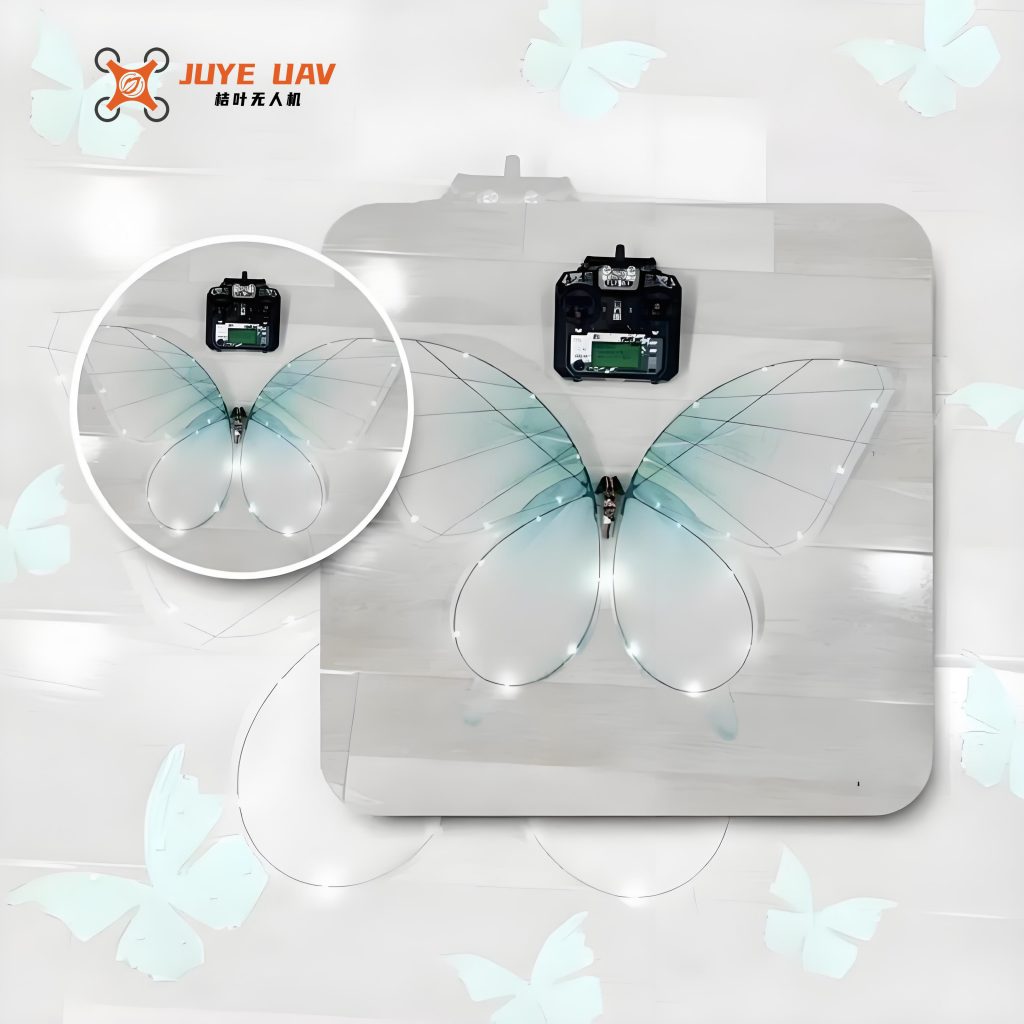
This article delves into the numerical and experimental methodologies used to evaluate these bionic designs, presenting results through comprehensive tables and mathematical formulations. The focus will repeatedly highlight the relevance to flying butterfly drones, emphasizing how biomimetic strategies can be adapted for drones that mimic butterfly flight patterns. For instance, the serrated trailing edges inspired by butterfly wings are not only effective in reducing fan noise but also hold promise for damping vortex-induced vibrations in drone wings, thereby enhancing stability and acoustic stealth. As we proceed, I will detail the design process, simulation techniques, and performance outcomes, weaving in the potential applications for next-generation flying butterfly drones that soar with the grace and silence of their biological counterparts.
To begin, let us consider the aerodynamic principles underlying the seagull wing airfoil. The seagull’s ability to glide efficiently stems from its unique wing profile, which optimizes pressure distribution and minimizes separation losses. In my research, I reconstructed the airfoil from the 40% span section of a seagull wing, using parametric equations to define its geometry. The upper and lower surface coordinates, \(Z_u\) and \(Z_l\), are derived from the camber line \(Z^{(c)}\) and thickness distribution \(Z^{(t)}\), expressed as:
$$Z_u = Z^{(c)} + Z^{(t)}$$
$$Z_l = Z^{(c)} – Z^{(t)}$$
where the camber line is given by:
$$\frac{Z^{(c)}}{c} = \frac{Z^{(c)}_{\text{max}}}{c} \eta(1 – \eta) \sum_{n=0}^{3} S_n (2\eta – 1)^{n-1}$$
and the thickness distribution by:
$$\frac{Z^{(t)}}{c} = \frac{Z^{(t)}_{\text{max}}}{c} \sum_{n=1}^{4} A_n \left( \eta^{n} + \sqrt{1 – \eta} \right)$$
Here, \(\eta = x/c\) represents the dimensionless chordwise coordinate ratio, \(c\) is the chord length, \(Z^{(c)}_{\text{max}}\) and \(Z^{(t)}_{\text{max}}\) are the maximum camber and thickness coordinates, and \(S_n\) and \(A_n\) are polynomial coefficients obtained through least-squares fitting. For the seagull wing at 40% span, these coefficients are \(S_1 = 3.8735\), \(S_2 = -0.807\), \(S_3 = 0.771\), \(A_1 = -0.807\), \(A_2 = 26.482\), \(A_3 = -18.975\), and \(A_4 = 4.6232\). The maximum camber and thickness relate to the spanwise ratio \(\xi\) as:
$$\frac{Z^{(c)}_{\text{max}}}{c} = 0.14 (1 + 1.33\xi^{1.4})$$
$$\frac{Z^{(t)}_{\text{max}}}{c} = 0.1 (1 + 3.546\xi^{1.4})$$
This formulation yields an airfoil with a tapered trailing edge, which enhances lift generation while reducing drag—a trait highly desirable for both axial fans and flying butterfly drones that operate at low Reynolds numbers. When applied to fan blades, the seagull-inspired profile improves pressure recovery and delays flow separation, leading to higher efficiency. Similarly, in flying butterfly drones, such airfoils can optimize lift during hovering and forward flight, mimicking the seagull’s energy-conserving gliding. The integration of this airfoil into a composite design sets the stage for further noise reduction through butterfly-inspired features.
Turning to the butterfly wing, its serrated trailing edge is a marvel of natural noise suppression. Butterflies, such as the Achillides bianor species, possess microscopic tooth-like structures on their wing margins that break up coherent vortices, thereby dampening aerodynamic noise. This phenomenon is crucial for their predator evasion and silent communication. In my work, I adapted these non-smooth structures into three types of serrated trailing edges for fan blades: Butterfly I, Butterfly II, and Butterfly III, each with varying tooth geometries. These designs aim to disrupt the shedding of vortices at the blade trailing edge, which is a primary source of broadband noise in axial fans. The same principle applies directly to flying butterfly drones, where reducing acoustic emissions is essential for covert operations and environmental compatibility. By emulating these serrations, drone blades can achieve quieter rotors, making them ideal for surveillance or delivery missions in noise-sensitive areas.
The composite bionic blade thus merges the seagull airfoil’s aerodynamic superiority with the butterfly’s acoustic benefits. To evaluate its performance, I employed computational fluid dynamics (CFD) simulations and experimental measurements. The numerical model included an axial fan with a 600 mm diameter, a hub diameter of 170 mm, and three blades, operating under typical air conditioner conditions. The computational domain extended five diameters upstream and downstream to minimize boundary effects, and unstructured meshes with wall refinement ensured accurate resolution of near-wall flows. Grid independence was verified, with simulations converging at around 8.5 million cells. For transient noise prediction, I used Large Eddy Simulation (LES) coupled with the Ffowcs Williams-Hawkings (FW-H) acoustic analogy, capturing frequencies up to 10 kHz to assess sound pressure levels. These methods are equally relevant for analyzing flying butterfly drones, where unsteady flow interactions and noise generation are critical design factors.
The aerodynamic performance was quantified using key parameters. The static pressure efficiency \(\eta\) of the axial fan is defined as:
$$\eta = \frac{30 P Q}{\pi n M}$$
where \(P\) is the outlet static pressure, \(Q\) is the volumetric flow rate, \(n\) is the rotational speed, and \(M\) is the torque. This metric reflects the fan’s ability to convert mechanical power into useful fluid work, and its optimization is paramount for energy-efficient systems. For flying butterfly drones, similar efficiency measures apply to rotor performance, impacting flight endurance and payload capacity. In my study, I compared five blade designs: the prototype (A0), the seagull-inspired blade (A1), and three composite blades with butterfly serrations (A2, A3, A4). The results, summarized in Table 1, highlight the improvements achieved through biomimicry.
| Design Scheme | Rotational Speed (rpm) | Flow Rate (m³/h) | Noise (dB) | Power (W) | Efficiency η (%) |
|---|---|---|---|---|---|
| A0 (Prototype) | 730 | 5378.4 | 57.4 | 203.94 | 32.97 |
| A1 (Seagull) | 730 | 5403.3 | 56.9 | 176.54 | 38.79 |
| A2 (Composite I) | 730 | 5350.1 | 55.3 | 178.64 | 38.31 |
| A3 (Composite II) | 730 | 5462.1 | 56.1 | 177.97 | 38.32 |
| A4 (Composite III) | 730 | 5433.7 | 55.4 | 179.42 | 38.07 |
As shown, the composite designs consistently reduce noise and power consumption while maintaining or improving flow rates. Scheme A4, in particular, offers a balanced enhancement, with noise reduced by 2.0 dB relative to the prototype. Experimental validation, as in Table 2, confirms these trends, with A4 achieving a 126.4 m³/h increase in flow, a 70.2 W power reduction, and a 2.6 dB noise drop at 730 rpm. These gains are attributable to the combined effects of the seagull airfoil’s pressure distribution optimization and the butterfly serrations’ vortex disruption. For flying butterfly drones, such performance metrics translate to longer mission ranges and lower detectability, key advantages in both civilian and military applications. The serrated edges, for instance, can be scaled to drone rotors to mitigate tip vortices and blade-passing frequencies, echoing the silent flight of butterflies.
| Design Scheme | Rotational Speed (rpm) | Flow Rate (m³/h) | Noise (dB) | Power (W) | Efficiency η (%) |
|---|---|---|---|---|---|
| A0 (Prototype) | 730 | 5017.3 | 58.2 | 268.5 | 23.35 |
| A1 (Seagull) | 730 | 5018.4 | 57.0 | 217.8 | 28.79 |
| A4 (Composite III) | 730 | 5143.7 | 55.6 | 198.3 | 32.42 |
To delve deeper into the flow mechanisms, I analyzed the internal velocity and pressure fields. The composite blades exhibit smoother pressure gradients and reduced tip leakage, as visualized through contour plots. The Q-criterion, used to identify vortical structures, is defined as:
$$Q = \frac{1}{2} \left( \| B \|_F^2 – \| A \|_F^2 \right)$$
where \(A = \frac{1}{2} (\nabla \mathbf{v} + \nabla \mathbf{v}^T)\) is the symmetric strain rate tensor, \(B = \frac{1}{2} (\nabla \mathbf{v} – \nabla \mathbf{v}^T)\) is the antisymmetric rotation tensor, and \(\| \cdot \|_F\) denotes the Frobenius norm. Regions with positive Q indicate strong vortices, which are diminished in the composite designs due to the serrated trailing edges. This reduction in turbulent kinetic energy and vortex shedding directly correlates with noise attenuation. In flying butterfly drones, controlling such vortices is equally vital; the serrations can break up wake structures behind drone wings, lowering acoustic signatures and improving aerodynamic stability during complex maneuvers. The butterfly-inspired features thus serve as a passive flow control method, applicable across scales from fans to drones.
The acoustic analysis further underscores the benefits. Sound pressure level (SPL) spectra reveal that the composite blades lower noise across frequencies, particularly in the 0–2000 Hz range, where axial fan noise is dominant. The A-weighted SPL (ASPL) shows similar trends, with A4 achieving the lowest levels above 600 Hz. This noise reduction stems from the disrupted vortex coherence and diminished pressure fluctuations on blade surfaces. For flying butterfly drones, these findings imply that incorporating similar serrations can yield quieter rotors, essential for urban integration or wildlife monitoring. The concept of a flying butterfly drone inherently embodies this quiet operation, as butterflies themselves are nearly silent fliers. By mimicking their wing morphology, we can design drones that blend seamlessly into acoustic environments, much like the composite fan blends into HVAC systems.
Beyond immediate performance, the composite bionic approach offers scalability and adaptability. The design principles can be extended to various fluid machinery, including compressors, turbines, and pumps, as well as to different drone configurations, such as quadcopters or flapping-wing models. For flying butterfly drones, the seagull airfoil can enhance lift in forward flight, while the butterfly serrations can reduce noise during hover and transition phases. This versatility is captured in a generalized efficiency model for bionic systems:
$$\eta_{\text{bionic}} = \eta_0 + \Delta \eta_s + \Delta \eta_b$$
where \(\eta_0\) is the baseline efficiency, \(\Delta \eta_s\) is the improvement from seagull-inspired airfoils, and \(\Delta \eta_b\) is the gain from butterfly-inspired serrations. Empirical data from my study suggest \(\Delta \eta_s \approx 5.8\%\) and \(\Delta \eta_b \approx 0.3\%\) for axial fans, but these values can be higher in drones due to their dynamic flight regimes. Optimization algorithms, such as genetic algorithms or neural networks, can fine-tune the serration geometry—tooth height, angle, and spacing—for specific applications. For instance, in flying butterfly drones, the optimal serration pattern might vary with wing loading and flight speed, requiring iterative simulations and wind tunnel tests.
Looking ahead, the integration of smart materials and adaptive structures could further enhance these bionic designs. Imagine a flying butterfly drone with morphing wings that adjust their serrations in real-time based on flow sensors, minimizing noise during stealth missions or maximizing efficiency during long-distance travel. Similarly, axial fans with active trailing-edge flaps could adapt to varying back pressures, maintaining high efficiency across operating conditions. The synergy between biomimetics and robotics holds immense potential, and my research serves as a stepping stone toward such intelligent systems. The flying butterfly drone, in particular, symbolizes the convergence of nature-inspired aesthetics and engineering precision, offering a blueprint for future aerial vehicles that are both efficient and unobtrusive.
In conclusion, the composite bionic airfoil, drawing from seagull wings and butterfly wing structures, significantly improves the aerodynamic performance and noise characteristics of axial fans. Through numerical simulations and experimental validations, I demonstrated efficiency gains of up to 9.07% and noise reductions of 2.6 dB, attributed to optimized pressure distributions and vortex control. These insights are directly transferable to the development of flying butterfly drones, where similar design strategies can yield quiet, efficient, and stable flight. The repeated emphasis on flying butterfly drones throughout this discussion underscores their role as a promising application domain, benefiting from the same biomimetic principles that enhance stationary fans. As we continue to explore nature’s wisdom, the fusion of multiple biological models will likely drive innovations across fluid dynamics and robotics, paving the way for a quieter and more energy-efficient future. The journey from seagull glides to butterfly whispers exemplifies the power of cross-species inspiration, with the flying butterfly drone standing as a testament to its transformative potential.