
As researchers in the field of bio-inspired robotics, we have been fascinated by the unique flight mechanisms of butterflies and their potential to inspire a new generation of flying butterfly drones. These drones, which mimic the low-frequency, large-amplitude flapping of butterflies, offer remarkable advantages in maneuverability, concealment, and energy efficiency, making them ideal for applications in military reconnaissance, search and rescue, and environmental monitoring. In this comprehensive review, we delve into the intricate flight mechanics of butterflies, summarize the progress in developing flying butterfly drones, and explore future directions. The term “flying butterfly drone” will be frequently referenced throughout to emphasize the focus on these bio-inspired aerial vehicles.
The flight of butterflies stands out among insects due to its low flapping frequency, typically around 10 Hz, compared to 25–400 Hz for other insects. This, combined with large wing areas, near-synchronous forewing and hindwing flapping, and significant body oscillations, results in a highly coupled wing-body motion. Despite these complexities, butterflies exhibit agile flight, capable of point-to-point navigation and long-distance migration. Understanding these mechanisms is crucial for designing effective flying butterfly drones. We begin by examining the flight behavior of real butterflies through observational studies.
1. Flight Mechanisms of Butterflies
Our investigations into butterfly flight have leveraged advanced motion capture and experimental techniques, such as high-speed cameras and particle image velocimetry (PIV), to record and analyze free flight. Key kinematic features include wing flapping, thorax pitching, and abdomen swinging, all of which are synchronized. For instance, the flapping amplitude can approach 180°, with the thorax undergoing substantial pitch oscillations. This coupling between wing and body movements is a hallmark of butterfly flight and poses challenges for replication in flying butterfly drones.
The aerodynamics of butterfly flight involve unsteady mechanisms, such as the clap-and-peel mechanism during the downstroke, where wings come together and then separate, generating high lift. Vortex structures around the wings, including leading-edge vortices and wake capture, contribute to lift production. To quantify this, we use computational fluid dynamics (CFD) simulations based on Navier–Stokes equations. The aerodynamic forces can be modeled using quasi-steady approximations or full unsteady analyses. For example, the lift force $L$ during flapping can be expressed as:
$$L = \frac{1}{2} \rho C_L A v^2$$
where $\rho$ is air density, $C_L$ is the lift coefficient, $A$ is wing area, and $v$ is the relative velocity. However, due to low Reynolds numbers (103–104), non-linear effects dominate, requiring more complex models. We have developed multi-body dynamics models to simulate butterfly flight. A simplified equation for thorax pitch dynamics is:
$$I_t \ddot{\theta}_t = \tau_a + \tau_g + \tau_i$$
where $I_t$ is thoracic inertia, $\theta_t$ is pitch angle, $\tau_a$ is aerodynamic torque, $\tau_g$ is gravitational torque, and $\tau_i$ is inertial torque from wing flapping. These models highlight the role of abdomen swinging in stabilizing pitch, as shown in numerical simulations where abdomen motion compensates for thoracic instabilities. Such insights are vital for designing stable flying butterfly drones.
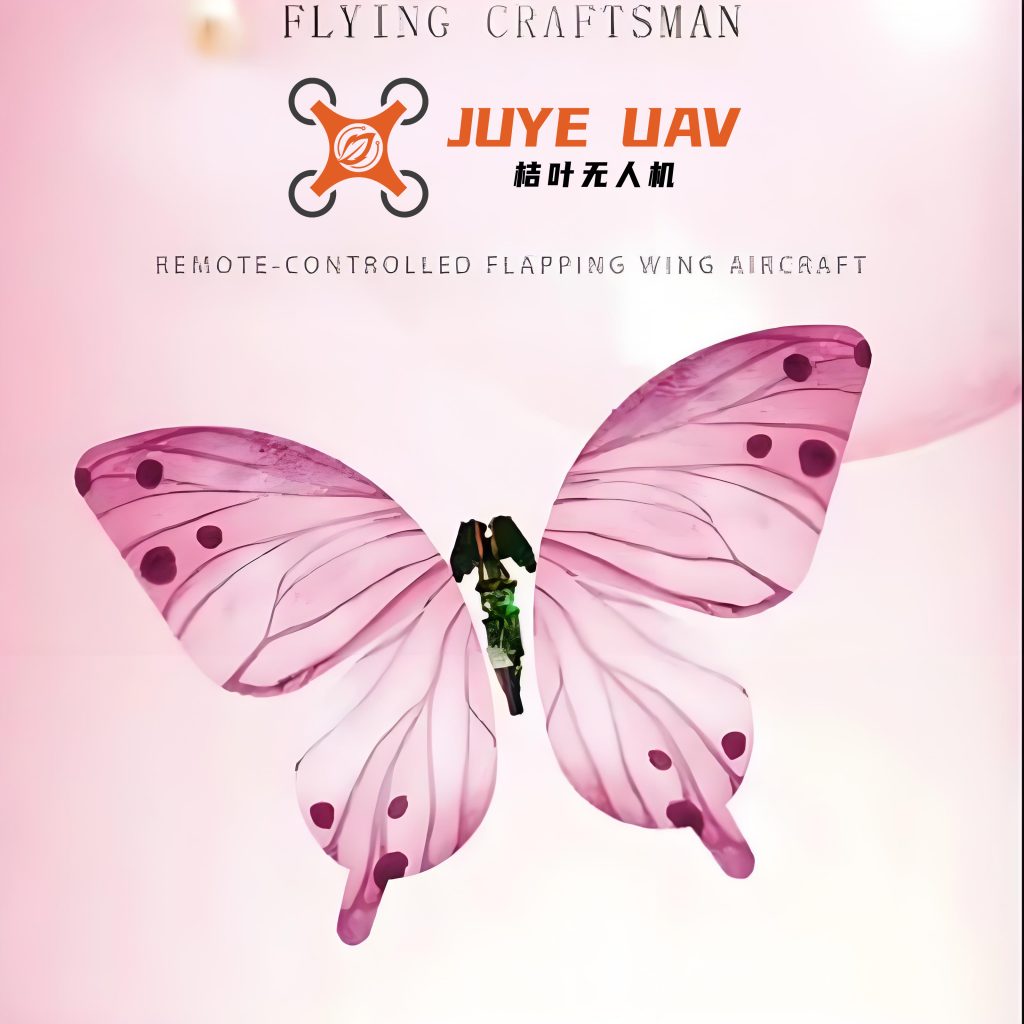
Our experimental studies using PIV systems have visualized vortex rings and wake structures around flapping wings, confirming that butterflies employ multiple unsteady mechanisms for efficient lift generation. The flexibility of wings, governed by venation patterns, also enhances aerodynamic performance by allowing passive deformation. This has been incorporated into finite element models for fluid-structure interaction simulations. For flying butterfly drones, replicating such flexibility could improve efficiency, but it requires advanced materials and manufacturing techniques.
2. Development of Flying Butterfly Drones
Inspired by butterfly flight, we and other researchers have developed various prototypes of flying butterfly drones. These drones aim to mimic the low-aspect-ratio wings and ultra-low frequency flapping of butterflies, but scaling up while maintaining similar dynamics is challenging. Most flying butterfly drones use electrical actuators, such as servo motors, to drive flapping mechanisms. Below, we summarize key prototypes in a table to compare their parameters.
| Prototype | Year | Weight (g) | Wingspan (cm) | Flapping Frequency (Hz) | Drive Mode | Controlled Flight | Endurance (min) |
|---|---|---|---|---|---|---|---|
| BTO (Tanaka et al.) | 2005 | 0.4 | 14 | 10 | Elastic mechanism | No | <1 |
| eMotionButterfly | 2015 | 32 | 50 | 1–2 | Servo direct drive | Yes | 3–4 |
| RoboButterfly-I | 2016 | 39.6 | 62 | 1.8–3.2 | Servo direct drive | Yes | 5 |
| USTButterfly-S | 2021 | 50 | 50 | 1–5 | Single motor with crank | No | 5 |
| RoboButterfly-II | 2020 | 45.8 | 63 | 2–3.9 | Servo direct drive with active abdomen | Yes | 4 |
As seen in the table, flying butterfly drones vary in design, with some achieving controlled flight through independent wing actuation. For instance, our RoboButterfly series employs dual servos for each wing pair, enabling differential flapping for turning and pitch control. The integration of an active abdomen in RoboButterfly-II allows for enhanced stability, mimicking the natural butterfly’s wing-body coupling. However, these flying butterfly drones still face limitations in endurance, often less than 5 minutes due to battery constraints. To address this, we are exploring high-energy-density power sources and efficient flapping mechanisms.
The actuation systems in flying butterfly drones often use crank-rocker mechanisms to convert rotary motion into flapping. The kinematic equations for such a mechanism can be described as:
$$\theta_f = \arcsin\left(\frac{r \sin(\phi)}{l}\right)$$
where $\theta_f$ is the flapping angle, $r$ is crank radius, $\phi$ is motor angle, and $l$ is connecting rod length. Optimizing these parameters is crucial for achieving large amplitudes at low frequencies. Additionally, wing flexibility is emulated using polymer films or composites, but achieving the precise stiffness distribution of real butterfly wings remains a challenge for flying butterfly drones.
3. Control Methods for Flying Butterfly Drones
Controlling flying butterfly drones is complex due to their tailless design and coupled dynamics. Unlike fixed-wing or rotary-wing drones, these drones rely on direct manipulation of flapping motions for attitude control. We have implemented control strategies based on proportional-derivative (PD) controllers and central pattern generators (CPGs). For example, the pitch attitude can be controlled by modulating the flapping asymmetry between forewings and hindwings. The control law for pitch is:
$$u_p = K_p (\theta_{desired} – \theta_{actual}) + K_d (\dot{\theta}_{desired} – \dot{\theta}_{actual})$$
where $u_p$ is the control input to adjust flapping amplitudes, and $K_p$, $K_d$ are gains. In flying butterfly drones with active abdomens, additional control inputs from abdomen swinging provide extra moments for stabilization. The dynamics of a flying butterfly drone can be modeled as a multi-body system, with equations of motion derived using Lagrangian mechanics. For a simplified 2D model, the equations are:
$$M(q)\ddot{q} + C(q, \dot{q})\dot{q} + G(q) = \tau_{aero} + \tau_{control}$$
where $q$ represents generalized coordinates (e.g., body pitch, wing angles), $M$ is the mass matrix, $C$ accounts for Coriolis forces, $G$ for gravity, and $\tau$ for torques. Simulation of these models helps design controllers that ensure stable hover and forward flight for flying butterfly drones.
Experiments with our flying butterfly drones in wind tunnels and using motion capture systems have validated control approaches. We have achieved remote-controlled flights with maneuvers like climbing and turning, but agility still lags behind real butterflies. Future flying butterfly drones may incorporate adaptive control algorithms, such as neural networks, to handle the non-linear aerodynamics. Moreover, energy-efficient control is critical to extend flight times, potentially using regenerative braking during upstrokes.
4. Future Trends and Applications
The development of flying butterfly drones is poised for significant advancements. Key trends include miniaturization towards insect-scale sizes, improved power-to-weight ratios with new actuators like artificial muscles, and enhanced materials for wing flexibility. For instance, flying butterfly drones with wingspans under 10 cm could operate in confined spaces, but this requires micro-electromechanical systems (MEMS) technology for actuation and sensing. We anticipate that future flying butterfly drones will feature:
- Multi-degree-of-freedom wing motions, including lead-lag and feathering, to replicate butterfly kinematics.
- Active abdomen mechanisms for better stability and control.
- Lightweight energy sources, such as hydrogen fuel cells or solar cells, for longer endurance.
- Advanced sensors, like inertial measurement units (IMUs) and cameras, for autonomous navigation.
These flying butterfly drones could revolutionize fields like surveillance, where their low noise and biomimetic appearance offer stealth advantages. In environmental monitoring, they could flutter through forests to collect data without disturbing wildlife. However, challenges remain in achieving robust outdoor flight, as flying butterfly drones are sensitive to wind gusts due to their low flapping frequencies. We are researching robust control algorithms and aerodynamics to mitigate this.
From a theoretical perspective, further research into butterfly flight mechanics will inform flying butterfly drone design. High-fidelity CFD simulations coupled with structural dynamics can optimize wing shapes and flapping patterns. The aerodynamic efficiency $\eta$ of a flying butterfly drone can be expressed as:
$$\eta = \frac{P_{out}}{P_{in}} = \frac{T v}{P_{motor}}$$
where $P_{out}$ is useful power for thrust $T$ and velocity $v$, and $P_{motor}$ is input power. Maximizing $\eta$ requires minimizing drag and inertial losses. Additionally, swarm intelligence algorithms could enable coordinated flights of multiple flying butterfly drones, mimicking butterfly migratory behavior.
5. Conclusion
In summary, the study of butterfly flight mechanics has revealed intricate wing-body couplings and unsteady aerodynamic mechanisms that inspire the design of flying butterfly drones. Our review highlights progress in developing these drones, from early uncontrolled prototypes to modern remotely piloted versions. However, flying butterfly drones still face hurdles in endurance, control, and scalability. By leveraging advances in materials, actuation, and control theory, we envision a future where flying butterfly drones perform agile, long-duration missions in diverse applications. Continued interdisciplinary research combining biology, robotics, and aerodynamics will be essential to realize the full potential of flying butterfly drones, making them a cornerstone of next-generation micro aerial vehicles.
Throughout this article, we have emphasized the term “flying butterfly drone” to underscore the focus on bio-inspired aerial systems. As we move forward, collaboration across academia and industry will accelerate innovation, bringing flying butterfly drones closer to practical deployment. The journey from observing butterflies to building functional drones is a testament to the power of biomimetics, and we are excited to contribute to this evolving field.