
System thinking provides an integrative framework for analyzing complex systems by emphasizing holistic understanding, interconnectedness, and hierarchical organization. This approach is indispensable for developing robust operational guarantee systems for delivery drone vertical take-off and landing (VTOL) airports. These airports serve as critical infrastructure for urban air mobility (UAM), facilitating the safe and efficient integration of electric Vertical Take-off and Landing (eVTOL) delivery UAVs into urban logistics networks. Their design must account for interdependencies across physical infrastructure, digital ecosystems, airspace management, and multimodal transportation networks.
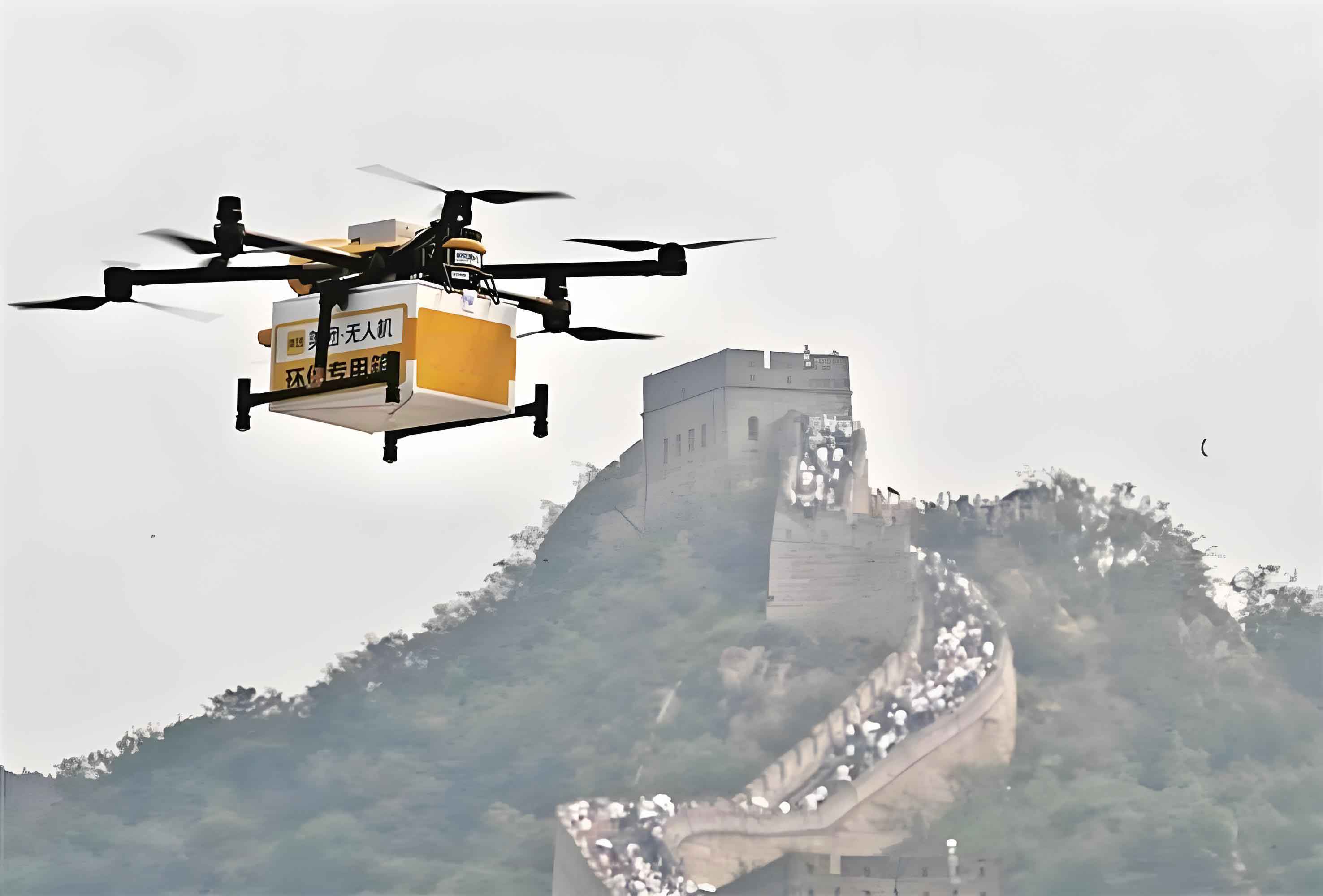
Operation Process of Delivery Drones
The operational lifecycle of a delivery drone involves sequential phases requiring precise coordination between the UAV, ground control systems, and airport infrastructure. Each phase demands specific support mechanisms from the VTOL airport’s operational guarantee system:
| Operational Phase | Key Activities | Airport Support Requirements |
|---|---|---|
| Mission Planning |
|
|
| Pre-flight Preparation |
|
|
| In-flight Execution |
|
|
| Delivery & Landing |
|
|
| Post-mission Activities |
|
|
The systemic integrity of the delivery drone operational chain can be represented as:
$$F_{system} = \sum_{i=1}^{n} F_{component_i} + \sum_{i \neq j} I_{ij}$$
Where \(F_{system}\) denotes overall system functionality, \(F_{component}\) represents individual subsystem performance, and \(I_{ij}\) quantifies interaction efficiencies between subsystems. This emphasizes that airport performance exceeds the sum of isolated infrastructure capabilities.
Hierarchical Planning of Airports
Effective delivery UAV networks require hierarchical airport structuring aligned with varying operational scales and urban integration levels. This stratification ensures appropriate resource allocation and functional specialization across the logistics ecosystem:
| Airport Tier | Functional Scope | Typical Infrastructure | Service Radius |
|---|---|---|---|
| Metropolitan Logistics Hub | Regional distribution center for inter-city delivery UAV operations |
|
100-300 km |
| Urban Distribution Center | Intra-city logistics transfer point for delivery drones |
|
20-50 km |
| Community Delivery Station | Last-mile delivery UAV operations center |
|
3-10 km |
| Micro Landing Point | Hyper-local delivery UAV terminus |
|
< 3 km |
The hierarchical relationship ensures operational efficiency through spatial optimization:
$$N = \sum_{k=1}^{4} \rho_k \cdot A_k^{-1} \cdot \int_{0}^{R_k} 2\pi r \cdot \sigma(r) dr$$
Where \(N\) represents total network throughput, \(\rho_k\) denotes node density per tier \(k\), \(A_k\) is average service area, \(R_k\) the service radius, and \(\sigma(r)\) the spatial demand distribution. This model informs tier-specific infrastructure investment.
Holistic Construction of Airports
A comprehensive delivery drone VTOL airport integrates physical infrastructure with digital service ecosystems, creating a unified operational environment.
Physical Infrastructure Components
The airside infrastructure must comply with aviation safety standards while optimizing for delivery UAV operational efficiency:
- Movement Areas:
- Final Approach and Take-off Area (FATO): Minimum dimensions based on largest service UAV class
- Touchdown and Lift-off Area (TLOF): Load-rated surfaces with anti-collision lighting
- Safety Areas: Obstacle-free zones surrounding movement areas
- Support Facilities:
- Meteorological Stations: Micro-weather sensors with predictive analytics
- Energy Infrastructure: Swappable battery systems with 150kW+ charging capacity
- Firefighting Systems: Automated suppression systems with Category VI capability
Low-altitude Flight Service Guarantee System
This digital backbone enables safe and coordinated delivery UAV operations across controlled airspace:
| Functional Module | Critical Components | Delivery UAV Service Functions |
|---|---|---|
| Airspace Coordination Center |
|
|
| Flight Operations System |
|
|
| Air Traffic Services |
|
|
| Emergency Response Unit |
|
|
The operational effectiveness of the flight service system depends on data integration quality:
$$E_{system} = 1 – \prod_{i=1}^{n} (1 – r_i \cdot d_i)$$
Where \(E_{system}\) represents overall system effectiveness, \(r_i\) is subsystem reliability, and \(d_i\) is data quality index (0-1) for each integrated data source.
Operational Relevance of Airports
Successful delivery UAV airport operation requires seamless integration with existing urban systems and emerging technologies.
Integration with Multimodal Transportation
Delivery drone logistics must interoperate with surface transportation networks through:
- Physical Interfacing:
- Dedicated transfer zones connecting delivery UAV facilities with road/rail terminals
- Automated guided vehicle pathways for intermodal cargo transfer
- Operational Synchronization:
- Joint scheduling algorithms coordinating delivery UAV and ground transport
- Unified tracking systems across transport modalities
The integration efficiency can be modeled as:
$$I = \frac{\sum T_{air} \cdot C_{air} + \sum T_{ground} \cdot C_{ground}}{\max(T_{total}) \cdot C_{system}}$$
Where \(I\) represents integration efficiency (0-1), \(T\) denotes transport volume, \(C\) indicates cost factor, and the denominator represents theoretical maximum throughput at optimal cost.
Convergence with Digital Infrastructure
Advanced technologies enhance delivery UAV operational capabilities:
- 5G Networks: Provide ultra-reliable low-latency communication (URLLC) for delivery drone command and control with <10ms latency
- BeiDou Navigation: Delivers centimeter-level positioning accuracy for precision delivery UAV operations
- Edge Computing: Enables real-time obstacle avoidance processing during delivery UAV flight
- Digital Twins: Creates virtual replicas of physical airport operations for delivery UAV flow optimization
The technological convergence follows an exponential improvement curve:
$$C(t) = C_0 \cdot e^{k \cdot \sum_{i=1}^{n} w_i \cdot \ln(T_i(t)/T_{i0})}$$
Where \(C(t)\) represents composite capability at time \(t\), \(C_0\) is baseline capability, \(w_i\) technology weighting factors, and \(T_i(t)\) performance metrics of individual technologies.
Conclusion
The development of delivery UAV VTOL airports necessitates a systems thinking approach that addresses hierarchical structuring, holistic integration, and multimodal relevance. Effective implementation requires tiered infrastructure aligned with operational scope—from metropolitan hubs to micro-landing points—each with specialized facilities supporting distinct phases of delivery drone operations. Physical infrastructure must incorporate standardized movement areas, energy systems, and safety features while integrating with comprehensive low-altitude service ecosystems encompassing airspace coordination, flight management, and emergency response. Crucially, these airports must maintain bidirectional integration with existing transportation networks while leveraging 5G, precise positioning, and edge computing technologies to ensure operational efficiency. The systemic perspective demonstrates that delivery drone airport functionality emerges not merely from physical components, but from their strategic organization and dynamic interactions across multiple urban systems.