
In the realm of bio-inspired robotics, the development of flapping-wing air vehicles has seen remarkable progress over the past three decades. Among these, flying butterfly drones, inspired by the unique flight characteristics of butterflies, have garnered significant attention from researchers worldwide. As I delve into this fascinating field, I aim to provide a thorough overview of the research advancements, structural designs, driving mechanisms, control strategies, and future directions for these butterfly-inspired systems. This review is based on extensive literature and my own perspectives as a researcher in biomimetic robotics.
Butterflies, unlike many other insects, exhibit distinct flight patterns due to their large wing area with an aspect ratio close to 1:1, resulting in low flapping frequencies typically around 10 Hz. This makes them ideal models for developing low-noise, energy-efficient drones. The flying butterfly drone concept leverages these natural advantages to create agile and stealthy aerial vehicles for applications in surveillance, environmental monitoring, and disaster response. In this article, I will explore the key aspects of these drones, emphasizing the term “flying butterfly drone” to highlight their inspiration and functionality.
The flight mechanism of butterflies is primarily based on drag principles, where lift and thrust are generated through wing resistance during flapping. During the downstroke, a strong vortex ring is formed, producing a jet that yields lift, while the upstroke, with body tilt, provides thrust. This can be modeled using aerodynamic equations. For instance, the lift force $V$ and thrust force $T$ can be expressed as:
$$ V = d \cos \beta + l \sin \beta $$
$$ T = -d \sin \beta + l \cos \beta $$
where $d$ is drag, $l$ is lift, and $\beta$ is the body angle. The lift coefficient $C_v$ is given by:
$$ C_v = \frac{V}{0.5 \rho U^2 S} $$
Here, $\rho$ is fluid density, $U$ is reference velocity, and $S$ is wing area. These equations underpin the design of flying butterfly drones, ensuring sufficient lift to overcome gravity. Stability in butterflies is achieved through body-pitching and abdominal undulation, which I have observed in high-speed camera studies. This coupling between wings and body allows for precise maneuverability, a feature that flying butterfly drones aim to replicate. For example, abdominal oscillations enhance climb rates and stabilize periodic orbits, as shown in dynamics models:
$$ \dot{\theta} = f(\theta, \phi, u) $$
where $\theta$ represents body pitch, $\phi$ wing flapping angle, and $u$ control inputs. Incorporating such mechanisms into flying butterfly drones can improve flight efficiency and robustness.
In terms of structural design, flying butterfly drones typically fall into two categories: four-winged and two-winged configurations. Four-winged designs, like the eMotionButterfly, mimic natural butterfly morphology with forewings and hindwings, allowing for wing overlap to adjust effective area during flapping. This maximizes lift during downstrokes and minimizes drag during upstrokes. Two-winged designs simplify the structure for easier fabrication but may sacrifice some aerodynamic benefits. I have compiled key parameters of existing flying butterfly drones in Table 1, which summarizes their mass, wingspan, wing area, flapping frequency, and other features. This table helps illustrate the trade-offs in design choices for these bio-inspired systems.
| Name | Year | Mass (g) | Wingspan (cm) | Wing Area (m²) | Number of Wings | Flapping Frequency (Hz) | Wing Mass Percentage (%) | Able to Lift Off |
|---|---|---|---|---|---|---|---|---|
| eMotionButterfly | 2016 | 32 | 50 | ~0.06 | 4 | 3 | ~30 | Yes |
| IBA1 | 2019 | 32.2 | 49.8 | ~0.05 | 4 | 1 | ~25 | No |
| IBA2 | 2018 | 38.6 | 64.8 | 0.1044 | 2 | 2 | 20.7 | Yes |
| IBA3 | 2020 | 40.47 | 49.3 | 0.0840 | 2 | 1-6 | 44.6 | Yes |
| USTButterfly-S | 2021 | 50 | 50 | 0.0619 | 4 | 1-5 | 34 | Yes |
From Table 1, I note that most flying butterfly drones have a mass between 30-50 g and a wingspan around 50 cm, with wing mass contributing 20-45% of total weight. This highlights the importance of lightweight materials in design. The flapping frequency varies from 1 to 6 Hz, lower than other insect-inspired drones, which aligns with butterfly biology. To achieve lift-off, output torque from drivers must be sufficient; for instance, drones with torque above 3 kg·cm tend to succeed, as seen in IBA2 and IBA3. This relationship can be expressed as:
$$ \tau_{\text{min}} = k \cdot m \cdot g \cdot r $$
where $\tau_{\text{min}}$ is the minimum required torque, $m$ is mass, $g$ is gravity, $r$ is wing radius, and $k$ is a coefficient accounting for aerodynamic drag. For flying butterfly drones, optimizing this torque is crucial for flight performance.
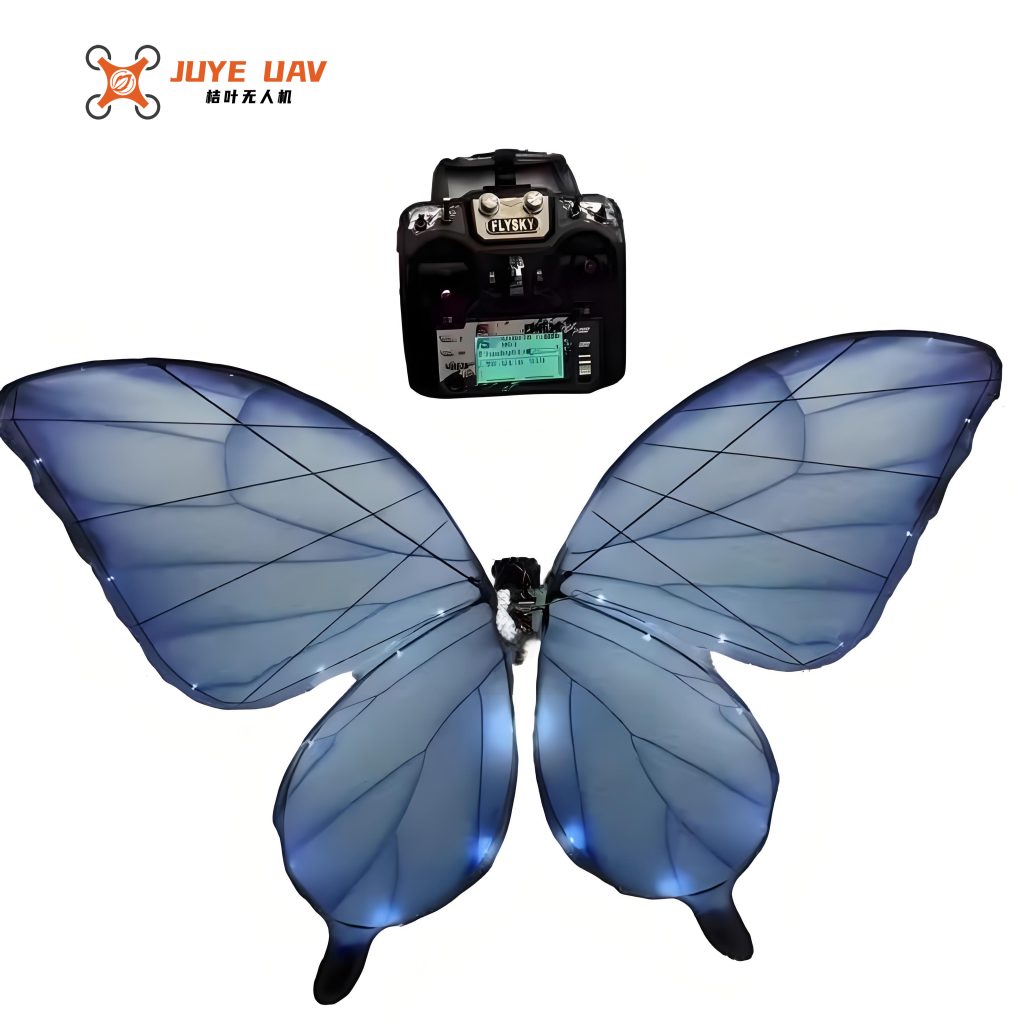
Manufacturing techniques for flying butterfly drones involve lightweight materials like carbon fiber rods for wing veins and elastic membranes for wing surfaces. Methods include direct adhesion, connector sleeves, and vacuum bag processes. I have found that vacuum bagging, which uses carbon fiber prepregs cured under heat and pressure, produces durable and flexible wings essential for mimicking butterfly wing deformation. This process ensures wings can withstand cyclic flapping while maintaining aerodynamic efficiency. Additionally, 3D printing and laser cutting are used for complex joints and frames, reducing weight and improving precision. For example, a flying butterfly drone’s chassis might be fabricated from carbon fiber tubes with 3D-printed linkages to connect wings to drivers, enhancing overall structural integrity.
Driving and control schemes for flying butterfly drones primarily use DC servo motors for direct drive, due to their high torque output at low speeds, matching the low flapping frequencies. Alternative mechanisms include gear-based transmissions, crank-slider systems, and string-driven steering. I have explored an “8-shaped” flapping mechanism that mimics insect flight patterns, potentially increasing lift compared to linear flapping. The dynamics of such a mechanism can be modeled as:
$$ x(t) = A \sin(\omega t) + B \cos(2\omega t) $$
where $x(t)$ is wing position, $A$ and $B$ are amplitudes, and $\omega$ is flapping frequency. This non-linear motion can enhance vortex generation, a key aspect for flying butterfly drones. Power sources typically involve high-density lithium batteries, but energy storage methods like rubber bands have been tested for short flights. Control strategies integrate microcontrollers like STM32 chips to generate PWM signals for independent wing control, enabling pitch, roll, and yaw maneuvers. Sensors such as IMUs and cameras provide feedback for stability, similar to insect ocelli and halteres. The control law for a flying butterfly drone might be:
$$ u = K_p e + K_i \int e \, dt + K_d \dot{e} $$
where $u$ is control input, $e$ is error in attitude, and $K_p$, $K_i$, $K_d$ are gains. Implementing this allows flying butterfly drones to adjust wing kinematics in real-time, compensating for disturbances.
Despite advancements, flying butterfly drones face several challenges. First, scaling down to insect size (e.g., wingspan < 10 cm) remains difficult due to power and material constraints. Current drones are at micro-scale, limiting applications in covert operations. Second, flight agility is often restricted; most prototypes perform basic turns but lack advanced maneuvers like rapid banking or hovering. I have observed that while other flapping-wing drones achieve complex motions, flying butterfly drones struggle with dynamic stability. Third, endurance is limited to under 5 minutes, compared to 20+ minutes for some bird-inspired drones. Improving energy efficiency through optimized flapping patterns or hybrid power systems is essential. Fourth, control robustness in turbulent environments is insufficient, as current systems rely on ideal conditions. Enhancing sensor fusion and adaptive control could address this. Fifth, biomimicry fidelity is low; wings often use uniform materials rather than graded stiffness like natural butterfly veins. Future flying butterfly drones should incorporate more realistic wing structures to improve aerodynamic performance.
Looking ahead, I believe flying butterfly drones will evolve in several directions. Miniaturization will be a key focus, requiring novel actuators like piezoelectric or artificial muscles to reduce weight while maintaining torque. The relationship for actuator selection can be summarized as:
$$ \text{Figure of Merit} = \frac{\tau \cdot f}{m \cdot V} $$
where $\tau$ is torque, $f$ is frequency, $m$ is mass, and $V$ is voltage. Higher values indicate better candidates for smaller flying butterfly drones. Agility will improve through advanced transmission mechanisms and active feedback systems, perhaps integrating abdominal-like appendages for stability. I propose using morphing wings with variable stiffness, controlled by smart materials, to enable precise maneuvers. Endurance can be extended by harvesting energy from solar cells or optimizing flapping trajectories to reduce power consumption. For instance, a flying butterfly drone might use a glide-and-flap cycle, modeled as:
$$ E_{\text{total}} = E_{\text{flap}} + E_{\text{glide}} $$
where $E_{\text{flap}}$ is energy during flapping and $E_{\text{glide}}$ during gliding. Minimizing $E_{\text{total}}$ through trajectory optimization can boost flight time. Biomimicry will deepen with bio-inspired wing veins and flexible membranes that replicate butterfly wing deformation. Computational fluid dynamics (CFD) simulations can guide this, using equations like the Navier-Stokes equations:
$$ \rho \left( \frac{\partial \mathbf{u}}{\partial t} + \mathbf{u} \cdot \nabla \mathbf{u} \right) = -\nabla p + \mu \nabla^2 \mathbf{u} + \mathbf{f} $$
where $\mathbf{u}$ is velocity, $p$ is pressure, $\mu$ is viscosity, and $\mathbf{f}$ is body force. Applying this to wing design can enhance lift generation in flying butterfly drones. Lastly, practical applications will expand, with flying butterfly drones deployed for tasks like pollination monitoring or search-and-rescue in confined spaces. Collaborative swarms, inspired by butterfly collective behavior, could enable scalable operations.
In conclusion, flying butterfly drones represent a promising branch of bio-inspired robotics, leveraging the unique aerodynamics of butterflies for efficient and stealthy flight. Through this review, I have summarized the lift mechanisms, structural designs, driving methods, and control strategies that underpin their development. While challenges in size, agility, endurance, robustness, and biomimicry persist, ongoing research points toward smaller, more agile, and more reliable systems. As I continue to explore this field, I am optimistic that flying butterfly drones will soon achieve broader real-world impact, bridging the gap between natural inspiration and engineering innovation. The journey to perfect these drones is complex, but with interdisciplinary efforts, the future of flying butterfly drones looks bright, potentially revolutionizing aerial robotics with their elegant and efficient flight.