In recent years, the rapid advancement of technology has led to the widespread adoption of unmanned aerial vehicles (UAVs) across various sectors, including military, commercial, agricultural, and personal use. As prices have plummeted and operational requirements simplified, UAVs are no longer exclusive to military applications but have become accessible to the general public. However, this proliferation has introduced significant security risks, such as privacy invasion, threats to national security near government or military facilities, and accidents due to unskilled operation. Consequently, the anti-UAV industry has emerged as a critical response, driven by the urgent need to mitigate these hazards. I will explore this burgeoning field, analyzing its growth, technological developments, and future directions, with a focus on the increasing importance of anti-UAV systems.
The rise of the anti-UAV industry is directly linked to the escalating hazards posed by UAVs. With companies like DJI leading the charge, UAV production has surged, making them affordable and user-friendly. Data from 2015 indicates that global UAV sales reached 600,000 units, with 97%用于民用 applications and only 3% for military purposes. Of these, approximately 200,000 were professional drones, while 400,000 were consumer models. Projections suggest that consumer UAV sales will exceed 26 billion RMB by 2020. This expansion has been accompanied by a spike in incidents: for instance, at Chengdu Shuangliu International Airport in 2016, a UAV interference incident forced the closure of a runway for over an hour, disrupting 55 flights. Similarly, in the Beijing-Tianjin-Hebei region, over 100 unidentified flying object reports in three years highlight the growing prevalence of违规飞行. Internationally, incidents like drones出现在白宫禁区 or the placement of radioactive materials via UAV at the Japanese Prime Minister’s office underscore global security concerns. These events have catalyzed demand for robust anti-UAV measures, pushing governments to enact regulations and spurring technological innovation in anti-UAV defenses.
| Year | Total UAV Sales (Units) | Civilian Market Share (%) | Military Market Share (%) | Notable Incidents |
|---|---|---|---|---|
| 2015 | 600,000 | 97 | 3 | Airport disruptions, privacy breaches |
| 2020 (Projected) | N/A | N/A | N/A | Consumer sales surge to 26B RMB |
The anti-UAV market is poised for explosive growth, with estimates from Markets and Markets indicating that it will surpass $1 billion by 2022. This reflects a compound annual growth rate that underscores the sector’s potential. In China, while over 400 UAV manufacturers exist, only a handful focus on anti-UAV defense research, highlighting a significant gap. During a marathon event, for example, strict UAV restrictions were imposed, leading to the development of systems like the “Electronic Eagle,” which uses radio waves to neutralize主流 UAVs. This demonstrates the practical application of anti-UAV technologies in public safety. I believe that as awareness grows, investment in anti-UAV solutions will accelerate, making this industry a cornerstone of modern security infrastructure.
Anti-UAV technologies are evolving rapidly, encompassing a range of methods from kinetic to non-kinetic approaches. The core principle involves detecting, tracking, and neutralizing UAV threats through various means. To quantify the effectiveness of these systems, we can use mathematical models. For instance, the signal干扰 power required to disrupt a UAV’s communication can be expressed as:
$$ P_j = \frac{P_t G_t G_r \lambda^2}{(4\pi d)^2 L} $$
where \( P_j \) is the jamming power, \( P_t \) is the transmitter power, \( G_t \) and \( G_r \) are the antenna gains, \( \lambda \) is the wavelength, \( d \) is the distance to the UAV, and \( L \) represents losses. This formula illustrates the technical challenges in designing anti-UAV systems that can effectively counter diverse UAV models. Additionally, the probability of successful interception can be modeled using statistical methods, such as:
$$ P_{success} = 1 – e^{-\lambda t} $$
where \( \lambda \) is the arrival rate of threats and \( t \) is the response time. These models aid in optimizing anti-UAV deployments for maximum efficacy.
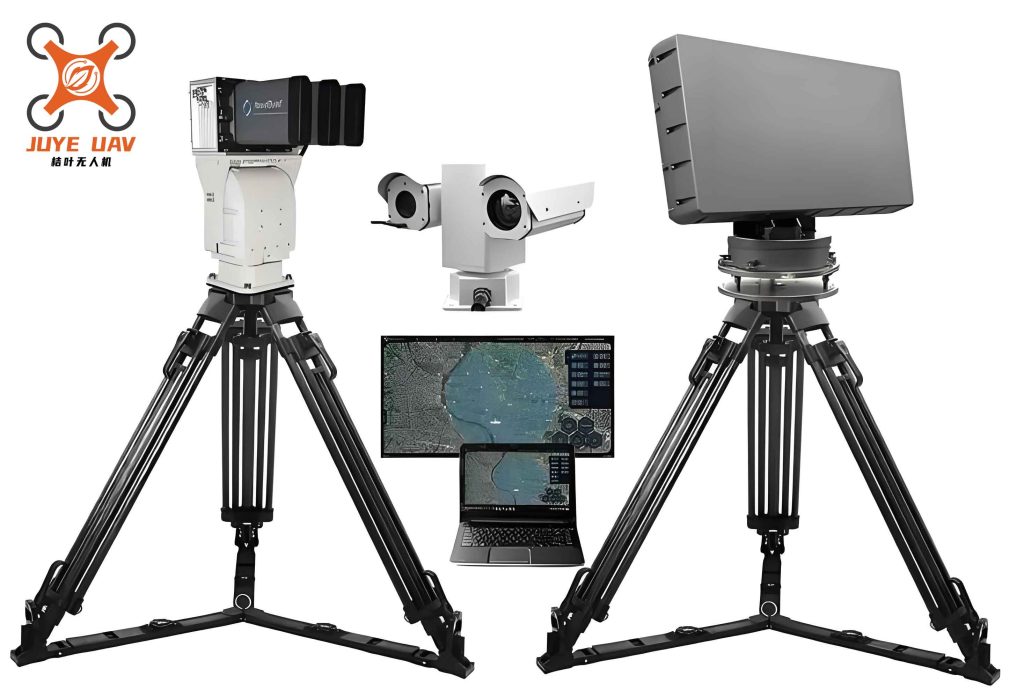
Looking ahead, the development of anti-UAV systems is expected to follow several key trajectories. First, directed-energy weapons, such as lasers, are gaining traction. In trials, a 30KW laser system mounted on a vessel successfully downed a UAV, showcasing its potential for hard-kill capabilities. The U.S. Department of Defense is actively researching tactical laser weapons specifically for anti-UAV applications. Second, missile-based systems are being refined; for example, QInetIQ and Sula Systems are developing kinetic interceptors that can target UAVs with low-cost, guided missiles. These systems, often less than a meter in length, rely on high-speed impact without warheads, reducing costs to around $40,000 per unit. Third, integrated defense systems like Israel’s “Iron Dome” have proven effective against UAVs at close ranges, using radar detection for precise strikes. Fourth, navigation signal干扰 remains a prevalent soft-kill method, disrupting UAVs’ GPS or control frequencies to force landings or malfunctions. The干扰 effectiveness can be enhanced by targeting multiple frequency bands simultaneously, as described by:
$$ JSR = \frac{P_j / B_j}{P_s / B_s} $$
where \( JSR \) is the jamming-to-signal ratio, \( P_j \) and \( P_s \) are jamming and signal powers, and \( B_j \) and \( B_s \) are bandwidths. Fifth, radar advancements, such as Russia’s panoramic surveillance radar, can detect UAVs within 20 kilometers, combining radar stations with electro-optical components for comprehensive monitoring.
| Technology Type | Mechanism | Advantages | Limitations | Cost Estimate |
|---|---|---|---|---|
| Directed-Energy Weapons | Laser or microwave beams to disable UAVs | Precision, rapid engagement | Limited range, atmospheric interference | High (millions of dollars) |
| Missile Systems | Kinetic interceptors for physical destruction | High lethality, scalable | Collateral risk, higher cost per engagement | Medium ($40,000 per missile) |
| Defense Systems (e.g., Iron Dome) | Radar detection and missile interception | Proven effectiveness, integrated approach | Expensive deployment, size constraints | Very high (system-wide costs) |
| Navigation Signal干扰 | Jamming control or GPS signals | Non-lethal, low collateral damage | Legal restrictions, potential for evasion | Low to medium (thousands of dollars) |
| Radar Detection | Surveillance and tracking of UAVs | Long-range, real-time monitoring | False alarms, susceptibility to stealth | Medium (hundreds of thousands) |
The future of anti-UAV technology will likely involve hybrid systems that combine multiple approaches for layered defense. For instance, integrating radar detection with directed-energy weapons can create a seamless anti-UAV network. The effectiveness of such systems can be evaluated using metrics like the probability of kill (\( P_k \)), which depends on factors like detection accuracy and engagement speed. Mathematically, this can be represented as:
$$ P_k = P_d \times P_t \times P_h $$
where \( P_d \) is the probability of detection, \( P_t \) is the probability of tracking, and \( P_h \) is the probability of hit. By optimizing each component, anti-UAV systems can achieve higher success rates against evolving UAV threats. Moreover, the use of artificial intelligence (AI) for threat classification and autonomous response is becoming crucial. AI algorithms can analyze UAV behavior patterns to distinguish between benign and malicious activities, enhancing the precision of anti-UAV measures. The decision process can be modeled as:
$$ \text{Decision} = \arg\max_{a \in A} \sum_{s} R(s, a) \cdot P(s|o) $$
where \( A \) is the set of actions (e.g., jam, destroy), \( R \) is the reward function, \( s \) is the state (e.g., UAV type), and \( o \) is the observation. This underscores the growing sophistication of anti-UAV research.
In conclusion, the anti-UAV industry is rapidly evolving to address the security challenges posed by ubiquitous UAVs. From directed-energy weapons to signal干扰 and radar systems, a diverse array of technologies is being developed to neutralize threats. The market potential is immense, with projections indicating sustained growth as incidents proliferate. I anticipate that future innovations will focus on cost-effective, scalable solutions that integrate detection, tracking, and neutralization into cohesive anti-UAV ecosystems. While current systems are still in nascent stages, they lay a foundation for more advanced defenses, ensuring public safety and national security in an era of increasing aerial autonomy. The continued emphasis on anti-UAV research will be pivotal in shaping a secure airspace for all.
| Year | Global Market Size (USD Billion) | Key Drivers | Regional Hotspots |
|---|---|---|---|
| 2017 | 0.5 | Rising UAV incidents, regulatory pressures | North America, Europe |
| 2020 | 0.8 | Technological advancements, military adoption | Asia-Pacific, Middle East |
| 2022 | 1.0+ | Integration of AI, hybrid systems | Global expansion |
To further illustrate the technical aspects, consider the interference range of an anti-UAV jammer, which can be derived from the Friis transmission equation. For a UAV operating at a frequency \( f \), the maximum干扰 range \( R_{\text{max}} \) is given by:
$$ R_{\text{max}} = \sqrt{\frac{P_t G_t G_r \lambda^2}{(4\pi)^2 P_{\text{min}} L}} $$
where \( P_{\text{min}} \) is the minimum power required to disrupt the UAV’s接收器. This formula highlights the importance of power management in anti-UAV design. Additionally, the economic impact of anti-UAV systems can be analyzed using cost-benefit models, such as:
$$ \text{Net Benefit} = \sum_{t=0}^{T} \frac{B_t – C_t}{(1 + r)^t} $$
where \( B_t \) are the benefits (e.g., prevented damages), \( C_t \) are the costs (e.g., system deployment), \( r \) is the discount rate, and \( T \) is the time horizon. Such analyses support investment decisions in anti-UAV infrastructure.
As I reflect on the trajectory of the anti-UAV industry, it is clear that collaboration between governments, private sector, and research institutions will be essential. Standardization of protocols and international cooperation can enhance the interoperability of anti-UAV systems. For example, developing common frequency bands for干扰 or shared databases of UAV signatures can improve response times. The role of simulation in testing anti-UAV technologies cannot be overstated; using Monte Carlo methods, we can estimate system performance under various scenarios:
$$ \hat{P}_{success} = \frac{1}{N} \sum_{i=1}^{N} I(\text{intervention successful in simulation } i) $$
where \( N \) is the number of simulations and \( I \) is an indicator function. This iterative approach accelerates the development of reliable anti-UAV solutions.
In summary, the anti-UAV industry represents a dynamic and critical field in modern security. With ongoing advancements in technology and increasing market demand, anti-UAV systems will become more pervasive, protecting sensitive areas from unauthorized UAV activities. I urge stakeholders to prioritize research and development in this area, fostering innovation that balances effectiveness with ethical considerations. The future of airspace security depends on our ability to adapt and counter emerging threats, making anti-UAV initiatives a cornerstone of global safety efforts.