
In the evolving landscape of unmanned aerial vehicle (UAV) technology, the proliferation of “low, slow, and small” drones has necessitated robust countermeasures against unauthorized flights, often termed “black flights.” As a strategic imperative, the development of effective anti-UAV systems has gained paramount importance. Among various interception methods, flexible tethered nets have emerged as a highly promising solution due to their inherent fault tolerance and high capture success rates. This approach leverages a net launched to entangle and neutralize target drones, offering a non-destructive means of mitigation. However, in practical anti-UAV operations, launch parameters such as velocity and timing are subject to inevitable errors due to mechanical inconsistencies, environmental factors, and system limitations. These errors can accumulate and significantly impact the capture outcome, potentially leading to mission failure. Therefore, a thorough analysis of the feasible regions for launch parameter errors is critical to ensure reliable performance in real-world anti-UAV scenarios. This article, from my perspective as a researcher in the field, delves into the dynamics of tethered net deployment and capture, establishing a comprehensive model to explore the tolerance limits for launch inaccuracies. The goal is to provide actionable insights that enhance the robustness of anti-UAV net capture systems, ensuring they remain effective even under non-ideal conditions.
The core of this analysis lies in developing a accurate dynamic model for the tethered net system. In ground-based anti-UAV applications, the net is subjected to gravitational forces and aerodynamic drag, making its behavior more complex compared to space environments. To capture these dynamics, I employ the spring-mass particle method, which discretizes the net into nodes connected by massless spring-damper elements. This method is computationally efficient and well-suited for simulating large deformations and interactions. The net configuration is typically square, with four bullets or牵引体 attached to its corners to propel and spread it during launch. The internal forces within the net are derived from the elastic and damping properties of the tethers. For any two connected nodes i and j, the internal force can be expressed as:
$$ f_{ij} = \begin{cases} a_{ij} [C_{ij} l’_{ij} + K_{ij} (l_{ij} – l_{0ij})], & l_{ij} > l_{0ij} \\ 0, & l_{ij} \le l_{0ij} \end{cases} $$
Here, $a_{ij}$ is the connectivity matrix element (1 if connected, 0 otherwise), $l_{0ij}$ is the original length, $l_{ij}$ is the current length, $l’_{ij}$ is its time derivative, $C_{ij}$ is the equivalent damping coefficient, and $K_{ij}$ is the equivalent stiffness coefficient. These coefficients are calculated based on material properties:
$$ K_{ij} = \frac{E S}{l_{0ij}} $$
$$ C_{ij} = 2 \xi \sqrt{m_{ij} K_{ij}} $$
where $E$ is Young’s modulus, $S$ is the cross-sectional area, $\xi$ is the damping ratio, and $m_{ij}$ is the mass of the tether segment. This formulation allows the net to realistically simulate stretching and damping effects during deployment in anti-UAV missions.
External forces play a crucial role in ground-based anti-UAV net capture. Gravity acts vertically downward, while aerodynamic forces—comprising lift and drag—depend on the net’s orientation and velocity relative to the air. For a tether segment between nodes i and j, the aerodynamic forces are given by:
$$ \mathbf{F}^L_{ij} = \frac{1}{2} \rho C^L_{ij} d_0 l_{0ij} \| \mathbf{V}_{ij} \|^2 \mathbf{e}^L_{ij} $$
$$ \mathbf{F}^D_{ij} = \frac{1}{2} \rho C^D_{ij} d_0 l_{0ij} \| \mathbf{V}_{ij} \|^2 \mathbf{e}^D_{ij} $$
where $\rho$ is air density, $d_0$ is the tether diameter, $\mathbf{V}_{ij}$ is the relative velocity vector, and $\mathbf{e}^L_{ij}$ and $\mathbf{e}^D_{ij}$ are unit vectors for lift and drag directions, respectively. The coefficients $C^L_{ij}$ and $C^D_{ij}$ are approximated using empirical formulas based on the angle of attack $\alpha_{ij}$:
$$ C^L_{ij} \approx 1.1 \sin^2 \alpha_{ij} \cos \alpha_{ij} $$
$$ C^D_{ij} \approx 0.022 + 1.1 \sin^3 \alpha_{ij} $$
These equations account for the complex fluid-structure interactions that affect net trajectory in anti-UAV operations. Additionally, the bullets experience drag and gravity, with the drag force modeled as $F_f = \frac{1}{2} \rho v_q^2 S_q C_{x0}(v_q/c)$, where $v_q$ is bullet velocity, $S_q$ is the reference area, and $C_{x0}$ is the drag coefficient at zero angle of attack. Integrating these forces enables a realistic simulation of the net’s flight path toward the target UAV.
Collision dynamics between the net and the target UAV are modeled using Hertz contact theory with a penalty method. The collision detection checks for penetration between net nodes and the target surface, typically enveloped as a cube for simplicity. The normal contact force $F_n$ is computed as:
$$ F_n = k_c \delta^m + \lambda \delta^m \delta’ $$
where $\delta$ is the penetration depth, $\delta’$ is its rate, $k_c$ is the contact stiffness, $\lambda$ is the damping coefficient, and $m=1.5$ is an empirical exponent. The parameters are derived from material properties:
$$ k_c = \frac{4}{3\pi} \sqrt{r} \left( \frac{1 – \nu_1^2}{\pi E_1} + \frac{1 – \nu_2^2}{\pi E_2} \right)^{-1} $$
$$ \lambda = \frac{3}{2} \alpha k_c $$
Here, $r$ is an equivalent radius, and $\nu$ and $E$ are Poisson’s ratio and Young’s modulus for the colliding bodies. The tangential friction force $F_\tau$ is modeled with Coulomb friction, incorporating static and dynamic regimes based on a velocity threshold. This comprehensive collision model ensures accurate simulation of net-target interaction, which is vital for assessing capture success in anti-UAV systems.
Under ideal conditions, where launch parameters are perfectly symmetric and synchronized, the feasibility of capture depends primarily on target size and launch velocity. For a square net with side length $L$ and mesh size $l$, the target must be large enough to avoid escape through meshes yet small enough to allow complete envelopment. Thus, the feasible region for target side length $M$ is:
$$ M_{\text{min}} = l $$
$$ M_{\text{max}} = \frac{L}{4} $$
This defines the allowable target dimensions for effective anti-UAV capture. For launch velocity, a minimum threshold exists to prevent excessive downward drift due to gravity before reaching the target. The criterion for successful capture requires that the net’s center displacement in the vertical direction $\Delta Z$ remains less than the target side length $M$ during deployment. Through numerical simulations, I derive the feasible launch velocity range. For instance, with $L = 1 \, \text{m}$, $l = 0.1 \, \text{m}$, and a launch distance of 3 m at an angle of 22.5°, the feasible velocity region is found to be $[20 \, \text{m/s}, +\infty)$. Table 1 summarizes key parameters used in this analysis for anti-UAV applications.
| Parameter | Symbol | Value |
|---|---|---|
| Net Young’s Modulus | $E$ | 87 GPa |
| Net Density | $\rho_{\text{net}}$ | 1440 kg/m³ |
| Net Poisson’s Ratio | $\nu$ | 0.35 |
| Net Damping Ratio | $\xi$ | 0.3 |
| Mesh Size | $l$ | 0.1 m |
| Tether Length | $L_q$ | 0.5 m |
| Bullet Mass | $m_q$ | 15 g |
| Target Young’s Modulus | $E_{\text{target}}$ | 70 GPa |
| Target Poisson’s Ratio | $\nu_{\text{target}}$ | 0.3 |
| Air Density | $\rho_{\text{air}}$ | 1.225 kg/m³ |
In non-ideal conditions, launch errors—such as velocity inconsistencies and timing asynchronies among bullets—are inevitable in practical anti-UAV systems. These errors can cause net skewing and reduce capture reliability. To analyze their impact, I define success criteria: the net center coordinates must remain within the target boundaries during deployment. For a target centered relative to the net, this means $x_{\text{net}} \in [-M/2, M/2]$ and $z_{\text{net}} \in [-M, 0]$ in a coordinate system where the net flies along the y-axis. Extensive numerical simulations are conducted to determine the feasible regions for velocity and timing errors. For velocity errors, consider a scenario where one bullet (e.g., bullet 4) has a deviation $\Delta v$ from the nominal launch velocity of 30 m/s. The net center shifts accordingly, and the feasible region is identified where capture remains successful. Similarly, for timing errors, a bullet may launch earlier or later by $\Delta t$, with a maximum allowable error limited by the tether length to prevent premature dragging. The results are summarized in Table 2, highlighting the tolerance of anti-UAV net systems to such inaccuracies.
| Error Type | Bullet Affected | Feasible Region | Comments |
|---|---|---|---|
| Velocity Error | Bullet 4 | $\Delta v \in [-9 \, \text{m/s}, 12 \, \text{m/s}]$ | Net center stays within target bounds |
| Velocity Error | Bullet 3 | $\Delta v \in [-10 \, \text{m/s}, 16 \, \text{m/s}]$ | Higher tolerance for positive errors |
| Timing Error | Bullet 4 | $\Delta t \in [-66 \, \text{ms}, 66 \, \text{ms}]$ | Limited by tether dynamics |
| Timing Error | Bullet 3 | $\Delta t \in [-66 \, \text{ms}, 66 \, \text{ms}]$ | Symmetric due to net geometry |
The mathematical underpinning for these feasible regions involves solving the net’s equations of motion with varied initial conditions. The net deployment rate, defined as the percentage of maximum expanded area, is monitored to ensure it exceeds a threshold (e.g., 50%) during target contact. For velocity errors, the net center displacement $\Delta x$ and $\Delta z$ can be approximated as functions of $\Delta v$, leading to boundary conditions derived from the success criteria. For timing errors, the dynamics involve chase phenomena among bullets, described by differential equations with time-delay terms. The feasible region is where solutions satisfy $\Delta x^2 + \Delta z^2 < (M/2)^2$ at the moment of capture. These analyses demonstrate that anti-UAV net systems possess considerable error tolerance, enhancing their practicality in field deployments.
To validate the dynamic model and error analysis, I conduct ground-based experiments using a tethered net launch system equipped with laser speed measurement. The setup includes a net launcher, a cubic target simulating a UAV, high-speed cameras, and supplementary lighting. The net is square with $L = 1 \, \text{m}$, made of Kevlar with 14 meshes per side, and bullets of mass 15 g each. The launch distance is 3 m, and the target side length is 0.2 m. Laser sensors at the muzzle measure individual bullet velocities and timing, revealing errors such as $\Delta v_{\text{max}} = 3.2 \, \text{m/s}$ and $\Delta t_{\text{max}} = 3 \, \text{ms}$. The experimental capture sequence is recorded and compared with simulations under identical parameters.
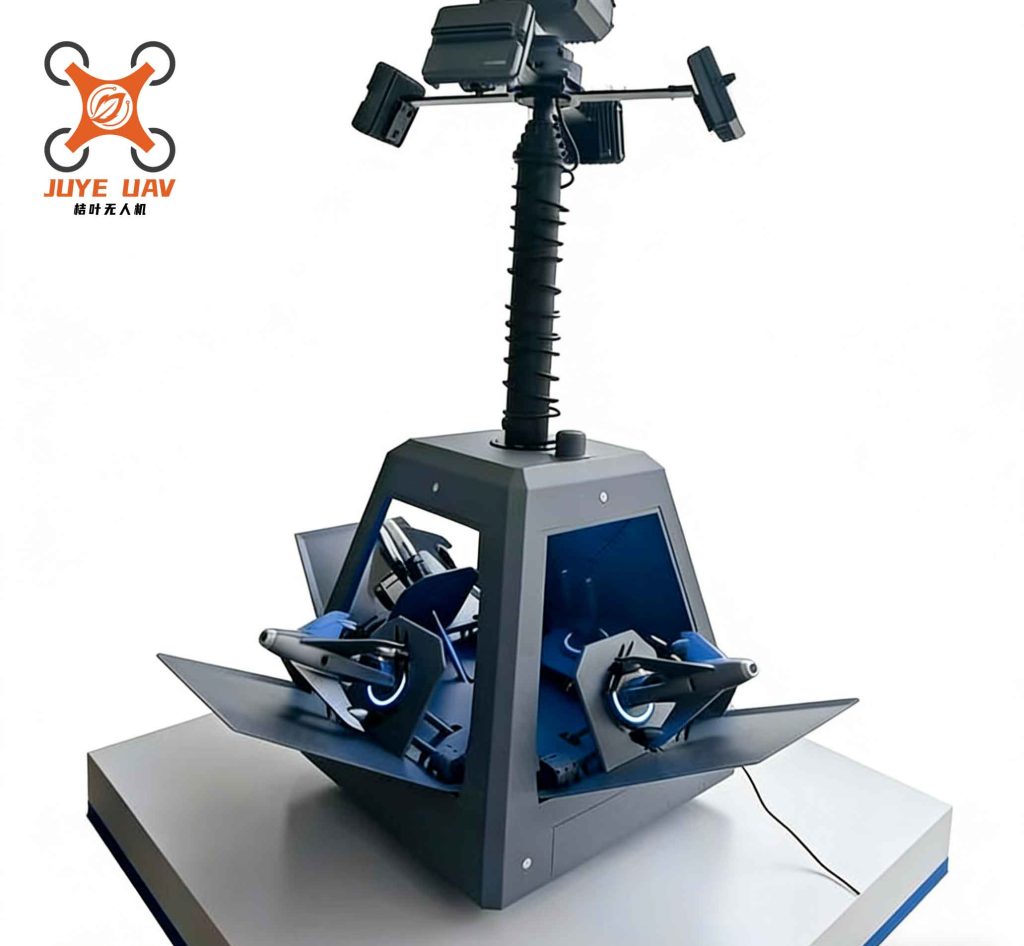
This image illustrates a typical anti-UAV net capture scenario, showing the net in flight toward a target drone. The visual confirms the net’s expansion and trajectory, aligning with simulation predictions for error-prone launches.
In the experiments, the net deployment and capture processes are analyzed frame-by-frame. The net’s shape at key displacements—e.g., at 1 m, 2 m, and 3 m—closely matches simulation results, with minor discrepancies due to unmodeled factors like net-pack resistance. The deployment rate, a critical metric for anti-UAV effectiveness, peaks at around 56% in experiments versus 66% in simulations, indicating good agreement within practical tolerances. The net successfully envelops the target despite measured errors, corroborating the feasible region analysis. This validation underscores the robustness of the model and its utility in designing anti-UAV systems that accommodate real-world imperfections.
Further insights into error propagation can be gained through sensitivity analysis. The net’s response to combined errors—e.g., simultaneous velocity and timing deviations—is explored using multivariate simulations. For anti-UAV applications, it is essential to quantify the probability of capture success given error distributions. Assuming Gaussian errors with standard deviations $\sigma_v$ and $\sigma_t$, the success probability $P_s$ can be estimated by integrating over the feasible regions:
$$ P_s = \int_{\Delta v \in R_v} \int_{\Delta t \in R_t} f(\Delta v, \Delta t) \, d\Delta v \, d\Delta t $$
where $f(\Delta v, \Delta t)$ is the joint probability density function, and $R_v$ and $R_t$ are the feasible regions from Table 2. This probabilistic approach enhances the reliability assessment of anti-UAV net systems in stochastic environments.
Another aspect is the optimization of net design parameters to expand feasible regions. For instance, varying tether stiffness $K_{ij}$ or net size $L$ can influence error tolerance. Using gradient-based optimization, I seek to maximize the volume of the feasible region in error space. The objective function $J$ is defined as the product of feasible ranges:
$$ J = ( \Delta v_{\text{max}} – \Delta v_{\text{min}} ) \times ( \Delta t_{\text{max}} – \Delta t_{\text{min}} ) $$
subject to constraints such as net mass and launch energy limits. This optimization yields designs that are more forgiving to launch inaccuracies, thereby improving anti-UAV system performance.
The interaction between net dynamics and environmental factors like wind also affects feasible regions. Crosswinds can induce additional lateral forces, potentially reducing error tolerance. To account for this, the aerodynamic model is extended to include wind velocity vectors $\mathbf{V}_w$. The relative velocity in force calculations becomes $\mathbf{V}_{ij} – \mathbf{V}_w$, modifying the net’s trajectory. Simulations with wind speeds up to 5 m/s show that feasible regions shrink by approximately 10-15%, emphasizing the need for adaptive launch parameters in windy conditions for anti-UAV operations.
In terms of implementation, the findings from this analysis can guide the development of launch control systems for anti-UAV nets. By incorporating real-time error compensation—e.g., adjusting launch angles or using guided bullets—the feasible regions can be effectively enlarged. Feedback from onboard sensors could enable dynamic corrections during flight, further enhancing capture success rates. Such advancements are crucial for deploying anti-UAV systems in diverse scenarios, from urban areas to critical infrastructure protection.
To summarize, this comprehensive analysis demonstrates that tethered net systems for anti-UAV capture exhibit significant tolerance to launch parameter errors. The feasible regions for velocity and timing errors are substantial, allowing for practical deployment even with typical manufacturing and operational variances. The dynamic model, validated through experiments, provides a reliable tool for predicting net behavior and optimizing designs. As anti-UAV technology evolves, the insights gained here will contribute to more robust and effective countermeasures against unauthorized drones, ensuring safety and security in airspace. Future work may explore multi-net systems, moving targets, and integration with other anti-UAV modalities to create layered defense networks.
The mathematical rigor applied throughout this study—from differential equations for net dynamics to statistical error analysis—underscores the interdisciplinary nature of anti-UAV research. By bridging mechanics, control theory, and probability, we can advance the state-of-the-art in drone interception. The tables and formulas presented serve as a reference for engineers and researchers aiming to develop or improve anti-UAV net capture systems. In conclusion, the feasibility region analysis not only validates the practicality of tethered nets but also paves the way for innovative solutions in the ongoing battle against rogue drones.