
In recent years, the proliferation of commercially available unmanned aerial vehicles (UAVs) has presented significant security challenges. While these systems offer immense utility for civilian applications, their potential for malicious use—such as unauthorized surveillance, contraband delivery, or as platforms for disruptive payloads—poses a severe threat to critical infrastructure, public events, and national security perimeters. The core of this threat lies in the inherent low-observable characteristics of small UAVs: low radar cross-section (RCS), very low-altitude flight profiles (often in the ground clutter regime), and low velocities. These features make them exceptionally difficult to detect and track using conventional surveillance radars, creating a critical gap in modern air defense and perimeter security systems. This paper, from my perspective as a practitioner in the field, delves into the technological response to this challenge, focusing on the pivotal role of advanced radar systems. Specifically, I will introduce and analyze an integrated anti-UAV system whose cornerstone is a circular phased array radar. This system represents a sophisticated fusion of detection, tracking, classification, and countermeasure technologies designed to neutralize the UAV threat.
The imperative for robust anti-UAV capabilities has catalyzed the development of a comprehensive technological ecosystem. An effective anti-UAV system is not a single device but a layered suite of sensors and effectors working in concert. The primary technical disciplines involved can be categorized as follows:
| Technical Domain | Primary Function | Typical Methods/Technologies |
|---|---|---|
| Detection & Tracking | To find, locate, and continuously monitor UAV targets. | Radar (various bands, pulsed/continuous wave), Electro-Optical/Infrared (EO/IR) sensors, Acoustic sensors, Radio Frequency (RF) scanners. |
| Classification & Identification | To distinguish UAVs from birds, clutter, and other objects, and to identify specific UAV types. | Machine Learning on radar/EO/IR/RF signatures, database matching of flight patterns and RF emissions. |
| Countermeasures (Soft-Kill) | To disrupt UAV control or navigation without physical destruction. | Radio Frequency Jamming (Control, GPS/GNSS, Wi-Fi), Spoofing (GPS, control link takeover), Directed Energy (laser dazzlers). |
| Countermeasures (Hard-Kill) | To physically disable or destroy the UAV. | Kinetic impact (nets, projectiles), High-Power Microwaves (HPM), High-Energy Lasers. |
Among these, radar provides the most reliable, all-weather, 24/7 capability for wide-area surveillance and initial detection. The fundamental challenge for any radar in the anti-UAV role is achieving sufficient signal-to-clutter ratio (SCR) and signal-to-noise ratio (SNR) to detect a tiny target amid strong ground clutter. The radar range equation, which governs detection performance, highlights the difficulty:
$$P_r = \frac{P_t G_t G_r \lambda^2 \sigma}{(4\pi)^3 R^4 L}$$
Where \(P_r\) is the received power, \(P_t\) is the transmitted power, \(G_t\) and \(G_r\) are the transmit and receive antenna gains, \(\lambda\) is the wavelength, \(\sigma\) is the target’s Radar Cross-Section (RCS, which is very small for UAVs, e.g., 0.01 m²), \(R\) is the range to the target, and \(L\) represents system losses. To overcome the \(R^4\) attenuation and tiny \(\sigma\), anti-UAV radars must employ high transmit power, high-gain antennas, sophisticated signal processing, and often operate at higher frequencies (like Ku, Ka, or W-band) where gain is higher and wavelength \(\lambda\) is smaller, though at the cost of increased atmospheric attenuation.
My work focuses on a system architecture where a circular phased array radar serves as the primary wide-area sensor. The system workflow is a continuous loop: Detect → Track → Identify → Assess → Counteract. The circular array radar performs the first two functions with exceptional efficacy. Once a track is established, its high-precision coordinates are used to cue a narrow-field-of-view EO/IR camera for visual confirmation and classification. A parallel RF scanning subsystem may passively listen for tell-tale communication signals from the UAV. All sensor data is fused at a central command and control (C2) unit. If the C2 system, often aided by automated threat evaluation algorithms, determines the UAV poses a threat, it can command an effector—typically a directional RF jammer as a first response—to engage the target. The jammer transmits noise or deceptive signals on the UAV’s control and navigation frequencies, forcing it to land, return to its point of origin, or enter a failsafe hover.
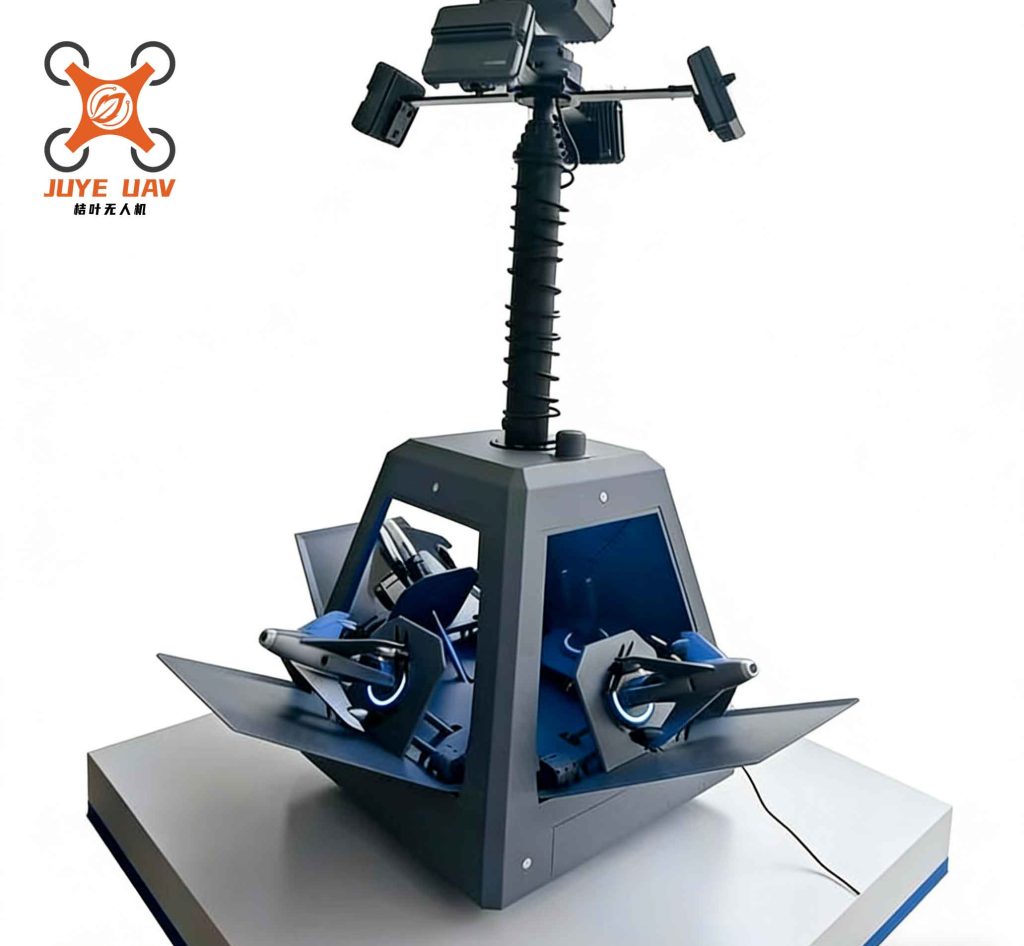
The heart of this anti-UAV system, the circular phased array radar, represents a significant departure from traditional mechanically rotating radars. Its design is optimized explicitly for the low, slow, small (LSS) target problem. Let’s examine its key characteristics and advantages in detail.
The Circular Phased Array Radar: Principle and Advantages
A circular array consists of multiple antenna elements arranged symmetrically around a vertical axis. Unlike a linear array that scans electronically in one plane (e.g., azimuth), a circular array can form beams and steer them electronically to any azimuth angle almost instantaneously, without any mechanical movement. This is achieved through complex digital beamforming (DBF) techniques applied to the signals received (and sometimes transmitted) by each element.
The basic principle of electronic steering for a uniform circular array (UCA) with N elements can be described. For a beam to be pointed in azimuth direction \(\phi_0\), a progressive phase shift \(\psi_n\) is applied to the nth element located at angular position \(\phi_n = 2\pi n / N\):
$$\psi_n = -k a \cos(\phi_0 – \phi_n)$$
where \(k = 2\pi / \lambda\) is the wavenumber, and \(a\) is the radius of the circular array. In practice, modern systems use digital receivers for each element channel, allowing for highly flexible and adaptive beamforming in both the spatial and temporal domains.
The advantages of this circular, all-electronic scanning architecture for anti-UAV applications are profound:
| Feature | Benefit for Anti-UAV Role |
|---|---|
| Extremely High Data Rate | Mechanical radars may scan a sector every few seconds. A circular array can revisit any direction within its 360° coverage within milliseconds. This allows for near-continuous monitoring of a target, enabling highly accurate tracking of evasive maneuvers and rapid detection of new threats. |
| Search-While-Track (SWT) | The radar can dedicate a small portion of its timeline to maintain high-update-rate tracks on confirmed targets while simultaneously using the majority of its resources to scan the entire surveillance volume for new intruders. This is very difficult for a single mechanically-scanned radar. |
| Flexible Power & Dwell Management | The system can “stare” or dwell longer on suspicious sectors or known threat axes, integrating more energy to improve detection probability for stealthy targets, while spending less time on low-priority areas. This is known as adaptive scheduling. |
| Low Probability of Intercept (LPI) | The ability to rapidly hop beams and use complex waveforms makes it harder for a sophisticated adversary to detect that they are being illuminated by the radar. |
| Graceful Degradation | If individual elements fail, the system performance degrades gradually rather than suffering a complete outage, improving reliability. |
| Compact Form Factor | With no rotating antenna dish and pedestal, the system can be packaged into a much smaller, lower-profile unit suitable for mobile deployment on vehicle roofs or rapid emplacement. |
To effectively detect miniature UAVs, the radar employs a suite of advanced signal processing techniques. A key technology is Pulse-Doppler processing with a high Pulse Repetition Frequency (PRF). This allows the radar to unambiguously measure the radial velocity of a target, which is crucial for distinguishing a slow-moving UAV (e.g., 10 m/s) from strong, stationary ground clutter. The Doppler frequency shift \(f_d\) is given by:
$$f_d = \frac{2v_r}{\lambda}$$
where \(v_r\) is the radial velocity of the target relative to the radar. By applying a Fast Fourier Transform (FFT) across a coherent processing interval (CPI) of multiple pulses, the radar generates a Range-Doppler map. Sophisticated Constant False Alarm Rate (CFAR) detectors are then used to identify potential targets in this map amidst noise and clutter residuals.
Furthermore, the system leverages its digital architecture for Space-Time Adaptive Processing (STAP) or simpler adaptive beamforming. This allows it to dynamically place nulls in the antenna pattern in the direction of strong sources of interference or clutter, further enhancing the SCR for weak UAV targets. The combined use of high PRF, long CPI for fine Doppler resolution, and adaptive processing gives this circular array radar its claimed “strong clutter suppression capability.”
System Architecture and Integration
The complete anti-UAV system integrates the radar with other critical subsystems. A typical functional block diagram of the circular array radar itself is shown below, illustrating the integration of key components:
| Subsystem | Description |
|---|---|
| Antenna & Front-End | The circular array of radiating elements, integrated with Transmit/Receive (T/R) modules. Each T/R module contains a power amplifier for transmit, a low-noise amplifier (LNA) for receive, and phase/gain control circuitry. This is the physical interface to free space. |
| Exciters & Waveform Generators | Generate the stable, low-phase-noise reference signals and the specific pulsed or modulated waveforms (e.g., Linear Frequency Modulation for pulse compression) to be transmitted. |
| Digital Receiver/Beamformer | The core of the digital array. Each receive channel is digitized by an Analog-to-Digital Converter (ADC) immediately after down-conversion. The digitized samples from all channels are fed to a powerful processor that applies the complex weights for digital beamforming, creating multiple simultaneous receive beams. |
| Signal Processor | Performs key functions on the beamformed data: Pulse Compression (to improve range resolution), Doppler Processing (FFTs), CFAR detection, and measurement extraction (range, azimuth, elevation, Doppler). |
| Data Processor & Tracker | Associates detections over time to form tracks (Kalman or particle filters are commonly used), manages track files, and performs coordinate transformations. It outputs stabilized target tracks with velocity and heading. |
| Command & Control Interface | Provides the communication link (e.g., Ethernet) to the wider anti-UAV C2 system, reporting tracks and receiving operational mode commands. |
The integration into the broader anti-UAV system is seamless due to its network-centric design. The radar output (target tracks) is formatted as standardized messages (e.g., using NATO’s LINK-16-like formats or simple TCP/IP protocols) and fed to the central fusion node. This node also ingests data from the EO/IR payload, which is precisely collocated or calibrated with the radar. Upon a radar track, the C2 system sends pointing commands to the EO/IR system, which slews to the specified azimuth and elevation. The high-magnification optics then provide a visual confirmation, distinguishing a UAV from a bird or other false alarm. The C2 graphical user interface (GUI) displays the radar tracks overlaid on a digital map and a live video feed from the camera.
When a decision to engage is made, the C2 system selects the appropriate countermeasure. For the commonly used RF jammer, the engagement sequence involves:
1. The jammer antenna (often a directional parabolic or phased array itself) is slewed to the azimuth of the target.
2. Based on a database of known UAV control and navigation frequencies (or through real-time analysis from a separate RF sensor), the jammer generates high-power noise or deceptive signals across those bands.
3. The UAV, losing its command link and/or GPS lock, typically executes its pre-programmed fail-safe procedure, which is often to land immediately or return to its take-off point.
This sequence, from detection to successful neutralization, can be completed in a matter of tens of seconds, providing a rapid response to incursions.
Deployment Modes and Performance
The versatility of this anti-UAV system is demonstrated by its multiple deployment configurations:
| Deployment Mode | Configuration | Use Case |
|---|---|---|
| Fixed/Static Site Defense | Radar, EO/IR, jammer, and C2 shelter permanently installed at critical infrastructure (e.g., airports, nuclear plants, government compounds). Multiple systems can be networked for extended coverage and redundancy. | Persistent, 24/7 protection of high-value fixed sites. |
| Mobile Vehicle-Based | All subsystems mounted on a tactical vehicle (e.g., truck, SUV). The radar is often on a retractable mast. Power is supplied by vehicle generators or batteries. | Rapid deployment for temporary events (sports, summits), battlefield force protection, or augmenting fixed-site defenses. |
| Transportable/Containerized | System housed in shipping containers or shelters that can be airlifted and quickly set up in forward operating bases. | Expeditionary operations where infrastructure is limited. |
The performance of the circular array radar is typically characterized by key parameters that make it suitable for the anti-UAV mission. While specific numbers are classified or vendor-dependent, the general performance class can be summarized:
| Parameter | Typical Performance Range/Value |
|---|---|
| Frequency Band | Ku-band (12-18 GHz) or Ka-band (26.5-40 GHz) |
| Detection Range (for 0.01 m² RCS) | 3 km to 8 km (depending on clutter environment and radar variant) |
| Azimuth Coverage | 360° (electronic) |
| Elevation Coverage | 0° to 40°-60° (mechanical tilt or electronic) |
| Range Resolution | < 5 m |
| Azimuth Accuracy | < 0.5° |
| Track Update Rate | ≥ 1 Hz (can be much higher for dedicated tracks) |
| Minimum Detectable Velocity | < 1 m/s |
In field tests against popular commercial drones like the DJI Phantom series, such radars have demonstrated robust capability. They can initiate detection at ranges exceeding 5 km under favorable conditions, automatically transition the target into a high-precision track, and maintain that track even as the UAV performs complex maneuvers. The high data rate provides a smooth, continuous track stream, which is far superior to the “stair-step” updates from a slower mechanical radar. This smooth, precise tracking is what enables reliable cueing of EO/IR and jamming systems.
Conclusion and Future Outlook
The threat posed by illicit and malicious use of small UAVs is persistent and evolving. Effective defense requires a system-of-systems approach where detection is the critical first link in the chain. The circular phased array radar technology described here represents a significant leap forward in the detection layer for anti-UAV systems. Its all-electronic, 360-degree scan capability provides the high data rate, precision tracking, and flexibility needed to cope with the low, slow, and small (LSS) target challenge that defines the modern UAV threat.
By integrating this radar as the primary sensor within a broader architecture that includes EO/IR confirmation, C2 fusion, and responsive countermeasures, a comprehensive and effective anti-UAV shield can be deployed. This shield can operate in fixed, mobile, or transportable configurations, making it adaptable to the protection needs of airports, critical national infrastructure, military bases, and public events.
The future development of anti-UAV radar technology will likely focus on several key areas: further miniaturization and cost reduction; enhanced artificial intelligence and machine learning for automatic target recognition (ATR) directly from radar micro-Doppler signatures (which provide a unique “fingerprint” of rotor blades); and the integration of multiple radar bands (e.g., combining S-band for longer-range cuing with Ka-band for fine tracking) in a single system. Furthermore, the development of cognitive radar techniques, where the radar intelligently adapts its waveform and search pattern in real-time based on the environment and perceived threats, holds great promise. The circular array architecture, with its inherent digital flexibility, is ideally positioned to incorporate these advances, ensuring it remains at the forefront of anti-UAV technology for years to come.