
From my perspective as a researcher in modern defense technology, the rapid proliferation of unmanned aerial vehicles (UAVs) has fundamentally altered the landscape of contemporary warfare. The prominence of UAVs in conflicts such as the Nagorno-Karabakh war in 2020 has underscored their role as both a strategic advantage and a critical vulnerability. This has catalyzed a global race to develop robust anti-UAV capabilities. In this analysis, I will delve into the explosive growth of military UAVs, the多元化trends in anti-UAV methodologies, and the strategic imperatives for future defense systems. The term ‘anti-UAV’ will be central to our discussion, as it encapsulates the suite of technologies and tactics designed to neutralize aerial drones.
The advent of UAVs in military operations is not merely an incremental change but a paradigm shift. Initially leveraged for reconnaissance, UAVs have evolved into potent strike platforms, capable of precision attacks with minimal risk to human operators. The affordability and accessibility of drone technology have democratized aerial warfare, enabling state and non-state actors to deploy sophisticated systems. Consequently, the development of anti-UAV systems has become a top priority for defense establishments worldwide. I believe that understanding this dynamic is crucial for maintaining tactical superiority.
The Exponential Growth of Military UAVs
My examination of global trends reveals that military UAV development has been nothing short of explosive. Since the early use of drones in Vietnam and the Middle East, followed by the first armed UAV strike in Afghanistan in 2001, the applications have diversified into roles such as intelligence, surveillance, reconnaissance (ISR), and targeted strikes. The data indicates that over 70 countries now operate military UAVs, a significant increase from the handful of nations with armed drones a decade ago. This扩散is driven by both technological advancements and market forces.
To encapsulate this growth, I have compiled a table summarizing key characteristics of internationally traded UAVs from 1980 to 2020, based on analyses from institutions like the Stockholm International Peace Research Institute (SIPRI). This table highlights the shift toward larger, more capable systems and the entry of new players into the market.
| UAV Class (NATO Standard) | Weight Range | Number of Models (1980-2020) | Percentage of Total | Primary Exporters |
|---|---|---|---|---|
| Class I | < 150 kg | 8 | 19% | USA, Israel |
| Class II | < 600 kg | 21 | 49% | USA, Israel, Turkey |
| Class III | > 600 kg | 14 | 33% | USA, Israel, Russia |
From my analysis, the post-2000 era has seen a 3.3-fold increase in new UAV models, with Class III drones comprising over 78% of those introduced since then. While the United States and Israel remain dominant exporters, countries like Turkey, Iran, and Germany are emerging as significant suppliers. This proliferation means that anti-UAV systems must contend with an increasingly diverse threat portfolio, from small consumer-grade drones to large, high-altitude long-endurance (HALE) platforms.
Furthermore, the rise of loitering munitions, often termed “suicide drones” or巡飞弹, represents a particularly disruptive trend. These systems, which combine the persistence of UAVs with the lethality of precision-guided munitions, are becoming ubiquitous in conflicts. Israel’s Harop and Harpy, along with products from the United States, Russia, and Iran, exemplify this shift. I estimate that their low cost and tactical flexibility will compel a reevaluation of traditional air defense paradigms, making anti-UAV measures even more critical.
Diverse Anti-UAV Methodologies: A Technical Overview
In response to the UAV threat, military forces are developing a multi-layered approach to anti-UAV defense. These methodologies can be broadly categorized into soft-kill (non-kinetic) and hard-kill (kinetic) systems, each with distinct advantages and limitations. From my research, I assert that no single solution is sufficient; rather, an integrated system is necessary to address the full spectrum of drone threats.
Electronic Warfare: The Foundation of Soft-Kill Anti-UAV Systems
Electronic warfare (EW) remains a cornerstone of anti-UAV strategy, primarily targeting the communication links and navigation systems of drones. By jamming or spoofing radio frequency (RF) signals, these systems can disrupt control, force a landing, or cause a crash. The effectiveness of EW against small UAVs is high due to their reliance on commercial protocols. For instance, the power required for jamming can be modeled by the Friis transmission equation, which relates transmitted power, gain, and distance:
$$ P_r = P_t G_t G_r \left( \frac{\lambda}{4 \pi d} \right)^2 $$
where \( P_r \) is the received power, \( P_t \) is the transmitted power, \( G_t \) and \( G_r \) are the antenna gains, \( \lambda \) is the wavelength, and \( d \) is the distance. In anti-UAV jamming, the goal is to ensure \( P_r \) exceeds the drone’s receiver sensitivity, thereby overwhelming it. Systems like Russia’s ‘Rook’ and Israel’s ‘Drone Dome’ employ such principles, offering cost-effective interception with minimal collateral damage. I consider EW a vital first line of defense in any comprehensive anti-UAV architecture.
Kinetic Hard-Kill Systems: Precision and Firepower
When soft-kill measures are insufficient, kinetic systems provide a reliable means of physically destroying UAVs. These include traditional anti-aircraft guns, missiles, and emerging solutions like hypervelocity projectiles. The probability of kill (\( P_k \)) for such systems can be expressed as a function of accuracy and lethality:
$$ P_k = 1 – e^{-\frac{A}{V}} $$
where \( A \) represents the effective area covered by the weapon’s fragmentation or blast, and \( V \) is the vulnerable area of the UAV. Modern advancements focus on enhancing precision while reducing cost. For example, the United States has modified Stinger missiles with proximity fuzes for anti-UAV roles, and Russia is developing specialized munitions like the ‘Gvozd’ for its Pantsir systems. I have observed that the challenge lies in achieving a favorable cost exchange ratio, especially against swarms of inexpensive drones.
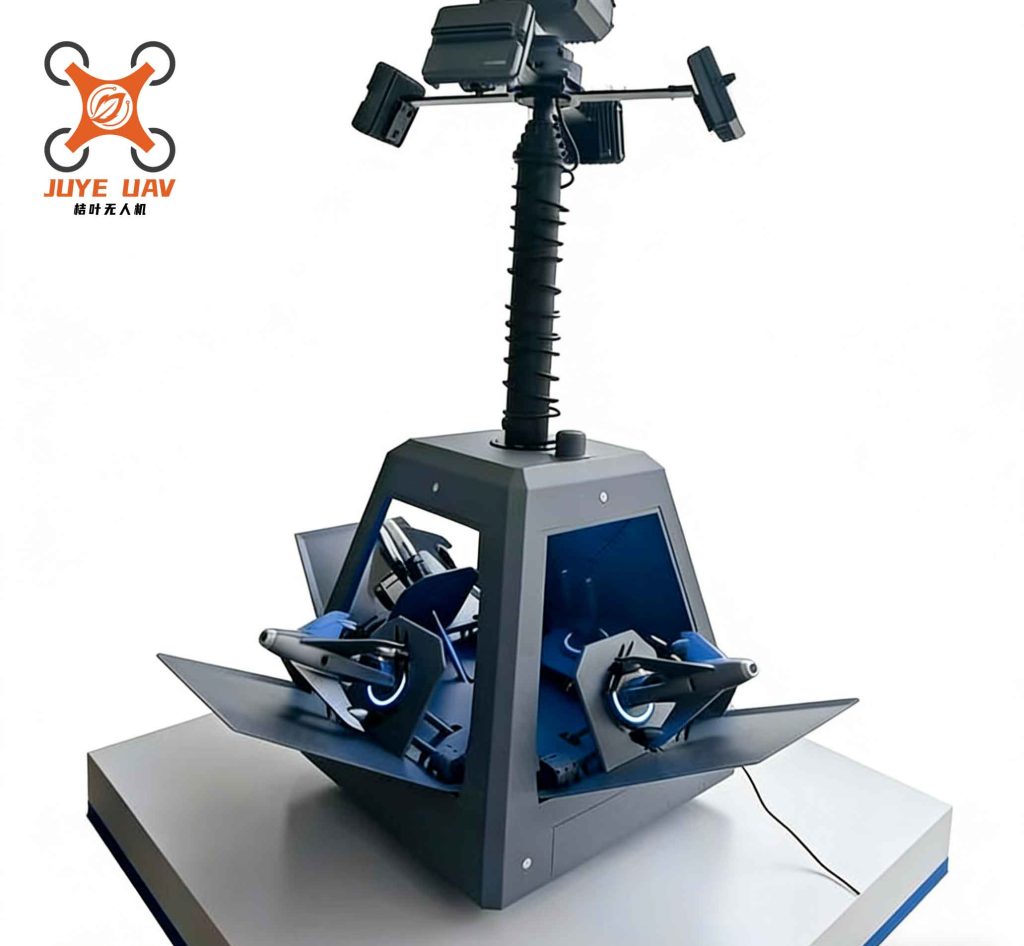
The image above illustrates the complexity of modern anti-UAV engagements, highlighting the need for integrated sensor and shooter networks. As shown, a layered defense is essential to counter diverse threats.
Directed Energy Weapons: The Future of Anti-UAV Defense
Directed energy weapons (DEWs), such as high-energy lasers (HELs) and high-power microwaves (HPMs), offer game-changing capabilities for anti-UAV missions. From my analysis, these systems provide rapid engagement, deep magazines, and low cost per shot, making them ideal for countering drone swarms.
For laser weapons, the energy required to disable a UAV can be estimated using the formula for thermal damage:
$$ E = \frac{\rho c_p \Delta T + L_v}{A_b \alpha} $$
where \( \rho \) is the target material density, \( c_p \) is specific heat, \( \Delta T \) is the temperature rise needed for melting or ablation, \( L_v \) is the latent heat of vaporization, \( A_b \) is the beam spot area, and \( \alpha \) is the absorption coefficient. Practical systems, like the U.S. Army’s 50 kW Multi-Mission High Energy Laser (MMHEL), have demonstrated the ability to burn through drone structures within seconds. I project that as power levels scale to 300 kW or more, lasers will become capable of defeating larger targets such as cruise missiles.
Microwave weapons, on the other hand, operate by emitting intense electromagnetic pulses to fry the electronics of UAVs. The power density (\( S \)) at a distance \( r \) from an antenna with gain \( G \) is given by:
$$ S = \frac{P_t G}{4 \pi r^2} $$
If \( S \) exceeds the vulnerability threshold of the drone’s circuits, it will be incapacitated. Systems like the U.S. Air Force’s Tactical High-power Operational Responder (THOR) and Epirus’s Leonidas have shown efficacy against groups of drones, making HPM a potent tool for area denial in anti-UAV operations. I contend that the combination of lasers and microwaves will form the backbone of next-generation anti-UAV defenses.
Drone-on-Drone Tactics: Autonomous Countermeasures
An emerging trend in anti-UAV warfare is the use of counter-drones to hunt and neutralize hostile UAVs. These can be equipped with nets, projectiles, or even explosive charges for kamikaze attacks. The dynamics of such engagements can be modeled using pursuit-evasion equations, where the interceptor drone (\( \vec{r}_i \)) chases the target drone (\( \vec{r}_t \)):
$$ \frac{d\vec{r}_i}{dt} = v_i \hat{d}, \quad \hat{d} = \frac{\vec{r}_t – \vec{r}_i}{|\vec{r}_t – \vec{r}_i|} $$
where \( v_i \) is the interceptor’s speed and \( \hat{d} \) is the unit vector toward the target. Systems like Russia’s ‘Wolf-18’ and the U.S. Coyote Block 2 exemplify this approach. From my assessment, drone-on-drone combat adds a layer of flexibility, allowing for beyond-line-of-sight engagements and reducing the risk to human operators. This represents a significant evolution in anti-UAV tactics.
Strategic Implications and Integrated Anti-UAV Architectures
Based on my observations of global developments, I have identified several key lessons for enhancing anti-UAV capabilities. First, strategic prioritization is essential. Nations like the United States and Russia have established dedicated offices and increased funding for anti-UAV research, recognizing its critical role in future conflicts. Regular exercises and real-world deployments, as seen in Syria, provide invaluable data for refining systems.
Second, interoperability and standardization are paramount. A fragmented anti-UAV ecosystem with proprietary systems is less effective against coordinated drone swarms. I advocate for open architectures that allow seamless integration of sensors, effectors, and command systems. The U.S. Army’s Integrated Battle Command System (IBCS) is a step in this direction, enabling plug-and-play functionality for new anti-UAV technologies.
To illustrate the components of an ideal anti-UAV system, I have developed a table outlining a five-layer defense-in-depth strategy. This framework ensures coverage across all threat echelons and engagement ranges.
| Layer | Primary Function | Typical Systems | Engagement Range |
|---|---|---|---|
| 1. Early Warning | Detection and tracking | Radar, electro-optical/infrared (EO/IR) sensors | Long-range (> 20 km) |
| 2. Electronic Shield | Soft-kill disruption | Jammers, spoofers, cyber tools | Medium-range (5-20 km) |
| 3. Kinetic Hard-Kill | Physical destruction | Anti-aircraft guns, missiles, hypervelocity projectiles | Short to medium (1-10 km) |
| 4. Ground-Based Directed Energy | Precision engagement | High-energy lasers, high-power microwaves | Short-range (0.5-5 km) |
| 5. Aerial Counter-Drone | Mobile interception | Interceptor drones, airborne jammers | Variable (0-10 km) |
This multi-layered approach mitigates the weaknesses of individual systems. For instance, while electronic warfare may be vulnerable to frequency-hopping drones, kinetic and directed energy systems provide backup. Moreover, cost considerations are addressed by using low-cost interceptors for cheap drones and reserving expensive missiles for high-value threats. I estimate that such an integrated anti-UAV network could achieve an overall effectiveness (\( E \)) described by:
$$ E = 1 – \prod_{i=1}^{n} (1 – P_{k,i}) $$
where \( P_{k,i} \) is the kill probability of the \( i \)-th layer, and \( n \) is the number of layers. By optimizing each layer, the cumulative probability of neutralizing a UAV approaches unity.
Finally, proactive measures should complement defensive ones. Attacking drone launch sites and control centers remains the most efficient anti-UAV strategy, as it eliminates threats at their source. This requires robust intelligence, surveillance, and reconnaissance (ISR) capabilities to locate and strike these assets promptly.
Conclusion
In my view, the evolution of military UAVs and anti-UAV systems is a classic example of offense-defense competition. As drones become more autonomous, stealthy, and numerous, the demands on anti-UAV technologies will intensify. The future battlefield will likely see a synergy of artificial intelligence, swarm tactics, and resilient communications on the UAV side, countered by adaptive, networked, and multi-domain anti-UAV defenses. Continuous innovation, international collaboration, and realistic testing are imperative to stay ahead in this arms race. By embracing a holistic approach that combines soft-kill and hard-kill methods, and by investing in emerging technologies like directed energy, nations can secure their airspace against the growing drone threat. The journey toward effective anti-UAV dominance is complex, but with strategic focus and technological agility, it is achievable.