
The modern battlespace has been irrevocably altered by the proliferation of Unmanned Aerial Vehicles (UAVs). From high-altitude strategic reconnaissance platforms to low-cost, commercially available drones modified for attack, these systems present a layered and persistent threat. For Russia, encounters with hostile UAVs, particularly in conflict zones like Syria, have served as a stark catalyst. Rather than engaging in a symmetric, resource-intensive race to match global leaders in UAV sophistication, Russian military strategy has pivoted towards an asymmetric, cost-effective counter-approach. This doctrine focuses on identifying and exploiting inherent vulnerabilities in UAV systems—their “soft underbelly”—through a combination of electronic warfare (EW), kinetic force, and emerging directed-energy technologies. The development of a comprehensive anti-UAV ecosystem is not merely a tactical necessity but a cornerstone of Russia’s strategy for maintaining strategic balance and operational security in an era of democratized air power.
The threat spectrum is broad and evolving. Russia has faced everything from coordinated swarms of crude, improvised attack drones to sophisticated intelligence, surveillance, and reconnaissance (ISR) platforms. Incidents, such as the January 2018 attack on the Khmeimim air base in Syria, where a mixed group of 13 drones was neutralized, underscored the reality of the threat. While those drones were technically simple, the event signaled the advent of swarm tactics. The core vulnerability of all UAVs, however, remains their reliance on data links for command and control (C2), navigation signals (GPS, GLONASS, etc.), and, for many, sensor data transmission. Exploiting this dependency forms the bedrock of Russian anti-UAV operations. The establishment of the world’s first dedicated anti-UAV EW unit and the integration of anti-UAV training across service branches, starting with the Airborne Forces, highlights the institutional priority placed on this mission.
Multi-Layered Anti-UAV Engagement Methodologies
Russian anti-UAV strategy employs a graduated, layered defense designed to counter threats across different altitudes, levels of sophistication, and swarm densities. The engagement methodologies can be categorized into three primary domains: soft-kill (electronic), hard-kill (kinetic), and capture.
1. Electronic Warfare (EW) and Soft-Kill
This is Russia’s premier and most cost-effective anti-UAV tool. By jamming or spoofing the radio frequencies used by a UAV, operators can achieve mission kill without firing a shot. The principles often involve overpowering the receiver on the UAV with noise or injecting deceptive signals.
- Data Link Jamming: This attacks the communication channel between the UAV and its ground control station (GCS). A powerful jamming signal saturates the frequency, rendering the command uplink and telemetry downlink unusable. This can force the UAV into a lost-link behavior, such as landing, returning to a pre-programmed point, or circling until battery depletion. The jamming power required must overcome the link margin. A simplified representation of the power at the UAV’s receiver, \( P_{rx} \), considering a jammer is:
$$ P_{rx} = P_t + G_t – L_{fs} + G_{r} $$
Where \( P_t \) is the jammer’s transmit power, \( G_t \) is the jammer antenna gain towards the UAV, \( L_{fs} \) is the free-space path loss, and \( G_{r} \) is the UAV receiver antenna gain. For effective jamming, \( P_{rx (jamming)} \) must be significantly greater than \( P_{rx (legitimate signal)} \). - Navigation Spoofing: A more sophisticated technique involves generating false Global Navigation Satellite System (GNSS) signals that are stronger than the authentic ones. The UAV’s receiver locks onto the spoofed signals, allowing the EW system to feed it false coordinates. This can divert the UAV from its target, cause it to crash, or guide it to a designated capture area. The deception signal must precisely replicate the signal structure, including encryption for military-grade GPS.
- Full-Spectrum Suppression: Modern Russian EW systems like the “Rex-1” electromagnetic gun or the “Moskite” (Mosquito) system are designed to blanket a wide range of frequencies (GPS, GLONASS, GSM, Wi-Fi) used by commercial and tactical UAVs. This broadband approach is crucial against diverse and evolving drone models.
2. Kinetic Hard-Kill
When electronic measures are insufficient, impractical, or when destruction is required, kinetic systems are employed. These range from traditional air defense to novel munitions.
- Air Defense Missile Systems: Systems like the Pantsir-S1 (SA-22) and Tor-M2 (SA-15) provide point defense. They are highly effective but pose a cost-exchange problem: a million-dollar missile against a thousand-dollar drone is unsustainable against swarms.
- Anti-Aircraft Artillery (AAA): Rapid-fire guns, such as the 2K22 Tunguska or the newer derivative combat modules, offer a cheaper kinetic solution for close-range threats. Their effectiveness is enhanced when coupled with radar/optronic detection.
- Directed-Energy Weapons (DEW): Laser and microwave systems represent the future of cost-effective hard-kill. A high-energy laser damages the UAV’s structure through thermal ablation. The time, \( t \), to create a damaging effect depends on the laser’s power density on target:
$$ \text{Power Density} = \frac{P \cdot \tau \cdot Q}{\pi \cdot ( \theta \cdot R / 2 )^2} $$
Where \( P \) is laser power, \( \tau \) is atmospheric transmission, \( Q \) is beam quality factor, \( \theta \) is beam divergence, and \( R \) is range. High-power microwave (HPM) weapons emit a powerful pulse that fries the drone’s electronic components, offering a potential “one-shot” capability against multiple drones in a cone of effect.
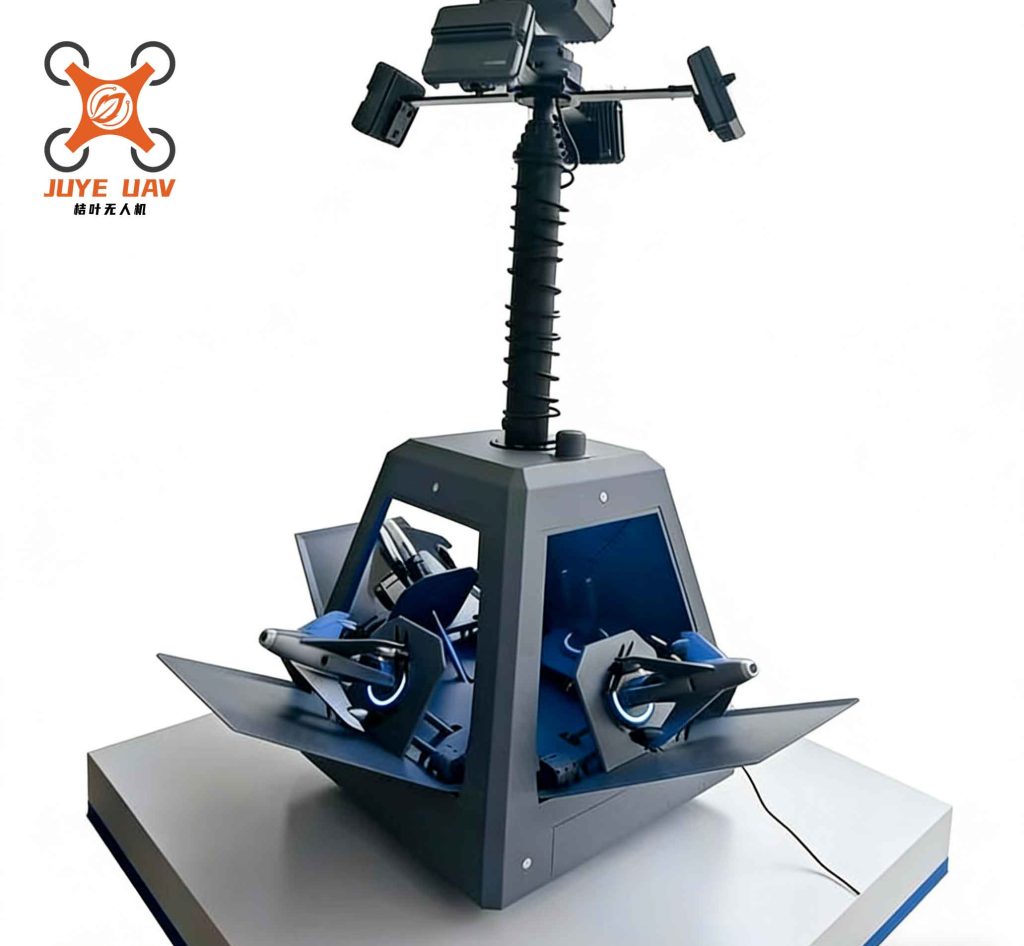
3. Electronic Capture and Hijacking
The most sophisticated form of electronic attack. By exploiting vulnerabilities in the UAV’s communication protocol, an EW system can intercept the link, decrypt it (if necessary), and inject its own commands. This allows for the seizure of control and the safe landing and recovery of the UAV for technical intelligence (TECHINT) purposes. Russia’s alleged success in guiding a US RQ-170 Sentinel to land in Iran in 2011 is the paradigmatic example of this capability.
The Russian Anti-UAV Technological Inventory
Russia’s anti-UAV capabilities are realized through a suite of integrated systems, each fulfilling a specific role in the detection-identification-tracking-engagement chain.
| System Name | Type | Primary Function | Key Characteristics / Notes |
|---|---|---|---|
| Polye-21 / “Avtobaza” | Mobile EW Complex | Detection, Direction Finding, and Jamming of UAV Links | Network of vehicles for long-range (hundreds of km) C2 and satellite link suppression. Credited with countering sophisticated UAVs. |
| Krasukha-2/4 | Mobile EW System | Suppression of Airborne Radar & Satellite Links | Designed to counter AWACS and reconnaissance satellites, its high-power emissions can also degrade the operational environment for UAVs. |
| Rex-1 / LPD-801 | Portable EW Gun | Close-Range UAV Disruption | Man-portable, disrupts GNSS and ISM bands (2.4/5.8 GHz). Used by personnel for point defense of high-value targets. |
| Repellent / “Moskite” | Containerized EW System | Area Denial for Micro/Mini UAVs | Automated system that scans, detects, classifies, and jams control and navigation channels of drone swarms within a ~5-10 km radius. |
| Pantsir-S1/SM | Gun-Missile Air Defense | Point Defense Hard-Kill | Combines radar/EO tracking, 30mm cannons, and missiles. Highly effective but expensive for massed small UAVs. |
| Tor-M2/M2DT | SAM System | Mobile Area Defense Hard-Kill | All-weather, vertical-launch system with high firepower (16 missiles). The M2DT variant is arctic-optimized. |
| Peresvet | Laser Weapon System | Directed-Energy Hard-Kill | Combat-deployed system mounted on a mobile platform. Capabilities are classified but intended to disable optics and possibly cause structural damage. |
| ZALA / “Predator” UAV | Counter-UAV Drone | Aerial Engagement & Kinetic Kill | A “drone vs. drone” concept involving larger UAVs equipped with nets, explosives, or possibly EW payloads to neutralize hostile drones. |
| SAM-16/18 (Igla/Verba) | Man-Portable SAM (MANPADS) | Infantry-Based Hard-Kill | Last-ditch, visual-range defense against low, slow UAVs. New seekers improve discrimination against small, low-IR signature targets. |
Detection and Command: The Enabling Layer
Effective anti-UAV action is impossible without robust detection. Russia employs specialized low-altitude radars like the “Sobolyatnik-2” and the “Pishchal” to detect small, low-flying objects in cluttered environments. These radars are often integrated with optronic sensors (TV/thermal cameras) for visual confirmation and tracking. Command vehicles, such as the PU-12M7 based on the BTR-80, fuse data from multiple sensors to create a unified air picture and coordinate the response between EW assets and kinetic shooters.
Technical Deep Dive: Formulas and Effectiveness Metrics
The effectiveness of various anti-UAV methods can be analyzed through fundamental physical and engineering principles.
1. Electronic Warfare Effectiveness
The success of a jamming operation hinges on the Jamming-to-Signal Ratio (JSR) at the victim receiver. For a drone’s command receiver, the JSR can be modeled as:
$$ \text{JSR} = \frac{P_{j} \cdot G_{j}(\theta) \cdot G_{r} \cdot \lambda^2}{(4\pi R_j)^2 \cdot L_j} \div \frac{P_{s} \cdot G_{s} \cdot G_{r} \cdot \lambda^2}{(4\pi R_s)^2 \cdot L_s} = \frac{P_{j} \cdot G_{j}(\theta) \cdot R_s^2 \cdot L_s}{P_{s} \cdot G_{s} \cdot R_j^2 \cdot L_j} $$
Where:
- \( P_{j}, P_{s} \): Jammer and legitimate signal transmitter power.
- \( G_{j}(\theta), G_{s} \): Antenna gains (jammer gain towards drone, signal transmitter gain).
- \( R_{j}, R_{s} \): Ranges from jammer to drone and from GCS to drone.
- \( L_{j}, L_{s} \): System and atmospheric losses for each path.
A JSR >> 1 (e.g., >10 dB) is typically required for reliable jamming. This equation shows why mobile jammers that can close the distance (\( R_j \)) are so effective in the anti-UAV role.
2. Laser Engagement Physics
The lethality of a laser anti-UAV system depends on delivering a sufficient energy density (fluence) on a vulnerable spot for a long enough time to cause failure. The required fluence \( F \) (J/cm²) is a material property. The time-on-target \( t \) to achieve this fluence is:
$$ t = \frac{F \cdot A_{spot}}{P \cdot \tau \cdot Q} $$
Where \( A_{spot} = \pi (R \cdot \theta / 2)^2 \) is the laser spot area at range \( R \), \( P \) is laser power, \( \tau \) is atmospheric transmission, and \( Q \) is beam quality. For a small drone, damaging the flight control board or burning through a motor wire requires less energy than destroying the airframe. This makes lasers potentially very efficient anti-UAV weapons, as the engagement time \( t \) can be very short for high-power systems.
3. Fragmentation Warheads for Swarms
To address the swarm threat cost-effectively, Russia is developing specialized airburst munitions. The probability \( P_k \) of a single fragmentation warhead disabling a drone within a swarm can be approximated by:
$$ P_k \approx 1 – e^{-n \cdot A_d / A_f} $$
Where:
- \( n \): Number of lethal fragments in the burst.
- \( A_d \): Presented vulnerable area of the drone.
- \( A_f \): Area over which fragments are dispersed at the drone’s range.
By using proximity-fuzed 30mm or 57mm shells that create a dense cloud of fragments, a single shot can have a high probability of hitting multiple drones within its effective radius, making it a scalable solution compared to guided missiles.
Future Trajectories in Russian Anti-UAV Development
Russian military research and development are focused on overcoming next-generation challenges: autonomous drone swarms, increased speed and stealth, and AI-driven evasion tactics. The future anti-UAV architecture will likely emphasize:
- AI-Powered Automation: Future systems will move from operator-in-the-loop to operator-on-the-loop. AI modules will handle detection, classification, threat prioritization, and even weapon assignment in milliseconds, a necessity for countering high-speed, multi-axis swarm attacks. We are already seeing prototypes of autonomous combat modules that fuse radar, optronics, and a gun/missile armament.
- Integration of Directed Energy: Laser and HPM weapons will move from experimental to mainstream within integrated air defense networks. The focus will be on increasing power output, improving beam control, and reducing system size and power consumption for tactical deployment.
- Network-Centric, Layered Defense: The most critical trend is the deep integration of all anti-UAV assets—long-range EW detectors, short-range jammers, kinetic systems, and DEW—into a single networked “system of systems.” Data from a distant radar or signals intelligence unit will cue a close-in HPM system or laser to engage before the threat enters the lethal range of protected assets.
- Development of “Smart” Area-Denial Munitions: Beyond simple fragmentation, research is ongoing into munitions that deploy sub-munitions with their own simple sensors or nets, creating a temporary “minefield” in the sky to degrade swarms.
- Enhanced Counter-Autonomy EW: As drones become less reliant on continuous external C2 links, EW will need to target other vulnerabilities, such as spoofing the sensors (LIDAR, computer vision) that autonomous drones use for navigation and target recognition.
In conclusion, Russia’s approach to the anti-UAV challenge is a defining case study in asymmetric defense. By leveraging its historic strength in electronic warfare and combining it with pragmatic upgrades to existing air defense systems and targeted investments in next-generation technologies like lasers and AI, Russia is constructing a multi-faceted and evolving anti-UAV shield. This shield is designed not to win a symmetric technology race, but to render an adversary’s UAV investment—whether in a single high-value platform or a thousand-strong swarm—prohibitively costly and ineffective. The continuous evolution of this anti-UAV arsenal will remain a critical factor in shaping the air domain of future conflicts, ensuring that the skies are never uncontested. The relentless pursuit of countermeasures against unmanned systems underscores a fundamental truth in modern warfare: for every new capability, a counter-capability will inevitably arise, and the cycle of measure and countermeasure will continue to accelerate.